Clopidogrel Krka d.d.
Italy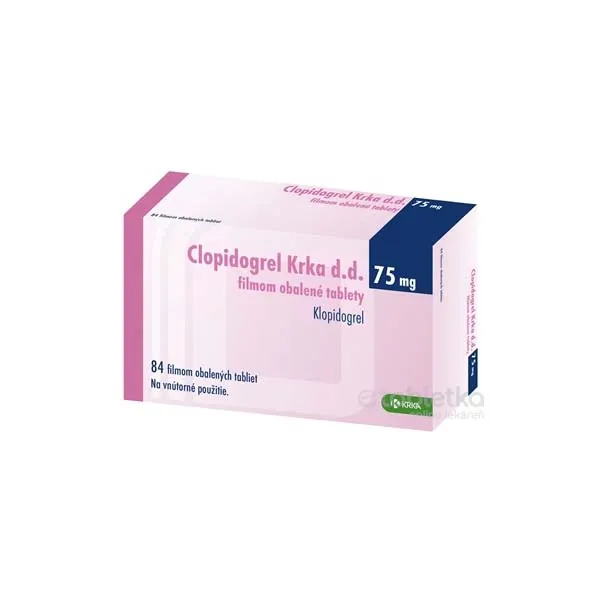
Table of Contents
- Package leaflet: Information for the user
- Clopidogrel Krka d.d. 75 mg film-coated tablets
- 1. What Clopidogrel Krka d.d. is and what it is used for
- 2. What you need to know before taking Clopidogrel Krka d.d.
- 3. How to take Clopidogrel Krka d.d.
- 4. Possible side effects
- 5. How to store Clopidogrel Krka d.d.
- 6. PACK CONTENTS AND OTHER INFORMATION
Package leaflet: Information for the user
Clopidogrel Krka d.d. 75 mg film-coated tablets
clopidogrel
Please read all of this leaflet carefully before you start taking this medicine because it contains important information for you.
- Keep this leaflet. You may need to read it again.
- If you have any questions, ask your doctor or pharmacist.
- This medicine has been prescribed for you only. Do not pass it on to other people, even if their symptoms are the same as yours, as it may be harmful to them.
- If you experience any side effect, including those not listed in this leaflet, tell your doctor or pharmacist. See section 4. Contents of this leaflet:
- What Clopidogrel Krka d.d. is and what it is used for
- What you need to know before taking Clopidogrel Krka d.d.
- How to take Clopidogrel Krka d.d.
- Possible side effects
- How to store Clopidogrel Krka d.d.
- Contents of the pack and other information
1. What Clopidogrel Krka d.d. is and what it is used for
Clopidogrel Krka d.d. contains clopidogrel and belongs to a group of medicines called
antiplatelet agents. Platelets are microscopic blood components that clump together during blood
clotting. By preventing this clumping, antiplatelet medicines reduce the likelihood of blood clot
formation (a process known as thrombosis).
Clopidogrel Krka d.d. is taken by adults to prevent the formation of blood clots (thrombi) in hardened blood vessels (arteries), a process known as atherothrombosis, which can
lead to atherothrombotic events (such as stroke, heart attack, or death).
Clopidogrel Krka d.d. has been prescribed to you to help prevent blood clots and to reduce the risk of these serious events because:
- you have a condition known as hardening of the arteries (also called atherosclerosis), and
- you have previously had a heart attack, a stroke, or a condition known as peripheral arterial disease, or
- you have previously experienced severe chest pain known as "unstable angina" or "myocardial infarction" (heart attack). To treat this condition, your doctor may have inserted a stent into the blocked or narrowed artery to restore blood flow. Your doctor may also have prescribed acetylsalicylic acid (a substance found in many medicines used to relieve pain and reduce fever, as well as to prevent blood clotting).
- you have had stroke symptoms that disappeared within a short period of time (also known as transient ischaemic attack) or a mild ischaemic stroke. Your doctor may prescribe acetylsalicylic acid starting within the first 24 hours.
- you have an irregular heartbeat, a condition called “atrial fibrillation”, and you cannot take medicines known as “oral anticoagulants” (vitamin K antagonists) which prevent the formation of new clots and the progression of existing ones. You will have been informed that “oral anticoagulants” are more effective than acetylsalicylic acid or the combination of Clopidogrel Krka d.d. and acetylsalicylic acid in treating this condition. If you cannot take “oral anticoagulants” and do not have a higher risk of bleeding, your doctor may have prescribed Clopidogrel Krka d.d. together with acetylsalicylic acid.
2. What you need to know before taking Clopidogrel Krka d.d.
Do not take Clopidogrel Krka d.d.
- If you are allergic (hypersensitive) to clopidogrel or to any of the excipients of this medicine (listed in section 6).
- If you have active bleeding, such as a stomach ulcer or bleeding in the brain.
- If you suffer from severe liver disease.
If you think any of these situations apply to you, or if you are unsure, consult your doctor before using Clopidogrel Krka d.d.
Warnings and precautions
If any of the conditions listed below apply to you, inform your doctor before taking Clopidogrel Krka d.d.:
- if you have a risk of bleeding such as:
- a medical condition that puts you at risk of internal bleeding (such as a stomach ulcer)
- a blood disorder that makes you prone to internal bleeding (bleeding within any tissue, organ, or joint of the body)
- a recent serious injury
- a recent surgical procedure (including dental surgery)
- a planned surgical procedure (including dental surgery) within the next seven days
- if you have had a blood clot in a brain artery (ischemic stroke) that occurred within the last seven days
- if you have kidney or liver disease
- if you have had an allergy or reaction to any medicine used to treat your condition
- if you have previously had a non-traumatic brain hemorrhage.
While taking Clopidogrel Krka d.d.:
- You must inform your doctor if you are scheduled to undergo surgery (including dental surgery)
- You must also inform your doctor immediately if you develop a medical condition (also known as Thrombotic Thrombocytopenic Purpura or TTP) which includes fever and skin bruising appearing as red spots, with or without unexplained extreme fatigue, confusion, yellowing of the skin or eyes (jaundice) (see section 4 "Possible side effects")
- If you cut or injure yourself, it may take longer than usual for the bleeding to stop. This is due to the way the medicine works, as it prevents blood clots from forming. For minor cuts or injuries, such as shaving or minor cuts, this usually does not cause problems. However, if you are concerned about bleeding, contact your doctor immediately (see section 4 "Possible side effects")
- Your doctor may prescribe blood tests for you
Children and adolescents
Do not give this medicine to children as it is not effective.
Other medicines and Clopidogrel Krka d.d.
Inform your doctor or pharmacist if you are taking, have recently taken, or might take any other medicines, including those without a prescription.
Some medicines may affect the use of Clopidogrel Krka d.d. or vice versa.
You must inform your doctor precisely if you are taking:
-
medicines that may increase your risk of bleeding such as:
o oral anticoagulants, medicines used to reduce blood clotting,
o a non-steroidal anti-inflammatory drug, generally used to treat painful and/or inflammatory conditions of muscles or joints,
o heparin or any other injectable medicine used to reduce blood clotting,
o ticlopidine or other antiplatelet agents,
o a selective serotonin reuptake inhibitor (including but not limited to fluoxetine or fluvoxamine), medicines usually used to treat depression,
o rifampicin (used to treat serious infections), -
omeprazole or esomeprazole, medicines used to treat stomach problems,
-
fluconazole or voriconazole, medicines used to treat fungal infections,
-
efavirenz or other antiretroviral medicines (used to treat HIV infections),
-
carbamazepine, a medicine used to treat certain forms of epilepsy,
-
moclobemide, a medicine used to treat depression,
-
repaglinide, a medicine used to treat diabetes,
-
paclitaxel, a medicine used to treat cancer,
-
opioids: while on clopidogrel therapy, you must inform your doctor before being prescribed any opioid (used to treat severe pain),
-
rosuvastatin (used to lower cholesterol levels). If you have had severe chest pain (unstable angina or heart attack), a transient ischemic attack, or a mild ischemic stroke, you may have been prescribed Clopidogrel Krka d.d. in combination with acetylsalicylic acid, a substance present in many medicines used to relieve pain and reduce fever. Occasional use of acetylsalicylic acid (not more than 1,000 mg within 24 hours) should generally not cause problems, but prolonged use in other circumstances should be discussed with your doctor. Clopidogrel Krka d.d. with food and drink Clopidogrel Krka d.d. can be taken with or without food. Pregnancy and breastfeeding It is preferable not to take this medicine during pregnancy. If you are pregnant or think you may be pregnant, inform your doctor or pharmacist before taking Clopidogrel Krka d.d. If you become pregnant while taking Clopidogrel Krka d.d., consult your doctor immediately, as clopidogrel is not recommended during pregnancy. You must not breastfeed while taking this medicine. If you are breastfeeding or planning to breastfeed, consult your doctor before taking this medicine. Ask your doctor or pharmacist for advice before taking any medicine. Driving and using machines It is unlikely that Clopidogrel Krka d.d. will affect your ability to drive or operate machinery.
3. How to take Clopidogrel Krka d.d.
Take this medicine exactly as directed by your doctor or pharmacist. If
you have any doubts, consult your doctor or pharmacist.
The recommended dose, including for patients diagnosed with “atrial fibrillation” (an irregular heartbeat),
is one 75 mg tablet of Clopidogrel Krka d.d. daily, taken orally during or apart from meals, at the same
time each day.
If you have experienced severe chest pain (unstable angina or heart attack), your doctor may prescribe
300 mg or 600 mg of Clopidogrel Krka d.d. (4 or 8 tablets of 75 mg) as a single dose at the beginning of
treatment. Afterwards, the recommended dose is one 75 mg tablet of Clopidogrel Krka d.d. daily, as
described above.
If you have experienced symptoms of a stroke that disappear within a short period of time (also known
as transient ischaemic attack) or a mild ischaemic stroke, your doctor may prescribe 300 mg of
Clopidogrel Krka d.d. (4 tablets of 75 mg) as a single dose at the beginning of treatment. Afterwards,
the recommended dose is one 75 mg tablet of Clopidogrel Krka d.d. daily, as described above, in
combination with acetylsalicylic acid for 3 weeks. After this, your doctor will prescribe either
Clopidogrel Krka d.d. alone or acetylsalicylic acid alone.
Clopidogrel Krka d.d. should be taken for as long as your doctor considers it necessary.
If you take more Clopidogrel Krka d.d. than you should
Contact your doctor or the nearest hospital emergency department due to the risk of increased
bleeding.
If you forget to take Clopidogrel Krka d.d.
If you forget to take a dose of Clopidogrel Krka d.d. but remember within 12 hours of your usual
dosing time, take one tablet immediately and then take the next dose at your usual time.
If more than 12 hours have passed, simply take your next dose at the regular time. Do not take a
double dose to make up for the missed dose.
If you stop taking Clopidogrel Krka d.d.
Do not stop treatment unless your doctor has told you to do so. Before stopping, contact your doctor
or pharmacist.
If you have any questions about how to use this medicine, ask your doctor or pharmacist.
4. Possible side effects
Like all medicines, this medicine can cause side effects, although not everybody gets them.
Contact your doctor immediately if you experience:
- fever, signs of infection, or severe weakness. These effects may be due to a rare reduction in certain blood cells.
- signs of liver problems such as yellowing of the skin and/or eyes (jaundice), with or without bleeding appearing under the skin as red spots, and/or confusion (see section 2 "Warnings and precautions").
- swelling in the mouth or skin problems such as rash, itching, or skin blisters. These may be signs of an allergic reaction. The most common side effect reported with Clopidogrel Krka d.d. is bleeding. Bleeding may present as bleeding in the stomach or intestines, easy bruising, haematomas (unusual or extensive bruising under the skin), nosebleeds, or blood in the urine. In rare cases, bleeding in the eye, intracranial bleeding, in the lungs, or in the joints has also been reported. If you experience prolonged bleeding while taking Clopidogrel Krka d.d., it may take longer than usual for bleeding to stop if you cut or injure yourself. This is due to the way the medicine works, as it prevents blood clots from forming. For minor cuts or injuries, such as shaving or minor cuts, this usually does not cause problems. However, if you are concerned about bleeding, contact your doctor immediately (see section 2 "Warnings and precautions").
Other side effects include
Common side effects (may affect up to 1 in 10 people):
Diarrhoea, abdominal pain, indigestion, or stomach burning.
Uncommon side effects (may affect up to 1 in 100 people):
Headache, gastric ulcer, vomiting, nausea, constipation, excess gas in the stomach or intestines, rash, itching, dizziness, tingling and numbness sensations.
Rare side effects (may affect up to 1 in 1,000 people):
Dizziness, breast enlargement in males.
Very rare side effects (may affect up to 1 in 10,000 people):
Jaundice; severe abdominal pain with or without back pain; fever, breathing difficulties sometimes associated with cough; generalized allergic reactions (for example, widespread feeling of warmth with sudden general malaise up to fainting); swelling in the mouth; skin blisters; skin allergy; mouth pain (stomatitis); decrease in blood pressure; confusion; hallucinations; joint pain; muscle pain; changes or loss of taste.
Side effects with unknown frequency (frequency cannot be estimated from the available data):
Hypersensitivity reactions with chest or abdominal pain, persistent symptoms of hypoglycaemia.
Additionally, your doctor may identify changes in blood and urine test results.
Reporting of side effects
If you experience any side effect, including those not listed in this leaflet, talk to your doctor or pharmacist. You can also report side effects directly through the national reporting system listed in Annex V.
By reporting side effects, you can help provide more information on the safety of this medicine.
5. How to store Clopidogrel Krka d.d.
Keep this medicine out of the sight and reach of children.
Do not use this medicine after the expiry date stated on the carton and blister after EXP. The expiry date refers to the last day of that month.
Store the medicine in the original packaging to protect it from moisture and light.
Do not dispose of medicines via wastewater or household waste. Ask your pharmacist how to dispose of medicines you no longer use. This will help protect the environment.
6. PACK CONTENTS AND OTHER INFORMATION
What Clopidogrel Krka d.d. contains
- The active substance is clopidogrel. Each film-coated tablet contains 75 mg of clopidogrel (as hydrochloride).
- The excipients in the tablet core are: microcrystalline cellulose, anhydrous colloidal silica, crospovidone (type A), macrogol 6000, hydrogenated castor oil; and in the tablet coating: polyvinyl alcohol, titanium dioxide (E171), red iron oxide (E172), yellow iron oxide (E172), talc and macrogol 3000.
Description of the appearance of Clopidogrel Krka d.d. and pack contents
The film-coated tablets are pink, round and slightly convex. They are supplied in packs containing blisters with 7, 14, 28, 30, 50, 56, 84, 90 and 100 film-coated tablets.
Not all pack sizes may be marketed.
Marketing Authorization Holder
KRKA, d.d., Novo mesto, Šmarješka cesta 6, 8501 Novo mesto, Slovenia
Manufacturer
KRKA, d.d., Novo mesto, Šmarješka cesta 6, 8501 Novo mesto, Slovenia
TAD Pharma GmbH, Heinz-Lohmann-Straße 5, 27472 Cuxhaven, Germany
For further information on this medicinal product, please contact the local representative of the Marketing Authorization Holder:
België/Belgique/Belgien Lietuva
KRKA Belgium, SA. UAB KRKA Lietuva
Tél/Tel: + 32 (0) 487 50 73 62 Tel: + 370 5 236 27 40
България Luxembourg/Luxemburg
КРКА България ЕООД KRKA Belgium, SA.
Teл.: + 359 (02) 962 34 50 Tél/Tel: + 32 (0) 487 50 73 62 (BE)
Česká republika Magyarország
KRKA ČR, s.r.o. KRKA Magyarország Kereskedelmi Kft.
Tel: + 420 (0) 221 115 150 Tel.: + 36 (1) 355 8490
Danmark Malta
KRKA Sverige AB E. J. Busuttil Ltd.
Tlf: + 46 (0)8 643 67 66 (SE) Tel: + 356 21 445 885
Deutschland Nederland
TAD Pharma GmbH KRKA Belgium, SA.
Tel: + 49 (0) 4721 606-0 Tel: + 32 (0) 487 50 73 62 (BE)
Eesti Norge
KRKA, d.d., Novo mesto Eesti filiaal KRKA Sverige AB
Tel: + 372 (0)6 671 658 Tlf: + 46 (0)8 643 67 66 (SE)
Ελλάδα Österreich
KRKA ΕΛΛΑΣ ΕΠΕ KRKA Pharma GmbH, Wien
Τηλ: + 30 2100101613 Tel: + 43 (0)1 66 24 300
España Polska
KRKA Farmacéutica S.L. KRKA-POLSKA Sp. z o.o.
Tel: + 34 911 61 03 80 Tel.: + 48 (0)22 573 7500
France Portugal
Laboratoires BIOGARAN KRKA Farmacêutica, Sociedade Unipessoal Lda.
Tél: + 33 (0) 800 970 109 Tel: + 351 (0)21 46 43 650
Hrvatska România
KRKA – FARMA d.o.o. KRKA Romania S.R.L., Bucharest
Tel: + 385 1 6312 100 Tel: + 4 021 310 66 05
Ireland Slovenija
KRKA Pharma Dublin, Ltd. KRKA, d.d., Novo mesto
Tel: + 353 1 413 3710 Tel: + 386 (0) 1 47 51 100
Ísland Slovenská republika
LYFIS ehf. KRKA Slovensko, s.r.o.
Sími: + 354 534 3500 Tel: + 421 (0) 2 571 04 501
Italia Suomi/Finland
KRKA Farmaceutici Milano S.r.l. KRKA Finland Oy
Tel: + 39 02 3300 8841 Puh/Tel: + 358 20 754 5330
Κύπρος Sverige
KI.PA. (PHARMACAL) LIMITED KRKA Sverige AB
Τηλ: + 357 24 651 882 Tel: + 46 (0)8 643 67 66 (SE)
Latvija United Kingdom (Northern Ireland)
KRKA Latvija SIA KRKA Pharma Dublin, Ltd.
Tel: + 371 6 733 86 10 353 1 413 3710
More detailed information on this medicinal product is available on the website of the European Medicines Agency: http://www.ema.europa.eu/