Clavomed
Italy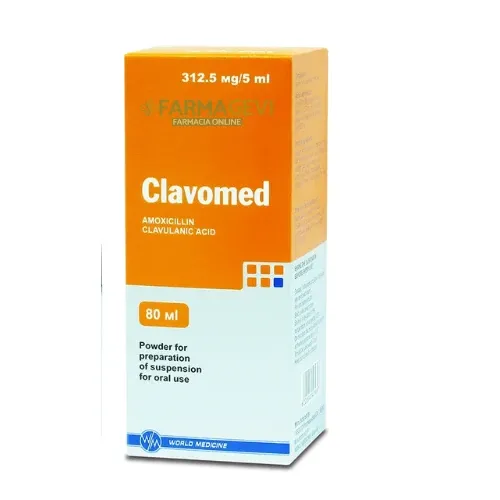
Table of Contents
- Patient Information Leaflet: Information for the User
- CLAVOMED 875 mg + 125 mg film-coated tablets, 875 mg + 125 mg powder for oral suspension
- 1. WHAT CLAVOMED IS AND WHAT IT IS USED FOR
- 2. WHAT YOU SHOULD KNOW BEFORE TAKING CLAVOMED
- 3. HOW TO TAKE CLAVOMED
- 4. POSSIBLE ADVERSE EFFECTS
- 5. HOW TO STORE CLAVOMED
- 6. PACKAGING CONTENTS AND OTHER INFORMATION
Patient Information Leaflet: Information for the User
CLAVOMED 875 mg + 125 mg film-coated tablets, 875 mg + 125 mg powder for oral suspension
amoxicillin + clavulanic acid
Generic medicine
Please read this leaflet carefully before taking this medicine because
it contains important information for you.
- Keep this leaflet. You may need to read it again.
- If you have any questions, ask your doctor or pharmacist.
- This medicine has been prescribed for you only. Do not give it to other people, even if their symptoms are the same as yours, as it may be harmful.
- If you experience any side effects, including those not listed in this leaflet, tell your doctor or pharmacist. See section 4. Contents of this leaflet:
- What CLAVOMED is and what it is used for
- What you need to know before taking CLAVOMED
- How to take CLAVOMED
- Possible side effects
- How to store CLAVOMED
- Contents of the pack and other information
1. WHAT CLAVOMED IS AND WHAT IT IS USED FOR
CLAVOMED is an antibiotic that works by killing the bacteria that cause infections.
It contains two different active ingredients called amoxicillin and clavulanic acid. Amoxicillin
belongs to a group of medicines known as "penicillins", whose activity can sometimes be
blocked (rendered inactive). The other active component (clavulanic acid) prevents this from occurring.
CLAVOMED is used in adults and children weighing more than 40 kg to treat the
following infections:
- middle ear and sinus infections;
- respiratory tract infections;
- urinary tract infections;
- skin and soft tissue infections, including dental infections;
- bone and joint infections.
2. WHAT YOU SHOULD KNOW BEFORE TAKING CLAVOMED
Do not take CLAVOMED:
- if you are allergic (hypersensitive) to amoxicillin, clavulanic acid, penicillin, or to any of the other ingredients of this medicine (listed in section 6);
- if you have previously had a severe allergic reaction (hypersensitivity) to any other antibiotic. This may include a skin rash or swelling of the face or throat;
- if you have had liver problems or jaundice (yellowing of the skin) when taking an antibiotic. Do not take CLAVOMED if any of the above conditions apply to you. If you are in doubt, speak with your doctor or pharmacist before taking CLAVOMED.
Warnings and precautions
Talk to your doctor or pharmacist before taking this medicine if you:
- have infectious mononucleosis;
- are undergoing treatment for liver or kidney problems;
- do not urinate regularly.
If you are unsure whether any of the above conditions apply to you, discuss this with your doctor or pharmacist before taking CLAVOMED.
In some cases, your doctor may perform tests to identify the type of bacteria causing your infection.
Based on the results, your doctor may prescribe a different dose of CLAVOMED or a different medicine.
Conditions to be aware of
CLAVOMED may worsen certain pre-existing conditions or cause serious adverse effects. These may include allergic reactions, seizures, and inflammation of the intestine. You should pay attention to certain symptoms while taking CLAVOMED in order to reduce any risk. See "Conditions to be aware of" in section 4.
Blood and urine tests
If you are scheduled for blood tests (such as checks for red blood cells or liver function tests) or urine tests (for glucose), inform your doctor or nurse that you are taking CLAVOMED. This is because CLAVOMED may affect the results of these types of tests.
Other medicines and CLAVOMED
Inform your doctor or pharmacist if you are currently using, have recently used, or might use any other medicines.
If you are taking allopurinol (used for gout) together with CLAVOMED, your risk of developing a skin allergic reaction may increase.
If you are taking probenecid (used for gout), your doctor may decide to adjust your dose of CLAVOMED.
If you are taking medicines (such as warfarin) that help prevent blood clots together with CLAVOMED, additional blood tests may be required.
CLAVOMED may affect the action of methotrexate (a medicine used to treat cancer or rheumatic diseases).
Pregnancy, breastfeeding and fertility
If you are pregnant, suspect you may be pregnant, planning to become pregnant, or breastfeeding, consult your doctor or pharmacist before using this medicine.
Driving and using machines
CLAVOMED may cause adverse effects, and symptoms may make you unfit to drive or operate machinery.
Do not drive or operate machinery if you do not feel well.
CLAVOMED oral suspension powder contains sucrose.
If your doctor has diagnosed you with an intolerance to certain sugars, contact him/her before taking this medicine.
3. HOW TO TAKE CLAVOMED
Take this medicine exactly as directed by your doctor or pharmacist. If you have any doubts, consult your doctor or pharmacist.
Tablets
Adults and children weighing 40 kg or more
- Usual dose – 1 tablet twice daily
- Higher dose – 1 tablet three times daily
Powder for oral suspension (sachets)
Adults and children weighing 40 kg or more
- Usual dose – 1 sachet twice daily
- Higher dose – 1 sachet three times daily
Children weighing less than 40 kg
Children aged 6 years or younger should preferably be treated with amoxicillin and clavulanic acid oral suspension or sachets.
CLAVOMED 875 mg + 125 mg film-coated tablets
Ask your doctor or pharmacist for advice on administering CLAVOMED tablets to children weighing less than 40 kg.
CLAVOMED 875 mg + 125 mg sachets are not recommended.
Patients with kidney or liver problems
- If you have kidney problems, your dose may need to be adjusted. Your doctor may choose a different dosage of CLAVOMED or a different medicine.
- If you have liver problems, more frequent blood tests may be required to monitor liver function.
How to take CLAVOMED
Tablets
- Swallow the tablets whole with a glass of water at the beginning of a meal or shortly before
- Space the doses evenly throughout the day, leaving at least 4 hours between doses. Do not take 2 doses within one hour.
- Do not take CLAVOMED for longer than 2 weeks. If you continue to feel unwell, you must return to your doctor.
Sachets
- Immediately before taking CLAVOMED, open the sachet and mix the contents with half a glass of water.
- Take the medicine at the beginning of a meal or shortly before.
- Space the doses evenly throughout the day, leaving at least 4 hours between doses. Do not take 2 doses within one hour.
- Do not take CLAVOMED for longer than 2 weeks. If you continue to feel unwell, you must return to your doctor.
If you take more CLAVOMED than you should
If you take too much CLAVOMED, symptoms may include stomach upset (nausea, vomiting or diarrhoea) or seizures. Inform your doctor as soon as possible. Take the medicine package or container with you so you can show it to the doctor.
If you forget to take CLAVOMED
Do not take a double dose to make up for a forgotten dose. Do not take the next dose too early; instead, wait approximately 4 hours before taking the next dose.
If you stop taking CLAVOMED
Continue taking CLAVOMED for the full duration of the prescribed treatment, even if you feel better. You need every dose to help fight the infection. If some bacteria survive, they may cause the infection to return.
If you have any questions about the use of this medicine, ask your doctor or pharmacist.
4. POSSIBLE ADVERSE EFFECTS
Like all medicines, this medicine can cause adverse effects, although not everyone will experience them.
Conditions you should pay attention to
Allergic reactions:
- skin rashes;
- inflammation of blood vessels ( vasculitis ), which may appear as red or purple spots on the skin, but may also affect other parts of the body;
- fever, joint pain, swelling of the glands in the neck, armpits, or groin;
- swelling, sometimes of the face or throat ( angioedema ), causing difficulty breathing;
- collapse;
- chest pain occurring during allergic reactions, which may be a symptom of an allergic-triggered heart attack (Kounis syndrome). → Contact your doctor immediately if you experience any of these symptoms. Stop taking CLAVOMED.
Intestinal inflammation
Intestinal inflammation causing watery diarrhoea, usually with blood and mucus, stomach pain and/or fever.
Acute inflammation of the pancreas (acute pancreatitis)
If you have severe and persistent pain in the stomach area, this could be a sign of acute pancreatitis.
Drug-induced enterocolitis syndrome (DIES)
DIES has been mainly reported in children treated with amoxicillin/clavulanate. It is a type of allergic reaction with the main symptom being repeated vomiting (1-4 hours after taking the medicine). Additional symptoms may include abdominal pain, lethargy, diarrhoea, and low blood pressure.
→ If you experience these symptoms, contact your doctor as soon as possible for advice.
Very common adverse effects
May affect more than 1 in 10 people
- diarrhoea (in adults).
Common adverse effects
May affect up to 1 in 10 people
- thrush ( candida – a fungal infection of the vagina, mouth or skin folds)
- nausea, especially when taking high doses: if affected, take CLAVOMED before meals
- vomiting
- diarrhoea (in children)
Uncommon adverse effects
May affect up to 1 in 100 people
- skin rashes, itching
- raised, itchy skin rash (urticaria)
- indigestion
- dizziness
- headache Uncommon adverse effects may be detected through blood tests:
- increased levels of certain proteins ( enzymes ) produced by the liver.
Rare adverse effects
May affect up to 1 in 1,000 people
- skin rashes, which may appear as blisters and resemble small targets (a dark central spot surrounded by a paler area, with a dark ring around the edge – erythema multiforme ) → if you notice any of these symptoms, contact your doctor urgently. Rare adverse effects may be detected through blood tests:
- low number of cells involved in blood clotting
- low number of white blood cells
Frequency not known
Frequency cannot be estimated from the available data:
- allergic reactions (see above);
- intestinal inflammation (see above);
- inflammation of the protective membrane surrounding the brain and spinal cord (aseptic meningitis);
- Severe skin reactions:
- widespread rash with blisters and peeling skin, particularly around the mouth, nose, eyes, and genitals ( Stevens-Johnson syndrome ) and a more severe form causing extensive skin peeling (more than 30% of body surface – toxic epidermal necrolysis );
- widespread red rash with small pus-filled blisters ( exfoliative bullous dermatitis );
- a red, scaly rash with raised areas under the skin and blisters ( pustular exanthema );
- flu-like symptoms with rash, fever, swollen glands, and abnormal blood test results (including increased white blood cell count (eosinophilia) and elevated liver enzymes) (Drug Reaction with Eosinophilia and Systemic Symptoms)
- skin rash with blistering arranged in a ring-shaped pattern with a central crust or resembling a string of pearls (linear IgA disease). If you experience any of these symptoms, contact your doctor immediately.
- liver inflammation ( hepatitis )
- jaundice, caused by increased levels of bilirubin (a substance produced by the liver) in the blood, which may make the skin and whites of the eyes appear yellow
- inflammation of the kidney tubules
- blood takes longer to clot
- hyperactivity
- seizures (in people taking high doses of CLAVOMED or who have kidney problems)
- black hairy tongue, appearing covered with hair-like projections
- tooth staining (in children), usually removable by brushing.
Adverse effects that may be detected through blood or urine tests:
- severe reduction in the number of white blood cells
- low number of red blood cells ( haemolytic anaemia )
- crystals in the urine leading to acute kidney damage.
Reporting of adverse effects
If you experience any adverse effect, including those not listed in this leaflet, talk to your doctor or pharmacist. You may also report adverse effects directly via the national reporting system at the following website:
https://www.aifa.gov.it/content/segnalazioni-reazioni-avverse
By reporting adverse effects, you can help provide more information on the safety of this medicine.
5. HOW TO STORE CLAVOMED
Store in the original packaging to protect the medicine from light and moisture.
Do not store above 25°C.
Keep this medicine out of the sight and reach of children.
Do not use this medicine after the expiry date stated on the packaging. The expiry date refers to the last day of that month.
Do not dispose of any medicine via wastewater or household waste. Ask your pharmacist how to dispose of medicines no longer in use. This will help protect the environment.
6. PACKAGING CONTENTS AND OTHER INFORMATION
What CLAVOMED contains
CLAVOMED 875 mg + 125 mg film-coated tablets
Each film-coated tablet contains:
- Active substances: amoxicillin trihydrate corresponding to 875 mg amoxicillin; potassium clavulanate corresponding to 125 mg clavulanic acid.
- Other excipients: colloidal silicon dioxide, magnesium stearate, sodium starch glycolate, microcrystalline cellulose, hypromellose, titanium dioxide, macrogol 4000, macrogol 6000, dimethicone.
CLAVOMED 875 mg + 125 mg powder for oral suspension
Each sachet contains:
Active substances: amoxicillin trihydrate corresponding to 875 mg amoxicillin; potassium clavulanate corresponding to 125 mg clavulanic acid.
Excipients: colloidal silicon dioxide, lemon flavour, strawberry flavour, xanthan gum, sucrose.
Description of CLAVOMED appearance and packaging contents
Film-coated tablets: cardboard box containing 12 tablets.
Powder for oral suspension: cardboard box containing 12 sachets.
Marketing Authorization Holder
NEOPHARMED GENTILI S.p.A., Via San Giuseppe Cottolengo, 15 – 20143 Milan, Italy.
Manufacturer
Tablets
Laboratorio Reig Jofré, S.A. - Jarama, 111, Polígono Industrial - 45007 Toledo - Spain
Powder for oral suspension
Laboratorio Reig Jofré, S.A. - Jarama, 111, Polígono Industrial - 45007 Toledo – Spain.