Clarithromycin Sandoz
Italy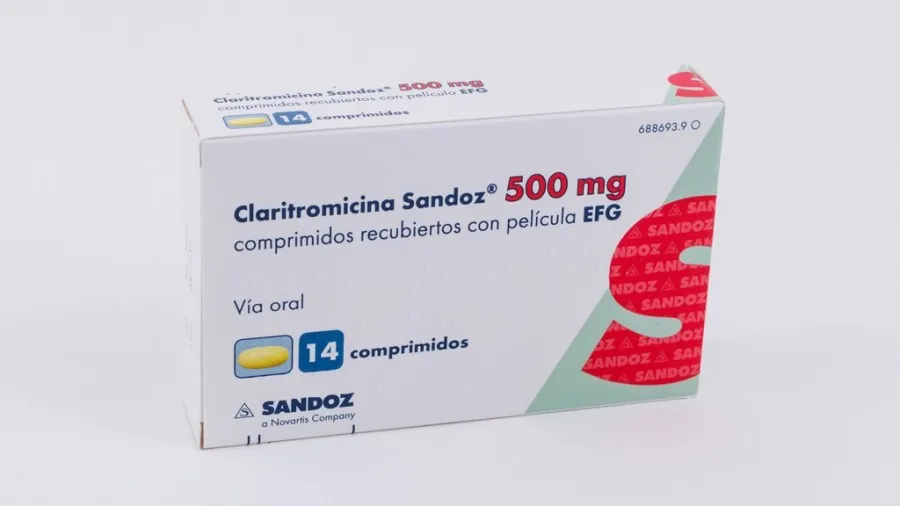
Table of Contents
- Package leaflet: Information for the patient
- Clarithromycin Sandoz 250 mg film-coated tablets, 500 mg film-coated tablets
- 1. What Claritromicina Sandoz is and what it is used for
- 2. What you need to know before taking Claritromycin Sandoz
- 3. How to take Claritromycin Sandoz
- 4. Possible side effects
- 5. How to store Clarithromycin Sandoz
- 6. Package contents and other information
Package leaflet: Information for the patient
Clarithromycin Sandoz 250 mg film-coated tablets, 500 mg film-coated tablets
Generic medicine
Please read all of this leaflet carefully before taking this medicine because it contains important information for you
- Keep this leaflet. You may need to read it again.
- If you have any questions, ask your doctor or pharmacist.
- This medicine has been prescribed for you only. Do not give it to other people, even if they have the same symptoms as you, because it could be harmful.
- If you experience any side effects, including those not listed in this leaflet, talk to your doctor or pharmacist. See section 4.
Contents of this leaflet
- What Clarithromycin Sandoz is and what it is used for
- What you need to know before taking Clarithromycin Sandoz
- How to take Clarithromycin Sandoz
- Possible side effects
- How to store Clarithromycin Sandoz
- Contents of the pack and other information
1. What Claritromicina Sandoz is and what it is used for
Claritromicina Sandoz, which belongs to the class of antibiotics known as macrolides, is an antibiotic that stops the growth of certain bacteria.
Claritromicina Sandoz is used to treat:
- respiratory tract infections (nose, throat and lungs), such as pneumonia, bronchitis, sinusitis and pharyngitis
- mild to moderate skin and soft tissue infections
- in combination with other appropriate antibacterial and anti-ulcer agents, it can also be used for eradication of H. pylori infections.
2. What you need to know before taking Claritromycin Sandoz
Do not take Claritromycin Sandoz
- if you are allergic to clarithromycin, to other macrolide antibiotics, or to any of the other ingredients of this medicine (listed in section 6);
- if you or someone in your family has a history of certain heart rhythm disorders (ventricular arrhythmia, including torsades de pointes) or changes in heart activity measured by electrocardiogram known as "prolongation of the QT interval";
- if you have severe hepatic insufficiency and renal impairment at the same time;
- if you have low levels of potassium or magnesium in the blood (hypokalemia or hypomagnesemia);
- if you are already taking:
o ticagrelor (to prevent blood clots) or ranolazine (used to treat angina pectoris) or ergotamine, dihydroergotamine (medicines used to treat migraine);
o cisapride (a medicine used to treat stomach acid);
o pimozide (an antipsychotic medicine);
o terfenadine or astemizole (antihistamines);
o lovastatin, simvastatin (medicines used to lower cholesterol);
o colchicine (for treating gout);
o or other medicines known to cause serious heart rhythm disturbances.
Warnings and precautions
Talk to your doctor or pharmacist before taking Claritromycin Sandoz
- if you have reduced liver or kidney function;
- if you develop severe or prolonged diarrhea (pseudomembranous colitis) during or after treatment with Claritromycin Sandoz, contact your doctor immediately. Inflammation of the colon (pseudomembranous colitis) has been reported with nearly all antibacterial medicines, including clarithromycin;
- if you have or have had heart problems;
- if you have previously had low magnesium levels in the blood;
- if you have previously taken clarithromycin for long periods on other occasions.
Other medicines and Claritromycin Sandoz
Tell your doctor or pharmacist if you are taking, have recently taken, or might take any other medicines, including those obtained without a prescription.
For certain medicines, taking them at the same time may affect the effectiveness of Claritromycin Sandoz and vice versa. These medicines include:
Claritromycin Sandoz may increase the effects of the following medicines:
- astemizole, terfenadine (antihistamines), pimozide (an antipsychotic), cisapride (a gastrointestinal medicine), ergotamine, dihydroergotamine (medicines for migraine), lovastatin, simvastatin (cholesterol-lowering medicines), ticagrelor (to prevent blood clots), ranolazine (used to treat angina pectoris), colchicine (for treating gout) (see "Do not take Claritromycin Sandoz"),
- alprazolam, triazolam, midazolam (sleeping pills);
- digoxin, verapamil, amlodipine, diltiazem (heart medicines);
- theophylline (for asthma);
- warfarin (a blood thinner);
- atorvastatin, rosuvastatin (cholesterol-lowering medicines);
- cyclosporine, sirolimus, tacrolimus (immunosuppressants);
- carbamazepine, phenytoin, valproate (medicines for epilepsy);
- cilostazol (used to improve circulation in the legs);
- insulin and other medicines for diabetes (such as nateglinide, repaglinide);
- methylprednisolone (a corticosteroid used to treat inflammation);
- omeprazole (a stomach medicine);
- sildenafil, tadalafil, vardenafil (medicines for erectile dysfunction);
- tolterodine (used to treat overactive bladder syndrome);
- vinblastine (a medicine used in cancer therapy);
- medicines that may impair hearing, particularly aminoglycosides such as gentamicin or neomycin (a group of antibiotics).
Both the effect of Claritromycin Sandoz and the effects of the following medicines may be increased if taken together:
- atazanavir, saquinavir (medicines for the treatment of HIV);
- itraconazole (a medicine for the treatment of fungal infections).
If your doctor has specifically instructed you to take Claritromycin Sandoz together with any of the above medicines, you may require closer monitoring.
The following medicines may reduce the effect of Claritromycin Sandoz
- rifampicin, rifabutin, rifapentine (antibiotics);
- efavirenz, etravirine, nevirapine (medicines for the treatment of HIV);
- phenytoin, carbamazepine, phenobarbital (antiepileptic medicines);
- St. John’s wort (Hypericum perforatum).
Pregnancy and breastfeeding
If you are pregnant, think you may be pregnant, are planning to become pregnant, or are breastfeeding, consult your doctor or pharmacist before taking this medicine.
Driving and using machines
Generally, Claritromycin Sandoz has no effect on the ability to drive or operate machinery. However, it may cause side effects such as dizziness, confusion, and disorientation. If you experience these symptoms, you should not drive, operate machinery, or perform any activity that could pose a risk to yourself or others.
3. How to take Claritromycin Sandoz
Take this medicine exactly as instructed by your doctor. If you have any doubts, consult your doctor or pharmacist.
Your prescription will provide specific instructions regarding the amount of medicine to take and how often to take it: read it carefully. The dose prescribed by your doctor depends on the type and severity of the infection, as well as your kidney function. Your doctor will provide more precise guidance.
Adults and children over 12 years of age
The usual dose is one 250 mg tablet twice daily for 6–14 days.
For certain infections, you may be instructed to take two 250 mg tablets or one 500 mg tablet twice daily.
For infections caused by Helicobacter pylori
One 500 mg tablet (or two 250 mg tablets) twice daily in combination with amoxicillin 1000 mg and omeprazole 20 mg, both also taken twice daily, for 7 days.
Patients with kidney problems
Depending on your kidney function, your doctor may prescribe a lower dose than the standard adult dose.
Children (under 12 years of age)
Claritromycin Sandoz is not recommended. Claritromycin Suspension is usually prescribed instead.
If you take more Claritromycin Sandoz than you should
If you have taken more Claritromycin Sandoz than prescribed, or if someone else has taken this medicine, contact your doctor immediately or go straight to the nearest hospital emergency department. Take any remaining tablets and the outer packaging with you, so that healthcare professionals can identify the medicine taken.
If you forget to take Claritromycin Sandoz
If you miss a dose, take it as soon as you remember, then continue your treatment according to the prescribed schedule. Do not take more tablets in one day than your doctor has prescribed. Do not stop taking Claritromycin Sandoz before completing the prescribed course, even if you feel better.
If you stop taking Claritromycin Sandoz
Do not stop taking Claritromycin Sandoz before the end of the prescribed treatment period, even if you think the infection has improved. Stopping treatment early may lead to a rapid recurrence of the infection. If you have any doubts, consult your doctor or pharmacist.
If you have any questions about the use of this medicine, ask your doctor or pharmacist.
4. Possible side effects
Like all medicines, this medicine can cause side effects, although not everybody gets them.
Serious side effects
If you experience any of the following symptoms, stop taking the medicine and contact your doctor immediately or go to the nearest hospital emergency department.
Uncommon serious side effects (may affect up to 1 in 100 people):
- fever, sore throat or mouth ulcers due to infections (signs of low white blood cell count)
- skin rash, itching, hives, shortness of breath or difficulty breathing, wheezing or cough, feeling of emptiness in the head, dizziness, changes in consciousness, hypotension, with or without mild generalized itching, skin redness, swelling of face/throat, bluish discoloration of lips, tongue or skin (signs of severe allergic reaction)
- irregular heartbeat (change in the heart's electrical activity)
- yellowing of the skin and eyes, nausea, loss of appetite, dark urine
Serious side effects with unknown frequency (frequency cannot be estimated from the available data):
- diarrhoea, abdominal pain, fever (signs of inflammation of the colon)
- severe pain in the abdomen and back due to inflammation of the pancreas
- low or excessive urine production, drowsiness, confusion and nausea caused by kidney inflammation
- severe or itchy skin rash, especially if accompanied by blisters and irritation of the eyes, mouth or genital organs
- unusual bruising or bleeding due to low platelet count
- fast or irregular heartbeat
- severe bleeding
- unusual muscle disorder causing pain, fever, red-brown coloured urine
- severely reduced urine output
- skin rash, fever, blood abnormalities (which may be signs of hypersensitivity syndrome, also known as DRESS), a red, scaly rash with pustules and blisters (exanthematous pustulosis)
These are all serious side effects. You may need urgent medical treatment.
Other possible side effects
If you experience any of the following side effects, inform your doctor.
Common (may affect up to 1 in 10 people):
- difficulty sleeping
- headache
- changes in taste sensation (e.g. metallic or bitter taste)
- abdominal pain, nausea or vomiting, diarrhoea, indigestion, heartburn
- abnormal liver function test results
- skin rash
- excessive sweating
Uncommon (may affect up to 1 in 100 people):
- yeast infections (candidiasis)
- vaginal infections
- low white blood cell count, increased count of certain white blood cells
- loss or reduced appetite
- anxiety
- dizziness, drowsiness, tremors
- hearing impairment
- sensation of dizziness
- ringing in the ears (tinnitus)
- inflammation of the stomach lining, constipation, flatulence, dry mouth, belching, abdominal enlargement or swelling
- increased liver enzymes in the blood
- general feeling of malaise, weakness, fatigue
- chest pain
- chills
- abnormal blood test results – high levels of an enzyme called alkaline phosphatase in the blood, indicating bone health status, or high levels of an enzyme called lactate dehydrogenase in the blood, indicating the health status of certain organs
Frequency not known (frequency cannot be estimated from the available data):
- nightmares, confusion, disorientation, hallucinations (seeing things that are not there), psychosis (loss of contact with reality), feeling of loss of identity, depression
- seizures, loss of taste or hearing, tingling and numbness of the skin
- deafness
- certain bacterial infections of the skin and underlying tissues
- altered sense of smell, loss of smell or taste
- discolouration of the tongue, discolouration of teeth
- bleeding
- acne
- muscle pain or weakness
- abnormal blood test results – prolonged blood clotting time
- abnormally coloured urine
Clarithromycin may also affect the results of certain laboratory tests. If you go to hospital or see a doctor for a blood test, it is important that you tell the doctor or nurse that you are taking clarithromycin.
Reporting of side effects
If you get any side effects, including those not listed in this leaflet, talk to your doctor or pharmacist. You can also report side effects directly via the national reporting system at www.agenziafarmaco.gov.it/content/come-segnalare-una-sospetta-reazione-avversa. By reporting side effects, you can help provide more information on the safety of this medicine.
5. How to store Clarithromycin Sandoz
Keep this medicine out of the sight and reach of children.
Store in the original packaging to protect from moisture.
Do not use this medicine after the expiry date stated on the packaging after the word EXP.
The expiry date refers to the last day of that month.
Do not dispose of any medicine via wastewater or household waste. Ask your pharmacist how to dispose of medicines you no longer use. This will help protect the environment.
6. Package contents and other information
What Claritromycin Sandoz contains
The active substance is clarithromycin.
Each film-coated tablet contains 250 mg of clarithromycin.
Each film-coated tablet contains 500 mg of clarithromycin.
The other components are: croscarmellose sodium, microcrystalline cellulose, povidone, magnesium stearate,
anhydrous colloidal silica, talc, hypromellose, propylene glycol, titanium dioxide (E171), hydroxypropylcellulose,
sorbitan monooleate, quinoline yellow (E104), vanillin.
Description of the appearance of Claritromycin Sandoz and pack contents
Claritromycin Sandoz 250 mg is supplied as dark yellow, capsule-shaped, film-coated tablets.
Claritromycin Sandoz 250 mg film-coated tablets are available in PVC/PVDC/aluminium blisters.
Pack sizes: 8, 10, 12, 14, 15, 16, 20, 21, 24, 49, 50, 100, 100x1 film-coated tablets.
Claritromycin Sandoz 500 mg is supplied as light yellow, oval, film-coated tablets.
Claritromycin Sandoz 500 mg film-coated tablets are available in PVC/PVDC/aluminium blisters.
Pack sizes: 5, 6, 7, 8, 10, 12, 14, 15, 16, 20, 21, 30, 42, 50, 60, 100, 100x1, 140 film-coated tablets.
Not all pack sizes may be marketed.
Marketing Authorisation Holder
Sandoz S.p.A. – Largo U. Boccioni, 1 – 21040 Origgio (VA)
Manufacturers
SC Sandoz S.R.L. – Livezeni Street No. 7a – Targu Mures – Romania
Sandoz GmbH – Biochemiestrasse, 10 – A-6250 Kundl – Austria
This medicinal product has been authorised in EEA member states under the following names:
Italy: CLARITROMICINA SANDOZ 250 MG COMPRESSE RIVESTITE CON FILM
CLARITROMICINA SANDOZ 500 MG COMPRESSE RIVESTITE CON FILM
Portugal: CLARITROMICINA SANDOZ 250 MG COMPRIMIDOS
CLARITROMICINA SANDOZ 500 MG COMPRIMIDOS
United Kingdom: CLARITHROMYCIN 250 MG FILM-COATED TABLETS
CLARITHROMYCIN 500 MG FILM-COATED TABLETS