Cisplatin Accord Healthcare Italia
Italy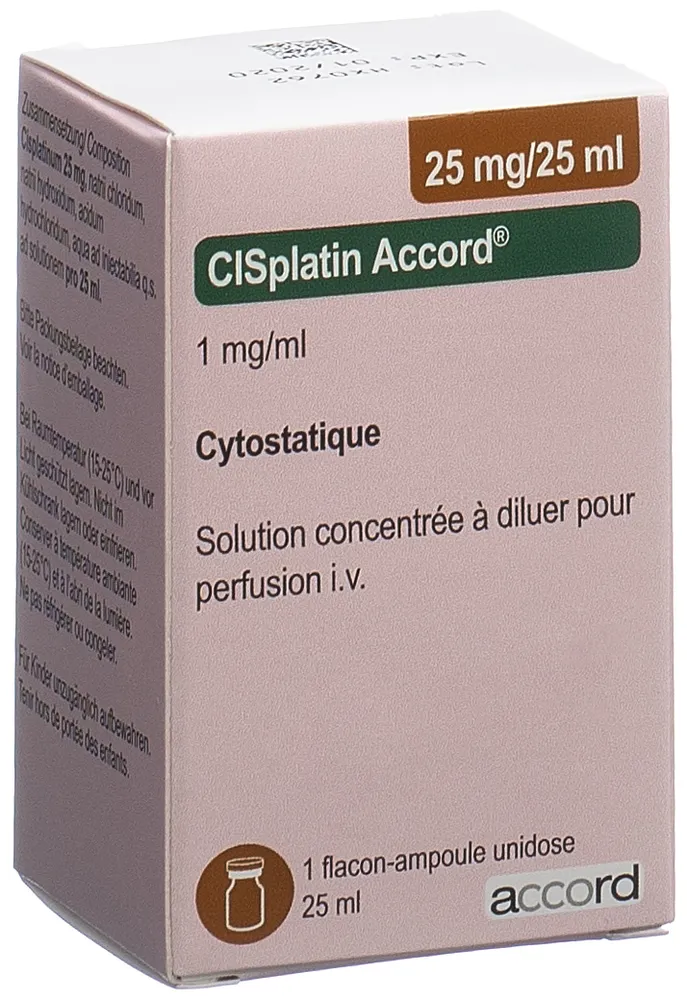
Table of Contents
- PACKAGE LEAFLET: INFORMATION FOR THE USER
- Cisplatino Accord Healthcare Italia 1 mg/ml concentrate for solution for infusion
- 1. What Cisplatino Accord Healthcare Italia is and what it is used for
- 2. What you need to know before using Cisplatin Accord Healthcare Italia
- 3. How to use Cisplatino Accord Healthcare Italia
- 4. Possible side effects
- 5. How to store Cisplatino Accord Healthcare Italia
- 6. Pack contents and other information
PACKAGE LEAFLET: INFORMATION FOR THE USER
Cisplatino Accord Healthcare Italia 1 mg/ml concentrate for solution for infusion
Equivalent medicine
The name of your medicine is 'Cisplatino Accord Healthcare Italia 1 mg/ml concentrate for solution for infusion', but throughout the rest of this leaflet it will be referred to as "Cisplatino Accord Healthcare Italia".
Please read this leaflet carefully before using this medicine because it contains important information for you.
- Keep this leaflet. You may need to read it again.
- If you have any questions, consult your doctor, pharmacist, or nurse.
- This medicine has been prescribed for you only. Do not give it to others, even if their symptoms are the same as yours, as it could be harmful.
- If you experience any side effects, including those not listed in this leaflet, tell your doctor, pharmacist, or nurse. See section 4.
Contents of this leaflet:
- What Cisplatino Accord Healthcare Italia is and what it is used for
- What you need to know before using Cisplatino Accord Healthcare Italia
- How to use Cisplatino Accord Healthcare Italia
- Possible side effects
- How to store Cisplatino Accord Healthcare Italia
- Contents of the pack and other information
1. What Cisplatino Accord Healthcare Italia is and what it is used for
Cisplatin belongs to a group of medicines called cytostatics, which are used in the treatment
of cancer. Cisplatin may be used alone, but more commonly it is used in
combination with other cytostatic agents.
What it is used for
Cisplatin can destroy body cells that can cause certain types of cancer (testicular tumour, ovarian tumour, bladder tumour, head and neck epithelial tumour, lung cancer, and cervical cancer when used in combination with radiotherapy).
2. What you need to know before using Cisplatin Accord Healthcare Italia
Do not use Cisplatin Accord Healthcare Italia if:
- you are allergic to cisplatin or to any of the other ingredients of this medicine (listed in section 6).
- you have had hypersensitivity reactions to other anticancer medicines in the past
- you have severe kidney disease
- you have hearing difficulties
- you have a very low number of blood cells (called “myelosuppression”) (your doctor will check this with a blood test)
- you are dehydrated
- you need to be vaccinated against “yellow fever”
- you are breastfeeding
Warnings and precautions
Talk to your doctor, pharmacist, or nurse before using Cisplatin Accord Healthcare Italia:
- if you have symptoms of nerve damage (peripheral neuropathy), such as tingling and needle-like sensations in the skin, numbness, or reduced sense of touch
- if you have undergone radiotherapy in the head area
Other medicines and Cisplatin Accord Healthcare Italia
Inform your doctor or pharmacist if you are taking, have recently taken, or might take any other medicines, such as:
- certain antibiotics, such as cephalosporins, aminoglycosides, and amphotericin B, and certain substances used in imaging diagnostics, which may worsen the side effects of cisplatin; particularly kidney problems
- certain diuretics called loop diuretics, antibiotics called aminoglycosides, and an anticancer medicine called ifosfamide, which may worsen the side effect of cisplatin related to hearing loss
- bleomycin (an anticancer medicine), methotrexate (used to treat cancer or arthritis), and paclitaxel (an anticancer medicine), which may cause more side effects if cisplatin is used at the same time
- the effectiveness of oral anticoagulants may be compromised. Your doctor will monitor this with blood tests
- the use of certain antihistamines may mask symptoms of balance disturbances (such as dizziness or tinnitus)
- the effectiveness of medicines used to treat seizures (e.g., phenytoin) may be reduced, so blood levels may need to be monitored
- cisplatin may worsen the side effects of the anticancer medicine ifosfamide
Pregnancy, breastfeeding and fertility
If you are pregnant or breastfeeding, think you may be pregnant, or are planning to have a baby,
ask your doctor or pharmacist for advice before using this medicine.
Due to the potential risk of congenital malformations, male and female patients
should use an effective contraceptive method both during treatment with cisplatin and for at least six
months after completion of treatment.
Treatment with cisplatin may potentially cause permanent infertility in men. It is
recommended that those who wish to become fathers in the future discuss the possibility of
sperm cryopreservation (freezing) before treatment. Consult your doctor if you have any
doubts.
Driving and using machines
Do not drive or operate machinery if you experience side effects that could impair your ability to do so.
Cisplatin Accord Healthcare Italia contains sodium
Cisplatin Accord Healthcare Italia contains 3.5 mg of sodium (main component of table salt) per
ml. This corresponds to 38.3% of the maximum daily recommended dietary intake for an adult.
3. How to use Cisplatino Accord Healthcare Italia
Dosage and method of administration
Cisplatino Accord Healthcare Italia must be administered only by a specialist experienced in cancer treatment.
The concentrate is diluted with a sodium chloride solution.
Cisplatin is administered only by intravenous injection (an intravenous infusion).
Supportive equipment should be available to manage anaphylactic reactions.
Cisplatin must not come into contact with any material containing aluminium.
The recommended dosage of cisplatin depends on your general health, the expected effects of treatment, and whether cisplatin is administered alone (monotherapy) or in combination with other medicines (combination chemotherapy).
Cisplatin (monotherapy):
The following dosages are recommended:
- A single dose of 50–120 mg/m² body surface area, every 3–4 weeks.
- 15 to 20 mg/m² per day for 5 consecutive days, every 3–4 weeks.
Cisplatin in combination with other chemotherapeutic agents (combination chemotherapy):
- 20 mg/m² or more, once every 3–4 weeks.
For the treatment of cervical cancer, cisplatin is used in combination with radiotherapy.
The usual dose is 40 mg/m² once weekly for 6 weeks.
To prevent or reduce kidney problems, you are advised to drink large amounts of fluids for 24 hours after treatment with cisplatin.
If you take more Cisplatino Accord Healthcare Italia than you should
Your doctor will ensure that you are given the correct dose for your condition. In case of overdose, you may experience an increase in adverse effects. Your doctor may provide symptomatic treatment for these side effects. If you think you have been given too much cisplatin, contact your doctor immediately.
Use this medicine exactly as your doctor or pharmacist has told you. If you are unsure, consult your doctor or pharmacist.
4. Possible side effects
Like all medicines, this medicine can cause side effects, although not everyone gets them.
Contact your doctor immediately if you experience any of the following side effects:
- severe allergic reaction – sudden itching (hives), swelling of hands, feet, ankles, face, lips, mouth or throat (which may cause difficulty swallowing or breathing), and you may feel faint
- severe chest pain that may spread to the jaw or arm, with sweating, shortness of breath and nausea (heart attack)
- pain or swelling at the injection site during injection (this may be due to incorrect intravenous administration, which can cause serious damage to surrounding tissue)
- infarction
- brain dysfunction (confusion, slurred speech, sometimes blindness, memory loss and paralysis)
These are serious side effects. Urgent medical treatment may be required.
Very common: may affect more than 1 in 10 people
- decreased bone marrow function (which may affect blood cell production)
- decreased white blood cells, making infections more likely (leucopenia)
- decreased platelet count, increasing the risk of bruising and bleeding (thrombocytopenia)
- reduced red blood cells, which may cause weakness and pale skin (anaemia)
- reduced sodium levels in the blood
- high temperature
Common: may affect up to 1 in 10 people
- severe pain or swelling in one of the legs, chest pain or difficulty breathing (may indicate dangerous blood clots in a vein)
- fast, irregular or slow heartbeat
- sepsis (blood poisoning)
Uncommon: may affect up to 1 in 100 people
- severe allergic reaction (see above)
- ear damage (ototoxicity)
- reduced magnesium levels in the blood
- abnormal sperm production
Rare: may affect up to 1 in 1,000 people
- increased risk of acute leukaemia
- seizures (fits)
- fainting, headache, confusion and loss of vision
- loss of certain brain functions, including brain dysfunction characterised by spasms and reduced levels of consciousness
- heart attack
- inflammation of the mucous membranes of the mouth (stomatitis)
- peripheral sensory nerve neuropathy, characterised by tingling, itching or pins and needles without cause, and sometimes characterised by loss of taste, touch, vision, or sudden shooting pains from the neck down the spine to the legs when bending forward
Very rare: may affect up to 1 in 10,000 people
- cardiac arrest
Not known: frequency cannot be estimated from the available data
- signs of infection such as fever or sore throat
- haemolytic anaemia
- inappropriate release of vasopressin hormone (ADH), which may lead to low sodium levels in the blood and fluid retention
- increased blood amylase (enzyme)
- dehydration
- reduced levels of calcium, phosphate and potassium in the blood
- high levels of uric acid in the blood
- muscle cramps
- spinal disease that may cause an electric shock-like sensation passing through the limbs
- loss of taste
- vision problems (blurred vision, unusual colours, vision loss or eye pain)
- ringing in the ears or deafness
- heart problems
- unusually cold or white hands and feet
- tingling, numbness or tremor in hands, feet, arms or legs
- persistent headache
- feeling unwell or malaise
- loss of appetite, anorexia
- hiccups
- diarrhoea
- increased liver enzymes, increased bilirubin
- difficulty breathing
- kidney or urine problems
- hair loss
- skin rash
- extreme tiredness/weakness
- swelling or pain at the injection site
- cramps or spasms
- burning or itching sensation
- unexpected bruising or bleeding
- haemolytic uremic syndrome, which may cause changes in the kidneys and blood
Cisplatin may cause problems with blood, liver and kidneys. Your doctor will take blood samples to monitor for these issues.
Reporting of side effects
If you get any side effects, including those not listed in this leaflet, talk to your doctor, pharmacist or nurse. You can also report side effects directly via the national reporting system at https://www.aifa.gov.it/content/segnalazioni-reazioni-avverse .
By reporting side effects, you can help provide more information on the safety of this medicine.
5. How to store Cisplatino Accord Healthcare Italia
Keep this medicine out of the sight and reach of children.
Store the vial in the outer carton (to protect cisplatin from light exposure).
Concentrate for solution for infusion 1 mg/ml
Keep the container in the outer packaging to protect the medicine from light. Do not refrigerate or
freeze.
Do not use this medicine after the expiry date which is stated on the vial and the outer packaging after 'Exp.'. The expiry date refers to the last day of that month. Do not use this medicine if you notice any visible signs of deterioration.
All materials used for the preparation and administration of this medicine, or that have come into contact with cisplatin in any way, must be disposed of in accordance with local guidelines for cytotoxic agents.
If the solution appears cloudy or if you notice a deposit that does not dissolve, the vial must be discarded.
6. Pack contents and other information
What Cisplatino Accord Healthcare Italia contains:
Cisplatino Accord Healthcare Italia contains the active substance cisplatin.
Each millilitre (ml) of solution contains 1 milligram (mg) of cisplatin. This medicine is
supplied in amber glass containers called vials.
| Available pack sizes | 10 ml | 25 ml | 50 ml | 100 ml |
| Cisplatin content | 10 mg | 25 mg | 50 mg | 100 mg |
It is available in packs containing a single vial (it is possible that not all pack sizes are marketed).
The other components include water for injections, sodium chloride, hydrochloric acid (to adjust pH) and/or sodium hydroxide (to adjust pH).
Description of the appearance of Cisplatino Accord Healthcare Italia and contents of the pack:
Cisplatino Accord Healthcare Italia is a clear, colourless to pale yellow solution, practically free from particles, in an amber glass vial with a transparent 'flip-off' seal.
Pack containing 1 injection vial of 10 ml, each injection vial containing 10 mg of cisplatin.
Pack containing 1 injection vial of 25 ml, each injection vial containing 25 mg of cisplatin.
Pack containing 1 injection vial of 50 ml, each injection vial containing 50 mg of cisplatin.
Pack containing 1 injection vial of 100 ml, each injection vial containing 100 mg of cisplatin.
It is possible that not all pack sizes are marketed.
Marketing Authorisation Holder and Manufacturer:
Marketing Authorisation Holder
Accord Healthcare S.L.U.
World Trade Center,
Moll de Barcelona,
s/n, Edifici Est 6ª planta,
08039 Barcelona,
Spain
Manufacturer
Accord Healthcare Limited
Sage House, 319 Pinner Road,
North Harrow, Middlesex, HA1 4HF,
United Kingdom
Accord Healthcare Polska Sp.z o.o.,
ul. Lutomierska 50, 95-200 Pabianice, Poland
(NB: This is a Prescriber Information Leaflet, NOT the Summary of Product Characteristics. For full details regarding this product, refer to the Summary of Product Characteristics.)
The following information is intended exclusively for physicians or healthcare professionals:
Preparation and handling of the product
As with all antineoplastic agents, caution is required in handling cisplatin. Dilution must be carried out under aseptic conditions by trained personnel in a designated area. Wear protective gloves during this procedure. Take precautions to avoid contact with skin and mucous membranes. If skin contact occurs, wash the affected area immediately with soap and water. Tingling, burning, and redness have been observed following skin contact. In case of contact with mucous membranes, flush thoroughly with copious amounts of water. Dyspnoea, chest pain, throat irritation, and nausea have been reported following inhalation.
Pregnant women should avoid contact with cytotoxic drugs. Cisplatin must not be used during pregnancy unless the physician considers the risk to the individual patient clinically justified.
Organic waste materials and vomit must be disposed of carefully.
If the solution is cloudy or if a deposit is observed that does not dissolve, the vial must be discarded.
A damaged vial must be considered and handled with the same precautions applied to contaminated waste. Contaminated waste must be stored in containers specifically labelled for such waste. See section “Disposal”.
Preparation for intravenous administration
Withdraw the required amount of solution from the vial and dilute with at least 1 litre of one of the following solutions:
- Sodium chloride 0.9%
- Mixture of sodium chloride 0.9% / glucose 5% (1:1) (resulting final concentrations: sodium chloride 0.45%, glucose 2.5%)
- Sodium chloride 0.9% and 1.875% mannitol for injections
- Sodium chloride 0.45%, glucose 2.5% and 1.875% mannitol for injections
Always inspect the solution before use. Only a clear, particle-free solution should be administered.
DO NOT allow contact with infusion equipment containing aluminium.
DO NOT administer the concentrate undiluted.
For information on microbiological, chemical and physical stability of undiluted solutions, see section “Special precautions for storage”.
Disposal
All materials used in the preparation and administration of cisplatin, or that have come into contact with cisplatin in any way, must be disposed of in accordance with local guidelines for cytotoxic agents. Medicines must not be disposed of via wastewater or household waste. Ask your pharmacist how to dispose of medicines you no longer use. This will help protect the environment.
Incompatibilities
Avoid contact with aluminium. Cisplatin may react with aluminium, forming a black precipitate of platinum. All intravenous infusion sets, needles, catheters, and syringes containing aluminium must be avoided.
Cisplatin decomposes in low-chloride media; the chloride concentration must be at least equivalent to 0.45% sodium chloride.
In the absence of compatibility studies, this medicinal product must not be mixed with other medicinal products.
Antioxidants (such as sodium metabisulphite), bicarbonates (sodium bicarbonate), sulphates, fluorouracil, and paclitaxel may inactivate cisplatin in infusion systems.
Special precautions for storage
Medicinal product as supplied for sale:
Concentrate for solution for infusion 1 mg/ml
Undiluted solution: Keep the container in the outer carton to protect from light. Do not refrigerate or freeze. If the solution is not clear or if an insoluble precipitate has formed, the solution must not be used.
Diluted solution:
For storage conditions of the diluted medicinal product, see below “Concentrate for solution for infusion after dilution”. Do not refrigerate or freeze.
Concentrate for solution for infusion after dilution:
After dilution
Chemical and physical in-use stability after dilution with the infusion fluids described in the section “Preparation and handling of the product” indicates that, after dilution with the recommended intravenous fluids, Cisplatino Accord Healthcare Italia remains stable for 24 hours at room temperature (20–25°C).
From a microbiological standpoint, the diluted solution should be used immediately. If not used immediately, the storage times and conditions prior to use are the responsibility of the user and the dilution must be performed under controlled, validated aseptic conditions.