Cinryze
Italy
Table of Contents
- Package leaflet: Information for the user
- Cinryze 500 IU powder and solvent for solution for injection
- 1. What Cinryze is and what it is used for
- 2. What you should know before taking Cinryze
- 3. How to take Cinryze
- 4. Possible side effects
- 5. How to store Cinryze
- 6. Package contents and other information
- The following information is intended exclusively for healthcare professionals:
Package leaflet: Information for the user
Cinryze 500 IU powder and solvent for solution for injection
human C1 esterase inhibitor
Please read all of this leaflet carefully before taking this medicine because it contains important information for you.
- Keep this leaflet. You may need to read it again.
- If you have any questions, ask your doctor or pharmacist.
- This medicine has been prescribed for you only. Do not pass it on to other people, even if their symptoms are the same as yours, as it may be harmful to them.
- If you experience any side effects, including those not listed in this leaflet, tell your doctor or pharmacist. See section 4.
Contents of this leaflet
- What Cinryze is and what it is used for
- What you need to know before using Cinryze
- How to use Cinryze
- Possible side effects
- How to store Cinryze
- Contents of the pack and other information
1. What Cinryze is and what it is used for
Cinryze contains the human protein called “C1 esterase inhibitor” as the active substance.
The C1 esterase inhibitor is a protein naturally present in the blood. If you have low levels of
C1 esterase inhibitor in your blood, or if the C1 esterase inhibitor does not function properly,
this may lead to episodes of swelling (called angioedema). Symptoms may include
abdominal pain and swelling of:
- hands and feet
- face, eyelids, lips or tongue
- larynx, which may make breathing difficult
- genitals
In adults and children, Cinryze can increase the amount of C1 esterase inhibitor in the blood
and prevent (prior to undergoing medical or dental procedures) the occurrence of these swelling
episodes, or stop attacks once they have started.
In adults, adolescents and children (from 6 years of age), Cinryze can increase the amount of
C1 esterase inhibitor in the blood and routinely prevent the occurrence of these swelling
episodes.
2. What you should know before taking Cinryze
Do not take Cinryze
- if you are allergic to C1 esterase inhibitor or to any of the other ingredients of this medicine (listed in section 6). It is important to inform your doctor if you think you have previously had an allergic reaction to any of the excipients in Cinryze.
Warnings and precautions
- Before treatment with Cinryze, it is important to inform your doctor if you have or have previously had problems with blood clotting (thrombotic events). In such cases, you will be closely monitored.
- If you develop a skin rash, chest tightness, breathing difficulty, or rapid heartbeat after taking Cinryze, you must inform your doctor immediately. See section 4.
- When medicines are derived from human blood or plasma, certain measures are taken to prevent the transmission of infections to patients. These include careful selection of blood and plasma donors to ensure that donors at risk of carrying infections are excluded, and testing of each donation and plasma pool to detect signs of viruses/infections. In addition, manufacturing processes include procedures that can inactivate or eliminate viruses. Despite these measures, when medicines prepared from human blood or plasma are administered, the possibility of transmitting an infection cannot be completely ruled out. This also applies to any unknown or emerging viruses or other types of infections.
- The measures taken are considered effective against enveloped viruses such as human immunodeficiency virus (HIV), hepatitis B virus, hepatitis C virus, and against non-enveloped viruses such as hepatitis A virus and parvovirus B19.
- Your doctor may recommend that you receive vaccinations against hepatitis A and B if you regularly or repeatedly receive products containing human plasma-derived C1 esterase inhibitor.
- To improve traceability of biological medicines, the name and batch number of the administered product must be clearly recorded by the nurse or doctor.
Children
The use of Cinryze for routine prevention of angioedema attacks is not indicated in children under 6 years of age.
Other medicines and Cinryze
Inform your doctor if you are taking, have recently taken, or might take any other medicines.
Pregnancy and breastfeeding
If you are pregnant, suspect you may be pregnant, are planning a pregnancy, or are breastfeeding, please consult your doctor before taking this medicine. There is limited information on the safety of using Cinryze during pregnancy and breastfeeding. Your doctor will discuss with you the risks and benefits of using this medicine.
Driving and using machines
Cinryze has a minor influence on the ability to drive vehicles or operate machinery.
Cinryze contains sodium
This medicine contains 11.5 mg of sodium (a main component of table salt) per vial. This corresponds to 0.5% of the maximum daily recommended dietary intake of sodium for an adult.
3. How to take Cinryze
Treatment will be initiated and managed under the supervision of a physician experienced in the treatment of patients with hereditary angioedema (HAE).
A physician or nurse will prepare and administer Cinryze for you. If your physician determines that you may perform self-administration, the physician or nurse will provide instructions to you or to a family member on the preparation and injection of Cinryze. Your physician will periodically review the preparation and administration procedure with you, a family member, or your caregiver.
The recommended dose of Cinryze for adults, adolescents, children, elderly patients, or patients with kidney or liver problems is as follows:
Use in adults and adolescents (from 12 years of age)
Treatment of swelling attacks
- A dose of 1,000 IU (two vials) of Cinryze should be injected at the first sign of a swelling attack.
- A second injection of 1,000 IU may be administered if symptoms have not improved after 60 minutes.
- If a severe attack occurs, particularly involving swelling of the larynx, or if treatment initiation is delayed, the second 1,000 IU dose may be given before 60 minutes have elapsed from the first dose, depending on the clinical response.
- Cinryze must be administered intravenously (into a vein).
Routine prevention of swelling attacks
- A dose of 1,000 IU (two vials) of Cinryze should be injected every 3 or 4 days for routine prevention of swelling attacks.
- The dosing interval may be adjusted by the physician according to the response to Cinryze.
- Cinryze must be administered intravenously (into a vein).
Prevention of swelling attacks prior to surgery
- A dose of 1,000 IU (two vials) of Cinryze should be injected up to 24 hours before a medical, dental, or surgical procedure.
- Cinryze must be administered intravenously (into a vein).
Use in children
| Treatment of angioedema attacks | Pre-procedure prevention of angioedema attacks | Routine prevention of angioedema attacks |
| 2 – 11 years, >25 kg: Inject a dose of 1,000 IU (two vials) of Cinryze at the first sign of a swelling attack. A second 1,000 IU injection may be administered if symptoms do not improve after 60 minutes. 2 – 11 years, 10 – 25 kg: Inject a dose of 500 IU of Cinryze at the first sign of a swelling attack. A second 500 IU injection may be administered if symptoms do not improve after 60 minutes. | 2 – 11 years, >25 kg: Inject a dose of 1,000 IU (two vials) of Cinryze up to 24 hours before a medical, dental, or surgical procedure. 2 – 11 years, 10 – 25 kg: Inject a dose of 500 IU (one vial) of Cinryze up to 24 hours before a medical, dental, or surgical procedure. | 6 – 11 years: Inject a dose of 500 IU (one vial) of Cinryze every 3 or 4 days for routine prevention of swelling attacks. The dosing interval may be adjusted by your doctor based on your response to Cinryze. |
Reconstitution and method of administration
Cinryze is usually administered by a doctor or nurse as an injection into a vein (intravenously).
You or your caregiver may also administer Cinryze as an injection, but only after receiving adequate
training. If you administer the injection yourself, always follow the doctor's instructions exactly.
If you have any doubts, consult your doctor. If your doctor considers you suitable for home treatment,
detailed instructions will be provided to you. You must keep a diary to document each treatment
received at home and bring it to every visit with your doctor. Your injection technique/your caregiver's
injection technique will be reviewed periodically to ensure that the treatment is always performed correctly.
If you have any questions about the use of this medicine, consult your doctor or pharmacist.
4. Possible side effects
Like all medicines, this medicine can cause side effects, although not everyone gets them.
Allergic-type reactions may occur as possible side effects.
Immediately inform your doctor if any of the following symptoms occur after taking this medicine. Although rare, these symptoms may be serious.
Sudden wheezing, difficulty breathing, swelling of the eyelids, face or lips, skin rash or itching (especially if affecting the whole body).
Very common side effects (may affect more than 1 in 10 people): headache, nausea.
Common side effects (may affect up to 1 in 10 people): hypersensitivity, dizziness, vomiting, skin rash, itching or redness of the skin, rash or pain at the injection site, fever.
Uncommon side effects (may affect up to 1 in 100 people): high blood sugar levels, blood clot formation, vein pain, hot flushes, cough, stomach ache, diarrhoea, skin peeling, joint swelling and pain, muscle pain and chest discomfort.
Side effects in children and adolescents are expected to be similar to those observed in adults.
Reporting of side effects
If you get any side effects, including those not listed in this leaflet, talk to your doctor or nurse.
You can also report side effects directly via the national reporting system listed in Annex V. By reporting side effects, you can help provide more information on the safety of this medicine.
5. How to store Cinryze
Keep this medicine out of the sight and reach of children.
Do not use this medicine after the expiry date stated on the carton and vials after "Exp.".
Store below 25 °C. Do not freeze. Keep in the original packaging to protect the medicine from light.
After reconstitution, the Cinryze solution should be used immediately.
Do not dispose of medicines via wastewater or household waste. Ask your pharmacist how to dispose of medicines you no longer use. This will help protect the environment.
6. Package contents and other information
What Cinryze contains
The active substance is human C1 esterase inhibitor produced from plasma of human donors. Each
vial of powder contains 500 IU of human C1 esterase inhibitor. After reconstitution, one
vial contains 500 IU of human C1 esterase inhibitor per 5 ml, corresponding to a
concentration of 100 IU/ml. Two reconstituted vials of Cinryze contain 1,000 IU of human C1 esterase inhibitor per 10 ml, corresponding to a concentration of 100 IU/ml.
The total protein content of the reconstituted solution is 15 ± 5 mg/ml.
One International Unit (IU) is equivalent to the amount of C1 esterase inhibitor present in 1 ml
of normal human plasma.
The other components are sodium chloride, sucrose, sodium citrate, L-valine, L-alanine and L-threonine
(see section 2).
Solvent: water for injections
Description of the appearance of Cinryze and contents of the pack
Powder and solvent for solution for injection.
Cinryze is a white powder contained in a vial.
Once dissolved with water for injections, the solution is clear and colourless or
slightly blue.
Each pack contains:
2 vials of Cinryze 500 IU powder for injectable solution
2 vials of water for injections (5 ml each)
2 transfer devices with filter
2 single-use 10 ml syringes
2 venipuncture sets
2 protective pads
Use only a silicone-free syringe (supplied in the pack) for administration of the medicinal product.
Marketing Authorisation Holder and Manufacturer
Marketing Authorisation Holder
Takeda Manufacturing Austria AG
Industriestrasse 67
1221 Vienna
Austria
Manufacturer
Takeda Manufacturing Austria AG
Industriestrasse 67
1221 Vienna
Austria
Shire International Licensing B.V.
Mercuriusplein 11
2132 HA Hoofddorp
The Netherlands
For further information about this medicinal product, please contact the local representative of the Marketing Authorisation Holder:
België/Belgique/Belgien Lietuva
Takeda Belgium NV Takeda, UAB
Tél/Tel: +32 2 464 06 11 Tel: +370 521 09 070
[email protected] [email protected]
България Luxembourg/Luxemburg
Такеда България ЕООД Takeda Belgium NV
Тел.: +359 2 958 27 36 Tél/Tel: +32 2 464 06 11
[email protected] [email protected]
Česká republika Magyarország
Takeda Pharmaceuticals Czech Republic s.r.o. Takeda Pharma Kft.
Tel: +420 234 722 722 Tel.: +36 1 270 7030
[email protected] [email protected]
Danmark Malta
Takeda Pharma A/S Τakeda HELLAS S.A.
Tlf.: +45 46 77 10 10 Tel: +30 210 6387800
[email protected] [email protected]
Deutschland Nederland
Takeda GmbH Takeda Nederland B.V.
Tel: +49 (0)800 825 3325 Tel: +31 20 203 5492
[email protected] [email protected]
Eesti Norge
Takeda Pharma OÜ Takeda AS
Tel: +372 6177 669 Tlf: +47 800 800 30
[email protected] [email protected]
Ελλάδα Österreich
Τakeda ΕΛΛΑΣ Α.Ε. Takeda Pharma Ges.m.b.H.
Tηλ: +30 210 6387800 Tel: +43 (0) 800-20 80 50
[email protected] [email protected]
España Polska
Takeda Farmacéutica España S.A. Takeda Pharma Sp. z o.o.
Tel: +34 917 90 42 22 Tel.: +48223062447
[email protected] [email protected]
France Portugal
Takeda France SAS Takeda Farmacêuticos Portugal, Lda.
Tél: + 33 1 40 67 33 00 Tel: + 351 21 120 1457
[email protected] [email protected]
Hrvatska România
Takeda Pharmaceuticals Croatia d.o.o. Takeda Pharmaceuticals SRL
Tel: +385 1 377 88 96 Tel: +40 21 335 03 91
[email protected] [email protected]
Ireland Slovenija
Takeda Products Ireland Ltd Takeda Pharmaceuticals farmacevtska družba d.o.o.
Tel: 1800 937 970 Tel: + 386 (0) 59 082 480
[email protected] [email protected]
Ísland Slovenská republika
Vistor ehf. Takeda Pharmaceuticals Slovakia s.r.o.
Sími: +354 535 7000 Tel: +421 (2) 20 602 600
[email protected] [email protected]
Italia Suomi/Finland
Takeda Italia S.p.A. Takeda Oy
Tel: +39 06 502601 Puh/Tel: 0800 774 051
[email protected] [email protected]
Κύπρος Sverige
Τakeda ΕΛΛΑΣ Α.Ε. Takeda Pharma AB
Τηλ: +30 210 6387800 Tel: 020 795 079
[email protected] [email protected]
Latvija
Takeda Latvia SIA
Tel: +371 67840082
[email protected]
Other sources of information
More detailed information about this medicinal product is available on the website of the European Medicines Agency, https://www.ema.europa.eu. In addition, links to other websites on rare diseases and their therapeutic treatments are provided.
The following information is intended exclusively for healthcare professionals:
Reconstitution and administration of Cinryze
Reconstitution, administration of the medicinal product, and handling of the administration kit and needles must be performed with caution.
Use the transfer device-filter provided with Cinryze, or a commercially available double-ended needle.
For administration of the medicinal product, use only a silicone-free syringe (supplied in the pack).
Preparation and handling
Cinryze is intended for intravenous administration (into a vein) after reconstitution with water for injections.
The Cinryze vial is for single use only.
Reconstitution
For a 500 IU dose: 1 vial of powder, 1 vial of diluent, 1 transfer device-filter, 1 single-use 10 ml syringe, 1 venipuncture set, and 1 protective mat are required. Store the remaining vial and administration materials for the next dose.
For a 1 000 IU dose: 2 vials of powder, 2 vials of diluent, 2 transfer device-filters, 1 single-use 10 ml syringe, 1 venipuncture set, and 1 protective mat are required.
Each vial of medicinal product must be reconstituted with 5 ml of water for injections.
One reconstituted Cinryze vial corresponds to a 500 IU dose. Therefore, only one vial of Cinryze should be reconstituted for a 500 IU dose.
Two reconstituted Cinryze vials correspond to a 1 000 IU dose. Therefore, two vials are combined to obtain a 1 000 IU dose.
- Use the provided mat and wash hands before performing the following procedures.
- An aseptic technique must be used during the reconstitution procedure.
- Ensure that the vial of powder and the vial of diluent are at room temperature (15°C – 25°C).
- Detach the label from the powder vial by pulling the purple tab indicated by the arrow.
- Remove the plastic caps from the vials of powder and diluent.
- Clean the stoppers with a disinfecting wipe and allow them to dry before use.
- Remove the protective covering from the top of the transfer device package. Do not remove the device from its packaging.
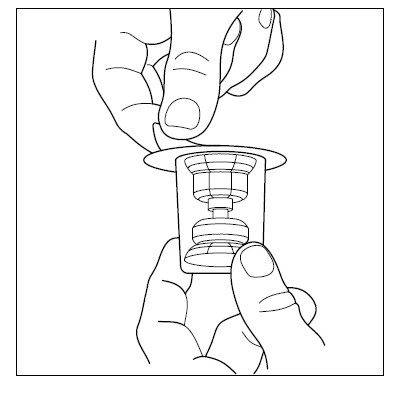
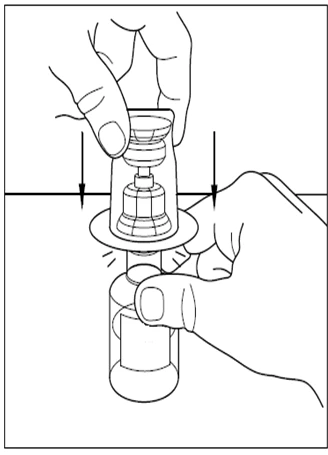
- Note: The transfer device must be applied to the diluent vial before being applied to the powder vial, to prevent loss of vacuum in the latter. Place the diluent vial on a flat surface and insert the blue end of the transfer device into the diluent vial, pushing until the spike penetrates the center of the rubber stopper of the diluent vial and the device clicks into place. The transfer device must be in a vertical position before penetrating the closure stopper.
- Remove the plastic packaging from the transfer device and discard it. Be careful not to touch the exposed end of the transfer device.
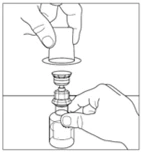
- Place the powder vial on a flat surface. Invert the transfer device and the diluent vial containing water for injections, and insert the transparent end of the transfer device into the powder vial, pressing down until the spike penetrates the rubber stopper and the transfer device clicks into place. The transfer device must be in a vertical position before penetrating the closure stopper of the powder vial. The vacuum in the powder vial will draw in the diluent. If no vacuum is present in the vial, do not use the medicinal product.
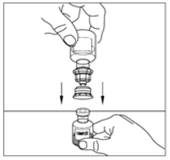
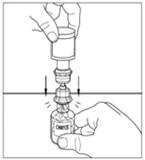
- Gently rotate the powder vial until all the powder is dissolved. Do not shake the powder vial. Ensure that all the powder is completely dissolved.
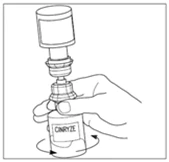
- Detach the diluent vial by rotating it counterclockwise. Do not remove the transparent end of the transfer device from the powder vial.
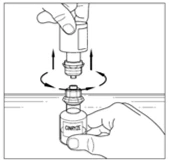
One reconstituted Cinryze vial contains 500 IU of C1 esterase inhibitor in 5 ml, resulting in a concentration of 100 IU/ml. Proceed to the administration procedure if patients are to receive a 500 IU dose.
Two vials of Cinryze powder must be reconstituted to obtain a dose (1 000 IU/10 ml). Therefore, repeat steps 1 to 12 above using another package containing a transfer device to reconstitute the second of the two powder vials. Do not reuse the transfer device. Once both vials are reconstituted, proceed to the administration procedure if patients are to receive a 1 000 IU dose.
Administration procedure for a 500 IU dose
- An aseptic technique must be used during the administration procedure.
- After reconstitution, the Cinryze solution is colorless or slightly blue and clear. Do not use the product if the solution is cloudy or shows changes in color.
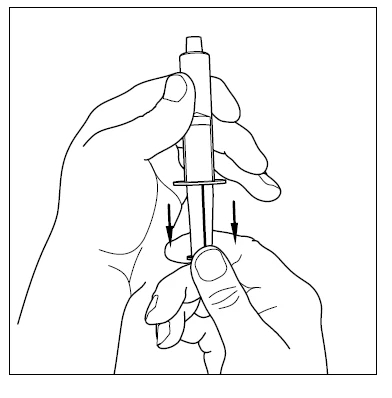
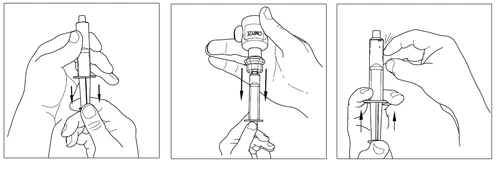
- Using a sterile, single-use 10 ml syringe, pull back the plunger to draw approximately 5 ml of air into the syringe.
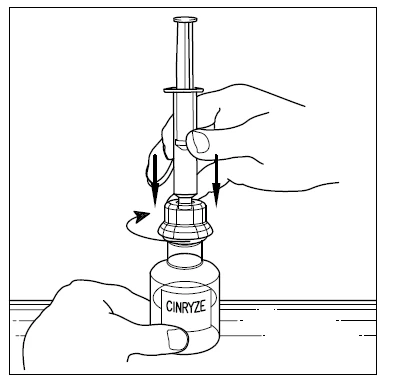
- Attach the syringe to the top of the transparent end of the transfer device by rotating it clockwise.
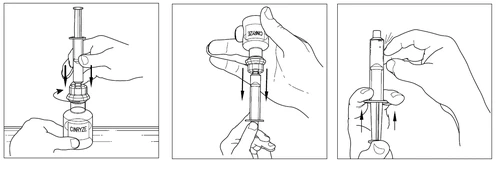
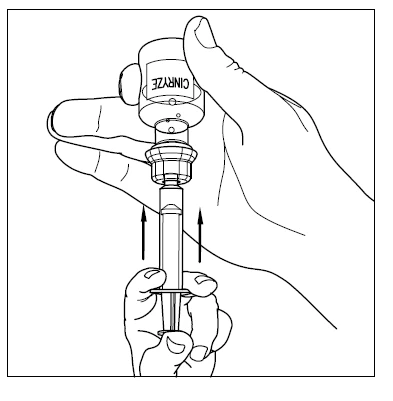
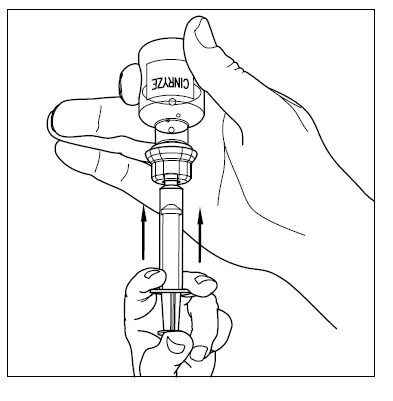
- Gently invert the vial and inject air into the solution, then slowly withdraw the reconstituted Cinryze solution into the syringe.
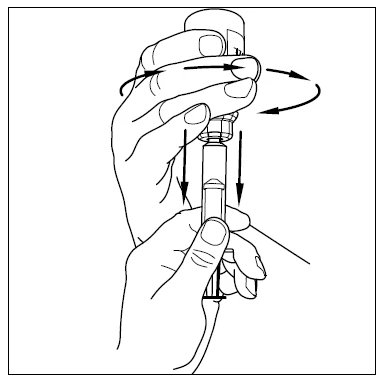
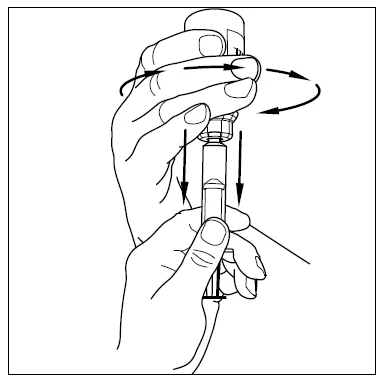
- Detach the syringe from the vial by rotating it counterclockwise and removing it from the transparent end of the transfer device.
- Before administration, inspect the reconstituted Cinryze solution for particulate matter; do not use if particles are observed.
- Connect the venipuncture set to the syringe containing the Cinryze solution and inject intravenously into the patient. Administer 500 IU (reconstituted in 5 ml of water for injections) of Cinryze by intravenous injection at a rate of 1 ml per minute over 5 minutes.
Administration procedure for a 1 000 IU dose
- An aseptic technique must be used during the administration procedure.
- After reconstitution, the Cinryze solution is colorless or slightly blue and clear. Do not use the product if the solution is cloudy or shows changes in color.
- Using a sterile, single-use 10 ml syringe, pull back the plunger to draw approximately 5 ml of air into the syringe.
- Attach the syringe to the top of the transparent end of the transfer device by rotating it clockwise.
- Gently invert the vial and inject air into the solution, then slowly withdraw the reconstituted Cinryze solution into the syringe.
- Detach the syringe from the vial by rotating it counterclockwise and removing it from the transparent end of the transfer device.
- Using the same syringe, repeat steps 3 to 6 with a second reconstituted Cinryze vial to obtain a complete 10 ml dose.
- Before administration, inspect the reconstituted Cinryze solution for particulate matter; do not use if particles are observed.
- Connect the venipuncture set to the syringe containing the Cinryze solution and inject intravenously (into a vein) into the patient. Administer 1 000 IU (reconstituted in 10 ml of water for injections) of Cinryze by intravenous injection (into a vein) at a rate of 1 ml per minute over 10 minutes.
Any unused medicinal product and waste materials derived from this medicinal product must be disposed of in accordance with local regulations.