Cibadrex
Italy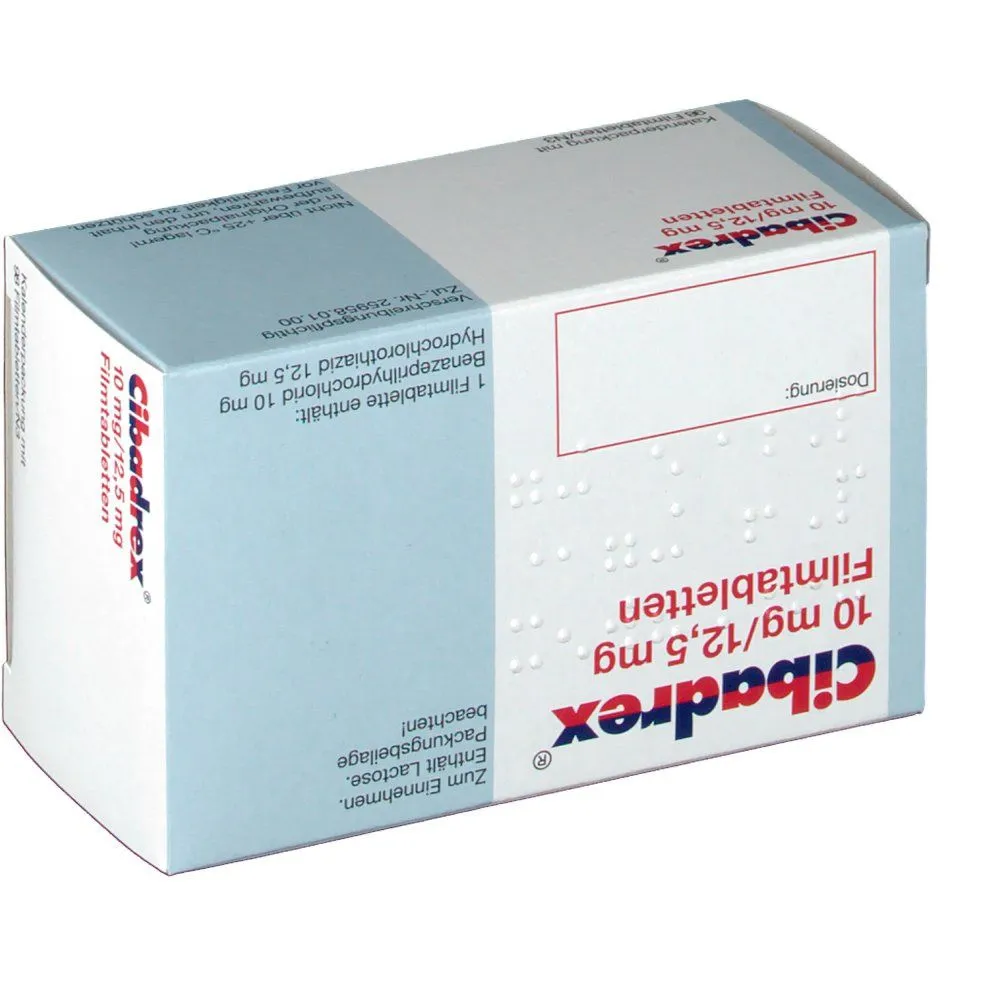
Table of Contents
PACKAGE LEAFLET: INFORMATION FOR THE PATIENT
CIBADREX 10 mg + 12.5 mg film-coated tablets
Benazepril hydrochloride + Hydrochlorothiazide
Please read this leaflet carefully before taking this medicine because it contains
important information for you.
- Keep this leaflet. You may need to read it again.
- If you have any questions, ask your doctor or pharmacist.
- This medicine has been prescribed for you only. Do not give it to others, even if they have the same symptoms as you, because it could be harmful.
- If you experience any side effects, including those not listed in this leaflet, contact your doctor or pharmacist. See section 4.
Contents of this leaflet:
- What CIBADREX is and what it is used for
- What you need to know before taking CIBADREX
- How to take CIBADREX
- Possible side effects
- How to store CIBADREX
- Contents of the pack and other information
1. What CIBADREX is and what it is used for
CIBADREX is a combination of two medicines called benazepril hydrochloride and hydrochlorothiazide.
Benazepril hydrochloride belongs to a group of medicines known as “ACE inhibitors” (Angiotensin-Converting Enzyme inhibitors). It works by:
- Reducing the body's production of substances that may cause an increase in blood pressure
- Relaxing and widening blood vessels, thereby lowering blood pressure and increasing blood flow from the heart
Hydrochlorothiazide belongs to a group of medicines called “thiazide diuretics”. It works by promoting the formation and elimination of urine, which leads to a reduction in blood pressure.
CIBADREX is used to treat hypertension (i.e. high blood pressure). The two active ingredients work together to lower blood pressure. They are used in combination when treatment with either component alone is not sufficient.
2. What you should know before taking CIBADREX
DO NOT take CIBADREX:
- If you are allergic to benazepril, hydrochlorothiazide, or any of the excipients of this medicine (see section 6)
- If you are allergic to medicines similar to CIBADREX (other ACE inhibitors or medicines derived from sulfonamides). Signs of an allergic reaction may include hoarseness (change in normal voice), swelling of the lips, face, throat, hands or feet, difficulty swallowing or breathing
- If you have previously had a severe allergic reaction (angioedema) with swelling of the face, eyelids, lips or tongue, regardless of taking medicines called ACE inhibitors
- If you have severe liver problems
- If you have severe kidney problems (creatinine clearance < 30 ml/min)
- If you have low levels of salts (potassium, sodium) in your blood
- If you have or have had high levels of uric acid in your blood (gout or history of gout)
- During the second and third trimesters of pregnancy, i.e. after the third month (see section below “Pregnancy and breastfeeding”)
- If you have diabetes or impaired kidney function and are being treated with a blood pressure-lowering medicine containing aliskiren
- If you have taken or are currently taking sacubitril/valsartan, a medicine used to treat a type of chronic heart failure in adults, as this increases the risk of angioedema (rapid swelling under the skin, such as in the throat). Consult your doctor or pharmacist before taking CIBADREX.
Warnings and precautions
Talk to your doctor or pharmacist before taking CIBADREX:
- if you have high levels of calcium in your blood (shown by a blood test)
- if you have low levels of phosphates or magnesium in your blood (shown by a blood test)
- if you have diabetes, gout or high cholesterol, as thiazide diuretics may reduce glucose tolerance and increase levels of cholesterol, triglycerides and uric acid in the blood. In some cases, gout may worsen.
- if you are taking potassium-containing salts or potassium-sparing diuretics
- if you have a cough
- if you are about to undergo general anesthesia for surgery or dental procedures. You may need to stop treatment with CIBADREX the day before; consult your doctor
- if a doctor has told you that you have narrowing of the heart's aortic valve (aortic stenosis) or mitral valve (mitral stenosis)
- if you have undergone, or are about to undergo, desensitization therapy for allergy to bee or wasp stings
- if you require hemodialysis (a procedure to purify the blood by filtration) with certain high-flux membranes, as reactions to the type of membrane used may occur
- if you have lost significant amounts of salts or body fluids (due to illness such as vomiting, diarrhea, following a low-salt diet, long-term use of oral diuretics, dialysis, or heart failure). In such cases, treatment should be started under close medical supervision
- if you have low blood pressure. A brief period of low blood pressure does not constitute a contraindication to continuing therapy
- if you experience vision changes or eye pain. These could be symptoms of fluid accumulation in the vascular layer of the eye (choroidal effusion) or increased pressure in the eye, and may occur from a few hours to weeks after taking CIBADREX. If untreated, they may lead to permanent vision loss. If you have previously had an allergic reaction to penicillin or sulfonamides, you may have a higher risk of developing these symptoms
- if a doctor has told you that you have renal artery stenosis or reduced kidney function, as this may cause increased blood urea levels. In this case, your doctor will perform tests to monitor blood urea levels both during the first weeks of treatment and periodically thereafter. Therefore, your doctor may decide to reduce your dose of CIBADREX
- if you have a "collagen disease" such as systemic lupus erythematosus, especially if associated with reduced kidney function
- if you have reduced liver function, which could lead to hepatic coma. If jaundice occurs (yellowing of the skin and whites of the eyes), stop treatment and contact your doctor immediately
- if you have reduced tolerance to sugars
- if you are taking any of the following medicines used to treat high blood pressure:
- an "angiotensin II receptor antagonist" (AIIRA) (also known as sartans – e.g. valsartan, telmisartan, irbesartan), especially if you have kidney problems related to diabetes
- Aliskiren
- if you are taking any of the following medicines, the risk of angioedema may be increased:
- Racecadotril, a medicine used to treat diarrhea
- Medicines used to prevent rejection of transplanted organs and to treat cancer (such as temsirolimus, sirolimus, everolimus)
- Vildagliptin, a medicine used to treat diabetes
- if you have previously had skin cancer or are developing unexpected skin lesions during treatment. Treatment with hydrochlorothiazide, particularly long-term use at high doses, may increase the risk of certain types of skin and lip cancer (non-melanoma skin cancer). Protect your skin from sun and UV exposure while taking CIBADREX
- If you have previously experienced breathing or lung problems (including inflammation or fluid in the lungs) after taking hydrochlorothiazide. If you develop shortness of breath or severe difficulty breathing after taking CIBADREX, consult a doctor immediately.
Your doctor may monitor your kidney function, blood pressure, and levels of electrolytes (e.g. potassium) in your blood at regular intervals.
See also the information under the section "DO NOT take CIBADREX".
Due to the diuretic component in CIBADREX, levels of sodium and potassium in the blood may decrease.
This may cause dry mouth, thirst, weakness, drowsiness, irritability, fatigue, muscle pain, hypotension, nausea, or rapid heartbeat. Low potassium levels in the blood may also exaggerate the heart's response to digitalis and are more likely to occur in patients with hepatic cirrhosis and in those also being treated with corticosteroids or ACTH.
Therefore, blood tests should be performed at the beginning and periodically during therapy.
Treatment with thiazide diuretics may trigger systemic lupus erythematosus.
Other metabolic disturbances
Thiazide diuretics such as hydrochlorothiazide may reduce glucose tolerance in diabetic patients. Adjustments in insulin or oral hypoglycemic agent dosage may be required. Latent diabetes mellitus may become apparent during treatment with thiazide diuretics.
Close monitoring of diabetic patients is required: avoid large fluctuations in blood glucose levels. Symptoms of hypoglycemia may be masked.
Patients of African descent
It has been observed that the incidence of angioedema (characterized by swelling of the face, lips, tongue, throat, or sudden breathing difficulty) during ACE inhibitor therapy is higher in patients of African descent compared to other racial groups.
For athletes
Using this medicine without therapeutic need constitutes doping and may result in a positive anti-doping test.
Other medicines and CIBADREX
Inform your doctor or pharmacist if you are taking, have recently taken, or might take any other medicines, as it may be necessary to adjust doses or, in some cases, discontinue one of the medicines.
In particular, inform your doctor or pharmacist if you are taking:
- other blood pressure-lowering medicines known as "antihypertensives" (e.g. alpha-blockers, beta-blockers, calcium antagonists)
- medicines to reduce cholesterol levels in the blood
- potassium supplements (including salt substitutes), potassium-sparing diuretics (such as spironolactone, triamterene, amiloride), and other medicines that may increase potassium levels in the blood (such as trimethoprim and cotrimoxazole for bacterial infections; cyclosporine, an immunosuppressant used to prevent transplant rejection; and heparin, a medicine used to thin the blood and prevent clotting)
- lithium (a medicine for psychiatric disorders)
- corticosteroids (medicines for treating inflammation)
- medicines for diabetes such as oral hypoglycemics (medicines to reduce blood sugar levels) and insulin
- medicines used to relieve pain and inflammation, e.g. non-steroidal anti-inflammatory drugs (NSAIDs)
- digoxin (a medicine for heart problems, including heart rhythm disorders)
- curare derivatives (medicines used for general anesthesia and intensive care)
- vitamin D
- cytotoxic medicines (anticancer medicines)
- allopurinol (a medicine for treating gout)
- amantadine (a medicine used for Parkinson's disease)
- carbamazepine (for treating epilepsy)
- anticholinergic medicines (for treating allergies and respiratory diseases)
- neprilysin inhibitors (NEP) such as sacubitril (available in fixed-dose combination with valsartan), used to treat chronic heart failure in adults (see section “Do not take CIBADREX”)
- vildagliptin (a medicine used to treat diabetes) (see section “Warnings and precautions”)
- medicines used to prevent rejection of transplanted organs and to treat cancer (e.g. temsirolimus, sirolimus, everolimus) (see section “Warnings and precautions”)
- racecadotril (used to treat diarrhea) (see section “Warnings and precautions”)
Concomitant administration of CIBADREX and non-steroidal anti-inflammatory drugs (NSAIDs) (concomitant therapy) may reduce the antihypertensive effect and may increase the risk of worsening kidney function, including possible acute kidney failure, and elevated potassium levels in the blood, especially in patients with pre-existing kidney impairment. This combination should be used with caution, particularly in the elderly. Patients should be adequately hydrated, and kidney function should be monitored when starting concomitant therapy.
Your doctor may consider it necessary to adjust the dose and/or take other precautions.
If you are taking an angiotensin II receptor antagonist (AIIRA) or aliskiren (see sections "Do not take CIBADREX" and "Warnings and precautions").
CIBADREX with food, drinks and alcohol
- Drinking alcohol together with CIBADREX may reduce the effectiveness of CIBADREX and cause dizziness or lightheadedness. If you want to know how much alcohol you can drink while taking CIBADREX, discuss it with your doctor. Alcohol increases the effects of blood pressure medicines.
- CIBADREX can be taken before, during or after meals.
Pregnancy and breastfeeding
If you are pregnant, think you may be pregnant, planning a pregnancy, or breastfeeding, consult your doctor or pharmacist before using this medicine.
Pregnancy
The use of CIBADREX is not recommended during the first trimester of pregnancy.
Do not take CIBADREX during the second and third trimesters (see section “Do not take CIBADREX”).
You must inform your doctor if you think you are pregnant (or if there is a possibility of becoming pregnant).
Treatment with CIBADREX should not be initiated during pregnancy.
Your doctor will usually advise you to stop taking CIBADREX before becoming pregnant or as soon as pregnancy is confirmed, and will recommend an alternative medicine unless continuation of ACE inhibitor therapy is considered essential. CIBADREX is not recommended during early pregnancy, as there may be a slight increased risk of teratogenicity. CIBADREX must not be taken if you are more than three months pregnant, as it may cause serious harm to the unborn child if taken after the third month of pregnancy (see section “Do not use CIBADREX”).
If exposure to an ACE inhibitor occurs after the first trimester of pregnancy, your doctor may recommend an ultrasound to assess fetal renal function and skull development, and will subsequently monitor the newborn for risk of hypotension (low blood pressure).
Breastfeeding
Inform your doctor if you are breastfeeding or planning to breastfeed.
Breastfeeding of newborns (first weeks after birth), and especially premature infants, is not recommended while taking CIBADREX. Your doctor will evaluate the benefits to you and the risks to the infant associated with taking CIBADREX during breastfeeding and may recommend an alternative treatment if you wish to breastfeed.
Driving and using machines
You may experience dizziness while taking CIBADREX. If this occurs, do not drive or operate tools or machinery.
CIBADREX contains lactose
If your doctor has diagnosed you with an intolerance to certain sugars, contact them before taking this medicine.
3. How to take CIBADREX
Take this medicine exactly as directed by your doctor. If you have any doubts, consult your doctor or pharmacist.
Taking this medicine
- Take the tablets by mouth at the same time each day (before, during, or after meals).
- Swallow the tablets with a liquid.
- The tablets may be taken whole or divided in half (for divisible tablets).
How much to take
Your doctor may adjust your dose until your blood pressure is under control. The usual starting dose of CIBADREX recommended for patients with mild to moderate hypertension is 5 mg + 6.25 mg once daily.
Most patients respond to a daily dose of 10 mg + 12.5 mg.
If further reduction of blood pressure is needed, after 3 or 4 weeks the dose may be increased up to 20 mg + 25 mg once daily.
The maximum recommended daily dose is 40 mg + 50 mg of CIBADREX, divided into two doses.
Another antihypertensive medicine may be added, but not a diuretic.
In patients already being treated with diuretics who are switching to CIBADREX, diuretic therapy should be discontinued at least 3 days before starting CIBADREX.
High blood pressure often does not cause specific symptoms. Therefore, follow your doctor's instructions carefully and do not change the dose or dosing schedule without consulting your doctor.
Children and adolescents
CIBADREX is not recommended for children and adolescents under 18 years of age, as this medicine has never been used in this age group.
If you take more CIBADREX than you should
If very high doses of CIBADREX are taken, severe dizziness and/or fainting may occur, along with severe or persistent nausea, vomiting or diarrhoea, unusual tiredness, weakness, muscle cramps, or cardiac arrhythmias.
Contact your doctor immediately. While waiting for medical help, it is advisable to induce vomiting and then lie down with your legs raised.
Your doctor may admit you to an intensive care unit if necessary.
If you forget to take CIBADREX
- If you forget to take a dose, take it as soon as you remember. However, if it is almost time for your next dose, skip the missed dose and continue with your regular schedule.
- Do not take a double dose to make up for the forgotten tablet.
4. Possible side effects
Like all medicines, this medicine can cause side effects, although not everyone experiences them.
Most of the side effects observed in clinical studies were mild to moderate in intensity, non-serious in nature, and resolved without discontinuing treatment.
Stop taking CIBADREX and contact your doctor immediately if you notice the onset of any serious side effect – you may require urgent medical treatment:
- Swelling of the face, eyes, lips, or throat causing difficulty in swallowing or breathing. This could be a sign of a serious allergic reaction to CIBADREX.
- Yellowing of the skin (jaundice) and whites of the eyes.
Inform your doctor as soon as possible if you experience:
- Dizziness, lightheadedness (especially during the first days of treatment), or fainting;
- Sore throat, fever, or chills. These may be symptoms of blood composition abnormalities;
- Abdominal pain with nausea, vomiting, and fever. These could be signs of pancreatitis (inflammation of the pancreas);
- Numbness or tingling in hands, feet, or lips; skin rashes with or without itching;
- Chest pain;
- Skin reactions (e.g., blisters), sometimes painful;
- Haemolytic anaemia (low haemoglobin concentration in the blood).
Other side effects include:
Common (affects less than 1 in 10 patients)
- Dry, persistent cough (especially at night)
- Stomach upset
- Rapid heartbeat
- Skin flushing
- Hives
- Itching
- Flu-like symptoms
- Headache
- Fatigue
- Frequent need to urinate
- Increased skin sensitivity to sunlight
- Loss of appetite
- Erectile dysfunction
- Orthostatic hypotension (sudden drop in blood pressure when standing up from a sitting or lying position), which may be worsened by concomitant intake of alcohol, anaesthetics, or sedatives
Uncommon (affects less than 1 in 100 patients)
- Acute renal failure (kidney problems)
Rare (affects less than 1 in 1000 patients undergoing treatment)
- Diarrhoea, nausea
- Nervousness
- Sleep disturbances
- Loss of taste
- Ringing in the ears
- Joint pain
- Muscle pain
- Blurred vision
- Hypokalaemia
- Drowsiness
- Dizziness
- Anxiety
- Constipation
- Increased uric acid, blood urea nitrogen, and serum creatinine levels
- Angina pectoris
- Arrhythmias
- Hepatitis
- Pemphigus (an autoimmune disorder affecting skin and mucous membranes)
- Decreased platelet count (sometimes with purpura)
- Depression
- Visual disturbances
- Intrahepatic cholestasis
Very rare (affects less than 1 in 10,000 patients undergoing treatment)
- Hyponatraemia
- Tinnitus
- Dysgeusia
- Myocardial infarction
- Stevens-Johnson syndrome
- Worsening of renal function
- Decreased white blood cell count
- Bone marrow depression
- Necrotizing vasculitis
- Breathing difficulties, including pneumonia and pulmonary oedema
- Toxic epidermal necrolysis, lupus erythematosus-like skin reactions, reactivation of cutaneous lupus erythematosus
- Acute respiratory distress (signs include severe shortness of breath, fever, weakness, and confusion)
Not known (frequency cannot be estimated from available data)
- Renal failure and worsening of renal function (kidney problems)
- Severe skin reactions (erythema multiforme)
- Fever
- Muscle cramps
- Rapid-onset reduction in distance vision (acute myopia), decreased vision, or eye pain due to elevated pressure (possible signs of fluid accumulation in the vascular layer of the eye (choroidal effusion) or acute angle-closure glaucoma)
- Weakness
- Decreased production of all blood cells (aplastic anaemia)
- Increased blood sugar levels (hyperglycaemia)
- Glucose excretion in urine
- Worsening metabolic status in diabetic patients
- Hyperkalaemia
- Decreased number of certain types of white blood cells (agranulocytosis, neutropenia)
- Angioedema of the small intestine
- Skin and lip cancer (non-melanoma skin cancer)
- Worsening of psoriasis (a skin condition causing red, itchy, scaly patches, most commonly on knees, elbows, trunk, and scalp)
- Syncope
Hydrochlorothiazide may cause metabolic disturbances, especially at high doses. It may increase blood sugar levels and cause glucose excretion in urine in diabetics and other susceptible patients. Treatment with thiazide diuretics has been associated with significant reduction of chloride in the body (hypochloraemic alkalosis).
Reporting of side effects
If you experience any side effect, including those not listed in this leaflet, talk to your doctor or pharmacist. You can also report side effects directly via the national reporting system at https://www.aifa.gov.it/content/segnalazioni-reazioni-avverse.
By reporting side effects, you can help provide more information on the safety of this medicine.
5. How to store CIBADREX
Do not store above 25 °C.
Keep in the original packaging.
Keep this medicine out of the sight and reach of children.
Do not use this medicine after the expiry date stated on the pack after EXP.
The expiry date refers to the last day of that month.
Do not dispose of any medicine via wastewater or household waste. Ask your pharmacist how to
dispose of medicines you no longer use. This will help protect the environment.
6. Package contents and other information
What CIBADREX contains
CIBADREX 10 mg + 12.5 mg film-coated tablets
The active substances are: benazepril hydrochloride 10 mg + hydrochlorothiazide 12.5 mg;
The other components are: hydrogenated castor oil; lactose (see section 2 “CIBADREX contains lactose”); crospovidone, hypromellose, iron oxide red (E172); macrogol; talc; titanium dioxide.
Description of the appearance of CIBADREX and contents of the pack
CIBADREX 10 mg + 12.5 mg film-coated tablets are oval-shaped, light pink, film-coated tablets. They are available in packs containing 14 or 28 film-coated tablets.
Not all pack sizes may be marketed.
Marketing Authorisation Holder and Manufacturer
Viatris Healthcare Limited,
Damastown Industrial Park,
Mulhuddart, Dublin 15,
DUBLIN, Ireland
Manufacturer
Madaus GmbH
Lütticher Straße 5
53842 Troisdorf
Germany
Mylan Hungary Kft,
Mylan utca 1 –
Komárom, H-2900,
Hungary