Chenodeoxycholic acid Leadiant
Italy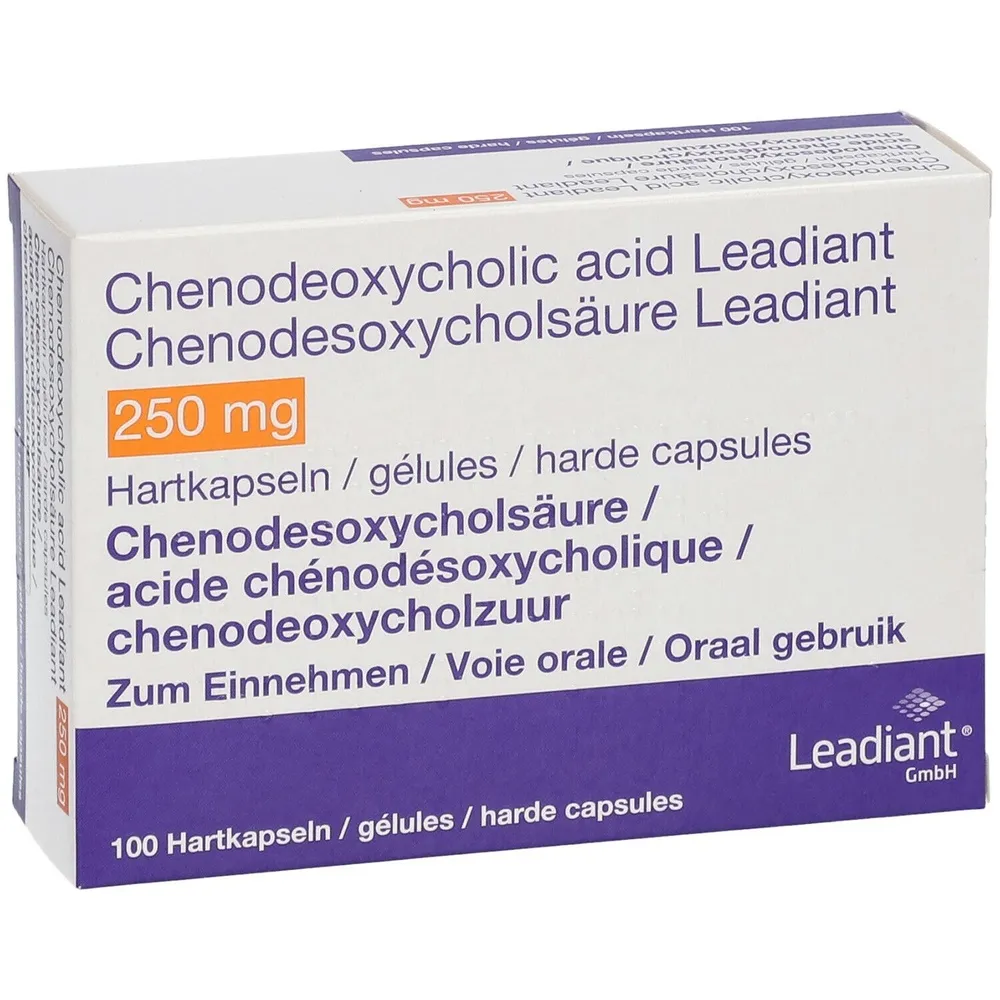
Table of Contents
- Package leaflet: Information for the user
- Chenodeoxycholic acid Leadiant 250 mg hard capsules
- 1. What Acido chenodesossicolico Leadiant is and what it is used for
- 2. What you need to know before taking Acido chenodesossicolico Leadiant
- 3. How to take Acido chenodesossicolico Leadiant
- 4. Possible side effects
- 5. How to store Chenodeoxycholic Acid Leadiant
- 6. Package contents and other information
- Information intended exclusively for healthcare professionals
Package leaflet: Information for the user
Chenodeoxycholic acid Leadiant 250 mg hard capsules
Chenodeoxycholic acid
This medicinal product is subject to additional monitoring. This will allow any new safety information to be identified quickly. You can help by reporting any side effects you experience while taking this medicine. See the end of section 4 for information on how to report side effects.
Please read all of this leaflet carefully before you start taking this medicine because it contains important information for you.
- Keep this leaflet. You may need to read it again.
- If you have any questions, ask your doctor or pharmacist.
- This medicine has been prescribed for you only. Do not give it to other people, even if their symptoms are the same as yours, as it may be harmful.
- If you experience any side effect, including those not listed in this leaflet, contact your doctor or pharmacist. See section 4.
Contents of this leaflet
- What Acido chenodesossicolico Leadiant is and what it is used for
- What you need to know before taking Acido chenodesossicolico Leadiant
- How to take Acido chenodesossicolico Leadiant
- Possible side effects
- How to store Acido chenodesossicolico Leadiant
- Contents of the pack and other information
1. What Acido chenodesossicolico Leadiant is and what it is used for
Acido chenodesossicolico Leadiant capsules contain a substance called acidum chenodesoxycholicum. This substance is normally produced in the liver from cholesterol. It is part of bile, a fluid that helps digest fats and vitamins from food. Patients with a rare condition known as cerebrotendinous xanthomatosis (CTX) are unable to produce chenodeoxycholic acid, leading to an accumulation of fatty deposits in various parts of the body. This can cause damage in the affected areas.
Acido chenodesossicolico Leadiant capsules treat CTX by replacing the missing chenodeoxycholic acid, thereby preventing the formation of fatty deposits.
Acido chenodesossicolico Leadiant capsules can be used from the age of one month, and patients affected by CTX will need to continue treatment for life.
2. What you need to know before taking Acido chenodesossicolico Leadiant
Do not take Acido chenodesossicolico Leadiant
- if you are allergic to chenodeoxycholic acid or to any of the other ingredients of this medicine (listed in section 6)
Warnings and precautions
Acido chenodesossicolico Leadiant must be used under medical supervision. During treatment, your
doctor will carry out blood and urine tests to monitor your response to this medicine and adjust the
dose if necessary. More frequent testing may be required in case of rapid growth, illness (e.g. liver
problems) or pregnancy. Your doctor will inform you if, for any reason, you should stop treatment with
Acido chenodesossicolico Leadiant.
Children (less than one month of age)
The safety and efficacy of Acido chenodesossicolico Leadiant have not been studied in children under
one month of age.
Other medicines and Acido chenodesossicolico Leadiant
Tell your doctor or pharmacist if you are taking, have recently taken, or might take any other medicines.
The following medicines may affect levels of Acido chenodesossicolico Leadiant:
- cyclosporine and sirolimus (medicines used to suppress the immune system)
- phenobarbital (a medicine used for epilepsy) If your doctor considers it necessary to take cyclosporine, sirolimus or phenobarbital, they will closely monitor your blood and urine test results and adjust the dose of Acido chenodesossicolico Leadiant if necessary.
Oral contraceptives may affect how Acido chenodesossicolico Leadiant works, making it less effective.
It is recommended not to take oral contraceptives while taking chenodeoxycholic acid. Please consult
your doctor regarding suitable contraceptive methods.
The following medicines may reduce the effect of Acido chenodesossicolico Leadiant:
- cholestyramine, colestipol (so-called bile acid sequestrants)
- medicines for treating heartburn (antacids) containing aluminium hydroxide and/or smectite (aluminium oxide) If you need to take cholestyramine, take chenodeoxycholic acid one hour before cholestyramine or 4–6 hours after. Colestipol or heartburn medicines should be taken 2 hours before or 2 hours after taking Acido chenodesossicolico Leadiant.
Please consult your doctor if you are taking any of these medicines.
Pregnancy
It is recommended not to take Acido chenodesossicolico Leadiant during pregnancy. There may be a
risk to the unborn child. If you suspect you are pregnant or are planning a pregnancy, consult your
doctor before taking this medicine.
Breast-feeding
It is not known whether Acido chenodesossicolico Leadiant is excreted in human breast milk. Inform
your doctor if you are breast-feeding or plan to breast-feed. Your doctor will help you decide whether
to discontinue breast-feeding or treatment with Acido chenodesossicolico Leadiant, taking into
account the benefit of breast-feeding for the child and the benefit of Acido chenodesossicolico Leadiant
for the mother.
Fertility in women
Women of childbearing potential must use effective contraceptive measures during treatment with
Acido chenodesossicolico Leadiant. Oral contraceptives are not recommended (see Other medicines
and Acido chenodesossicolico Leadiant). Consult your doctor regarding appropriate contraceptive
methods.
Driving and using machines
Acido chenodesossicolico Leadiant is not expected to affect the ability to drive or use machinery.
3. How to take Acido chenodesossicolico Leadiant
Take this medicine exactly as directed by your doctor. If you have any doubts, consult your doctor.
The usual starting dose in adults is one 250 mg capsule three times daily. The maximum dose is one 250 mg capsule four times daily. Swallow the capsules whole with sufficient water, approximately at the same time each day. The capsules may be taken with or without food.
Your doctor may decide to increase the dose depending on how your body responds to treatment. Your doctor will inform you how many capsules to take and when to take them.
Use in children and adolescents (aged between one month and 18 years)
In neonates, children, and adolescents, the dose will be calculated based on body weight. The initial dose will be 5 mg per kg per day. The maximum dose in children is 15 mg per kg per day. Your doctor will determine how many times and when the child should take the dose(s) to achieve the total daily dose. The doctor may adjust the dose depending on how the child responds to treatment.
For neonates, children, or patients who cannot swallow capsules and/or require a dose lower than 250 mg, the capsule may be opened and the contents mixed with a solution of sodium bicarbonate 8.4%. The active substance will dissolve in the sodium bicarbonate solution, although not all of the capsule contents will dissolve, resulting in a mixture. This mixture can be prepared and supplied by the pharmacy. The mixture must be dispensed in a glass vial and may be stored for up to 7 days. Do not refrigerate or freeze the mixture. Your doctor or pharmacist will provide instructions on how and how often the child should take the mixture. The mixture contains sodium; inform your doctor if you are on a low-sodium diet.
If you take more Acido chenodesossicolico Leadiant than you should
It is unlikely that Acido chenodesossicolico Leadiant will cause serious adverse effects. However, you should contact your doctor if you or your child have taken more than the prescribed dose.
If you forget to take Acido chenodesossicolico Leadiant
Skip the missed dose and take the next dose at your usual scheduled time. Do not take a double dose to make up for the forgotten dose.
If you stop taking Acido chenodesossicolico Leadiant
This medicine is intended for long-term use. Do not stop taking Acido chenodesossicolico Leadiant without first talking to your doctor. If you stop taking the medicine, symptoms may worsen.
If you have any questions about the use of this medicine, consult your doctor or pharmacist.
4. Possible side effects
Like all medicines, this medicine can cause side effects, although not everybody gets them.
Side effects of unknown frequency (frequency cannot be estimated from the available data)
- Constipation
- Abnormal liver function tests (increased transaminases)
- Yellowing of the skin and whites of the eyes (jaundice)
Reporting of side effects
If you experience any side effect, including those not listed in this leaflet, talk to your doctor or pharmacist. You may also report side effects directly through the national reporting system indicated in Annex V. By reporting side effects, you can help provide more information on the safety of this medicine.
5. How to store Chenodeoxycholic Acid Leadiant
Keep this medicine out of the sight and reach of children.
Do not use this medicine after the expiry date which is stated on the carton and on the blister pack after “Exp/EXP”. The expiry date refers to the last day of that month.
Do not dispose of medicines via wastewater or household waste. Ask your pharmacist how to dispose of medicines you no longer use. This will help protect the environment.
6. Package contents and other information
What Acido chenodesossicolico Leadiant contains
- The active substance is chenodesoxycholic acid. Each capsule contains 250 mg of chenodesoxycholic acid.
- The other components are:
Capsule contents: maize starch, magnesium stearate, anhydrous colloidal silica
Capsule shell: gelatin, titanium dioxide (E 171), quinoline yellow (E 104), erythrosine (E 127)
Description of the appearance of Acido chenodesossicolico Leadiant and contents of the pack
Acido chenodesossicolico Leadiant is supplied as hard capsules of size 0, 21.7 mm in length. The capsules consist of a yellow body and an orange cap, containing white compressed powder.
Acido chenodesossicolico Leadiant is available in blister packs containing 100 hard capsules.
Marketing Authorization Holder
Leadiant GmbH
Liebherrstr. 22
80538 Munich
Germany
email: [email protected]
Manufacturer
Pharmaloop S.L.
C/Bolivia, no 15 Polígono Industrial Azque
Alcalá de Henares
Madrid 28806
Spain
Other sources of information
More detailed information on this medicinal product is available on the website of the European Medicines Agency: http://www.ema.europa.eu. In addition, links to other websites on rare diseases and their therapeutic treatments are provided.
Information intended exclusively for healthcare professionals
Preparation of chenodeoxycholic acid suspension
For children and adolescents (from 1 year to 18 years of age) and for adults who cannot swallow capsules and/or require a dose lower than 250 mg, one capsule may be opened and its contents added to 25 mL of sodium bicarbonate 8.4% solution (1 mmol/mL) to produce a suspension containing chenodeoxycholic acid 10 mg/mL.
For infants (from 1 month to 11 months of age), one capsule may be opened and its contents added to 50 mL of sodium bicarbonate 8.4% solution (1 mmol/mL) to produce a suspension containing chenodeoxycholic acid 5 mg/mL.
Mix the mixture until all powder is suspended. Take care to scrape down the sides of the container into the mixture and continue stirring (for approximately 5 minutes) to ensure no lumps remain. The mixture is ready when no lumps or visible powder are present.
The resulting suspension contains 22.9 mg of sodium per mL, a value that should be considered in patients on a low-sodium diet.
It is recommended that this suspension be prepared by the pharmacy, and that appropriate administration instructions be provided to a parent.
The suspension must be stored in a glass vial. Do not refrigerate or freeze. The suspension is stable for up to 7 days.
The pharmacy must provide appropriately sized and calibrated oral dosing syringes for administration of the suspension. Correct volumes should preferably be marked on the oral syringe.
The pharmacy label must be affixed to the vial and include the patient’s name, dosing instructions, expiry date, name of the medicinal product, and any other information required to comply with local pharmacy regulations.
The physician must provide information on the dose to be administered based on the child’s body weight. The dose for paediatric patients (from 1 month to 18 years of age) ranges between 5 and 15 mg/kg/day.
Dose calculation (children 1–11 years, adolescents 12–18 years) of chenodeoxycholic acid suspension 10 mg/mL
Daily dose: (Weight in kg) × (Dose in mg/kg) = Daily dose in mg
Fractionated dose* (Daily dose in mg) = Fractionated dose in mg
(Dosing frequency)
Volume to (Fractionated dose in mg × 1 mL) = Quantity of suspension to
administer: administer
10 mg
Example: Patient weighing 10 kg receiving a dose of 15 mg/kg of chenodeoxycholic acid.
Total daily dose =
10 kg × 15 mg/kg = 150 mg
Fractionated dose when administered three times daily =
150 mg ÷ 3 = 50 mg
Corresponding volume of suspension to administer =
(50 mg × 1 mL) ÷ 10 mg = 5 mL
*Number of fractionated doses according to physician’s advice.
Dose calculation (infants 1 month–11 months) of chenodeoxycholic acid suspension 5 mg/mL
Daily dose: (Weight in kg) × (Dose in mg/kg) = Daily dose in mg
Fractionated dose* (Daily dose in mg) = Fractionated dose in mg
(Dosing frequency)
Volume to (Fractionated dose in mg × 1 mL) = Quantity of suspension to
administer: administer
5 mg
Example: Patient weighing 3 kg receiving a dose of 5 mg/kg of chenodeoxycholic acid.
Total daily dose =
3 kg × 5 mg/kg = 15 mg
Fractionated dose when administered three times daily =
15 mg ÷ 3 = 5 mg
Corresponding volume of suspension to administer =
(5 mg × 1 mL) ÷ 5 mg = 1 mL
*Number of fractionated doses according to physician’s advice.
ANNEX IV
SCIENTIFIC CONCLUSIONS AND REASONS FOR THE CHANGE IN THE TERMS OF THE
MARKETING AUTHORISATION(S)
Scientific conclusions
Taking into account the assessment by the Pharmacovigilance and Risk Assessment Committee (PRAC) of the Periodic Safety Update Reports (PSURs) for chenodeoxycholic acid (inborn errors of primary bile acid synthesis, xanthomatosis – centrally authorised products only), the PRAC’s scientific conclusions are as follows:
In light of cumulative data on hepatic adverse reactions from the literature and spontaneous reports, and considering a plausible mechanism of action, the PRAC considers that there is at least a reasonable possibility of a causal relationship between chenodeoxycholic acid and elevated transaminases and jaundice.
The PRAC concluded that the product information for medicinal products containing chenodeoxycholic acid should be updated accordingly.
Having reviewed the PRAC’s recommendation, the Committee for Human Medicinal Products (CHMP) agrees with the general conclusions and the rationale of the recommendation.
Reasons for the change in the terms of the marketing authorisation(s)
Based on the scientific conclusions regarding chenodeoxycholic acid (inborn errors of primary bile acid synthesis, xanthomatosis – centrally authorised products only), the CHMP considers that the benefit-risk balance of medicinal products containing chenodeoxycholic acid (inborn errors of primary bile acid synthesis, xanthomatosis – centrally authorised products only) remains unchanged, subject to the proposed amendments to the product information.
The CHMP recommends a change to the terms of the marketing authorisation(s).