Chemacin
Italy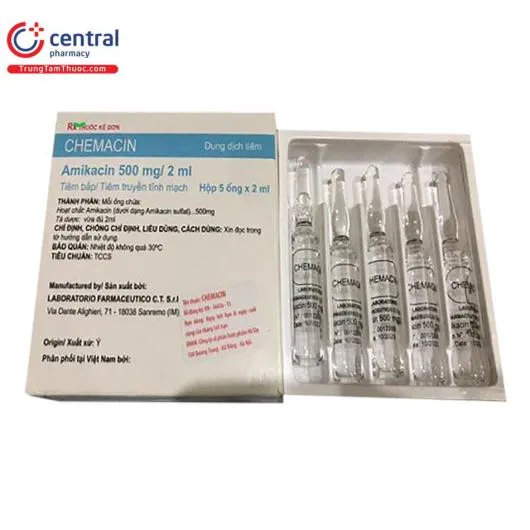
Table of Contents
- Patient Information Leaflet
- Chemacin 500 mg/2 ml solution for injection, 1 g/4 ml solution for injection
- 1. What Chemacin is and what it is used for
- 2. What you need to know before using Chemacin
- 3. How to use Chemacin
- 4. Possible side effects
- 5. How to store Chemacin
- 6. Package contents and other information
- The following information is intended for healthcare professionals only:
Patient Information Leaflet
Chemacin 500 mg/2 ml solution for injection, 1 g/4 ml solution for injection
Amikacin (sulfate)
Equivalent medicine
Please read all of this leaflet carefully before you use this medicine because it contains important information for you.
- Keep this leaflet. You may need to read it again.
- If you have any questions, ask your doctor, pharmacist, or nurse.
- This medicine has been prescribed for you only. Do not give it to other people, even if their symptoms are the same as yours, as it may be harmful.
- If you experience any side effects, including those not listed in this leaflet, tell your doctor, pharmacist, or nurse. See section 4.
Contents of this leaflet
- What Chemacin is and what it is used for
- What you need to know before using Chemacin
- How to use Chemacin
- Possible side effects
- How to store Chemacin
- Contents of the pack and other information
1. What Chemacin is and what it is used for
Chemacin contains the active substance amikacin, which belongs to a group of medicines called aminoglycoside antibiotics, used to treat infections caused by bacteria.
This medicine is indicated for short-term treatment of serious infections caused by bacterial strains sensitive to amikacin (Gram-negative organisms, including Pseudomonas species, E. coli, Proteus indole-positive and indole-negative, Providencia species, Klebsiella-Serratia group, and Acinetobacter).
Chemacin has proven effective in treating the following infections:
- infections characterized by the presence of bacteria in the blood (bacteraemia, septicaemia), including in neonates;
- severe respiratory tract, bone, and joint infections;
- infections of the Central Nervous System (including meningitis) and intra-abdominal infections, including infection of the tissue lining the abdominal cavity (peritonitis);
- infections arising following burns;
- infections occurring after surgery (including vascular surgery);
- severe, complicated, and recurrent urinary tract infections caused by Gram-negative organisms;
However, like other aminoglycosides, amikacin is not indicated for initial, uncomplicated urinary tract infections when the causative agent is sensitive to antibiotics that are potentially less toxic;
- staphylococcal infections, both confirmed and suspected, when the patient is allergic to other antibiotics or when a mixed infection involving staphylococci and Gram-negative organisms is present;
- treatment of neonatal sepsis, when sensitivity testing indicates that other aminoglycosides cannot be used. In such cases, concomitant therapy with a penicillin-type antibiotic may also be indicated due to the possibility of superinfection with Gram-positive organisms (streptococci or pneumococci);
- infections caused by Gram-negative organisms resistant to gentamicin and tobramycin (antibiotics of the same class as Chemacin), particularly Proteus rettgeri, Providencia stuartii, Serratia marcescens, and Pseudomonas aeruginosa.
2. What you need to know before using Chemacin
Do not use Chemacin
- if you are allergic to amikacin, to other similar antibiotics (other aminoglycosides), or to any of the other ingredients of this medicine (listed in section 6);
- if you have previously experienced an allergic reaction or toxic reactions after using an antibiotic of the same class as Chemacin (aminoglycoside antibiotics).
Warnings and precautions
Talk to your doctor, pharmacist, or nurse before using Chemacin.
This medicine may cause damage to hearing, kidneys, and the nervous system, therefore patients
must be closely monitored during treatment with Chemacin.
The safety of this medicine has not been established for treatment periods longer than 14
days.
Be especially careful and consult your doctor:
-
If you are taking other medicines, as the use of Chemacin concurrently or consecutively with other medicines (taken orally, by injection, infusion, or local application) that may increase the risk of kidney or nerve problems should be avoided (see section “Other medicines and Chemacin”).
-
If you have reduced kidney function or if kidney damage is suspected, either before starting this medicine or during treatment with Chemacin. In such cases, it is recommended to perform: blood tests to determine the levels of the medicine in the blood; specific urine tests (reduced specific gravity, increased protein excretion, presence of cells or urinary casts);
periodic blood and urine tests (blood urea nitrogen, serum creatinine, or
creatinine clearance);
hearing checks if you are at high risk of developing kidney or hearing problems
(serial audiograms). -
If you experience dizziness, vertigo, hearing problems (tinnitus, noises in the ears, hearing loss), or kidney problems, your doctor will need to assess whether to reduce the dose or discontinue treatment. Elderly patients and those with low fluid levels (dehydration) are at higher risk of developing the toxic effects described above.
-
If you suffer from muscle disorders (myasthenia gravis, parkinsonism), as this medicine may increase the sensation of muscle weakness.
-
If you develop new infections during treatment. As with other antibiotics, the use of this medicine may promote the development of other infections caused by bacteria or fungi to which Chemacin is not effective (superinfections). If this occurs, it is advisable to stop treatment with this medicine and consult your doctor, who will recommend appropriate therapy.
-
If you or your family members have a genetic disorder causing mitochondrial mutation or hearing loss due to antibiotic use, we recommend informing your doctor or pharmacist before taking an aminoglycoside, as certain mitochondrial mutations associated with this product may increase the risk of hearing loss. Your doctor may recommend genetic testing before administering Chemacin.
Hearing problems (ototoxicity) and nervous system problems (neurotoxicity)
The use of this medicine may cause damage to hearing, kidneys, and the nervous system, especially if you:
- have kidney problems (renal failure); in this case, the risk of severe hearing damage and deafness is much higher, and it is necessary to reduce the dose and increase the interval between doses. If kidney problems occur during treatment (increased blood urea nitrogen and creatinine levels or decreased urine output), consult your doctor, who will check your hearing (via audiometric testing) and may decide to discontinue treatment;
- already have hearing damage (auditory or vestibular impairment);
- are otherwise healthy but receive prolonged therapy for 5–7 days with this medicine.
Therefore, during treatment with Chemacin, you must be closely monitored by your
doctor, especially if you are elderly or if you are receiving doses exceeding 15 g of
Chemacin, as hearing damage (ototoxic reactions) may occur.
Deafness (high-frequency hearing loss) may occur early in treatment and can be detected by
hearing tests (audiometric testing). In general, hearing damage caused by this
medicine is permanent, and the risk is higher if, in addition to Chemacin, you take
medicines that promote fluid elimination (diuretics) (see section “Other medicines and Chemacin”).
Nervous system damage (neurotoxicity) may manifest as:
- hearing damage (ototoxicity affecting both the vestibular and bilateral acoustic branches). In some cases, hearing damage (damage to the cochlea or vestibule) may occur without symptoms.
- partial or complete permanent deafness even after treatment is stopped;
- severe dizziness that may interfere with normal daily activities (disabling vertigo);
- dizziness (indicative of vestibular damage);
- reduced sensitivity and reflex response (numbness);
- skin tingling sensation;
- involuntary and repeated muscle contractions (spasms);
- seizures.
If you have kidney problems and have been prescribed treatment with this medicine for 5 days or more, a hearing test (audiogram) is recommended before starting therapy and should be repeated during treatment.
Stop treatment with Chemacin if you experience noises and/or ringing in the ear
(tinnitus), notice a decrease in hearing, or if hearing tests show reduced perception of high-pitched sounds.
During treatment with this medicine, significant changes in kidney function may occur; therefore, periodic checks of creatinine levels—a substance indicating proper kidney function—are necessary. If creatinine levels are abnormal, the dosing frequency must be adjusted.
Nerve and muscle problems (neuromuscular toxicity)
The use of this medicine may cause nerve and muscle problems (neuromuscular blockade) and respiratory paralysis (respiratory blockade). These effects are more likely if, together with Chemacin, you are also using other medicines such as anesthetics or neuromuscular blockers, used to reduce pain and muscle contractions during surgery (see section “Other medicines and Chemacin”).
In case of respiratory blockade, calcium salts may be administered, and respiratory support (mechanical ventilation) may be required.
Kidney problems
The use of Chemacin may cause kidney toxicity (nephrotoxicity), especially if:
- you already have kidney problems;
- you are undergoing prolonged treatment or receiving high doses of this medicine;
- you are elderly;
- you are dehydrated;
- you are being treated with other medicines that may damage organ function.
During treatment with this medicine, it is recommended to drink plenty of fluids and to perform kidney function tests both before starting therapy and daily thereafter. If test results show impaired kidney function (presence of urinary casts, red and white blood cells, albuminuria, reduced creatinine clearance, reduced urine specific gravity, increased blood urea nitrogen and creatinine, or decreased urine output), the dose of the medicine must be reduced. Your doctor will instruct you to stop treatment with Chemacin if blood nitrogen levels increase or if the need to urinate progressively decreases.
If you are elderly, specific tests (creatinine clearance) are necessary to monitor kidney function, as standard checks may not be sufficient.
Children
In newborns and premature infants, due to immature kidney function, this medicine will be administered only if strictly necessary and under direct medical supervision.
Other medicines and Chemacin
Inform your doctor or pharmacist if you are taking, have recently taken, or might take any other medicine.
Do not use this medicine if you are taking:
- Medicines that promote fluid elimination (diuretics), such as ethacrynic acid, furosemide, sodium mercaptomerin, sodium metalluride, and mannitol, as they increase the ototoxic effects of Chemacin.
Use this medicine with caution and consult your doctor if you are taking any of the following medicines:
- Medicines that may cause nervous system, hearing, or kidney problems (neurotoxic, ototoxic, and nephrotoxic medicines), such as:
- certain antibiotics (bacitracin, cephaloridine, paromomycin, vancomycin, streptomycin, polymyxin B, polymyxin E (colistin), neomycin, gentamicin, viomycin, or other aminoglycosides);
- amphotericin B (used to treat fungal infections);
- cisplatin (used to treat tumors);
- cyclosporine and tacrolimus (used to treat autoimmune diseases or in transplant patients). In these cases, avoid using the above-mentioned medicines concurrently or consecutively with Chemacin.
- Antibiotics belonging to the cephalosporin group administered intravenously or intramuscularly (parenteral route), as they may increase kidney toxicity and may alter blood test results (false increase in blood creatinine levels);
- Antibacterial medicines prescribed together with Chemacin to treat mixed infections or other infections caused by germs not sensitive to Chemacin (superinfections)—in such cases, Chemacin must not be mixed with other medicines in the same syringe or infusion vials; in some cases, concomitant use of another antibiotic is not recommended even if administered separately;
- Bisphosphonates (used to treat bone disorders), as concurrent use may cause decreased calcium levels (hypocalcemia);
- Platinum-based medicines, as they may increase the risk of kidney and hearing toxicity;
- Vitamin B1 (used to treat vitamin B1 deficiency), as it may lose its effect when administered together with Chemacin;
- Indomethacin (used to treat inflammation), if administered to a newborn, as it may increase Chemacin levels in newborns;
- Medicines used to reduce pain and muscle contractions during surgery (anesthetics and neuromuscular blockers), such as tubocurarine, succinylcholine, decamethonium, atracurium,
rocuronium, vecuronium; in these cases, muscle paralysis and/or respiratory blockade may occur.
Pregnancy, breastfeeding, and fertility
If you are pregnant, suspect you may be pregnant, planning a pregnancy, or breastfeeding, consult your doctor or pharmacist before using this medicine.
Pregnancy
Use this medicine during pregnancy or when planning a pregnancy only if strictly necessary and under direct medical supervision, as Chemacin crosses the placenta and may cause irreversible harm to the fetus (deafness).
If you take Chemacin during pregnancy, your doctor will inform you of the potential risks to your baby.
Breastfeeding
If you are breastfeeding, consult your doctor, who will assess whether to discontinue breastfeeding or treatment with this medicine.
Driving and using machines
The use of this medicine may cause side effects that may impair your ability to drive vehicles or operate machinery (see section “Possible side effects”). In such cases, avoid driving and operating machinery.
Chemacin contains sodium and sodium metabisulfite
Chemacin 500mg/2ml
This medicine contains less than 1 mmol (23 mg) of sodium per maximum dose, i.e., it is practically ‘sodium-free’.
This medicine contains sodium metabisulfite, which may rarely cause severe hypersensitivity reactions and bronchospasm.
Chemacin 1g/4ml
This medicine contains 30 mg of sodium (a main component of table salt) per vial. This corresponds to 1.5% of the maximum daily dietary intake recommended for an adult.
This medicine contains sodium metabisulfite, which may rarely cause severe hypersensitivity reactions and bronchospasm.
3. How to use Chemacin
This medicine will be administered to you by a doctor or nurse, either into the muscle or into the vein.
The recommended dose for adults and children with normal kidney function is 15 mg per kg of body
weight per day, divided into two to three doses (every 8–12 hours).
High-risk infections and/or those caused by Pseudomonas : in adults, the dose may be increased to 500
mg every 8 hours, but the daily dose must never exceed 1.5 g, nor should treatment last longer than 10
days.
Urinary tract infections (excluding those caused by Pseudomonas): the recommended dose is 7.5 mg per
kg of body weight per day, divided into two doses (one every 12 hours).
Use in newborns and premature infants
The recommended initial dose is 10 mg per kg of body weight per day, followed by 15 mg per kg of
body weight per day, given in two doses (every 12 hours).
Use in patients with kidney problems
If you have kidney problems, your doctor may decide to reduce the dose and/or increase the interval
between doses.
Duration of treatment
The duration of treatment is approximately 3–7 days for intravenous administration and 7–10 days for
intramuscular administration.
At the recommended doses, in cases of less severe infections, improvement of symptoms is usually seen
within 1–2 days of starting treatment with Chemacin. If your condition does not improve within 4–5 days,
your doctor will consider an alternative therapy.
If you use more Chemacin than you should
Since this medicine will be administered by a doctor or nurse, overdose is unlikely. However, if you think
you have been given too much of this medicine, inform your doctor immediately or go to the nearest
hospital.
In case of overdose, hearing damage, kidney damage, and nervous system disorders (ototoxicity,
nephrotoxicity, and neurotoxicity) as well as disturbances in muscle contraction (neuromuscular blockade)
associated with respiratory paralysis may occur. These effects require immediate and appropriate
treatment in a hospital.
If you forget to use Chemacin
If you think you have missed a dose, consult your doctor. Do not take a double dose to make up for a
forgotten dose.
If you stop using Chemacin
Do not stop treatment without first consulting your doctor.
If you have any questions about the use of this medicine, ask your doctor, pharmacist, or nurse.
4. Possible side effects
Like all medicines, this medicine can cause side effects, although not everybody gets them.
All antibiotics belonging to the same class as Chemacin may cause toxicity to the ear, kidneys, nerves, and muscles (neuromuscular blockade), especially if you already have kidney problems, are undergoing prolonged treatment and/or are using doses higher than those recommended for this medicine, or are taking other medicines that may cause toxic effects on the kidneys and hearing (see section “Warnings and precautions”).
The following side effects may occur:
Uncommon (may affect up to 1 in 100 people)
- development of infections caused by bacteria or fungi not susceptible to Chemacin (see section “Warnings and precautions”);
- nausea, vomiting;
- skin irritation (rash).
Rare (may affect up to 1 in 1,000 people)
- changes in levels of red and white blood cells in the blood (anaemia, eosinophilia);
- decreased levels of magnesium in the blood;
- tremors, sensation of reduced sensitivity in the legs and arms (paraesthesia);
- headache and balance disorders;
- perception of noises and/or ringing in the ear (tinnitus), reduced hearing (see section “Warnings and precautions”);
- decreased blood pressure;
- itching, skin irritation (urticaria);
- joint pain;
- repeated muscle contractions (spasms);
- reduced need to urinate, changes in urine tests (albuminuria, red blood cells in urine, white blood cells in urine);
- changes in blood tests (increased blood creatinine, azotemia);
- fever;
- loss of vision and retinal problems (retinal infarction) if Chemacin is administered by injection into the eye (intravitreal injection).
Not known (frequency cannot be estimated from the available data)
- severe allergic reactions (anaphylactic reaction, anaphylactic shock, anaphylactoid reaction), hypersensitivity;
- muscle blockage (paralysis, see section “Warnings and precautions”);
- deafness and/or loss of balance, sometimes associated with nerve damage (sensorineural deafness, see section “Warnings and precautions”);
- kidney problems, usually reversible upon discontinuation of treatment (acute renal failure, toxic nephropathy);
- changes in urine tests (presence of cells in urine);
- breathing disorders (apnoea, bronchospasm).
Reporting of side effects
If you experience any side effect, including those not listed in this leaflet, talk to your doctor, pharmacist, or nurse. You may also report side effects directly through the national reporting system at www.agenziafarmaco.gov.it/content/segnalazioni-reazioni-avverse. By reporting side effects, you can help provide more information on the safety of this medicine.
5. How to store Chemacin
Keep this medicine out of the sight and reach of children.
Do not use this medicine after the expiry date stated on the packaging after "Exp". The expiry date refers to the last day of that month. The expiry date applies to the product in its original packaging, stored correctly.
Store at a temperature not exceeding 25°C.
Do not dispose of any medicine via wastewater or household waste. Ask your pharmacist how to dispose of medicines you no longer use. This will help protect the environment.
6. Package contents and other information
What Chemacin contains
- The active substance is amikacin sulfate. Each 500 mg/2 ml vial contains 500 mg of amikacin. Each 1 g/4 ml vial contains 1000 mg of amikacin.
- The other components are: sodium citrate, sodium metabisulfite, water for injections.
Description of the appearance of Chemacin and package contents
Chemacin is a solution for injection for intramuscular and intravenous use.
Pack: 1 vial of 2 ml.
Pack: 1 vial of 4 ml.
Marketing Authorization Holder
Laboratorio Farmaceutico C.T. S.r.l.
Via Dante Alighieri, 71
Sanremo (IM)
Italy
Manufacturer
Laboratorio Farmaceutico C.T. S.r.l.
Via Dante Alighieri, 71
Sanremo (IM)
Italy
The following information is intended for healthcare professionals only:
When Chemacin is indicated to be used in combination with other antibiotics, these agents should not be mixed together in the same syringes or infusion bottles.
Since renal function may vary significantly during therapy, serum creatinine levels should be monitored frequently.
In cases of impaired renal function, the dosage should be reduced or the intervals between doses should be prolonged to prevent drug accumulation.
A recommended method for determining the appropriate dosing interval in such cases is to multiply the serum creatinine concentration (in mg/dL) by 9; the resulting number represents the interval, in hours, between doses. For example, if the serum creatinine level is 1.5 mg/dL, the recommended dose should be administered every 13 hours and 30 minutes.
Intravenous infusion administration
The volume of diluent used should allow each dose to be administered over a period of 30 to 60 minutes. In younger children, the infusion should last from 1 to 2 hours.
The recommended diluents are: sodium chloride 0.9% solution, 5% glucose solution, and Ringer's lactate solution.