Cevenfacta
Italy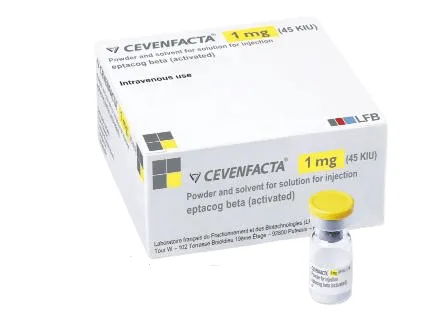
Table of Contents
- Package leaflet: Information for the user
- CEVENFACTA 1 mg (45 KIU) powder and solvent for injectable solution, 2 mg (90 KIU) powder and solvent for injectable solution, 5 mg (225 KUI) powder and solvent for injectable solution
- 1. What CEVENFACTA is and what it is used for
- 2. What you need to know before using CEVENFACTA
- 3. How to use CEVENFACTA
- 4. Possible side effects
- 5. How to store CEVENFACTA
- 6. Contents of the pack and other information
Package leaflet: Information for the user
CEVENFACTA 1 mg (45 KIU) powder and solvent for injectable solution, 2 mg (90 KIU) powder and solvent for injectable solution, 5 mg (225 KUI) powder and solvent for injectable solution
Eptacog beta (activated)
This medicinal product is subject to additional monitoring. This will allow for rapid identification of new safety information. You can help by reporting any side effects you experience while taking this medicine. See the end of section 4 for information on how to report side effects.
Please read this leaflet carefully before using this medicine because it contains important information for you.
- Keep this leaflet. You may need to read it again.
- If you have any questions, consult your doctor, pharmacist, or nurse.
- This medicine has been prescribed for you only. Do not give it to other people, even if their symptoms are the same as yours, as it may be harmful.
- If you experience any side effect, including those not listed in this leaflet, consult your doctor. See section 4.
Contents of this leaflet
- What CEVENFACTA is and what it is used for
- What you need to know before using CEVENFACTA
- How to use CEVENFACTA
- Possible side effects
- How to store CEVENFACTA
- Contents of the pack and other information
- Instructions for the use of CEVENFACTA
1. What CEVENFACTA is and what it is used for
CEVENFACTA contains the active substance eptacog beta (activated), a recombinant human coagulation factor VIIa (rhFVIIa).
CEVENFACTA is used in adults and adolescents (aged 12 years and older) who were born with haemophilia A or B and who have developed inhibitors (antibodies). It is used for:
- the treatment of bleeding episodes;
- the management of bleeding during surgical procedures.
How CEVENFACTA works
This medicine works by forming a blood clot at the site of bleeding when the body's own coagulation factors are ineffective.
2. What you need to know before using CEVENFACTA
DO NOT use CEVENFACTA
- if you are allergic to eptacog beta (activated) or to any of the other ingredients of this medicine (listed in section 6);
- if you are allergic to rabbit or rabbit proteins.
Warnings and precautions
Before treatment with CEVENFACTA, inform your doctor if:
- you suffer from atherosclerosis (a disease causing narrowing of the arteries), coronary heart disease (heart disease due to narrowing of the blood vessels supplying the heart), cerebrovascular disease (disease of the blood vessels supplying the brain), crush injury, sepsis (a severe blood infection), or blood clot formation;
- you have a heart condition, suffer from heart failure, or have an irregular heartbeat;
- you have previously had blood clots in the lungs or undergone heart surgery;
- you have had or currently have any other medical condition or illness.
Patients with known allergy to casein may have an increased risk of developing hypersensitivity reactions. If signs or symptoms of hypersensitivity occur, treatment must be discontinued and immediate medical attention sought. Symptoms may include: urticaria (swelling with itching under the skin), itching, rash, difficulty breathing, swelling of the mouth and throat, chest tightness, wheezing, dizziness or fainting, and low blood pressure.
Although not observed with CEVENFACTA, the following conditions may occur:
- blood clots in the arteries of the heart (which may cause heart attack or angina), brain (which may cause stroke), lungs, or deep veins of the body. Symptoms may include: swelling and pain in arms, legs, or abdomen, chest pain, shortness of breath, loss of sensation or movement, altered consciousness or speech;
- hypersensitivity or anaphylactic reactions, with symptoms such as: urticaria (swelling with itching under the skin), itching, rash, difficulty breathing, swelling of the mouth and throat, chest tightness, wheezing, dizziness or fainting, and low blood pressure;
- inhibitors (antibodies) that may cause bleeding problems.
If you have one or more of these conditions, talk to your doctor before using CEVENFACTA.
It is important to record the batch number of CEVENFACTA that you use. Each time you use a new package of CEVENFACTA, record the date and the batch number (found on the packaging, after the word "Batch") and keep this information in a safe place.
Adolescents
The warnings and precautions listed apply to both adults and adolescents (from 12 years of age).
Other medicines and CEVENFACTA
Inform your doctor if you are taking, have recently taken, or might take any other medicines.
Talk to your doctor before using CEVENFACTA if:
- you are taking or have recently taken another activated factor VII or activated or non-activated prothrombin complex concentrates,
- you are taking or have recently taken factor XIII, as combining these medicines with CEVENFACTA may increase the risk of thromboembolic events (formation of blood clots in veins).
Talk to your doctor before using CEVENFACTA together with these medicines.
Pregnancy, breastfeeding and fertility
If you are pregnant, suspect you may be pregnant, planning a pregnancy, or breastfeeding, consult your doctor before taking this medicine.
Driving and using machines
Dizziness may occur after administration of CEVENFACTA. Avoid driving vehicles or operating machinery when experiencing these symptoms.
CEVENFACTA contains sodium
This medicine contains less than 1 mmol of sodium (23 mg) per injection, i.e., essentially "sodium-free".
3. How to use CEVENFACTA
Treatment with this medicine must be initiated and carried out under the supervision of a
physician experienced in the treatment of haemophilia and/or coagulation disorders.
CEVENFACTA is marketed as a powder that must be dissolved in the solvent (reconstitution) and
injected intravenously (intravenous injection). See the instructions for use at the end of this leaflet
(section 7).
When to self-administer the medicine
To inject a medicine, specific training is required. Do not attempt to perform the injection on yourself
unless you have been properly trained by a healthcare professional or at a haemophilia centre.
Many people who have developed inhibitors learn to perform the injection themselves or with the help of
a family member: after training, you will need to obtain additional equipment in addition to the
CEVENFACTA kit in order to effectively treat bleeding episodes at home. Make sure you have all the
necessary equipment available before starting to prepare the medicine for injection. This
additional injection equipment will be provided by a healthcare professional (e.g. pharmacist or
haemophilia centre).
CEVENFACTA may be administered at the haemophilia centre, at the healthcare provider's office, or at
home. For appropriate management of bleeding, it is important to start treatment as soon as the first
signs of bleeding appear.
Begin treatment for bleeding promptly, ideally within 2 hours.
- In case of mild or moderate bleeding (e.g. in limbs, superficial muscles, soft tissues, or mucous membranes), you should self-administer treatment as soon as possible, ideally at home.
- In case of severe bleeding (e.g. life-threatening or limb-threatening [arm or leg], intracranial [within the skull], or gastrointestinal), you must contact your doctor immediately.
Severe bleeding episodes are generally treated in hospital, and an initial dose of CEVENFACTA may
be administered while you are en route to the hospital.
Do not extend treatment beyond 24 hours without consulting your doctor.
- Each time you use this medicine, inform your healthcare provider as soon as possible.
- If bleeding is not controlled within 24 hours, contact your healthcare provider immediately or go to the emergency department, as hospital care will generally be required.
For instructions on reconstituting the medicine before administration, see the guide in the section Instructions for use at the end of this patient information leaflet (section 7).
Inject the solution intravenously over a period of no more than 2 minutes.
Always use this medicine exactly as your doctor has instructed. If you have any doubts, consult your doctor.
Dosage
Your healthcare provider will determine the dose of CEVENFACTA and the treatment schedule based
on your body weight, your medical conditions, and the type of bleeding episode.
Treatment of bleeding episodes
Treatment with this medicine should begin as soon as a bleeding event occurs.
Mild and moderate bleeding
For mild to moderate bleeding episodes, home treatment should not exceed 24 hours.
Continuation of home treatment beyond 24 hours should only be considered after consulting the
haemophilia centre.
Severe bleeding
If signs or symptoms of severe bleeding occur while you are at home, seek medical attention immediately.
To avoid any delay in treatment, you may self-administer the initial dose while on your way to the
haemophilia centre or healthcare provider's office.
Always use this medicine exactly as described in this leaflet or as directed by your doctor. If you have any doubts, consult your doctor.
Method of administration
For instructions on reconstituting the medicine before administration and on administration procedures, see the guide in the section Instructions for use at the end of this patient information leaflet (section 7).
If you use more CEVENFACTA than you should
If you administer an excessive dose of CEVENFACTA, contact a doctor immediately.
If you forget to use CEVENFACTA
If you forget to use CEVENFACTA, contact your doctor.
If you have any doubts about the use of this medicine, consult your doctor.
4. Possible side effects
Like all medicines, this medicine can cause side effects, although not everyone gets them.
Common side effects
(may affect up to 1 in 10 people)
- Dizziness
- Headache
- Discomfort at the injection site
- Bruising at the injection site (haematoma)
- Increased body temperature
- Post-procedural haematoma
- Injection-related reaction
Reporting of side effects
If you experience any side effect, including those not listed in this leaflet, tell your doctor. You can also report side effects directly through the national reporting system listed in Annex V. By reporting side effects, you can help provide more information on the safety of this medicine.
5. How to store CEVENFACTA
Keep this medicine out of the sight and reach of children.
Do not use this medicine after the expiry date stated on the label and the carton after "Exp.". The expiry date refers to the last day of that month.
Store below 30 °C.
Do not freeze.
Keep the vial in the outer packaging to protect the medicine from light.
Reconstitute CEVENFACTA only using the materials provided in the kit.
After reconstitution, the product must be stored in the vial and administered within 4 hours.
Discard any unused solution 4 hours after reconstitution.
Do not use this medicine if you notice that the solution is cloudy or contains particles after mixing.
Do not dispose of any medicine via wastewater or household waste. Ask your pharmacist how to dispose of medicines no longer in use. This will help protect the environment.
6. Contents of the pack and other information
What CEVENFACTA contains
- The active substance is recombinant coagulation factor VIIa (eptacog beta [activated]).
- The other components are:
Powder: hydrochloride arginine, isoleucine, trisodium citrate dihydrate, glycine, hydrochloride lysine, polysorbate 80, hydrochloric acid (for pH adjustment).
Solvent: water for injections. See section 2 “CEVENFACTA contains sodium”.
The powder for solution for injection contains: 1 mg/vial (equivalent to 45 KIU/vial), 2 mg/vial (equivalent to 90 KIU/vial), 5 mg/vial (equivalent to 225 KIU/vial).
After reconstitution, the concentration of the solution is approximately 1 mg/mL (45 KIU/mL) of eptacog beta (activated). 1 KIU equals 1000 IU (International Units).
Description of the appearance of CEVENFACTA and contents of the pack
The vial of powder contains a white to off-white lyophilized powder; the pre-filled syringe of solvent contains a clear, colourless solution. The reconstituted solution should be from transparent to slightly opalescent.
Each pack of CEVENFACTA contains:
- 1 glass vial containing powder for solution for injection
- 1 sterile vial adapter for reconstitution, equipped with a 5 µm filter
- 1 pre-filled syringe with water for injections
- 1 plunger with stopper
Packs: 1 mg (45 KIU), 2 mg (90 KIU) and 5 mg (225 KIU).
Marketing Authorisation Holder
Laboratoire français du Fractionnement et des Biotechnologies
Tour W
102 Terrasse Boieldieu, 19ème Étage
92800 Puteaux
France
Manufacturer
LFB Biotechnologies
Zone d'activité de Courtabœuf
3 Avenue des Tropiques
91940 Les Ulis
France
+33 1 69 82 70 10
For further information on this medicine, please contact the local representative of the Marketing Authorisation Holder.
Other sources of information
More detailed information on this medicine is available on the website of the European Medicines Agency, http://www.ema.europa.eu/
This leaflet is available in all languages of the European Union/European Economic Area on the European Medicines Agency website.
INSTRUCTIONS FOR USE
READ THE FOLLOWING INSTRUCTIONS CAREFULLY BEFORE USING
CEVENFACTA
CEVENFACTA is supplied as a powder. Before injection, the powder must be dissolved in the solvent provided in the syringe (reconstitution). The solvent is water for injections. Once reconstituted, CEVENFACTA must be injected into a vein (intravenous use only).
This kit contains the equipment necessary to reconstitute this medicine. Additional equipment is required to inject the medicine after reconstitution, which will be provided by a healthcare professional (e.g. pharmacist or haemophilia centre).
Your doctor or nurse will teach you or your caregiver how to reconstitute and inject CEVENFACTA. Do not use this kit without receiving adequate training from a healthcare professional or haemophilia centre.
Prepare and inject the medicine with great care to maintain cleanliness and prevent contamination (aseptic technique).
The CEVENFACTA kit contains:
- 1 glass vial containing powder for solution for injection
- 1 sterile vial adapter for reconstitution, equipped with a 5 µm filter
- 1 pre-filled syringe with water for injections
- 1 plunger with stopper
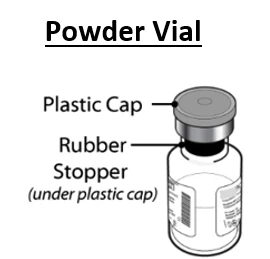
Powder vial

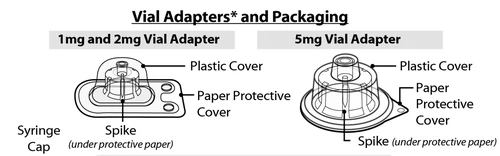
Vial adapters* and packaging
1 mg and 2 mg vial adapter 5 mg vial adapter


Plastic cover Plastic cover
Protective paper sheet Protective paper sheet
Syringe cap Tip Tip (under the paper sheet)
(under the paper sheet)
*NOTE. The CEVENFACTA kit contains only one vial adapter.
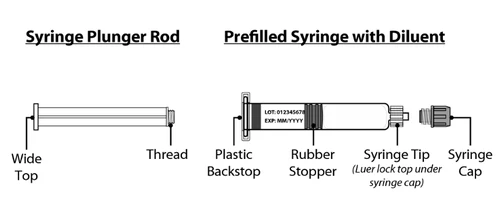
Syringe plunger Pre-filled syringe with solvent
Threaded end Syringe tip Stopper Cap


Upper plastic end Rubber stopper Syringe tip
(Luer attachment under cap)
(enlarged end under cap)
A sterile infusion set (tubing and butterfly needle), a sterile plastic syringe, sterile alcohol swabs, and a sharps container compliant with local regulations will also be required. This equipment is not included in the CEVENFACTA pack and will be provided by a healthcare professional (e.g. pharmacist or haemophilia centre).
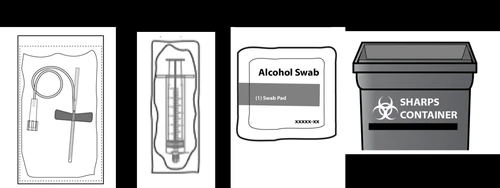
Infusion set Plastic syringe Alcohol swab Sharps
container

1) Preparation of equipment and vial preparation
- Take the number of CEVENFACTA kits required to achieve the prescribed dose, a sterile infusion set (not provided), and an alcohol swab (not provided).
Do not use the kit if the tamper-evident seal is broken or if contamination is suspected. Use a new kit instead.
- Check the expiry date on the side of the kit (Fig. A).
Do not use after the expiry date.
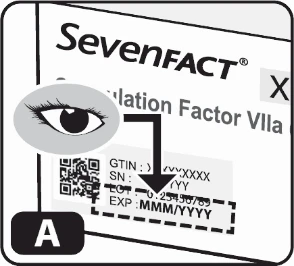

- Check the name, concentration, and colour of the packaging to ensure it contains the correct product (the 1 mg pack is yellow, the 2 mg pack is green, the 5 mg pack is purple).
- Prepare a clean, flat surface before beginning reconstitution of CEVENFACTA.
- Wash hands with soap and water and dry with a clean towel or allow to air dry (Fig. B).
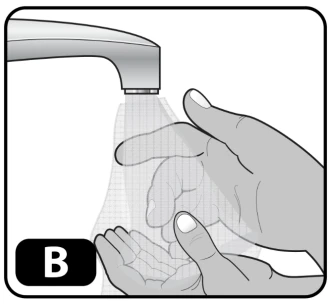
- Remove the contents of one kit and an alcohol swab. Place the items on the clean surface (Fig. C).
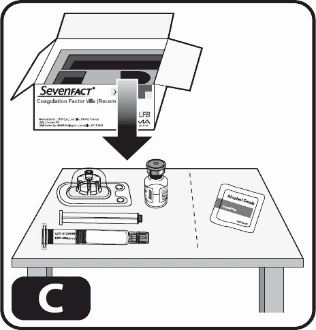
- Inspect all kit contents. Ensure each vial has the corresponding coloured syringe.
Do not use the kit contents if they have been dropped or damaged. Use a new kit instead.
- If necessary, bring the vial and pre-filled syringe to room temperature by holding them in your hands.
Do not heat the vial or pre-filled syringe in any other way.
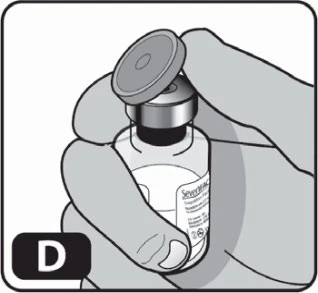
- Remove the plastic cap from the vial (Fig. D).
If the plastic cap is loose or missing, do not use the vial.
- Clean the rubber stopper with an alcohol swab (Fig. E) and allow it to air dry for a few seconds to ensure maximum sterility.
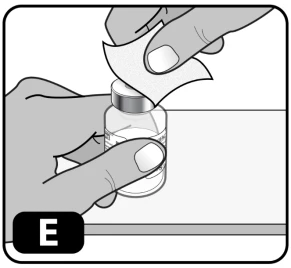
- After cleaning with alcohol, do not touch the rubber stopper with fingers or place it in contact with other objects until the vial adapter is attached, as this could transfer germs.
2) Insertion of the vial adapter
- Remove the protective paper sheet from the adapter cover (Fig. F).
If the protective paper sheet is not fully sealed or is torn, do not use the adapter.
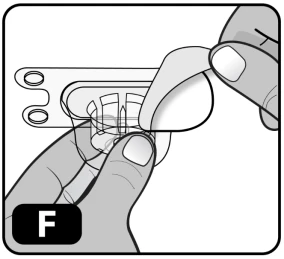
Do not remove the adapter from the plastic cover with fingers. Touching the adapter tip may transfer germs from fingers to the tip.
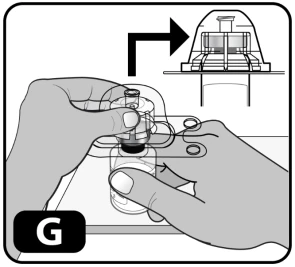
- Place the vial on a clean surface and hold it with one hand; with the other hand, hold the plastic cover (with the adapter inside) directly above the vial, aligning the adapter tip with the centre of the grey rubber stopper.
- Firmly press the plastic cover downward so that the adapter tip pierces the rubber stopper (you may see or hear a click as the adapter locks into place) (Fig. G).
- Gently press the plastic cover and lift it off to remove it from the adapter (Fig. H).
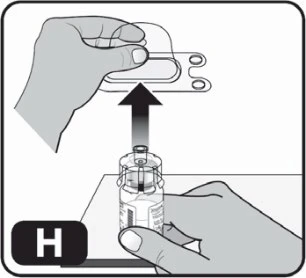
Do not touch the top of the adapter until the plastic cover is removed, to avoid transferring germs from fingers.
NOTE. The 5 mg vial adapter may not sit completely flat on the vial, but it is fully functional. As previously stated, the CEVENFACTA kit contains only one vial adapter, specifically the one matching the vial included in the kit.
3) Attaching the pre-filled syringe and inserting the plunger
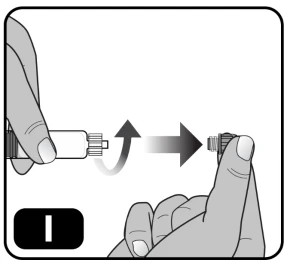
- Remove the cap from the pre-filled syringe by holding the syringe body with one hand and unscrewing the cap with the other hand (turn to the left) (Fig. I).
Do not touch the syringe tip under the cap to avoid transferring germs from fingers.
Do not use the pre-filled syringe if the cap is loose or missing.
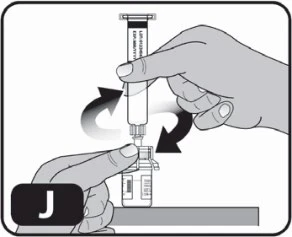
- Hold the adapter by the edges and simultaneously screw the pre-filled syringe onto it (turn to the right) several times until resistance is felt (Fig. J).
Do not overtighten, as the syringe will need to be removed later.
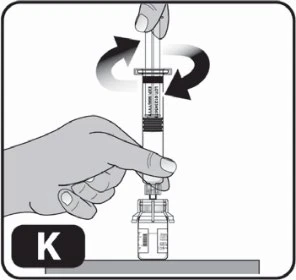
- To insert the plunger, hold the enlarged upper end of the plunger with one hand and the syringe body with the other.
- Insert the plunger into the syringe, then screw it (turn to the right) so that the plunger engages with the grey rubber stopper of the syringe (Fig. K).
4) Mixing the medicine in the vial
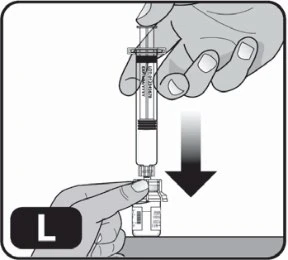
- Slowly depress the plunger all the way to the bottom of the syringe to transfer all the liquid from the syringe to the vial (Fig. L).
Do not push too quickly, as this may cause foaming and excess air in the vial.
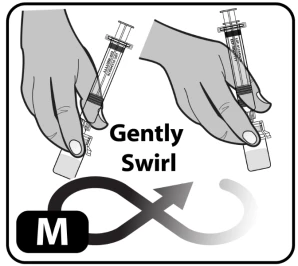
- Gently rotate or invert the vial until all the powder is dissolved (Fig. M).
Do not shake the vial to avoid creating foam and air.
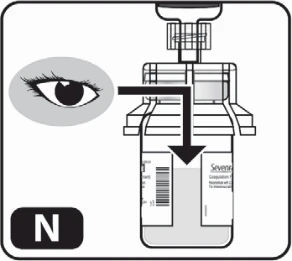
- Visually inspect the mixed solution (Fig. N), which should appear from transparent to slightly opalescent. All powder must be dissolved and no particles should be visible in the liquid.
Do not use the medicine if, after mixing, the liquid contains particles or appears cloudy.
Restart the procedure with a new kit.
5) Removing the empty syringe from the vial adapter
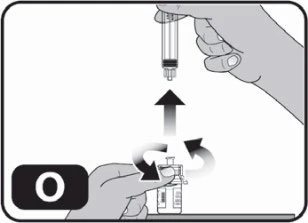
- Without drawing back any medicine, unscrew the syringe from the vial adapter (turn to the left) until completely detached (Fig. O).
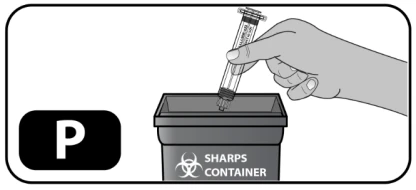
- Dispose of the empty syringe in the designated sharps container (Fig. P).
Do not remove the vial adapter.
Do not touch the Luer end of the adapter, as this may transfer germs from fingers to the adapter.
6) Mixing additional vials and injecting the dose
- If more than one vial is required to achieve the prescribed dose, repeat the previous steps with additional kits until the required dose is obtained.
- Draw up the liquid medicine from the vial(s) using a sterile syringe provided by the pharmacy; the syringe must have sufficient capacity to contain the prescribed dose.
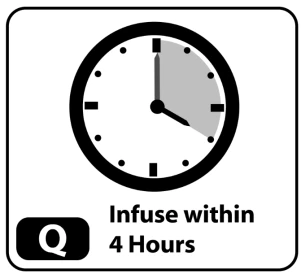
- CEVENFACTA must be administered within 4 hours of reconstitution (Fig. Q).
If more than 4 hours have passed since reconstitution, the medicine must not be used.
- CEVENFACTA may be administered by intravenous injection over a period not exceeding 2 minutes, as instructed by the healthcare professional.
7) Disposal of empty medicine vials
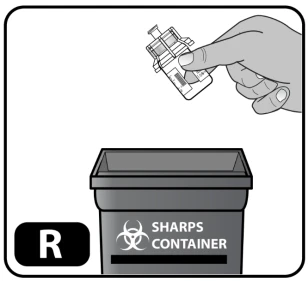
- After reconstitution and injection, safely dispose of the vials with the adapter attached, the injection syringe, and any other waste materials by placing them in the sharps container (Fig. R).
Do not dispose of this material in household waste.
Do not separate the vial and adapter after disposal.
Do not reuse any kit components.
Dispose of the sharps container according to local regulations and requirements.
Storage
CEVENFACTA is supplied in a kit to be stored below 30 °C.
Do not open the kit contents until ready to use.
Do not freeze or store syringes containing reconstituted CEVENFACTA solution.
Avoid exposing the reconstituted CEVENFACTA solution to direct light.
Important information
CEVENFACTA is for intravenous injection only (intravenous administration). Do not inject in any other way, for example under the skin (subcutaneous route) or into the muscle (intramuscular route).
If you have any problems, consult your doctor, nurse, or pharmacist.