Cetraflux
Italy
Table of Contents
PACKAGE LEAFLET: INFORMATION FOR THE USER
Cetraflux 3 mg/ml eye drops, solution
Ciprofloxacin
Please read this leaflet carefully before using this medicine.
- Keep this leaflet. You may need to read it again.
- If you have any questions, consult your doctor or pharmacist.
- This medicine has been prescribed for you. Do not give it to others, even if their symptoms are the same as yours, as it may be harmful.
- If any of the side effects worsens, or if you notice any side effects not listed in this leaflet, consult your doctor or pharmacist.
Contents of this leaflet:
- What Cetraflux is and what it is used for
- What you need to know before using Cetraflux
- How to use Cetraflux
- Possible side effects
- How to store Cetraflux
- Contents of the pack and other information
1. What Cetrafluxe is and what it is used for
Cetrafluxe is available as an eye drop solution. It is an antibiotic belonging to the class of medicines known as quinolones and to the subgroup of fluoroquinolones. It is used to treat bacterial infections of the eye: purulent bacterial conjunctivitis, keratitis (inflammation of the cornea caused by bacteria), corneal ulcers, and corneal abscesses.
2. What you need to know before using Cetraflux
Do not use Cetraflux
If you are allergic to ciprofloxacin or to any other quinolone antibiotic or to any of the other ingredients of this medicine listed in section 6.
Consult your doctor.
Warnings and precautions
- Use this medicine only in the eyes. Do not inject or ingest it.
- In case of severe allergic reactions, skin rash, hives, itching, or difficulty breathing, stop using the medicine immediately and consult your doctor, as these may occur after the first dose.
- If symptoms worsen or return suddenly, consult your doctor. With use of this medicine, you may become more susceptible to other infections.
- If pain, swelling, or inflammation of tendons occur during or shortly after using the eye drops, stop treatment and consult your doctor.
- If you wear contact lenses:
- Wearing contact lenses is not recommended during treatment.
- If you are taking other medicines, see section "Other medicines and Cetraflux".
Other medicines and Cetraflux
Inform your doctor or pharmacist if you are taking, have recently taken, or might take any other medicines, including those without a prescription.
Pregnancy, breastfeeding, and fertility
If you are pregnant, suspect you may be pregnant, planning a pregnancy, or breastfeeding, ask your doctor for advice before using Cetraflux.
It is preferable to avoid using this medicine during pregnancy, except when the expected therapeutic benefit outweighs the potential risk to the fetus.
Ciprofloxacin is excreted in breast milk. If you are breastfeeding, consult your doctor before using Cetraflux.
Driving and using machines
If your vision is in any way affected after using Cetraflux, you must not drive or operate machinery.
Important information if you wear contact lenses
Wearing contact lenses is not recommended during treatment of an eye infection, as this may worsen your condition. Do not apply the eye drops while wearing contact lenses. Wait at least 15 minutes after applying the eye drops before reinserting your contact lenses.
If you have any doubts about the use of Cetraflux, consult your doctor or pharmacist.
3. How to use Cetraflux
Use this medicine exactly as directed by your doctor. If you have any doubts, consult your
doctor or pharmacist.
The recommended dose depends on whether you are being treated for corneal abscess or
another bacterial eye infection.
Adults, newborns, children and adolescents:
Corneal abscess
The eye solution should be administered at the following intervals, including during the night:
Day 1: 2 drops every 15 minutes for the first 6 hours, then 2 drops every 30 minutes in the affected
eye for the remainder of the day.
Day 2: 2 drops every hour in the affected eye.
Day 3 to Day 14: 2 drops every 4 hours in the affected eye.
Your doctor will advise you if treatment should continue beyond 14 days.
Other bacterial infections
For the first two days: one or two drops every two hours in the affected eye while awake.
Thereafter: one or two drops every four hours while awake.
Your doctor will determine the duration of treatment.
It is important that you continue using Cetraflux for the entire treatment period as directed by
your doctor.
Instructions for use
Use Cetraflux exactly as directed by your doctor. If you have any doubts, consult your doctor or
pharmacist.
- Wash your hands before starting.
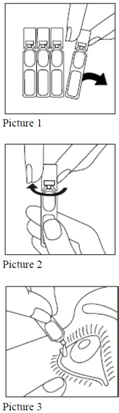
- Remove the single-dose vial from the package. (Figure 1)
- Unscrew the cap from the vial. (Figure 2)
- Hold the vial between your thumb and fingers, pointing downwards.
- Tilt your head backward.
- Gently pull down the lower eyelid with one finger to create a "pocket" between the eyelid and the eye. Instill the drop into this pocket. (Figure 3)
- Bring the tip of the vial close to the eye. A mirror may be helpful.
- Do not touch the eye, eyelid, surrounding areas, or any other surface with the vial tip. The eye drop could become contaminated.
- Gently squeeze the base of the vial to release one drop at a time.
- Do not squeeze too hard; light pressure at the base is sufficient.
- After instilling the drop, press gently on the inner corner of the eye near the nose to prevent the medicine from draining into the throat.
- If you are using the eye drops in both eyes, repeat the steps above for the other eye. Immediately replace the cap securely on the vial after use.
If a drop does not enter the eye correctly, try again.
If you use more Cetraflux than you should
Rinse the eye with warm water. Do not administer another dose until the next scheduled dose.
Contact your doctor or pharmacist.
If you forget to use Cetraflux
Do not use a double dose to make up for a missed dose. If you forget to administer a dose, do so as soon as you remember, and then take the next dose at the usual time. If it is almost time for the next dose, do not take the missed dose. Take only the next dose as scheduled.
4. Possible side effects
Like all medicines, Cetraflux can cause side effects, although not everyone experiences them.
You may experience some or all of the following effects in one or both eyes:
Common (1 patient in 10): corneal deposits, ocular discomfort, ocular hyperemia
Uncommon (1 patient in 100): keratopathy (non-inflammatory disease of the cornea),
corneal infiltrates, corneal spots, photophobia (sensitivity to light), reduced visual acuity
(reduced vision), eyelid edema (swelling of the eyelid), blurred vision, eye pain, dry eye,
ocular swelling, eye itching, sensation of foreign body in the eyes, increased lacrimation,
ocular discharge, crusting at the eyelid margin, eyelid desquamation, conjunctival edema,
eyelid erythema (redness inside the eyelid)
Rare (1 patient in 1,000): ocular toxicity, punctate keratitis (destruction of pinpoint areas in the outer layer of the cornea), keratitis (inflammation of the cornea), conjunctivitis, corneal pathology, corneal epithelial defects, diplopia (double vision), ocular hypoesthesia (reduced sensitivity to stimulation), asthenopia (eye strain), eye irritation, ocular inflammation, conjunctival hyperemia. If you notice white particles in your eyes, continue using Cetraflux but inform your doctor immediately.
You may also experience effects in other parts of the body, such as:
Infections and infestations:
Rare (1 patient in 1,000): hordeolum (stye), rhinitis (inflammation of the mucous membranes inside the nose)
Immune system disorders:
Rare (1 patient in 1,000): allergic reactions such as skin rash, itching, swelling, difficulty breathing
Nervous system disorders:
Common (1 patient in 10): unpleasant taste in mouth
Uncommon (1 patient in 100): headache
Rare (1 patient in 1,000): dizziness
Ear disorders:
Rare (1 patient in 1,000): ear pain
Respiratory disorders:
Rare (1 patient in 1,000): hypersecretion of the paranasal sinuses
Gastrointestinal disorders:
Uncommon (1 patient in 100): nausea
Rare (1 patient in 1,000): diarrhea, abdominal pain
Skin disorders:
Rare (1 patient in 1,000): dermatitis (inflammation of the skin)
General disorders:
Rare (1 patient in 1,000): drug intolerance
Investigations:
Rare (1 patient in 1,000): abnormal laboratory test results
In case of an allergic reaction, stop using Cetraflux and consult your doctor.
Reporting of side effects
If you experience any side effect, including those not listed in this leaflet, talk to your doctor or pharmacist. You can also report side effects directly via the national reporting system at www.agenziafarmaco.gov.it/it/responsabili. By reporting side effects, you can help provide more information on the safety of this medicine.
5. How to store Cetraflux
Keep out of the reach and sight of children.
Do not store at temperatures above 30°C. Store in the original packaging to
protect the medicine from light. Do not use the eye drops after the expiry date (shown as
“EXP”) printed on the vial, outer packaging, and carton, following “Exp.”. The expiry date refers to the last day of that month.
Validity period after first opening of the packaging: 90 days
Validity period after opening the single-dose container: the contents of the vial must
be used immediately after opening the single-dose vial. Any unused portion must be discarded.
Do not dispose of any medicine via wastewater or household waste. Ask your pharmacist
how to dispose of medicines no longer in use. This will help protect the environment.
Do not give this medicine to other people, even if their symptoms are the same as yours, as it could be dangerous.
6. Package contents and other information
What Cetraflux contains
The active substance is ciprofloxacin 3 mg/ml (as hydrochloride).
The other ingredients are mannitol, disodium edetate, glacial acetic acid, sodium acetate
trihydrate, sodium hydroxide, purified water.
Description of the appearance of Cetraflux and contents of the pack
Cetraflux is a clear, colourless or slightly yellow aqueous solution supplied in a pack containing 10, 15 or 20 single-dose vials. Each single vial provides 0.25 ml as drop-by-drop administration. The vials are contained in a protective aluminium foil pouch.
Medical advice/education
Antibiotics are used to treat bacterial infections. They are ineffective against viral infections.
If your doctor has prescribed antibiotics for you, you must take them exactly as directed for the illness you currently have.
Despite antibiotic treatment, some bacteria may survive or multiply. This phenomenon is known as resistance: some antibiotic treatments become ineffective.
Improper use of antibiotics increases resistance. It could even help bacteria become resistant and thus delay your recovery or reduce the effectiveness of antibiotics if you do not correctly follow
- the dosage;
- the timing;
- the duration of treatment.
Therefore, to preserve the effectiveness of this medicine:
1 – Use antibiotics only when prescribed by a doctor.
2 – Follow the instructions carefully.
3 – Do not reuse an antibiotic without a medical prescription, even if you intend to treat a similar illness.
4 – Do not give your antibiotic to another person; it may not be suitable for their condition.
5 – After completing the treatment, return any unused medicines to your pharmacist to ensure they are properly disposed of.
Marketing Authorisation Holder and Manufacturer
LABORATORIOS SALVAT, S.A.
Gall 30 - 36
08950 Esplugues de Llobregat
Barcelona (Spain)
For further information on this medicinal product, please contact the local representative of the Marketing Authorisation Holder.
Spain
LABORATORIOS SALVAT, S.A.
Gall 30 - 36
08950 Esplugues de Llobregat (Barcelona)
Portugal
LABORATORIOS SALVAT, S.A.
Gall 30 - 36
08950 Esplugues de Llobregat (Barcelona)
France
LABORATORIOS SALVAT, S.A.
Gall 30 - 36
08950 Esplugues de Llobregat (Barcelona)
Italy
LABORATORIOS SALVAT, S.A.
Gall 30 - 36
08950 Esplugues de Llobregat (Barcelona)