Catapresan TTS
Italy
Table of Contents
Package Leaflet
CATAPRESAN TTS-1 2.5 mg Transdermal Patches
CATAPRESAN TTS-2 5 mg Transdermal Patches
CATAPRESAN TTS-3 7.5 mg Transdermal Patches
clonidine
PHARMACOTHERAPEUTIC CATEGORY
Imidazoline receptor agonists
THERAPEUTIC INDICATIONS
Catapresan TTS is indicated in the treatment of all forms of arterial hypertension. Catapresan TTS may be
used alone or in combination with other antihypertensive drugs.
CONTRAINDICATIONS
Catapresan TTS must not be used in patients with known hypersensitivity to the active substance or to any
other component of the transdermal patch, and in patients with severe bradyarrhythmia due to sick sinus
syndrome or second- or third-degree atrioventricular block.
PRECAUTIONS FOR USE
Catapresan TTS should be used with caution in patients with mild to moderate bradyarrhythmia, such as
sinus bradycardia, Raynaud's disease and other disorders of peripheral or cerebral perfusion, depression,
polyneuropathy and constipation.
In cases of hypertension caused by phaeochromocytoma, the use of Catapresan TTS has shown no
therapeutic effect.
Clonidine, the active substance in Catapresan TTS, and its metabolites are extensively excreted via the
renal route. In case of renal impairment, dose adjustment must be particularly careful (see section “Dosage,
method and duration of administration”).
In patients with heart failure or severe coronary artery disease, treatment with Catapresan TTS must be
monitored with particular care, as with other antihypertensive drugs.
Patients must be warned not to discontinue therapy without first consulting their physician.
Sudden discontinuation of prolonged treatment with Catapresan TTS at high doses has led to restlessness,
palpitations, rapid increase in blood pressure, nervousness, tremors, headache or nausea. If therapy with
Catapresan TTS is to be discontinued, the physician must gradually reduce the dose over a period of 2–4 days.
A marked increase in blood pressure following discontinuation of Catapresan TTS therapy can be counteracted
by administering oral clonidine hydrochloride or intravenous phentolamine (see section “Interactions”).
If combined therapy with a beta-blocker requires discontinuation of antihypertensive treatment, the
beta-blocker must always be withdrawn gradually first, followed by clonidine.
In patients who have experienced a local skin reaction to Catapresan TTS, switching to oral clonidine therapy
may be associated with the development of generalized skin rash.
Promptly consult the physician regarding the possibility of removing the patch if moderate to severe
erythema and/or blistering at the application site or generalized skin rash occurs.
If isolated, mild local skin irritation occurs within 7 days of patch application, the patch may be removed and
replaced with a new one applied to a different skin area.
Catapresan TTS must not be discontinued during the surgical period. Blood pressure must be carefully
monitored during surgery, and additional measures for blood pressure control should be available if needed.
If initiating Catapresan TTS therapy during the perioperative period is being considered, it should be noted
that therapeutic plasma levels are not achieved until 2–3 days after initial application of Catapresan TTS
(see section “Dosage, method and duration of administration”).
Catapresan TTS must be removed prior to defibrillation or cardioversion procedures due to the potential
alteration of electrical conductivity, which may increase the risk of arcing, a phenomenon associated with
defibrillator use.
Since Catapresan TTS contains aluminium, it is recommended to remove the patch before undergoing
magnetic resonance imaging (MRI). Skin burns at the patch application site have been reported in numerous
patients wearing transdermal patches containing aluminium during MRI.
Treatment with Catapresan TTS may reduce tear production; this should be considered when wearing
contact lenses.
Paediatric use
The use and safety of clonidine in children and adolescents have not been established in controlled,
randomised studies; therefore, use in this patient population cannot be recommended.
In particular, when clonidine is used off-label in combination with methylphenidate in children with ADHD
(attention deficit hyperactivity disorder), serious adverse reactions, including death, have been observed.
Therefore, the use of clonidine in this combination is not recommended.
INTERACTIONS
The antihypertensive effect of Catapresan TTS may be enhanced by concomitant administration of other
drugs used to lower blood pressure. This may be therapeutically exploited by administering other types of
antihypertensives such as diuretics, vasodilators, beta-blockers, calcium antagonists and ACE inhibitors,
but not alpha1-blockers.
Substances that increase blood pressure or cause sodium and water retention, such as non-steroidal anti-
inflammatory drugs (NSAIDs), may reduce the efficacy of clonidine.
Substances with α-blocking activity, such as phentolamine or tolazoline, may inhibit the effects of clonidine
mediated by α-receptors in a dose-dependent manner.
Concomitant administration of substances with negative chronotropic or dromotropic activity, such as
beta-blockers or digitalis glycosides, may cause or exacerbate rhythm disturbances in bradycardia.
Concomitant administration of a beta-blocker may cause or exacerbate peripheral vascular dysfunction.
The antihypertensive effect of clonidine may be reduced or abolished, and orthostatic regulation disorders
may be induced or worsened, by concomitant administration of tricyclic antidepressants or neuroleptics
with alpha-blocking activity.
The effects of central nervous system (CNS) depressants, or the effects of alcohol, may be potentiated by
clonidine.
Inform your doctor or pharmacist if you are taking or have recently taken any other medicines, including
those not requiring a prescription.
SPECIAL WARNINGS
Fertility, pregnancy and breastfeeding
Consult your doctor or pharmacist before taking any medicine.
Adequate and well-controlled studies in pregnant women have not been conducted.
During pregnancy, Catapresan TTS, like any other medicine, should be administered only if clearly needed.
In such cases, careful monitoring of both mother and child is recommended.
Clonidine crosses the placental barrier and may slow the fetal heart rate.
There is inadequate experience regarding the long-term effects of prenatal exposure to the drug. During
pregnancy, oral formulations of clonidine are preferred.
Intravenous administration of clonidine must be avoided.
Preclinical studies with clonidine in rats and rabbits have not shown teratogenic effects. In rats, increased
resorption rates were observed after oral administration of clonidine.
A transient increase in postpartum blood pressure in the newborn cannot be excluded.
Due to lack of supporting data, use of Catapresan TTS during breastfeeding is not recommended.
No clinical studies on the effects of clonidine on human fertility have been conducted.
Animal studies with clonidine have not shown direct or indirect harmful effects on fertility parameters.
Effects on ability to drive and use machines
No studies have been conducted to evaluate effects on the ability to drive vehicles or operate machinery.
However, during treatment with Catapresan TTS, the following possible adverse effects may occur: dizziness,
sedation and accommodation disorders. Therefore, particular caution is advised when driving or operating
machinery. If any of the above-mentioned adverse effects are experienced, potentially hazardous activities
such as driving or operating machinery should be avoided.
DOSAGE, METHOD AND DURATION OF ADMINISTRATION
Treatment with Catapresan TTS, to be adjusted according to individual therapeutic needs, should be
initiated with Catapresan TTS-1 2.5 mg transdermal patch.
If after 1 or 2 weeks the reduction in blood pressure values is insufficient, the dosage may be increased by
adding another 2.5 mg patch or switching to Catapresan TTS-2 5 mg transdermal patch.
Dosage increases above two Catapresan TTS patches of 7.5 mg are usually not associated with increased
efficacy.
When Catapresan TTS is first applied as a replacement for oral clonidine hydrochloride therapy or other
antihypertensive drugs, the physician should be aware that the antihypertensive effect of the Catapresan
TTS transdermal patch may not be achieved until 2–3 days after initial application. Therefore, it is advisable
to gradually reduce the dose of the current medication; some or all previous antihypertensive therapies
may be maintained, especially in patients with more severe forms of hypertension.
Renal impairment
Dosage must be adjusted based on both individual response, which may vary significantly in patients with
renal impairment, and the degree of renal function impairment.
Continuous monitoring is necessary. Since only a minimal amount of clonidine is removed during routine
haemodialysis, no additional doses of clonidine need to be administered after dialysis.
Paediatric population
Evidence supporting the use of clonidine in children and adolescents under 18 years of age is insufficient.
Therefore, the use of clonidine is not recommended in paediatric patients under 18 years of age.
Instructions for use
The Catapresan TTS transdermal system must be applied to an intact, hairless area of skin on the upper
chest or upper outer arm, once every 7 days. Each new application of Catapresan TTS must be made on a
different skin area than the previous one. Before application, remove both parts of the transparent film
protecting the adhesive layer of the system. If the TTS transdermal system tends to detach during the 7-day
application period, the adhesive cover patch must be applied directly over the system to ensure proper
adhesion. Rare cases have been reported where the patch needed to be changed before 7 days to maintain
blood pressure control.
- Apply Catapresan TTS transdermal patch every 7 days on the same day of the week.
- Choose a hairless application site (e.g. outer arm or upper chest) (Fig. 1).
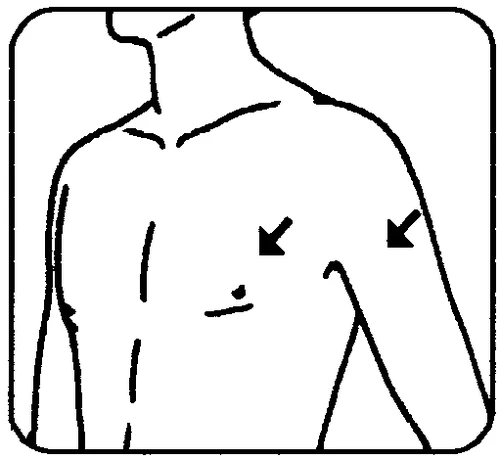
Fig. 1
The selected area must not have cuts, abrasions, irritation, calluses or scars and must be completely dry
before applying the Catapresan TTS transdermal patch.
It is advisable not to apply the Catapresan TTS transdermal patch in skin folds or at sites where it may be
constricted by clothing, to avoid premature detachment of the patch.
3) Wash and thoroughly dry hands before removing the transdermal system from its pouch.
4) Wash the selected area only with water and soap and dry it carefully.
5) Open the pouch labelled Catapresan TTS (clonidine) (Fig. 2) and remove the transdermal patch.
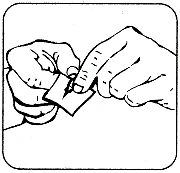
Fig. 2
6) Remove both parts of the transparent protective film by peeling them from the centre of the patch,
avoiding touching the medicated part with hands (Fig. 3).
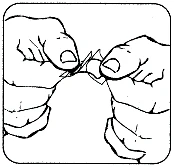
Fig. 3
7) Press gently along the edges to adhere the Catapresan TTS transdermal patch to the selected skin
area (Fig. 4).
Wash hands immediately after application.
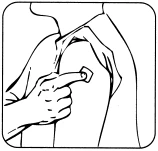
Fig. 4
8) After 7 days, remove the old patch and apply a new one to a different skin area, repeating the
procedure from step 2 onwards.
Instructions for use of the cover patch
Caution: The adhesive cover patch does not contain any drug and must not be used alone.
The adhesive cover patch must be applied directly over the Catapresan TTS transdermal patch only if the
patch detaches from the skin.
- Wash hands with water and soap and dry them thoroughly.
- Wipe dry around the area where the Catapresan TTS transdermal patch is applied and gently press
the edges of the Catapresan TTS transdermal patch to ensure contact with the skin. - Open the pouch labelled "Adhesive Cover Patch" and remove the protective plastic.
- Apply the adhesive cover patch with gentle pressure, especially on the edges, directly over the
Catapresan TTS transdermal patch, ensuring that the cover patch is positioned so that the Catapresan
TTS transdermal patch is centred within it (Fig. 5).
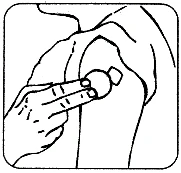
Fig. 5
If you have any doubts about the use of this medicine, consult your doctor or pharmacist.
OVERDOSE
Symptoms
Clonidine has a wide therapeutic range. Clonidine intoxication manifests as general sympathetic nervous
system depression, which may cause miosis, lethargy, bradycardia, hypotension, hypothermia, somnolence
up to coma, respiratory depression including apnoea. Due to stimulation of peripheral α1 receptors,
paradoxical hypertension may also occur.
Rarely, cases of poisoning with Catapresan TTS due to accidental or intentional ingestion of patches have
been reported. Most of these cases involve children.
Treatment
Close monitoring and symptomatic measures.
There is no specific antidote for clonidine overdose. If symptoms of overdose occur following transdermal
patch application, all transdermal patches must be removed. After patch removal, plasma levels of clonidine
persist for approximately 8 hours and then decline slowly over several days.
In case of accidental ingestion of an excessive dose of the medicine, contact your doctor immediately or go
to the nearest hospital.
UNDESIRABLE EFFECTS
Like all medicines, this medicine can cause adverse effects, although not everybody gets them.
Most of the adverse effects observed during treatment with Catapresan TTS were mild and tended to
diminish with continued therapy.
Adverse reactions are listed below by system organ class and frequency, according to the following
categories:
Very common ≥ 1/10
Common ≥ 1/100 < 1/10
Uncommon ≥ 1/1,000 < 1/100
Rare ≥ 1/10,000 < 1/1,000
Very rare < 1/10,000
Frequency not known cannot be estimated from the available data.
Psychiatric disorders:
Common: Depression, sleep disorders.
Uncommon: Confusional state, delirious perception, hallucinations, decreased libido, nightmares.
Nervous system disorders:
Very common: Dizziness, sedation.
Common: Headache, somnolence.
Uncommon: Paraesthesia.
Eye disorders:
Uncommon: Accommodation disorders.
Rare: Reduced lacrimation.
Cardiac disorders:
Uncommon: Bradyarrhythmia, sinus bradycardia.
Rare: Atrioventricular block.
Vascular disorders:
Very common: Orthostatic hypotension.
Uncommon: Raynaud's syndrome.
Respiratory, thoracic and mediastinal disorders:
Rare: Dryness of nasal mucosa.
Gastrointestinal disorders:
Very common: Dry mouth.
Common: Constipation, nausea, pain in salivary glands, vomiting.
Rare: Pseudo-obstruction of the colon.
Skin and subcutaneous tissue disorders:
Very common: Erythema at application site.
Common: Irritation at application site, burning sensation at application site, skin discoloration at
application site.
Uncommon: Papules at application site, dermatitis at application site, urticaria, pruritus, rash.
Rare: Alopecia.
Reproductive system and breast disorders:
Common: Erectile dysfunction.
Rare: Gynaecomastia.
General disorders and administration site conditions:
Common: Pain at application site, fatigue.
Uncommon: Malaise.
Investigations:
Rare: Increased blood glucose.
Following the instructions in this leaflet reduces the risk of adverse effects.
If any of the adverse effects worsens or if you notice any adverse effect not listed in this leaflet, inform your
doctor or pharmacist.
Reporting of adverse effects
If you experience any adverse effect, including those not listed in this leaflet, contact your doctor or
pharmacist. You may also report adverse effects directly via the national reporting system at the website
https://www.aifa.gov.it/content/segnalazioni-reazioni-avverse
Reporting adverse effects helps provide more information on the safety of this medicine.
EXPIRY DATE AND STORAGE
Expiry date: see date on the packaging.
The expiry date refers to the product in its original, unopened packaging, correctly stored.
Caution: do not use the medicine after the expiry date stated on the packaging.
KEEP THIS MEDICINE OUT OF THE SIGHT AND REACH OF CHILDREN
Medicines must not be disposed of via wastewater or household waste. Ask your pharmacist how to
dispose of medicines no longer required. This will help protect the environment.
COMPOSITION
Catapresan TTS is a transdermal patch containing clonidine, providing continuous and constant systemic
delivery of the active substance over 7 days.
Clonidine is an imidazolidine derivative, chemically known as 2,6-dichloro-N-2-
imidazolidinylidenebenzenamine.
The packaging consists of rectangular patches with rounded corners; the adhesive side is opaque white,
covered with two transparent, overlapping protective liners; the non-adhesive side is light brown with a
diagonal print indicating the active substance name followed by TTS-1, TTS-2 or TTS-3 and the company
logo.
CATAPRESAN TTS-1 2.5 mg transdermal patches (3.5 cm 2 surface area)
Designed to release 0.1 mg of clonidine per day in vivo for 7 days, contains:
- active substance: clonidine 2.5 mg
- other excipients: light mineral oil; high molecular weight polyisobutylene; medium molecular weight
polyisobutylene; colloidal silicon dioxide. Support composed of: polyethylene film, aluminium-
polyester/ethylene-vinyl acetate copolymer; polypropylene membrane; diacrylate fluorocarbon/polyester
film.
CATAPRESAN TTS-2 5 mg transdermal patches (7.0 cm 2 surface area)
Designed to release 0.2 mg of clonidine per day in vivo for 7 days, contains:
- active substance: clonidine 5 mg
- other excipients: light mineral oil; high molecular weight polyisobutylene; medium molecular weight
polyisobutylene; colloidal silicon dioxide. Support composed of: polyethylene film, aluminium-
polyester/ethylene-vinyl acetate copolymer; polypropylene membrane; diacrylate fluorocarbon/polyester
film.
CATAPRESAN TTS-3 7.5 mg transdermal patches (10.5 cm 2 surface area)
Designed to release 0.3 mg of clonidine per day in vivo for 7 days, contains:
- active substance: clonidine 7.5 mg
- other excipients: light mineral oil; high molecular weight polyisobutylene; medium molecular weight
polyisobutylene; colloidal silicon dioxide. Support composed of: polyethylene film, aluminium-
polyester/ethylene-vinyl acetate copolymer; polypropylene membrane; diacrylate fluorocarbon/polyester
film.
PHARMACEUTICAL FORM AND CONTENT
Rectangular patches with rounded corners; the adhesive side is opaque white, covered with two
transparent, overlapping protective liners; the non-adhesive side is light brown with a diagonal print
indicating the active substance name followed by TTS-1, TTS-2 or TTS-3 and the company logo.
2 transdermal patches + 2 adhesive cover patches.
Pouch containing the therapeutic transdermal patch made of paper/polyethylene/aluminium foil/low-
density polyethylene – linear low-density polyethylene.
Pouch containing the adhesive cover patch made of paper/low-density polyethylene/aluminium foil/low-
density polyethylene.
It is possible that not all pack sizes are marketed.
MARKETING AUTHORISATION HOLDER
Lavipharm S.A.
Agias Marinas street,
19002 Peania, Attica, Greece
MANUFACTURER
Lavipharm S.A.
Agias Marinas Street
GR-190 02 Peania, Attica, Greece