Carvasin
Italy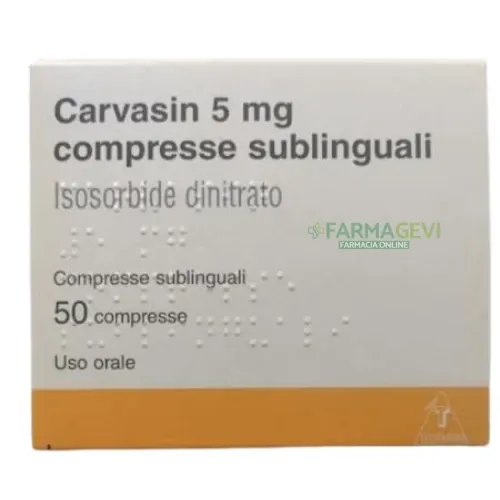
Table of Contents
Patient Information Leaflet
Carvasin 5 mg sublingual tablets, 10 mg tablets, 40 mg tablets
isosorbide dinitrate
Please read this leaflet carefully before taking this medicine because it contains important information for you.
- Keep this leaflet. You may need to read it again.
- If you have any questions, ask your doctor or pharmacist.
- This medicine has been prescribed for you only. Do not give it to others, even if their symptoms are the same as yours, as it could be harmful.
- If you experience any adverse reactions, including those not listed in this leaflet, contact your doctor or pharmacist. See section 4.
Contents of this leaflet:
- What Carvasin is and what it is used for
- What you need to know before taking Carvasin
- How to take Carvasin
- Possible side effects
- How to store Carvasin
- Contents of the pack and other information
1. What Carvasin is and what it is used for
Carvasin contains the active substance isosorbide dinitrate, a compound that dilates blood vessels and is used to treat heart conditions.
Carvasin is used for:
- the treatment of coronary insufficiency (reduced blood flow in the coronary arteries, the blood vessels supplying the heart);
- the prevention and treatment of angina pectoris, a heart disease characterized by chest pain.
Carvasin sublingual is indicated when a rapid effect is desired, and is therefore used to treat angina attacks. Moreover, since its effect lasts about 2 hours, it can also be used to prevent an angina attack when engaging in physical exertion likely to provoke it, e.g. muscular effort, sexual activity, heavy meals.
Carvasin tablets have a slower onset of action but a longer duration, and are thus used to prevent angina attacks and in the treatment of coronary insufficiency.
2. What you should know before taking Carvasin
DO NOT take Carvasin
- if you are allergic to isosorbide dinitrate, to other nitrates, or to any of the other ingredients of this medicine (listed in section 6);
- if you are taking medicines that inhibit the phosphodiesterase enzyme, such as sildenafil, vardenafil, tadalafil, used for the treatment of erectile dysfunction (see "Other medicines and Carvasin");
- if you are currently experiencing a heart attack;
- if you have blood circulation problems;
- if you suffer from heart function problems (difficulty pumping blood throughout the body);
- if you suffer from low blood pressure (systolic pressure <90 mmHg);
- if you suffer from heart disorders due to thickening of the heart walls (obstructive hypertrophic cardiomyopathy);
- if you have inflammation of the membrane surrounding the heart (constrictive pericarditis);
- if you have problems related to blood volume in the veins (severe hypovolemia);
- if you suffer from a condition causing fluid or blood accumulation within the membrane surrounding the heart (cardiac tamponade);
- if you suffer from increased blood pressure in the lungs (primary pulmonary hypertension).
Warnings and precautions
Talk to your doctor or pharmacist before taking Carvasin.
Pay special attention and inform your doctor:
- if you have glaucoma (increased pressure inside the eye);
- if you suffer from headaches, as Carvasin may cause severe and persistent headaches at the beginning of treatment. Your doctor will evaluate whether to reduce the dose of Carvasin or prescribe a pain-relieving medicine;
- if you have recently had a heart attack: your doctor will carefully assess your condition and prescribe Carvasin only if necessary;
- if you are taking medicines that increase urine production (diuretics) to lower blood pressure (see section "Other medicines and Carvasin");
- if you experience, even at low doses, a further drop in blood pressure, especially when standing (orthostatic hypotension). Hypotension may be accompanied by a slowed heart rate (bradycardia) or heart problems (worsening of angina pectoris);
- if you are taking medicines to lower blood pressure belonging to the class of calcium antagonists (see section "Other medicines and Carvasin"), as you may experience an additional drop in blood pressure, particularly when standing;
- if you have a heart condition called hypertrophic cardiomyopathy, in which there is thickening of the heart walls. Treatment with Carvasin may worsen angina caused by this condition or may trigger angina attacks as a "rebound" effect after stopping the medicine;
- if your stomach or intestinal motility is excessive or increased (gastrointestinal hypermotility) or if you have problems with absorption through the stomach or intestine. Your doctor will prescribe the most appropriate Carvasin dosage for you;
- if you notice a loss of response (tolerance) to Carvasin treatment. This may also occur with other medicines of the nitrite and nitrate class;
- if cyanosis (bluish discoloration of the skin) occurs, your doctor may wish to measure the level of a substance in the blood called methemoglobin.
During treatment, a temporary condition may occur characterized by a reduction in the amount of oxygen in the blood (hypoxemia), possibly affecting the heart (myocardial hypoxia), especially if you suffer from a disease affecting the coronary arteries (coronary artery disease).
Carvasin, in sensitive individuals, may further reduce blood supply to the heart (ischemia) and lead to increased damage to the heart muscle and reduced ability of the heart to pump blood through the body (congestive heart failure).
Children
The safety and efficacy of Carvasin in children has not been studied.
Elderly patients
To date, sufficient data on the use of Carvasin in patients aged 65 years or older are not available.
Your doctor will carefully evaluate your condition, determine the appropriate dose for you, and will start with the lowest dose.
Other medicines and Carvasin
Tell your doctor or pharmacist if you are taking, have recently taken, or might take any other medicines.
In particular, inform your doctor if you are taking:
- medicines for erectile dysfunction (sildenafil, vardenafil, tadalafil), as they enhance the effects of Carvasin (see DO NOT take Carvasin);
- medicines to lower blood pressure and to treat heart or blood vessel problems (calcium antagonists, beta-blockers, vasodilators, diuretics, ACE inhibitors) or medicines used to treat mental illnesses (neuroleptics) or depression (tricyclic antidepressants), since taking Carvasin together with these medicines may enhance the hypotensive effect (lowering of blood pressure).
This medicine may also reduce the action of norepinephrine, acetylcholine, and histamine.
Carvasin and alcohol
Do not consume alcohol during treatment with Carvasin, as alcohol may increase the effect of Carvasin.
Pregnancy and breastfeeding
If you are pregnant, suspect you may be pregnant, plan to become pregnant, or are breastfeeding, consult your doctor or pharmacist before taking this medicine.
Pregnancy
Talk to your doctor, who will assess whether to prescribe Carvasin during pregnancy.
Breastfeeding
The amount of medicine that passes into breast milk is currently unknown. Consult your doctor, who will assess whether to discontinue breastfeeding or treatment with Carvasin.
Driving and using machines
Adverse effects such as dizziness, vertigo, and low blood pressure have been reported, which may impair the ability to drive vehicles and operate machinery.
Carvasin 5 mg sublingual tablets contain lactose
Carvasin 5 mg sublingual tablets contain lactose: if your doctor has diagnosed you with an intolerance to certain sugars, contact them before taking this medicine.
Carvasin 10 mg tablets contain lactose and sucrose
Carvasin 10 mg tablets contain lactose and sucrose: if your doctor has diagnosed you with an intolerance to certain sugars, contact them before taking this medicine.
Carvasin 40 mg tablets contain lactose
Carvasin 40 mg tablets contain lactose: if your doctor has diagnosed you with an intolerance to certain sugars, contact them before taking this medicine.
3. How to take Carvasin
Take this medicine exactly as instructed by your doctor or pharmacist.
If you have any doubts, consult your doctor or pharmacist.
Carvasin 5 mg sublingual tablets
The recommended starting dose is 5 mg.
Let one tablet dissolve under the tongue (the tablets dissolve within 20 seconds). Carvasin
may be taken every 2–3 hours.
Carvasin 10 mg tablets
The recommended dose is one tablet 4 times daily, before the three main meals (breakfast, lunch, and
dinner) and before going to bed.
Carvasin 40 mg tablets
The recommended dose is one tablet every 12 hours.
Your doctor will decide whether to prescribe you sublingual Carvasin or Carvasin tablets based on your condition.
Your doctor will prescribe the lowest effective dose and then evaluate whether adjustment is needed.
If you take more Carvasin than you should
In case of accidental overdose, contact your doctor immediately or go to the nearest hospital.
Symptoms due to an overdose of this medicine may include:
- sudden drop in blood pressure
- changes in heart rhythm
- alterations in blood haemoglobin with bluish discoloration of the skin (cyanosis), leading to rapid and deep breathing, anxiety, loss of consciousness, and cardiac arrest;
- weak pulse;
- headache, dizziness, dizziness upon rising from a lying position;
- weakness, drowsiness;
- pallor;
- visual disturbances;
- hot flushes and sweating (skin becomes cold and bluish);
- nausea, vomiting, and diarrhoea;
- increased intracranial pressure with confusion and mild fever;
If you forget to take Carvasin
Do not take a double dose to make up for the missed dose.
If you stop taking Carvasin
If you have any doubts about using this medicine, consult your doctor or pharmacist.
Do not stop using Carvasin abruptly, as angina attacks have been reported in patients with angina pectoris after discontinuation of nitrate therapy. Your doctor will advise you when and how to gradually discontinue the medicine.
4. Possible side effects
Like all medicines, this medicine can cause side effects, although not everybody gets them.
The following side effects may occur during treatment:
Very rare (may affect up to 1 in 10,000 people);
Rare (may affect up to 1 in 1,000 people);
Uncommon (may affect up to 1 in 100 people);
Common (may affect up to 1 in 10 people);
Not known (frequency cannot be estimated from the available data)
Very rare: stomach burning (pyrosis), muscle pain (myalgia).
Uncommon: worsening of chest pain (angina pectoris), circulatory collapse (sometimes accompanied by slowed heartbeat and loss of consciousness), vomiting, diarrhoea, allergic skin reactions (e.g. rash) and redness.
Common: dizziness, drowsiness, increased heart rate (tachycardia), drop in blood pressure when standing up (orthostatic hypotension), nausea, physical weakness (asthenia).
Very common: headache (cephalalgia).
Not known: drop in blood pressure (hypotension), severe skin inflammation (exfoliative dermatitis), reduced effectiveness of the medicine and of similar medicines (development of tolerance and cross-tolerance to other nitrates).
During treatment with Carvasin, a decrease in blood oxygen (temporary hypoxaemia) may occur. This may lead to reduced oxygen supply to the heart (myocardial hypoxia), particularly in patients with coronary artery disease (coronary artery disease).
Following the instructions provided in the package leaflet reduces the risk of side effects.
With the use of this class of medicines, severe drops in blood pressure may occur, including nausea, vomiting, weakness, agitation, pallor, excessive sweating and collapse. Alcohol may intensify this effect.
Reporting of side effects
If you experience any side effect, including those not listed in this leaflet, please inform your doctor or pharmacist. You can also report side effects directly via the national reporting system at the following website:
http://www.agenziafarmaco.gov.it/it/responsabili
By reporting side effects, you can help provide more information on the safety of this medicine.
5. How to store Carvasin
Keep this medicine out of sight and reach of children.
Do not use this medicine after the expiry date which is stated on the packaging after "Exp". The expiry date refers to the last day of that month.
Do not dispose of any medicine via wastewater or household waste. Ask your pharmacist how to dispose of medicines you no longer use. This will help protect the environment.
6. Package contents and other information
What Carvasin contains
Carvasin 5 mg sublingual tablets
- The active substance is isosorbide dinitrate. Each sublingual tablet contains 5 mg of isosorbide dinitrate.
- The other components are lactose, starch, erythrosine (E127), powdered cellulose, magnesium stearate.
Carvasin 10 mg tablets
- The active substance is isosorbide dinitrate. Each tablet contains 10 mg of isosorbide dinitrate.
- The other components are lactose, mannitol, starch, sucrose, magnesium stearate.
Carvasin 40 mg tablets
- The active substance is isosorbide dinitrate. Each tablet contains 40 mg of isosorbide dinitrate.
- The other components are lactose, aluminum tristearate, magnesium stearate, talc, methylcellulose, sodium silicoaluminate, polacrilin potassium.
Description of Carvasin and contents of the pack
Carvasin 5 mg sublingual tablets
Each pack contains 50 sublingual tablets.
Carvasin 10 mg tablets
Each pack contains 50 tablets.
Carvasin 40 mg tablets
Each pack contains 50 tablets.
Marketing Authorization Holder
TEOFARMA S.r.l.
Via F.lli Cervi, 8
27010 Valle Salimbene (PV)
Manufacturer
TEOFARMA S.r.l.
Viale Certosa, 8/A
27100 Pavia