Carteabak
Italy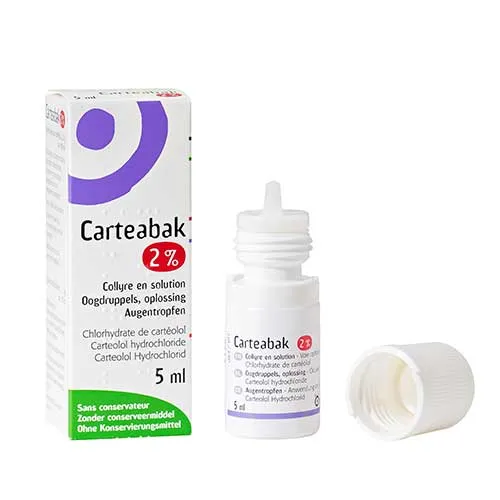
Table of Contents
PATIENT INFORMATION LEAFLET: INFORMATION FOR THE USER
CARTEABAK 1% and 2%, eye drops, solution
Carteolol hydrochloride
Please read this leaflet carefully before using this medicine.
- Keep this leaflet. You may need to read it again.
- If you have any questions, ask your doctor or pharmacist.
- This medicine has been prescribed for you personally. Never give it to others. It may be harmful to other people, even if their symptoms are the same as yours.
- If any of the side effects worsen, or if you notice any side effects not listed in this leaflet, inform your doctor or pharmacist.
Contents of this leaflet:
- What CARTEABAK is and what it is used for
- Before you use CARTEABAK
- How to use CARTEABAK
- Possible side effects
- How to store CARTEABAK
- Further information
1. WHAT CARTEABAK IS AND WHAT IT IS USED FOR
This medicinal product is a beta-blocker administered by ocular route.
It is used in the treatment of certain types of ocular diseases involving ocular hypertension (glaucoma and
ocular hypertension).
1) BEFORE USING CARTEABAK
Do not use CARTEABAK eye drops, solution
- if you are allergic (hypersensitive) to carteolol hydrochloride, beta-blockers, or any of the excipients.
- if you have or have previously had respiratory problems such as asthma, severe chronic obstructive bronchitis (severe lung disease that may cause shortness of breath, difficulty breathing and/or long-standing cough).
- if you have a slow heartbeat, heart failure, or heart rhythm disorders (irregular heartbeats).
- in case of untreated pheochromocytoma (excessive production of a hormone causing severe arterial hypertension).
- in case of concomitant therapy with floctafénine (a medicine used to treat pain).
- in case of concomitant therapy with sultopride (a medicine mainly used for psychiatric treatment).
Take special care with CARTEABAK
- Do not stop treatment suddenly without consulting your doctor .
- Do not inject, do not swallow. If you use CARTEABAK, you should undergo regular eye examinations, particularly to monitor for possible drug resistance (the medicine may become less effective during long-term treatment). Before using this medicine, inform your doctor if you have or have previously had:
- coronary heart disease (symptoms may include chest pain or tightness, shortness of breath or suffocation), heart failure, low blood pressure
- heart rate disorders, such as slow heartbeat
- respiratory problems, asthma or chronic obstructive pulmonary disease (lung disease that may cause shortness of breath, difficulty breathing and/or long-term cough)
- disease due to poor blood circulation (such as Raynaud's disease or Raynaud's syndrome)
- diabetes, as Carteolol may mask the signs and symptoms of low blood sugar
- overactivity of the thyroid gland, as Carteolol may mask its signs and symptoms
- treated pheochromocytoma
- psoriasis
- corneal diseases
Precautions regarding contact lens use
- Avoid wearing contact lenses during treatment, as tear secretion is reduced; this effect is generally associated with beta-blockers.
Before undergoing surgery, inform your doctor that you are taking Carteabak, as carteolol may alter the effects of certain medicines used during anaesthesia.
Use of CARTEABAK with other medicines
- If your doctor has prescribed another type of eye drop, you must wait 15 minutes between instillation of the two eye drops . Carteabak may interact with or be affected by other medicines you are taking, including other eye drops for glaucoma treatment. Inform your doctor if you are using or intend to use medicines to lower blood pressure, medicines for the heart, or medicines to treat diabetes. Inform your doctor or pharmacist if you are taking or have recently taken any other medicine, particularly floctafénine and sultopride, including those obtained without a prescription.
Pregnancy and breastfeeding
Do not use Carteabak during pregnancy unless your doctor considers it necessary.
Do not use Carteabak while breastfeeding. Carteolol may be excreted in breast milk.
Ask your doctor for advice before taking any medicine during breastfeeding.
Driving and using machines
You may experience transient visual disturbances after ocular administration of this medicine. Wait until your vision returns to normal before driving or operating machinery. CARTEABAK may also cause other adverse effects (dizziness, fatigue) that could potentially affect your ability to drive or operate machinery. If in doubt, consult your doctor.
Sports
The active substance in this medicine may lead to positive anti-doping test results.
2) HOW TO USE CARTEABAK
Always use CARTEABAK eye drops, solution exactly as directed by your doctor . If in doubt, consult your doctor or pharmacist.
Dosage
- Adults The usual dose is one drop in the affected eye twice daily (morning and evening).
- Children There is no experience in premature infants, neonates, and children. Use of this eye drop is therefore not recommended in these patients.
- Elderly patients Dose adjustment is not required; follow the adult dosage. Method of administration This medicine is intended for ocular administration (ophthalmic use). Wash your hands thoroughly before using the product. Avoid contact between the tip of the container and the eye or eyelids. Instill one drop into the affected eye, looking upwards and gently pulling down the lower eyelid. After using Carteabak, press a finger against the inner corner of the eye, near the nose, for 2 minutes. This helps prevent carteolol from spreading throughout the rest of the body. 5. Close the bottle after use.
Frequency of administration 2 doses per day (morning and evening).
Duration of treatment
Always use CARTEABAK exactly as directed by your doctor.
If you use more CARTEABAK than you should
If you instill too many drops or accidentally swallow the contents of the bottle, you may experience dizziness, difficulty breathing, or feel that your heart rate has slowed down.
Contact your doctor or pharmacist immediately.
If you forget to use CARTEABAK
Instill the missed dose as soon as possible. However, if it is almost time for the next dose, simply skip the missed dose.
If you have any doubts about using this medicine, consult your doctor or pharmacist.
If you stop using CARTEABAK
The pressure inside your eye may increase and damage your vision.
Do not stop treatment suddenly without consulting your doctor.
If you have any further questions about using this product, consult your doctor or pharmacist.
4. POSSIBLE ADVERSE REACTIONS
Like all medicines, CARTEABAK eye drops, solution can cause adverse reactions, although not everyone experiences them.
You can usually continue using the eye drops unless the reactions are severe. If you are concerned, consult your doctor or pharmacist.
Do not stop using Carteabak without first talking to your doctor.
As with other medicines applied to the eye, carteolol is absorbed into the bloodstream. This may cause adverse reactions similar to those observed with beta-blocking agents administered intravenously and/or orally.
The incidence of adverse reactions following topical ophthalmic administration is lower than when medicines are taken orally or by injection, for example.
The adverse reactions listed below include those observed within the class of beta-blockers used to treat eye disorders:
- Systemic allergic reactions including generalized swelling under the skin (which may occur in areas such as the face and limbs, and may obstruct the airways, causing difficulty in swallowing or breathing), urticaria (itchy rash), localized and generalized skin eruptions, pruritus, and severe, life-threatening anaphylactic reactions.
- Low blood glucose levels
- Sleep disturbances (insomnia), depression, nightmares, memory loss
- Fainting, stroke, reduced blood supply to the brain, worsening of signs and symptoms of myasthenia gravis (a muscle disorder), dizziness, unusual sensations (such as tingling), and headache.
- Signs and symptoms of ocular irritation (e.g. burning, irritation, itching, tearing, redness), conjunctival redness, conjunctivitis, eyelid inflammation, corneal inflammation, blurred vision, and retinal pigment epithelial detachment (a layer beneath the retina containing blood vessels) following filtering surgery, which may lead to visual disturbances; reduced corneal sensitivity, dry eyes, corneal erosion (damage to the anterior layer of the eyeball), drooping of the upper eyelid (resulting in the eye being half-closed), double vision, and refractive changes (in some cases due to discontinuation of miotic therapy).
- Slowed heart rate, chest pain, palpitations, edema (fluid accumulation), changes in heart rhythm or heart rate, congestive heart failure (a heart condition causing shortness of breath and swelling of the feet and legs due to fluid accumulation), a type of cardiac arrhythmia, myocardial infarction, heart failure, leg cramps and/or leg pain when walking (claudication).
- Low blood pressure, Raynaud's phenomenon, cold hands and feet.
- Airway constriction in the lungs (predominantly in patients with pre-existing conditions), breathing difficulties, cough.
- Taste disturbances, nausea, indigestion, diarrhea, dry mouth, abdominal pain, vomiting.
- Hair loss, skin rashes with a silvery appearance (psoriasiform rash) or worsening of psoriasis, skin rash.
- Muscle pain not caused by physical exercise, systemic lupus erythematosus.
- Sexual dysfunction, decreased libido, impotence.
- Muscle weakness/fatigue.
- Positive antinuclear antibody test results.
If any of the adverse reactions worsens, or if you notice any adverse reaction not listed in this leaflet, inform your doctor or pharmacist immediately.
5. HOW TO STORE CARTEABAK
Keep CARTEABAK out of the reach and sight of children.
Do not use CARTEABAK after the expiry date stated on the carton and on the bottle after EXP. The expiry date refers to the last day of that month.
The bottle must not be stored for more than eight weeks after first opening.
6. OTHER INFORMATION
What CARTEABAK contains
- The active substance is carteolol hydrochloride at a concentration of 1% or 2%.
- The excipients are sodium chloride, disodium phosphate dodecahydrate, sodium dihydrogen phosphate dihydrate, water for injections.
Description of the appearance of CARTEABAK and contents of the pack
CARTEABAK is an eye drop solution supplied in a bottle containing 5 or 10 ml of solution. It is a
colourless and transparent liquid.
It is possible that not all pack sizes are marketed.
Marketing Authorization Holder
LABORATOIRES THEA
12, rue Louis Blériot
63017 CLERMONT-FERRAND CEDEX 2
FRANCE
Manufacturer
Laboratoires THISSEN S.A.
Rue de la Papyrée 2-4
1420 BRAINE-L’ALLEUD
BELGIUM
and/or
EXCELVISION
77, rue de la Lombardière
ZI la Lombardière
07100 ANNONAY
FRANCE
This medicinal product is authorized in the European Economic Area countries under the following names:
Belgium, France, Italy, Luxembourg, Poland, Portugal, Netherlands,.................. CARTEABAK
This leaflet was last approved in July 2012
Blue box: generic medicine