Carnitene
Italy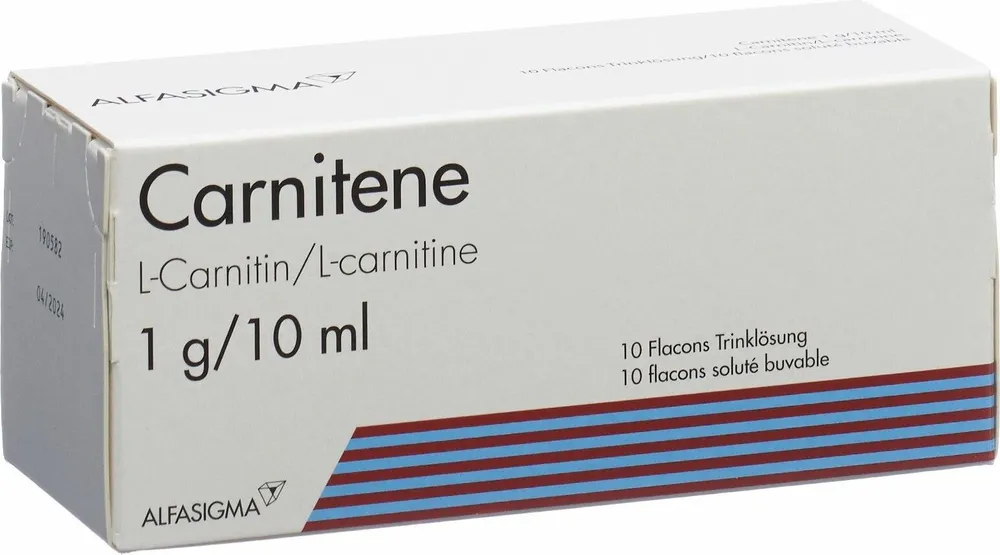
Table of Contents
- Patient Information Leaflet
- Carnitene 1 g/10 ml oral solution, 1.5 g/5 ml oral solution, 1 g chewable tablets
- 1. What Carnitene is and what it is used for
- 2. What you should know before taking Carnitene
- 3. How to take Carnitene
- 4. Possible side effects
- 5. How to store Carnitene
- 6. Contents of the pack and other information
- 1. What Carnitene is and what it is used for
- 2. What you need to know before taking Carnitene
- 3. How to take Carnitene
- 4. Possible side effects
- 5. How to store Carnitene
- 6. Package contents and other information
- 1. What Carnitene is and what it is used for
- 2. What you should know before using Carnitene
- 3. How to use Carnitene
- 4. Possible side effects
- 5. How to store Carnitene
- 6. Package contents and other information
Patient Information Leaflet
Carnitene 1 g/10 ml oral solution, 1.5 g/5 ml oral solution, 1 g chewable tablets
L-carnitine
Please read all of this leaflet carefully before taking this medicine because it contains important information for you.
Always take this medicine exactly as described in this leaflet or as your doctor or pharmacist has instructed you.
- Keep this leaflet. You may need to read it again.
- If you need more information or advice, consult your pharmacist.
- If you experience any side effects, including those not listed in this leaflet, contact your doctor or pharmacist. See section 4.
- Contact your doctor if you do not notice any improvement or if you notice worsening of symptoms after a short period of treatment.
Contents of this leaflet:
- What Carnitene is and what it is used for
- What you need to know before taking Carnitene
- How to take Carnitene
- Possible side effects
- How to store Carnitene
- Contents of the pack and other information
1. What Carnitene is and what it is used for
Carnitene contains the active substance L-carnitine. Carnitine is a natural component of human body cells and plays a fundamental role in energy production and transport.
Carnitene is indicated for the treatment of carnitine deficiencies.
Consult your doctor if you do not feel better or feel worse after a short period of treatment.
2. What you should know before taking Carnitene
Do not take Carnitene
- if you are allergic to L-carnitine or to any of the other ingredients of this medicine (listed in section 6).
Warnings and precautions
Talk to your doctor or pharmacist before taking Carnitene.
Inform your doctor, who will keep you under close monitoring:
- if you have diabetes and are using insulin or oral hypoglycaemic agents (medicines taken by mouth that lower blood sugar levels), because Carnitene may cause a further reduction in blood sugar. In such cases, your doctor will perform frequent blood sugar checks and may adjust the dose of insulin or oral hypoglycaemic agents (see section “How to take Carnitene”)
- if you are prone to seizures, as treatment with L-carnitine may trigger them; if you already suffer from seizures, administration of L-carnitine may increase the frequency and/or severity of epileptic episodes
- if you have severe kidney problems (severe renal insufficiency or end-stage renal failure) or are undergoing dialysis. In these cases, your doctor will monitor your kidney function during treatment, especially if prolonged (see section “How to take Carnitene”)
- if you are taking medicines that reduce blood clotting (anticoagulants). In such cases, your doctor will prescribe periodic blood clotting tests (see section “Other medicines and Carnitene”)
Carnitene does not pose risks of tolerance (loss of medicine effectiveness over time) or dependence.
Other medicines and Carnitene
Tell your doctor or pharmacist if you are taking, have recently taken, or might take any other
medicines.
Inform your doctor if you are taking medicines that reduce blood clotting (anticoagulants), because
very rare cases of blood clotting alterations may occur during concomitant treatment with Carnitene. In such cases, your doctor will prescribe periodic clotting tests (see section “Warnings and precautions”).
Inform your doctor if you are taking antiepileptic drugs (valproic acid), antibiotics (containing pivalic acid, cephalosporins), or anticancer drugs (cisplatin, carboplatin, and ifosfamide), as they may reduce the amount of Carnitene in the blood.
Pregnancy, breastfeeding, and fertility
If you are pregnant, think you may be pregnant, are planning a pregnancy, or are breastfeeding, consult your doctor or pharmacist before taking this medicine.
Pregnancy
Carnitene may be used during pregnancy if your doctor considers that the benefit to you outweighs the potential risks to the fetus.
Breastfeeding
L-carnitine is a normal component of breast milk. Carnitene may be used during breastfeeding if your doctor considers that the benefit to you outweighs the potential risks to the infant.
Fertility
Carnitene has no adverse effects on fertility.
Driving and using machines
Carnitene does not impair the ability to drive or operate machinery.
Carnitene 1 g/10 ml oral solution contains sodium benzoate and sodium
This medicine contains 48 mg of sodium benzoate in 10 ml of solution. Sodium benzoate may increase jaundice (yellowing of the skin and eyes) in newborns up to 4 weeks of age.
This medicine contains 8.1 mg of sodium (a main component of table salt) per 10 ml of solution. This corresponds to 0.41% of the maximum daily recommended dietary intake for an adult.
Carnitene 1.5 g/5 ml oral solution contains sucrose, sorbitol, methyl para-hydroxybenzoate, propyl para-hydroxybenzoate, sodium, and ethanol
Carnitene 1.5 g/5 ml oral solution contains sucrose. If your doctor has diagnosed you with intolerance to certain sugars, contact him before taking this medicine. It may be harmful to teeth.
This medicine contains 350 mg of sorbitol per 5 ml of solution. Sorbitol is a source of fructose. If your doctor has told you that you (or your child) have an intolerance to certain sugars, or if you have been diagnosed with hereditary fructose intolerance, a rare genetic disorder in which patients cannot metabolize fructose, speak with your doctor before you (or your child) take this medicine.
Carnitene 1.5 g/5 ml oral solution contains methyl para-hydroxybenzoate and propyl para-hydroxybenzoate, which may cause allergic reactions (including delayed reactions).
This medicine contains less than 1 mmol (23 mg) of sodium per dose, i.e., essentially “sodium-free”.
This medicine contains 5.2 mg of alcohol (ethanol) per ml. The amount in each ml of this medicine is equivalent to 0.13 ml of beer or 0.05 ml of wine. The small amount of alcohol in this medicine will not produce significant effects.
Carnitene 1 g chewable tablets contain sucrose and maltodextrin (glucose)
If your doctor has diagnosed you with intolerance to certain sugars, contact him before taking this medicine. This medicine contains 1.9 g of sucrose per tablet. This should be taken into account in patients with diabetes mellitus. It may be harmful to teeth.
3. How to take Carnitene
Take this medicine exactly as directed by your doctor or pharmacist. If you
have any doubts, consult your doctor or pharmacist.
Primary and secondary carnitine deficiencies due to genetic metabolic disorders
The daily dose varies according to the patient's age and body weight.
Use in adults and adolescents from 12 years of age
The recommended dose is 2–4 grams per day, depending on the severity of the disease and the physician’s judgment.
Use in children
Children from 0 to 2 years
The recommended dose is 150 mg per kg of body weight.
Children from 2 to 6 years
The recommended dose is 100 mg per kg of body weight.
Children from 6 to 12 years
The recommended dose is 75 mg per kg of body weight.
Secondary carnitine deficiencies due to haemodialysis
The recommended dose is 2–4 grams per day.
The oral solution must only be taken after dilution. Pour the oral solution contained in the single-dose
container into a glass of water before drinking it or giving it to your child.
If you have severe kidney problems, oral treatment with Carnitene should not be prolonged or given at high doses.
If you are elderly, no special precautions or dose adjustments of Carnitene are required.
If you have diabetes and are using insulin or oral antidiabetic medicines that lower blood sugar levels, Carnitene may cause a further reduction in blood glucose. Therefore, your doctor will perform frequent blood glucose monitoring and may adjust the dose of your insulin or oral hypoglycaemic agents (see section “Warnings and precautions”).
If you take more Carnitene than you should
In case of accidental overdose, contact your doctor immediately or go to the nearest hospital. An overdose of Carnitene may cause diarrhoea.
If you forget to take Carnitene
Do not take a double dose to make up for the missed dose.
If you stop taking Carnitene
If you have any doubts about using this medicine, consult your doctor or pharmacist.
4. Possible side effects
Like all medicines, this medicine can cause side effects, although not everyone gets them.
Common side effects (may affect up to 1 in 10 people)
- vomiting
- nausea
- diarrhoea
- abdominal pain
Uncommon side effects (may affect up to 1 in 100 people)
- headache
- increased or high blood pressure
- low blood pressure
- taste disturbances
- difficulty digesting
- dry mouth
- fishy odour in urine, breath and sweat*
- sudden and involuntary muscle contractions (muscle spasms)
- chest pain
- feeling strange
- fever
Very rare side effects (may affect up to 1 in 10,000 people)
- blood coagulation disorders**
Side effects with unknown frequency (frequency cannot be estimated from the available data)
- seizures***
- dizziness
- irregular heartbeat (palpitations)
- difficulty breathing
- itching
- skin rash
- myasthenia (a disease characterised by muscle weakness)****
- muscle tension
* This occurs in patients with severe kidney problems or on dialysis, due to the accumulation of L-carnitine metabolites in the blood.
** In patients concurrently using medicines that reduce blood coagulation (anticoagulants).
*** In patients with or without previous seizure episodes or who are predisposed.
**** In patients with end-stage kidney failure.
Reporting of side effects
If you experience any side effect, including those not listed in this leaflet, talk to your doctor or pharmacist. You can also report side effects directly via the national reporting system at https://www.aifa.gov.it/content/segnalazioni-reazioni-avverse. By reporting side effects, you can help provide more information on the safety of this medicine.
5. How to store Carnitene
Keep this medicine out of the sight and reach of children.
This medicine does not require any special storage conditions.
Do not use this medicine after the expiry date stated on the packaging after "Exp.". The expiry date refers to the last day of that month.
Do not dispose of any medicine via wastewater or household waste. Ask your pharmacist how to dispose of medicines you no longer use. This will help protect the environment.
6. Contents of the pack and other information
What Carnitene contains
Carnitene 1 g/10 ml oral solution
- The active substance is L-carnitine inner salt. Each single-dose container of 10 ml contains 1 g of L-carnitine inner salt.
- The other components are malic acid d-l, sodium benzoate, sodium saccharin, purified water.
Carnitene 1.5 g/5 ml oral solution
- The active substance is L-carnitine inner salt. 100 ml of solution contain 30 g of L-carnitine inner salt.
- The other components are sucrose, sorbitol 70 percent (non-crystallizable), sodium methyl parahydroxybenzoate, sodium propyl parahydroxybenzoate, cherry flavour (contains ethanol), sour cherry flavour (contains ethanol), purified water.
Carnitene 1 g chewable tablets
- The active substance is L-carnitine inner salt. Each chewable tablet contains 1 g of L-carnitine inner salt.
- The other components are mint flavour powder (contains glucose from maltodextrin), liquorice flavour powder, sucrose, magnesium stearate.
Description of the appearance of Carnitene and contents of the pack
Carnitene 1 g/10 ml oral solution
Each pack contains 10 single-dose containers of 10 ml oral solution.
Carnitene 1.5 g/5 ml oral solution
Each pack contains 1 bottle of 20 ml oral solution.
Carnitene 1 g chewable tablets
Each pack contains 10 chewable tablets in blister packs.
Marketing Authorisation Holder
Alfasigma S.p.A. - Via Ragazzi del ’99, n. 5 - 40133 Bologna (BO)
Manufacturer
Alfasigma S.p.A. - Via Pontina km 30.400 - 00071 Pomezia (RM)
Carnitene 2 g/10 ml oral solution
L-carnitine
Please read this leaflet carefully before taking this medicine because it contains important information for you.
- Keep this leaflet. You may need to read it again.
- If you have any questions, ask your doctor or pharmacist.
- This medicine has been prescribed for you only. Do not give it to others, even if their symptoms are the same as yours, as it may be harmful.
- If you experience any adverse reactions, including those not listed in this leaflet, inform your doctor or pharmacist. See section 4.
Contents of this leaflet:
- What Carnitene is and what it is used for
- What you need to know before taking Carnitene
- How to take Carnitene
- Possible side effects
- How to store Carnitene
- Contents of the pack and other information
1. What Carnitene is and what it is used for
Carnitene contains the active substance L-carnitine. Carnitine is a natural constituent of human body cells and plays a fundamental role in energy production and transport.
Carnitene is indicated for the treatment of carnitine deficiencies.
2. What you need to know before taking Carnitene
Do not take Carnitene
- if you are allergic to L-carnitine or to any of the other ingredients of this medicine (listed in section 6).
Warnings and precautions
Talk to your doctor or pharmacist before taking Carnitene.
Inform your doctor, who will keep you under close monitoring:
- if you have diabetes and are using insulin or oral hypoglycaemics (medicines taken by mouth that lower blood sugar levels), because Carnitene may cause a further reduction in blood sugar. In such cases, your doctor will perform frequent blood sugar checks and may adjust the dose of insulin or oral hypoglycaemics (see section “How to take Carnitene”)
- if you are prone to seizures, as treatment with L-carnitine could trigger them; if you already suffer from seizures, administration of L-carnitine may increase the frequency and/or severity of seizure episodes
- if you have severe kidney problems (severe renal insufficiency or end-stage renal failure) or are undergoing dialysis. In these cases, your doctor will monitor your kidney function during treatment, especially if prolonged (see section “How to take Carnitene”)
- if you are taking medicines that reduce blood coagulation (anticoagulants). In such cases, your doctor will prescribe periodic coagulation tests (see section “Other medicines and Carnitene”).
Carnitene does not present risks of tolerance (loss of effectiveness over time) or dependence.
Other medicines and Carnitene
Inform your doctor if you are currently taking, have recently taken, or might take any other medicines.
Inform your doctor if you are taking medicines that reduce blood coagulation (anticoagulants), because very rarely, alterations in blood coagulation may occur during concomitant treatment with Carnitene. In such cases, your doctor will prescribe periodic coagulation tests (see section “Warnings and precautions”).
Inform your doctor if you are taking antiepileptic drugs (valproic acid), antibiotics (containing pivalic acid, cephalosporins), or anticancer drugs (cisplatin, carboplatin, and ifosfamide), as they may reduce the levels of Carnitene in the blood.
Pregnancy, breastfeeding and fertility
If you are pregnant, think you may be pregnant, planning a pregnancy, or breastfeeding, consult your doctor before taking this medicine.
Pregnancy
Carnitene may be used during pregnancy if your doctor considers that the benefit to you outweighs the potential risks to the fetus.
Breastfeeding
L-carnitine is a normal component of human breast milk. Carnitene may be used during breastfeeding if your doctor considers that the benefit to you outweighs the potential risks to the infant.
Fertility
Carnitene has no adverse effects on fertility.
Driving and using machines
Carnitene does not impair the ability to drive or operate machinery.
Carnitene 2 g/10 ml oral solution contains sodium benzoate, sodium, and benzyl alcohol
This medicine contains 48 mg of sodium benzoate in 10 ml of solution. Sodium benzoate may increase jaundice (yellowing of the skin and eyes) in newborns up to 4 weeks of age.
This medicine contains less than 1 mmol (23 mg) of sodium per 10 ml of solution, i.e. essentially “sodium-free”.
This medicine contains 0.2 mg of benzyl alcohol per 10 ml of oral solution. Benzyl alcohol may cause allergic reactions. Benzyl alcohol has been associated with a risk of serious adverse effects, including breathing problems (gasping syndrome), in young children. Do not administer to newborns up to 4 weeks of age unless otherwise recommended by the doctor. Do not use for more than one week in young children (under 3 years of age) unless otherwise recommended by the doctor or pharmacist. Consult your doctor or pharmacist if you are pregnant or breastfeeding. This is because large amounts of benzyl alcohol may accumulate in the body and cause adverse effects (such as metabolic acidosis). Consult your doctor or pharmacist if you have liver or kidney disease. This is because large amounts of benzyl alcohol may accumulate in the body and cause adverse effects (such as metabolic acidosis).
3. How to take Carnitene
Take this medicine exactly as instructed by your doctor or pharmacist. If you have
any doubts, consult your doctor or pharmacist.
Primary and secondary carnitine deficiencies due to genetic metabolic disorders
The daily dose varies depending on the patient's age and body weight.
Use in adults and adolescents from 12 years of age onwards
The recommended dose is 2–4 grams per day, depending on the severity of the disease and the physician’s judgment.
Use in children
Children from 0 to 2 years
The recommended dose is 150 mg per kg of body weight.
Children from 2 to 6 years
The recommended dose is 100 mg per kg of body weight.
Children from 6 to 12 years
The recommended dose is 75 mg per kg of body weight.
Secondary carnitine deficiencies due to haemodialysis
The recommended dose is 2–4 grams per day.
The oral solution must only be taken after dilution. Pour the oral solution contained in the single-dose container into a glass of water before drinking it or giving it to your child.
If you have severe kidney problems, prolonged oral treatment with Carnitene and high doses should be avoided.
If you are elderly, no special precautions or dosage adjustments are necessary for Carnitene.
If you have diabetes and are using insulin or oral antidiabetic medicines that lower blood sugar levels, Carnitene may cause a further reduction in blood sugar. Therefore, your doctor will perform frequent blood sugar checks and may adjust the dose of your insulin or oral hypoglycaemic agents (see section “Warnings and precautions”).
If you take more Carnitene than you should
In case of accidental overdose, contact your doctor immediately or go to the nearest hospital. An excessive dose of Carnitene may cause diarrhoea.
If you forget to take Carnitene
Do not take a double dose to make up for the forgotten dose.
If you stop taking Carnitene
If you have any doubts about using this medicine, consult your doctor or pharmacist.
4. Possible side effects
Like all medicines, this medicine can cause side effects, although not everyone gets them.
Common side effects (may affect up to 1 in 10 people)
- vomiting
- nausea
- diarrhoea
- abdominal pain
Uncommon side effects (may affect up to 1 in 100 people)
- headache
- increased or high blood pressure
- low blood pressure
- altered taste
- difficulty digesting
- dry mouth
- fishy odour in urine, breath and sweat*
- sudden and involuntary muscle contractions (muscle spasms)
- chest pain
- feeling strange
- fever
Very rare side effects (may affect up to 1 in 10,000 people)
- disturbances in blood coagulation**
Side effects with unknown frequency (frequency cannot be estimated from the available data)
- seizures***
- dizziness
- irregular heartbeat (palpitations)
- difficulty breathing
- itching
- skin rash
- myasthenia (a disease characterised by muscle weakness)****
- muscle tension
* This occurs in patients with severe kidney problems or on dialysis, due to accumulation of L-carnitine metabolites in the blood.
** In patients concurrently using medicines that reduce blood coagulation (anticoagulants).
*** In patients with or without previous history of seizures or predisposed to seizures.
**** In patients with end-stage renal failure.
Reporting of side effects
If you experience any side effect, including those not listed in this leaflet, talk to your doctor or pharmacist. You may also report side effects directly via the national reporting system at https://www.aifa.gov.it/content/segnalazioni-reazioni-avverse. By reporting side effects, you can help provide more information on the safety of this medicine.
5. How to store Carnitene
Keep this medicine out of the sight and reach of children.
This medicine does not require any special storage conditions.
Do not use this medicine after the expiry date stated on the packaging after "Exp.". The expiry date refers to the last day of that month.
Do not dispose of medicines via wastewater or household waste. Ask your pharmacist how to dispose of medicines you no longer use. This will help protect the environment.
6. Package contents and other information
What Carnitene contains
- The active substance is L-carnitine inner salt. Each 10 ml single-dose container contains 2 g of L-carnitine inner salt.
- The other ingredients are d-l malic acid, sodium benzoate, sodium saccharin, pineapple flavour powder (contains benzyl alcohol), purified water.
Description of the appearance of Carnitene and package contents
Each pack contains 10 single-dose containers of 10 ml oral solution.
Marketing Authorization Holder
Alfasigma S.p.A. - Via Ragazzi del '99, n. 5 - 40133 Bologna (BO)
Manufacturer
Alfasigma S.p.A. - Via Pontina km 30,400 - 00071 Pomezia (RM)
Carnitene 1 g/5 ml injectable solution for intravenous use
Carnitene 2 g/5 ml injectable solution for intravenous use
L-carnitine
Please read this leaflet carefully before using this medicine because it contains important information for you.
- Keep this leaflet. You may need to read it again.
- If you have any questions, ask your doctor or pharmacist.
- This medicine has been prescribed for you only. Do not give it to others, even if their symptoms are the same as yours, as it could be harmful.
- If you experience any side effects, including those not listed in this leaflet, tell your doctor or pharmacist. See section 4.
Contents of this leaflet:
- What Carnitene is and what it is used for
- What you need to know before using Carnitene
- How to use Carnitene
- Possible side effects
- How to store Carnitene
- Package contents and other information
1. What Carnitene is and what it is used for
Carnitene contains the active substance L-carnitine. Carnitine is a natural component of human body cells and plays a fundamental role in the production and transport of energy.
Carnitene is indicated for the treatment of carnitine deficiencies.
2. What you should know before using Carnitene
Do not use Carnitene
- if you are allergic to L-carnitine or to any of the other ingredients of this medicine (listed in section 6).
Warnings and precautions
Talk to your doctor or pharmacist before using Carnitene.
Inform your doctor, who will keep you under close monitoring:
- if you have diabetes and are using insulin or oral hypoglycemic agents (medicines taken by mouth that lower blood sugar levels), because Carnitene may cause a further reduction in blood sugar. In such cases, your doctor will perform frequent blood sugar level checks and may adjust the dose of insulin or oral hypoglycemic agents (see section "How to take Carnitene").
- if you are prone to seizures, treatment with L-carnitine may trigger them; if you already suffer from seizures, administration of L-carnitine may increase the frequency and/or severity of epileptic episodes.
- if you are taking medicines that reduce blood clotting (anticoagulants). In these cases, your doctor will prescribe periodic blood clotting tests (see section "Other medicines and Carnitene").
Carnitene does not carry any risk of tolerance (loss of medicine effectiveness over time) or dependence.
Other medicines and Carnitene
Inform your doctor if you are currently using, have recently used, or might use any other medicine.
Inform your doctor if you are taking medicines that reduce blood clotting (anticoagulants), because in very rare cases, changes in blood coagulation may occur during concomitant treatment with Carnitene. In such cases, your doctor will prescribe periodic coagulation tests (see section "Warnings and precautions").
Inform your doctor if you are taking antiepileptic drugs (valproic acid), antibiotics (containing pivalic acid, cephalosporins), or anticancer drugs (cisplatin, carboplatin, and ifosfamide), as these may reduce the amount of Carnitene in the blood.
Pregnancy, breastfeeding, and fertility
If you are pregnant, think you might be pregnant, planning a pregnancy, or breastfeeding, consult your doctor before taking this medicine.
Pregnancy
Carnitene may be used during pregnancy if your doctor considers that the benefit to you outweighs the potential risks to the fetus.
Breastfeeding
L-carnitine is a normal component of breast milk. Carnitene may be used during breastfeeding if your doctor considers that the benefit to you outweighs the potential risks to the infant.
Fertility
Carnitene has no adverse effects on fertility.
Driving and using machines
Carnitene does not impair the ability to drive or operate machinery.
3. How to use Carnitene
Use this medicine exactly as instructed by your doctor or pharmacist. If you have any doubts, consult your doctor or pharmacist.
Carnitine deficiencies due to haemodialysis
The recommended dose is 2 grams administered slowly into a vein at the end of dialysis.
A dose of 2.5 g may be used in patients who have been undergoing dialysis for more than 1 year.
Intravenous administration must be performed slowly over a period of 2–3 minutes.
If you are elderly, no special precautions or dosage adjustments of Carnitene are required.
If you have diabetes and are using insulin or oral antidiabetic medicines, Carnitene may cause a further reduction in blood sugar levels. Therefore, your doctor will perform frequent blood sugar checks and may adjust the dose of your insulin or oral hypoglycaemics (see section “Warnings and precautions”).
If you use more Carnitene than you should
In case of accidental ingestion or overdose with Carnitene, inform your doctor immediately or go to the nearest hospital. An overdose of Carnitene may cause diarrhoea.
If you forget to use Carnitene
Do not take a double dose to make up for the missed dose.
If you stop using Carnitene
If you have any doubts about using this medicine, consult your doctor or pharmacist.
4. Possible side effects
Like all medicines, this medicine can cause side effects, although not everyone will experience them.
Common side effects (may affect up to 1 in 10 people)
- vomiting
- nausea
- diarrhoea
- abdominal pain
Uncommon side effects (may affect up to 1 in 100 people)
- headache
- increased or high blood pressure
- low blood pressure
- taste disturbance
- difficulty digesting
- dry mouth
- fish-like odour in urine, breath, and sweat*
- sudden and involuntary muscle contraction (muscle spasms)
- chest pain
- feeling strange
- fever
- injection site reaction
Very rare side effects (may affect up to 1 in 10,000 people)
disturbances in blood coagulation**
Side effects with unknown frequency (frequency cannot be estimated from the available data)
- seizures***
- dizziness
- irregular heartbeat (palpitations)
- difficulty breathing
- itching
- skin rash
- myasthenia (a disease characterised by muscle weakness) ****
- muscle tension
* This occurs in patients with severe kidney problems or on dialysis, due to the accumulation of
L-carnitine metabolites in the blood
** In patients concurrently using medicines that reduce blood coagulation (anticoagulants)
*** In patients with or without previous seizure episodes or predisposed to seizures
**** In patients with end-stage renal failure.
Reporting of side effects
If you experience any side effect, including those not listed in this leaflet, talk to your doctor or pharmacist. You can also report side effects directly through the national reporting system at https://www.aifa.gov.it/content/segnalazioni-reazioni-avverse. Reporting side effects can help provide more information on the safety of this medicine.
5. How to store Carnitene
Keep this medicine out of the sight and reach of children.
This medicine does not require any special storage conditions.
Do not use this medicine after the expiry date stated on the packaging after “Exp.”. The expiry date refers to the last day of that month.
Do not dispose of medicines via wastewater or household waste. Ask your pharmacist how to dispose of medicines no longer in use. This will help protect the environment.
6. Package contents and other information
What Carnitene contains
Carnitene 1 g/5 ml solution for injection for intravenous use
- The active substance is L-carnitine inner salt. Each vial contains 1 g of L-carnitine inner salt.
- The other component is water for injections.
Carnitene 2 g/5 ml solution for injection for intravenous use
- The active substance is L-carnitine inner salt. Each vial contains 2 g of L-carnitine inner salt.
- The other component is water for injections.
Description of the appearance of Carnitene and contents of the pack
Carnitene 1 g/5 ml solution for injection for intravenous use
Each pack contains 5 vials of 5 ml of solution for injection for intravenous use.
Carnitene 2 g/5 ml solution for injection for intravenous use
Each pack contains 5 vials of 5 ml of solution for injection for intravenous use.
Marketing Authorization Holder
Alfasigma S.p.A. - Via Ragazzi del ’99, n. 5 - 40133 Bologna (BO)
Manufacturer
Alfasigma S.p.A. - Via Pontina km 30,400 - 00071 Pomezia (RM)
Alfasigma S.p.A. - Via E. Fermi, n.1 – 65020 Alanno (PE)