Calcium gluconate B. Braun
Italy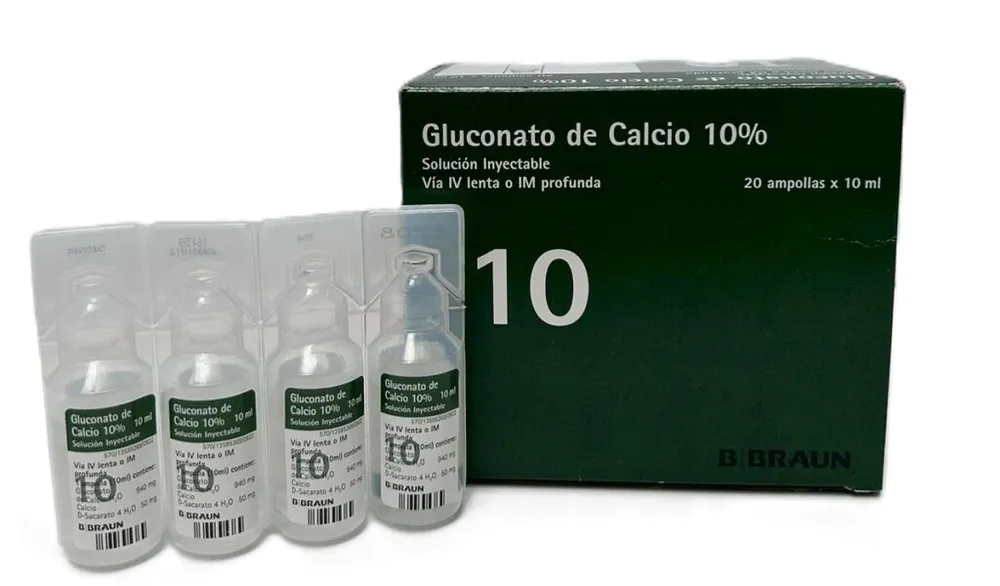
Table of Contents
- PACKAGE LEAFLET: INFORMATION FOR THE USER
- Calcium Gluconate 10% B. Braun Injection Solution
- 1. What Calcio gluconato 10% B. Braun is and what it is used for
- 2. What you need to know before using Calcio gluconato 10% B. Braun
- 3. How to use Calcium Gluconate 10% B. Braun
- 4. Possible side effects
- 5. How to store Calcium Gluconate 10% B. Braun
- 6. Package contents and other information
- The following information is intended for healthcare professionals only:
PACKAGE LEAFLET: INFORMATION FOR THE USER
Calcium Gluconate 10% B. Braun Injection Solution
Calcium Gluconate
Please read this leaflet carefully before using this medicine because it contains important information for you.
- Keep this leaflet. You may need to read it again.
- If you have any questions, ask your doctor.
- If any of the side effects worsen, or if you notice any side effects not listed in this leaflet, inform your doctor. See section 4. Contents of this leaflet:
- What Calcium Gluconate 10% B. Braun is and what it is used for.
- What you need to know before using Calcium Gluconate 10% B. Braun.
- How to use Calcium Gluconate 10% B. Braun.
- Possible side effects.
- How to store Calcium Gluconate 10% B. Braun.
- Contents of the pack and other information.
1. What Calcio gluconato 10% B. Braun is and what it is used for
Calcio gluconato 10% B. Braun is a solution for calcium supplementation.
It is used to provide calcium in patients with extremely low blood calcium levels (hypocalcemia) who are
experiencing acute symptoms such as impaired skin sensations (numbness, itching, burning), spasmodic muscle
rigidity (tetany), cramps in the hands and feet, colic, muscle weakness, confusion, which may progress to
seizures and cardiac symptoms (irregular heartbeat and even acute heart failure).
2. What you need to know before using Calcio gluconato 10% B. Braun
Do not use Calcio gluconato 10% B. Braun
- If you are allergic to calcium gluconate or to any of the other ingredients of this medicine (listed in section 6).
- If you have high levels of calcium in your blood (e.g. in patients with overactive parathyroid glands, high levels of vitamin D in the blood, tumour diseases associated with bone breakdown, impaired kidney function, osteoporosis due to immobility, sarcoidosis, and the so-called milk-alkali syndrome).
- If you are excreting excessive amounts of calcium in your urine.
- If you are suffering from digitalis drug intoxication (a type of heart medication).
- During treatment with digitalis drugs, unless you have extremely low calcium levels in the blood with potentially life-threatening symptoms that can only be treated by immediate injection of calcium.
- The antibiotic ceftriaxone must not be used in premature neonates and newborns (≤ 28 days of life) if they are receiving (or are about to receive) calcium-containing products to be administered intravenously. Warnings and precautions. Talk to your doctor before using Calcio gluconato 10% B. Braun. If you are regularly taking digitalis preparations and, exceptionally, urgently require a calcium injection (see above), your doctor will monitor your cardiac function very carefully.
This monitoring ensures that any worsening of cardiac function, for example, a severe arrhythmia
(irregular heartbeat), can be treated immediately.
Your doctor will carefully consider whether this medicine is suitable for you if you suffer from:
- calcium deposits in the kidneys (nephrocalcinosis);
- heart diseases;
- sarcoidosis. In these cases, calcium injections will be administered only if absolutely necessary. The same applies if you are being treated with adrenaline (see “Other medicines and Calcio gluconato 10% B. Braun”) or if you are elderly. Impaired kidney function (renal impairment) may be accompanied by increased calcium levels in the blood and overactivity of the parathyroid glands. If you have renal impairment, you will receive calcium injections only if strictly necessary. Calcium and phosphate balance must be monitored. Your doctor will pay particular attention if you are receiving the antibiotic ceftriaxone. It must not be administered simultaneously with calcium gluconate, even through different infusion lines or at different infusion sites. Calcium must be injected slowly to prevent, as far as possible, dilation of blood vessels or impairment of cardiac function. Cardiac function or ECG must be monitored when this medicine is administered intravenously (intravenous injection). During treatment with calcium salts, you will be closely monitored to ensure normal calcium balance (calcium intake versus calcium excretion) and to prevent calcium deposits in tissues. Blood calcium levels and the amount of calcium excreted in urine will be checked, particularly when calcium is injected at high doses. Calcium is insoluble in fatty tissues and may cause inflammatory reactions followed by abscess formation, tissue hardening, and tissue destruction (necrosis) if accidentally injected into these areas. If the solution is accidentally injected near a blood vessel or not deeply enough into a muscle, this may cause local tissue irritation, which could lead to skin peeling or even necrosis (see section 4). Your doctor will ensure that the solution does not leak into the tissue surrounding the blood vessel and will carefully observe the injection site. High doses of vitamin D must be avoided. Children and adolescents In children (Other medicines and Calcio gluconato 10% B. Braun Inform your doctor if you are taking, have recently taken, or might take any other medicines. The effects of heart medications such as digoxin and other digitalis drugs may be increased by calcium to the point of causing digitalis intoxication. Therefore, if you are being treated with digitalis drugs, you will receive an intravenous calcium injection only for the treatment of severe, life-threatening symptoms associated with very low calcium levels in the blood. The administration of calcium together with adrenaline after heart surgery reduces the effects of adrenaline on the heart and circulation. Calcium and magnesium inhibit each other's effects. Calcium may reduce the effects of certain medicines used to regulate heart function (calcium antagonists). The concomitant administration of calcium with certain medicines that increase urine production and excretion (thiazide diuretics) may lead to excessively high calcium levels in the blood (hypercalcemia), as these medicines reduce calcium excretion through the kidneys. The simultaneous administration of calcium with ceftriaxone may lead to the formation of precipitates.
Pregnancy and breastfeeding
If you are pregnant, suspect you may be pregnant, plan to become pregnant, or are breastfeeding, consult your doctor before taking this medicine.
Pregnancy
Calcium passes through the placenta into the fetal circulation and reaches higher levels in the fetal blood than in the mother's blood.
Therefore, pregnant women should receive calcium injections only if absolutely necessary. The dose must be carefully calculated and blood calcium levels regularly monitored to avoid reaching excessive levels that could be harmful to the fetus.
Breastfeeding
Calcium is excreted in breast milk. Your doctor will take this into account when administering calcium to you if you are breastfeeding your baby.
Driving and using machines
This medicine does not affect the ability to drive or operate machinery.
3. How to use Calcium Gluconate 10% B. Braun
Use this medicine exactly as instructed by your doctor. If you have any doubts, consult your doctor.
The recommended dose will be determined by your doctor in order to raise the calcium level in the blood / your child's blood calcium level to normal values.
Adults
The usual initial dose is 10 ml, i.e. one vial of Calcium Gluconate 10% B. Braun. If necessary, the dose may be repeated. Subsequent doses will be adjusted according to current blood calcium levels.
Use in infants, toddlers, children and adolescents
The doctor will decide the dosage and method of administration based on blood calcium levels and the severity of symptoms. In case of mild symptoms affecting nerves and muscles, oral calcium preparations will be preferred.
The following table shows the usual initial dose values:
| Age | ml/kg |
| 3 months 6 months 1 year 3 years 7.5 years 12 years >12 years | 0.4-0.9 0.3-0.7 0.2-0.5 0.4-0.7 0.2-0.4 0.1-0.3 As for adults |
In cases of exceptionally low blood calcium levels in neonates and infants, for example with impaired cardiac function, higher initial doses may be required to rapidly increase blood calcium levels (up to 2 ml per kg of body weight). Calcium administration may be repeated if necessary. The concentration of subsequent doses will depend on existing blood calcium levels. After intravenous therapy, treatment with oral calcium preparations may be required, for example in cases of vitamin D deficiency.
Elderly patients
Some disorders occasionally associated with advanced age, such as impaired renal function and undernutrition (malnutrition), may affect tolerance to calcium gluconate. Therefore, a lower dose may be necessary.
Method of administration
Calcium gluconate 10% B. Braun will be given to you by slow injection into a vein, or deeply into a large muscle. You will be given this medication while lying down, and cardiac function will be closely monitored during the injection.
Intramuscular injections (injections into the muscle) should only be performed if intravenous administration is not possible due to the risk of local tissue irritation. Your doctor will ensure carefully that intramuscular injections are administered deeply enough, preferably into the buttock muscle.
The rate of intravenous infusion or injection must be sufficiently slow.
Infants, toddlers, children and adolescents
For intravenous administration (into a vein) as a slow injection or slow intravenous infusion (drip-by-drip administration), both after dilution.
In children, this medicine must not be injected into the muscle or under the skin.
If you use more Calcium gluconate 10% B. Braun than you should
Symptoms related to high blood calcium levels (hypercalcemia) include: loss of appetite, feeling unwell, nausea (vomiting), constipation, abdominal pain, excessive urination, increased thirst, fluid loss, muscle weakness, calcium deposition in the kidneys, fatigue, confusion, high blood pressure (hypertension), and, in severe cases, irregular heartbeat, which may lead to heart attack and loss of consciousness.
Symptoms of high blood calcium levels (hypercalcemia), chalky taste, hot flushes, and drop in blood pressure may occur if the intravenous injection is administered too rapidly.
Treatment aims to reduce elevated blood calcium levels.
Your doctor will decide on the appropriate treatment, which may include administration of fluids or specific medications to lower blood calcium levels. In severe cases, dialysis may be necessary.
If you have any doubts about using this medicine, consult your doctor.
4. Possible side effects
Like all medicines, this medicine can cause side effects, although not everyone will experience them.
The frequency of side effects is described below:
Very common: affects more than 1 in 10 people.
Common: affects 1 to 10 in 100 people.
Uncommon: affects 1 to 10 in 1,000 people.
Rare: affects 1 to 10 in 10,000 people.
Very rare: affects fewer than 1 in 10,000 people.
Not known: frequency cannot be estimated from the available data.
Side effects affecting the heart, circulation, or other body functions may occur as symptoms of excessively high calcium levels in the blood, following overdose or too rapid intravenous injection. The occurrence and frequency of such symptoms are directly related to the speed of injection and the dose administered.
The following side effects can be serious. If you experience any of the side effects listed below, contact your doctor immediately; treatment with this medicine will be discontinued:
Not known (frequency cannot be estimated from the available data):
- Slow or irregular heartbeat,
- Low blood pressure (hypotension),
- Circulatory collapse (potentially fatal).
Rare (affects 1 to 10 in 10,000 people):
Severe and in some cases fatal adverse reactions have been reported in premature and full-term neonates (age < 28 days) treated with intravenous ceftriaxone and calcium. Precipitates of ceftriaxone-calcium salts have been observed post mortem in the lungs and kidneys.
Other side effects include:
Not known (frequency cannot be estimated from the available data):
- Dilation of blood vessels,
- Flushing, mainly after an injection administered too rapidly,
- Feeling of malaise or malaise (vomiting),
- Sensation of warmth,
- Sweating,
- Intramuscular injections may be accompanied by pain and redness.
Side effects occurring when the medicine is not used correctly
- If the injection is not administered deeply enough into the muscle, the solution may leak into fatty tissue, possibly causing inflammation, hardening, and destruction (necrosis) of the tissue.
- Following infiltration of the solution from the vein into surrounding tissue, calcium deposition in soft tissues has been reported. This may lead to skin desquamation and tissue destruction.
- Skin redness and burning or pain during intravenous injection may indicate accidental injection adjacent to a blood vessel, which could result in tissue damage.
Reporting of side effects
If any of the side effects worsens, or if you experience any side effect not listed in this leaflet, inform your doctor or pharmacist. You can also report side effects directly via the national reporting system at www.agenziafarmaco.gov.it/it/responsabili. By reporting side effects, you can help provide more information on the safety of this medicine.
5. How to store Calcium Gluconate 10% B. Braun
Keep this medicine out of the sight and reach of children.
Do not use this medicine after the expiry date stated on the container and carton.
The expiry date refers to the last day of that month.
This medicine does not require any special storage conditions.
The solution must be used immediately after the ampoule has been opened.
After dilution, the ready-to-use solution should be administered as soon as possible, but must not be stored for more than 24 hours at 2–8 °C.
Do not use this medicine if you notice any of the following changes:
- damage to the ampoule, discoloration or cloudiness of the solution, visible particles in the solution. Do not dispose of any medicine via wastewater. Ask your pharmacist how to dispose of medicines you no longer use. This will help protect the environment.
6. Package contents and other information
What Calcio gluconato 10% B. Braun contains
- The active substance is calcium gluconate.
- 1 ml of solution contains 94 mg of calcium gluconate, equivalent to 0.21 mmol of calcium.
- 10 ml contain 940 mg of calcium gluconate, equivalent to 2.10 mmol of calcium.
Excipients: The product also contains an amount of the excipient calcium D-saccharate tetrahydrate equivalent to 0.02 mmol of calcium per ml (or 0.15 mmol of calcium per 10 ml). The other component is water for injections. Total calcium content: 0.23 mmol per ml (2.25 mmol per 10 ml).
Description of the appearance of Calcio gluconato 10% B. Braun and package contents
Calcio gluconato 10% B. Braun is an injectable solution (a solution administered by syringe). It is a transparent solution ranging from colourless to light brown. Calcio gluconato 10% B. Braun is supplied in 10 ml polyethylene vials. Available in packs of 20 x 10 ml.
Marketing Authorisation Holder
B. Braun Melsungen AG
Carl-Braun Strasse, 1
34212 Melsungen, Germany
Manufacturer
B. Braun Melsungen AG, Carl Braun Strasse 1, D-34212, Melsungen (Germany), manufacturing site located at Mistelweg 2, D-12357, Berlin (Germany)
This medicinal product is authorised in the European Economic Area Member States under the following names:
Austria: Calciumgluconat 10% B.BRAUN Injektionslösung
Belgium: Calcium Gluconate 10 % B. Braun oplossing voor injectie
Denmark: Calciumgluconat B. Braun 100 mg/ml
Finland: Calciumgluconat B. Braun 100 mg/ml
France: Gluconate de Calcium 10 % B.Braun, solution pour perfusion
Italy: Calcio gluconato 10% B.Braun soluzione iniettabile
Netherlands: Calcium Gluconaat 10 % B.Braun, oplossing voor injectie 10 %
Portugal: Gluconato de cálcio 10 % B.Braun
Czech Republic: Calcium Gluconicum 10 % B.Braun
Slovakia: Calcium Gluconicum 10% B.Braun
United Kingdom: Calcium Gluconate 10 % w/v Injection BP
The following information is intended for healthcare professionals only:
Route of Administration
In obese patients, a longer needle must be used to ensure that the injection is delivered into the muscle and not into adipose tissue.
When repeated injections are required, the injection site should be changed each time.
Paediatric patients (<18 years)
Only slow intravenous injection or intravenous infusion (both after dilution) should be used, in order to achieve sufficiently low administration rates and to avoid irritation or necrosis in case of accidental extravasation. The intravenous administration rate must not exceed 5 ml per minute of a 1:10 dilution of Calcium Gluconate 10% B. Braun in children and adolescents.
Special Warnings and Precautions for Use
In patients of any age, ceftriaxone must not be mixed or administered simultaneously with any intravenous solution containing calcium, even via different infusion lines or different infusion sites.
Fatal reactions due to ceftriaxone-calcium precipitates in the lungs and kidneys have been reported in premature and full-term neonates under one month of age.
However, in patients older than 28 days, ceftriaxone and calcium-containing solutions may be administered sequentially, one after the other, provided that different infusion sites are used or the infusion lines are either replaced or thoroughly flushed with saline solution between infusions to prevent precipitation.
Sequential infusions of ceftriaxone and calcium-containing products should be avoided in cases of hypovolemia.
Incompatibilities
Calcium salts may form complexes with many drugs, potentially leading to precipitation.
Calcium salts are incompatible with oxidizing agents, citrates, soluble carbonates, bicarbonates, oxalates, phosphates, tartrates, and sulfates.
Physical incompatibility has been reported with amphotericin, cephalothin sodium, ceftriaxone (see "Warnings and Precautions"), cefazolin sodium, cefamandole nafate, novobiocin sodium, dobutamine hydrochloride, prochlorperazine, and tetracyclines.
This medicinal product must not be mixed with other medicinal products except those mentioned in the section “Dilutions” or unless compatibility has been adequately demonstrated.
Dilution
For intravenous infusions, Calcium Gluconate 10% B. Braun may be diluted 1:10 to a concentration of 10 mg/ml using one of the following infusion solutions: sodium chloride 9 mg/ml (0.9%) injection or glucose 50 mg/ml (5%) injection. When diluted with these recommended infusion solutions, the resulting solutions are intended for immediate single use only.
Dilution must be performed under controlled, validated aseptic conditions. After mixing, the container should be gently shaken to ensure homogeneity.
Management of Overdose
Initial management should include rehydration. In cases of severe hypercalcemia, administration of isotonic sodium chloride solution via intravenous infusion may be necessary to expand the extracellular fluid volume. Calcitonin may be administered to reduce elevated serum calcium levels.
Furosemide may be given to enhance calcium excretion; however, thiazide diuretics must be avoided, as they may increase renal calcium reabsorption.
Serum electrolytes must be closely monitored during the management of overdose.