Cablivi
Italy
Table of Contents
- Package leaflet: Information for the user
- Cablivi 10 mg powder and solvent for injectable solution
- 1. What Cablivi is and what it is used for
- 2. What you should know before taking Cablivi
- 3. How to use Cablivi
- Instructions for use
- 4. Possible side effects
- 5. How to store Cablivi
- 6. Package contents and other information
- The following information is intended for healthcare professionals only:
- Cablivi may be administered intravenously by connecting the prepared syringe to a
Package leaflet: Information for the user
Cablivi 10 mg powder and solvent for injectable solution
caplacizumab
Please read all of this leaflet carefully before you use this medicine because it contains important information for you.
- Keep this leaflet. You may need to read it again.
- If you have any questions, ask your doctor or pharmacist.
- This medicine has been prescribed for you only. Do not pass it on to other people, even if their symptoms are the same as yours, as it may be harmful to them.
- If you experience any side effects, including those not listed in this leaflet, tell your doctor, pharmacist or nurse. See section 4.
Contents of this leaflet
- What Cablivi is and what it is used for
- What you need to know before taking Cablivi
- How to use Cablivi
- Possible side effects
- How to store Cablivi
- Contents of the pack and other information
1. What Cablivi is and what it is used for
Cablivi contains the active substance caplacizumab. It is used to treat an episode of acquired thrombotic thrombocytopenic purpura in adults and adolescents aged 12 years and older with a body weight of at least 40 kg. This is a rare blood clotting disorder in which blood clots form in small blood vessels. These clots can block blood vessels and damage the brain, heart, kidneys or other organs. Cablivi prevents the formation of these blood clots by inhibiting platelet aggregation in the blood. By acting in this way, Cablivi reduces the risk of experiencing another episode of acquired thrombotic thrombocytopenic purpura (TTP) immediately after the first.
2. What you should know before taking Cablivi
Do not use Cablivi
if you are allergic to caplacizumab or to any of the other ingredients of this medicine (listed in
section 6).
Warnings and precautions
Tell your doctor if:
- you have excessive bleeding or experience unusual symptoms such as headache, shortness of breath, fatigue, or fainting, which may indicate serious internal bleeding. Your doctor may ask you to stop treatment. Your doctor will advise you when you can restart treatment.
- you are taking medicines that prevent or treat blood clots, such as warfarin, heparin, rivaroxaban, apixaban (for the treatment of blood clots). Your doctor will decide how to treat you.
- you are taking antiplatelet medicines such as aspirin or low molecular weight heparin (for the prevention of blood clots). Your doctor will decide how to treat you.
- you have a bleeding disorder, such as haemophilia. Your doctor will decide how to treat you.
- you have severely reduced liver function. Your doctor will decide how to treat you.
- you are scheduled for surgery or a dental procedure. Your doctor will decide whether it should be postponed or whether you need to stop Cablivi before the procedure or dental treatment.
Children and adolescents
Cablivi is not recommended for children under 12 years of age and weighing less than 40 kg.
Other medicines and Cablivi
Tell your doctor or pharmacist if you are taking, have recently taken or might take any other medicines.
Also inform your doctor if you are taking anticoagulant medicines such as vitamin K antagonists,
rivaroxaban or apixaban for the treatment of blood clots, or antiplatelet medicines such as aspirin or
low molecular weight heparin for the prevention of blood clots.
Pregnancy and breastfeeding
Tell your doctor if you are pregnant or planning to become pregnant. The use of Cablivi is not
recommended during pregnancy.
Tell your doctor if you are breastfeeding. Your doctor will advise you whether to stop breastfeeding
or to not use Cablivi, taking into account the benefits of breastfeeding for the child and the benefits of
Cablivi for you.
Driving and using machines
Cablivi is not expected to have any effect on the ability to drive or use machines.
Cablivi contains sodium
This medicine contains less than 1 mmol of sodium (23 mg) per dose, i.e. is essentially “sodium-free”.
3. How to use Cablivi
Use this medicine exactly as instructed by your doctor or pharmacist. If you have
any doubts, consult your doctor or pharmacist.
Treatment with Cablivi must be initiated by a doctor specialized in the treatment of
blood disorders.
The recommended treatment consists of:
- First dose
- 1 vial administered intravenously by a healthcare professional
- the medicine will be given before the start of plasma exchange.
- Subsequent doses
- 1 vial once daily by subcutaneous injection (under the skin of the abdomen)
- the subcutaneous injection will be administered after each daily plasma exchange
- at the end of daily plasma exchange, treatment with Cablivi will continue for at least 30 days with one vial injected once daily
- your doctor may ask you to continue daily treatment until resolution of the underlying signs of the disease.
Your doctor may decide that the Cablivi injection can be administered by you or by your caregiver.
In such case, your doctor or a healthcare professional will teach you or your caregiver
how to use Cablivi.
Instructions for use
The first intravenous injection of Cablivi must be administered by a healthcare professional. Instructions for healthcare professionals on how to administer Cablivi intravenously are provided at the end of this leaflet.
Use a new kit for preparing the injectable solution for each injection. Do not attempt to inject Cablivi before receiving instructions on how to proceed from a healthcare professional. Do not reuse the kit for another injection.
Step 1 – Cleaning
- Wash your hands thoroughly with soap and water.
- Prepare a clean, flat surface on which to place the kit packaging.
- Ensure you have a sharps disposal container within reach.
Step 2 – Before use
- Check that the kit packaging is intact and complete.
- Check the expiry date. Do not use if the expiry date has passed.
- Do not use the kit if the packaging or any of its contents appear damaged in any way.
- Place all kit components on the clean, flat surface.
- If the kit has not been stored at room temperature, allow the vial and syringe to reach room temperature (15°C – 25°C) by leaving them at room temperature for several minutes. Do not heat them by any other means.
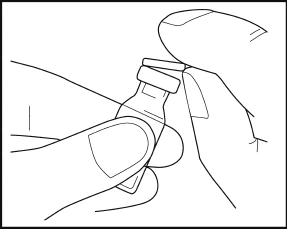
Step 3 – Disinfection of the rubber stopper
- Remove the removable plastic overcap from the vial. Do not use the vial if the green plastic overcap is missing.
- Clean the exposed part of the rubber stopper using one of the provided alcohol swabs and allow it to dry for several seconds.
- After cleaning, do not touch the rubber stopper and avoid contact with any surface.
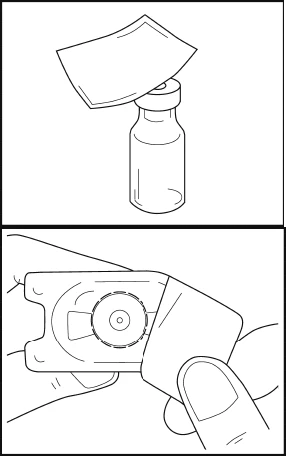
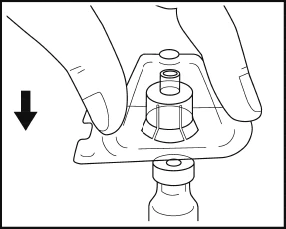
Step 4 – Application of the adapter
- Take the packaged vial adapter and remove the paper cover. Leave the adapter inside its open plastic packaging. Do not touch the adapter.
- Position the adapter over the vial, keeping it inside the plastic packaging.
- Press firmly downward until the adapter clicks into place; the tip of the adapter must pierce the vial stopper. Leave the adapter attached to the vial, still inside its outer packaging.
Step 5 – Preparation of the syringe
- Holding the syringe in one hand, break off the white cap with the other hand.
- Do not use the syringe if the white cap is missing, loose, or damaged.
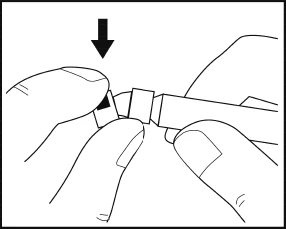
- Do not touch the tip of the syringe and avoid contact with any surface.
- Place the syringe on the clean, flat surface.
Step 6 – Connecting the syringe to the adapter and vial
- Take the vial with the attached adapter.
- Holding the vial in one hand, remove the plastic packaging from the adapter by pressing on the sides of the adapter packaging with the other hand, then lifting the packaging upward. Be careful not to detach the adapter from the vial.
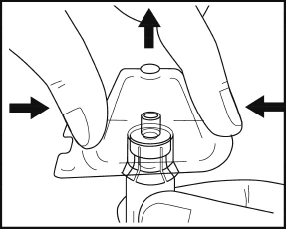
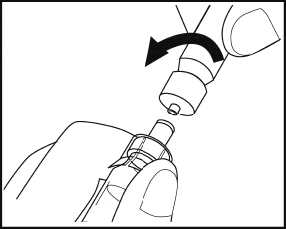
- Hold the adapter attached to the vial with one hand. Place the tip of the syringe onto the connector of the vial adapter.
- Securely lock the syringe to the vial by rotating it clockwise until resistance is felt.
Step 7 – Preparation of the solution
- Hold the vial vertically on the surface with the syringe pointing downward.
- Slowly push the plunger of the syringe all the way down until the syringe is empty. Do not remove the syringe from the vial.
- With the syringe still attached to the vial adapter, gently rotate the vial with the syringe attached until the powder is completely dissolved. Avoid foaming. Do not shake the vial.
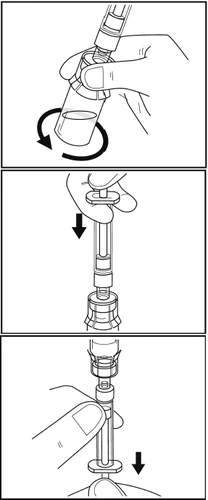
- Let the vial with the syringe attached rest on a surface for 5 minutes at room temperature to allow complete dissolution of the solution. The plunger may rise slightly on its own, which is normal.
- After these 5 minutes, proceed immediately to Step 8.
Step 8 – Withdrawal of the solution
- Inspect the solution for particles. The powder must be completely dissolved and the solution must be clear.
- Push the syringe plunger slowly all the way in.
- Invert the assembly of vial, adapter, and syringe.
- While holding it vertically, slowly pull back the plunger to transfer all the solution into the syringe. Do not shake it.
Step 9 – Preparation of the syringe for administration
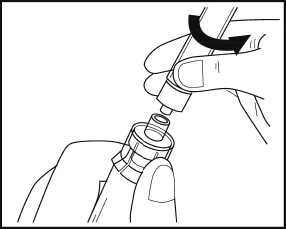
- Invert the assembly of vial, adapter, and syringe again, returning it to upright position (with the syringe on top). Detach the filled syringe from the adapter by holding the adapter in one hand and gently rotating the syringe counterclockwise.
- Dispose of the vial and attached adapter in an appropriate sharps disposal container.
- Do not touch the tip of the syringe and avoid contact with any surface. Place the syringe on the clean, flat surface.
- Proceed to Step 10 to inject caplacizumab subcutaneously into the abdomen. Instructions for healthcare professionals on how to administer Cablivi intravenously are provided at the end of this leaflet.
Step 10 – Attaching the needle
- Open the needle package by tearing off the paper cover and remove the needle with its protective cap.
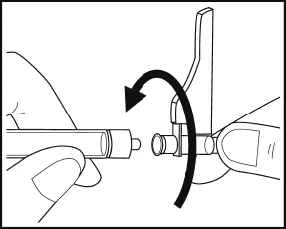
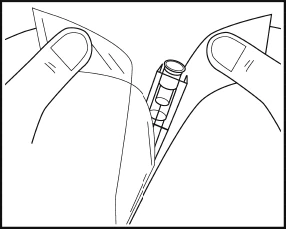
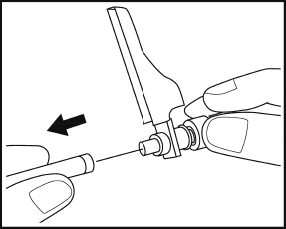
- Without removing the needle cap, attach the needle to the syringe by rotating it clockwise until resistance is felt.
- Pull back the needle safety device.
- Inspect the contents of the syringe. Do not use the medicine if it appears cloudy, contains particles, or shows any other visible abnormalities. If so, contact your doctor or nurse.
Step 11 – Preparation of the injection site for subcutaneous injection
- Select an appropriate site (“injection site”) on the abdomen for subcutaneous injection.
Avoid the area around the navel. Choose a different injection site than the one used the previous day to allow the skin to recover after the previous injection.
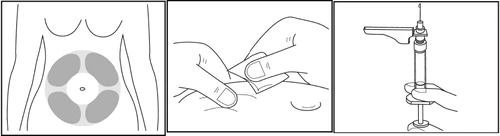
- Use the second alcohol swab to clean the selected injection site.
Step 12 – Administration
- Carefully remove the protective cap from the needle and discard it. Ensure the needle does not touch anything before injection.
- Hold the syringe at eye level with the needle pointing upward.
- Remove any air bubbles by gently tapping the side of the syringe with your finger so that bubbles rise to the tip. Then slowly push the plunger to expel a small amount of liquid from the needle.
- Gently pinch the cleaned skin between your thumb and index finger to form a skin fold.
- Keep holding the skin fold throughout the injection.
- Insert the needle fully into the skin fold at the angle shown in the figure.
- Push the plunger down completely.
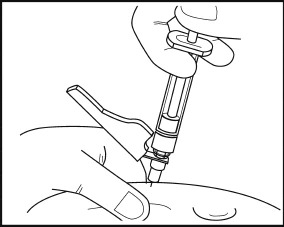
- Remove the needle at the same angle used for insertion. Do not rub the injection site.
Step 13 – After administration
- Immediately after the injection, slide the safety shield over the needle until it locks into place.
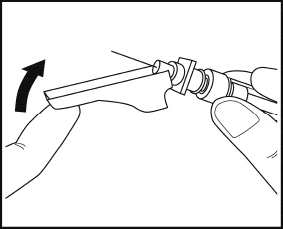
- Dispose of the syringe with the needle in a sharps disposal container.
If you use more Cablivi than you should
Overdose is unlikely because each vial contains only a single dose. Inform your doctor if you think you have received too much.
If you forget to use Cablivi
If you miss a dose, you may still take it within 12 hours of the scheduled time. If more than 12 hours have passed since the missed dose, do not take the missed dose; instead, administer the next dose at the scheduled time.
If you stop using Cablivi
To achieve the maximum benefit from treatment, it is important to use Cablivi as prescribed and for the full duration indicated by your doctor. Consult your doctor before stopping treatment, as premature discontinuation may cause the disease to reappear.
If you have any questions about the use of this medicine, consult your doctor or pharmacist.
4. Possible side effects
Like all medicines, this medicine can cause side effects, although not everybody gets them.
Contact your doctor immediately if you experience any of the following serious side effects.
Prolonged or excessive bleeding.
Your doctor may decide to monitor you closely or adjust your treatment.
In a clinical study, side effects were reported at the following frequencies:
Very common: may affect more than 1 in 10 people
- bleeding gums
- fever
- fatigue
- headache
- nosebleeds
- urticaria
Common: may affect up to 1 in 10 people
- eye bleeding
- vomiting blood
- blood in stools
- black, tarry stools
- stomach bleeding
- hemorrhoidal bleeding
- rectal bleeding
- injection site reactions: skin rash, itching, and bleeding
- brain bleeding shown by sudden severe headache, vomiting, reduced level of consciousness, fever, sometimes seizures and neck stiffness or neck pain
- muscle pain
- stroke
- blood in urine
- excessive menstrual bleeding
- vaginal bleeding
- coughing up blood
- shortness of breath
- bruising
Reporting of side effects
If you experience any side effect, including those not listed in this leaflet, talk to your doctor or pharmacist.
You can also report side effects directly via the national reporting system listed in Annex V. By reporting side effects, you can help provide more information on the safety of this medicine.
5. How to store Cablivi
Keep this medicine out of the sight and reach of children.
Do not use this medicine after the expiry date which is stated on the label and outer carton after "Exp.". The expiry date refers to the last day of that month.
Store in a refrigerator (2 °C – 8 °C). Do not freeze.
Keep the container in the original packaging to protect from light.
Cablivi may be stored at a temperature not exceeding 25 °C for a single period of up to 2 months, but not beyond the expiry date. Do not return Cablivi to the refrigerator after storage at room temperature. Never expose to temperatures above 30 °C.
Do not use Cablivi if you notice the presence of particles or changes in colour before administration.
Do not dispose of medicines via wastewater or household waste. Ask your pharmacist how to dispose of medicines no longer required. This will help protect the environment.
6. Package contents and other information
What Cablivi contains
- Vial with powder
- The active substance is caplacizumab. Each vial contains 10 mg of caplacizumab.
- The other components are: sucrose, anhydrous citric acid, trisodium citrate dihydrate (see section 2 “Cablivi contains sodium”), and polysorbate 80.
- Pre-filled syringe
- The pre-filled syringe contains 1 mL of water for injections.
Description of the appearance of Cablivi and contents of the pack
Cablivi is supplied as:
- white powder for solution for injection in a glass vial, and
- water for injections in a pre-filled syringe to dissolve the powder. After dissolving the powder in the solvent, the solution is clear, colourless or slightly yellowish.
Cablivi is available in:
- single packs, each containing 1 vial with caplacizumab powder, 1 pre-filled syringe containing solvent, 1 vial adapter, 1 needle, and 2 alcohol swabs;
- multiple packs, each containing 7 single packs;
- multiple packs, each containing 7 vials with caplacizumab powder, 7 pre-filled syringes containing solvent, 7 vial adapters, 7 needles, and 14 alcohol swabs.
Not all pack sizes may be marketed.
Marketing Authorisation Holder and Manufacturer
Ablynx NV
Technologiepark 21
9052 Zwijnaarde
Belgium
For further information about this medicinal product, please contact the local representative of the Marketing Authorisation Holder.
België/Belgique/Belgien Lietuva
Sanofi Belgium Swixx Biopharma UAB
Tél/Tel: +32 (0)2 710 54 00 Tel: +370 5 236 91 40
България Luxembourg/Luxemburg
Swixx Biopharma EOOD Sanofi Belgium
Тел.: +359 (0)2 4942 480 Tél/Tel: +32 (0)2 710 54 00 (Belgique/Belgien)
Česká republika Magyarország
Sanofi s.r.o. SANOFI-AVENTIS Zrt.
Tel: +420 233 086 111 Tel.: +36 1 505 0050
Danmark Malta
Sanofi A/S Sanofi S.r.l.
Tlf: +45 45 16 70 00 Tel: +39 02 39394275
Deutschland Nederland
Sanofi-Aventis Deutschland GmbH Sanofi B.V.
Tel.: 0800 04 36 996 Tel: +31 20 245 4000
Tel. aus dem Ausland: +49 69 305 70 13
Eesti Norge
Swixx Biopharma OÜ sanofi-aventis Norge AS
Tel: +372 640 10 30 Tlf: +47 67 10 71 00
Ελλάδα Österreich
sanofi-aventis Μονοπρόσωπη AEBE sanofi-aventis GmbH
Τηλ: +30 210 900 16 00 Tel: +43 1 80 185 – 0
España Polska
sanofi-aventis, S.A. Sanofi Sp. z o.o.
Tel: +34 93 485 94 00 Tel.: +48 22 280 00 00
France Portugal
Sanofi Winthrop Industrie Sanofi - Produtos Farmacêuticos, Lda.
Tél: 0 800 222 555 Tel: +351 21 35 89 400
Appel depuis l’étranger : +33 1 57 63 23 23
Hrvatska România
Swixx Biopharma d.o.o. Sanofi Romania SRL
Tel: +385 1 2078 500 Tel: +40 (0) 21 317 31 36
Ireland Slovenija
sanofi-aventis Ireland Ltd. T/A SANOFI Swixx Biopharma d.o.o.
Tel: +353 (0) 1 403 56 00 Tel: +386 1 235 51 00
Ísland Slovenská republika
Vistor hf. Swixx Biopharma s.r.o.
Sími: +354 535 7000 Tel: +421 2 208 33 600
Italia Suomi/Finland
Sanofi S.r.l. Sanofi Oy
Tel: 800 536389 Puh/Tel: +358 (0) 201 200 300
Κύπρος Sverige
C.A. Papaellinas Ltd. Sanofi AB
Τηλ: +357 22 741741 Tel: +46 (0)8 634 50 00
Latvija United Kingdom (Northern Ireland)
Swixx Biopharma SIA sanofi-aventis Ireland Ltd. T/A SANOFI
Tel: +371 6 616 47 50 Tel: +44 (0) 800 035 2525
More detailed information on this medicinal product is available on the European Medicines Agency website: http://www.ema.europa.eu/
The following information is intended for healthcare professionals only:
The intravenous bolus injection of Cablivi scheduled at the beginning of treatment must be
administered by a healthcare professional. Preparation of a dose of Cablivi for intravenous injection
must follow the same procedure as that for subcutaneous injection (see Instructions for Use, steps 1 to 9, in section 3).
Cablivi may be administered intravenously by connecting the prepared syringe to a
standard Luer Lock connection for intravenous lines or by using a suitable needle.
The line may be flushed with an injectable solution of sodium chloride 9 mg/mL (0.9%).