Busulfan Accord
Italy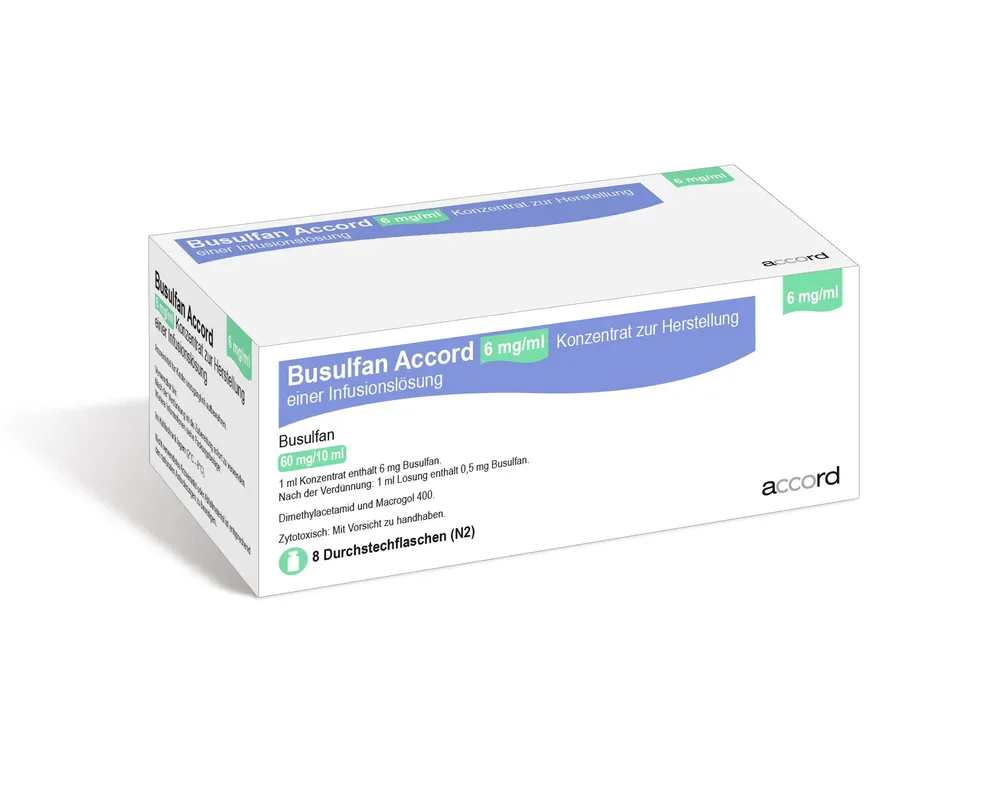
Table of Contents
Patient Information Leaflet
Busulfan Accord 6 mg/ml concentrate for solution for infusion
Generic medicine
Please read all of this leaflet carefully before you are given this medicine because it contains important information for you.
- Keep this leaflet. You may need to read it again.
- If you have any questions, ask your doctor.
- If you get any side effects, talk to your doctor. This includes any possible side effects not listed in this leaflet.
Contents of this leaflet:
- What Busulfan Accord is and what it is used for
- What you need to know before using Busulfan Accord
- How to use Busulfan Accord
- Possible side effects
- How to store Busulfan Accord
- Contents of the pack and other information
1 What Busulfan Accord is and what it is used for
Busulfan Accord contains the active substance busulfan, which belongs to a group of medicines called alkylating agents. Busulfan Accord destroys the original bone marrow prior to transplantation.
Busulfan Accord is used in adults, neonates, children and adolescents as conditioning treatment prior to transplant.
In adults, Busulfan Accord is used in combination with cyclophosphamide or fludarabine.
In neonates, children and adolescents, Busulfan Accord is used in combination with cyclophosphamide or melphalan.
You will be given this conditioning medicine before undergoing a bone marrow or haematopoietic stem cell transplant.
2 What you need to know before using Busulfan Accord
Do not use Busulfan Accord
- if you are allergic to busulfan or to any of the other ingredients of Busulfan Accord listed in section 6,
- if you are pregnant or suspect you may be pregnant.
Warnings and precautions
Busulfan Accord is a potent cytotoxic medicine that causes marked suppression of blood cells. At the prescribed dose, this is the intended effect. Therefore, careful monitoring will be carried out.
The use of Busulfan Accord may increase the risk of developing another tumour in the future.
You must inform your doctor:
- if you have problems with your liver, kidneys, heart or lungs,
- if you have had epileptic seizures,
- if you are taking any other medicines.
Blood clots in small blood vessels may occur following haematopoietic cell transplantation (HCT) with high-dose treatment such as yours in combination with other medicines.
Other medicines and Busulfan Accord
Tell your doctor if you are taking, have recently taken or might take any other medicines, including those not requiring a prescription; in particular, inform your doctor if you are taking deferasirox (a medicine used to remove excess iron from the body). Busulfan Accord may interact with other medicines.
Particular caution is required if you are taking itraconazole and metronidazole (used for certain types of infections) or ketobemidone (used for pain), as this could increase side effects.
The use of paracetamol within 72 hours before or during administration of Busulfan Accord should be done with caution.
Pregnancy, breast-feeding and fertility
If you are pregnant, suspect you may be pregnant, plan to become pregnant, or are breast-feeding, ask your doctor for advice before treatment with Busulfan Accord. Women must not become pregnant during treatment with Busulfan Accord and for 6 months after treatment.
Women must stop breast-feeding during treatment with Busulfan Accord.
Adequate contraceptive precautions must be taken when your partner is being treated with Busulfan Accord.
You may no longer be able to become pregnant (infertility) after treatment with busulfan.
If you wish to have children, discuss this with your doctor before starting treatment.
Busulfan Accord may also cause symptoms of menopause and, in pre-adolescent girls, may prevent the onset of puberty.
Men treated with Busulfan Accord are advised not to father a child during and for 6 months after treatment.
3. How to use Busulfan Accord
Dosage and administration:
The dose of Busulfan Accord will be calculated based on body weight.
In adults:
Busulfan Accord in combination with cyclophosphamide:
- The recommended dose of Busulfan Accord is 0.8 mg/kg.
- Each infusion will last 2 hours.
- Busulfan Accord will be administered every 6 hours for 4 consecutive days prior to transplantation.
Busulfan Accord in combination with fludarabine
- The recommended dose of Busulfan Accord is 3.2 mg/kg.
- Each infusion will last 3 hours.
- Busulfan Accord will be administered once daily for 2 or 3 consecutive days prior to transplantation.
In neonates, children and adolescents (from 0 to 17 years of age):
The recommended dose of Busulfan Accord in combination with cyclophosphamide or melphalan is based on body weight and ranges between 0.8 and 1.2 mg/kg.
- Each infusion will last 2 hours.
- Busulfan Accord will be administered every 6 hours for 4 consecutive days before transplantation.
Therapies prior to treatment with Busulfan Accord:
Before treatment with Busulfan Accord, you will be given:
- anticonvulsant medications to prevent seizures (phenytoin or benzodiazepines), and
- antiemetic medications to prevent vomiting.
4. Possible side effects
Like all medicines, this medicine can cause side effects, although not everyone experiences them.
Serious side effects:
The most serious side effects of busulfan therapy or following transplant procedures may include reduction in circulating blood cell counts (an intended effect of the medicine to prepare you for transplant infusion), infections, liver disorders including blockage of a vein in the liver, graft-versus-host disease (where the transplant attacks your body), and pulmonary complications. Your doctor will regularly monitor your blood cell counts and liver enzymes to detect and manage these events.
Other possible side effects may include:
Very common (may affect more than 1 in 10 people):
Blood: reduction in circulating blood cells (red and white blood cells) and platelets. Infections.
Nervous system: insomnia, anxiety, dizziness, and depression. Nutrition: loss of appetite, reduced levels of magnesium, calcium, potassium, phosphate, and albumin in the blood, and increased blood glucose. Cardiac: increased heart rate, increased or decreased blood pressure, vasodilation (a condition involving enlargement of blood vessel diameter), and blood clots. Respiratory: shortness of breath, nasal discharge (rhinitis), pharyngitis, cough, hiccups, nosebleeds, abnormal breathing sounds. Gastrointestinal: nausea, inflammation of the mucous membrane of the mouth, vomiting, abdominal pain, diarrhoea, constipation, heartburn, anal pain, fluid in the abdomen. Hepatic: enlarged liver, jaundice, blockage of a vein in the liver. Skin: skin rashes, itching, hair loss. Musculoskeletal: back pain, muscle and joint pain. Renal: increased creatinine excretion, difficulty urinating, reduced urine output, and blood in the urine. General disorders: fever, headache, weakness, chills, pain, allergic reactions, oedema, generalized pain or inflammation at the injection site, chest pain, inflammation of the mucous membranes. Clinical tests: increased liver enzymes and weight gain.
Common (may affect up to 1 in 10 people):
Nervous system: confusion, nervous system disorders. Nutrition: low sodium levels in the blood. Cardiac: changes and abnormalities in heart rhythm, fluid retention or inflammation around the heart, reduced cardiac output. Respiratory: increased respiratory rate, respiratory failure, alveolar haemorrhage, asthma, collapse of small areas of the lung, fluid around the lung. Gastrointestinal: inflammation of the oesophageal mucosa, intestinal paralysis, vomiting with blood. Skin: skin colour changes, skin redness, skin peeling. Renal: increased levels of nitrogen-containing compounds in the blood, moderate renal failure, kidney disorders.
Uncommon (may affect up to 1 in 100 people):
Nervous system: delirium, nervousness, hallucinations, agitation, abnormal brain function, cerebral haemorrhage, and seizures. Cardiac: femoral arterial thrombosis, extrasystoles, decreased heart rate, widespread leakage of fluid from capillaries (small blood vessels). Respiratory: decreased levels of oxygen in the blood. Gastrointestinal: bleeding in the stomach and/or intestines.
Not known (frequency cannot be estimated from available data):
Dysfunction of the sex glands.
Disorders of the lens, including clouding of the eye's lens (cataract) and blurred vision (corneal thinning).
Increased pressure in the blood vessels of the lungs (pulmonary hypertension).
Menopausal symptoms and female infertility.
Brain abscess, skin inflammation, generalized infection.
Liver disorders.
Increased lactate dehydrogenase in the blood.
Increased uric acid and urea in the blood.
Incomplete tooth development.
Reporting of side effects
If you experience any side effects, including those not listed in this leaflet, talk to your doctor or pharmacist.
By reporting side effects, you can help provide more information on the safety of this medicine.
You can also report side effects directly via the website: https://www.aifa.gov.it/content/segnalazioni-reazioni-avverse
5. How to store Busulfan Accord
Keep this medicine out of the sight and reach of children.
Do not use this medicine after the expiry date stated on the vial label and on the
packaging after "Exp.".
Unopened vials:
Store in a refrigerator (2°C–8°C).
Diluted solution:
Chemical and physical stability after dilution in 5% glucose solution for injection or 9 mg/ml (0.9%) sodium chloride solution for injection has been demonstrated for:
- 4 hours (including infusion time) after dilution when stored at 20°C–25°C
- 15 hours after dilution when stored at 2°C–8°C and subsequently kept for 3 hours at 20°C–25°C (including infusion time). Do not freeze.
From a microbiological point of view, the product should be used immediately after dilution. If this is not the case, the duration and conditions of storage prior to use are the responsibility of the user.
Do not dispose of any medicine via wastewater or household waste. Ask your pharmacist how to dispose of medicines you no longer use. This will help protect the environment.
6. Package contents and other information
What Busulfan Accord contains
- The active substance is busulfan. One ml of concentrate contains 6 mg of busulfan (60 mg per vial). After dilution: one ml of solution contains 0.5 mg of busulfan.
- The other components are dimethylacetamide and macrogol 400.
Description of the appearance of Busulfan Accord and contents of the pack
Busulfan Accord consists of a concentrate for solution for infusion, supplied in clear glass vials; each vial contains 60 mg of busulfan.
Busulfan Accord is a clear, colourless solution and is available in packs containing either 1 vial or 8 vials of 10 ml concentrate for infusion solution.
Not all pack sizes may be marketed.
Once diluted, Busulfan Accord is a clear, colourless solution.
Marketing Authorisation Holder and Manufacturer
Marketing Authorisation Holder
Accord Healthcare S.L.U.
World Trade Center,
Moll de Barcelona,
s/n, Edifici Est 6ª planta,
08039 Barcelona,
Spain
Manufacturers
Accord Healthcare Polska Sp.z o.o.,
ul. Lutomierska 50, 95-200 Pabianice,
Poland
Accord Healthcare Single Member S.A.
64th Km National Road Athens,
Lamia, Schimatari, 32009, Greece
This medicinal product is authorised in the Member States of the European Economic Area under the following names:
| Member State Name | Medicinal Product Name |
| Austria | Busulfan Accord 6 mg/ml concentrate for solution for infusion |
| Czech Republic | Busulfan Accord 6 mg/ml concentrate for solution for infusion |
| Germany | Busulfan Accord 6 mg/ml concentrate for solution for infusion |
| Spain | Busulfan Accord 6 mg/ml concentrate for solution for infusion |
| France | Busulfan Accord 6 mg/mL solution to be diluted for infusion |
| Hungary | Busulfan Accord 6 mg/ml concentrate for solution for infusion |
| Italy | Busulfan Accord |
| Poland | Busulfan Accord |
| Portugal | Busulfan Accord 6 mg/ml concentrate for solution for infusion |
| Romania | Busulfan Accord 6 mg/ml concentrate for solution for infusion |
| United Kingdom | Busulfan 6 mg/ml concentrate for solution for infusion |
The following information is intended exclusively for medical or healthcare personnel:
INSTRUCTIONS FOR PREPARATION
Busulfan Accord 6 mg/ml concentrate for solution for infusion
Read these instructions before preparing and administering Busulfan Accord.
1. PRESENTATION
Busulfan Accord is presented as a clear, colourless solution in 10 ml glass vials (type I).
Busulfan Accord must be diluted prior to administration.
2. RECOMMENDATIONS FOR SAFE HANDLING
Procedures for the proper handling and disposal of antineoplastic medicinal products must be observed.
All transfer procedures must be carried out under aseptic conditions, preferably within a laminar flow cabinet.
As with other cytotoxic products, caution must be exercised when handling and preparing the Busulfan Accord solution:
- Use of gloves and protective clothing is recommended.
- If the concentrate or diluted busulfan solution comes into contact with skin or mucous membranes, immediately and thoroughly wash with water.
Calculation of the amount of Busulfan Accord to be diluted and of the diluent
Busulfan Accord must be diluted before use either in sodium chloride 9 mg/ml (0.9%) injection solution or in 5% glucose injection solution.
The volume of diluent must be 10 times the volume of Busulfan Accord to ensure that the final concentration of busulfan is approximately 0.5 mg/ml.
For a patient weighing Y kg, the required amounts of Busulfan Accord and diluent should be calculated as follows:
- Amount of Busulfan Accord:
Y (kg) x D (mg/kg) = A ml of Busulfan Accord to be diluted
6 (mg/ml)
Y: patient's body weight in kg
D: busulfan dose (see Summary of Product Characteristics, section 4.2)
- Amount of diluent:
(A ml of Busulfan Accord) x (10) = B ml of diluent
To prepare the final infusion solution, add (A) ml of Busulfan Accord to (B) ml of diluent (sodium chloride 9 mg/ml (0.9%) injection solution or 5% glucose injection solution).
Preparation of the infusion solution
Busulfan Accord must be prepared by trained healthcare personnel using sterile transfer techniques.
- Use a syringe (not made of polycarbonate) with a needle:
- Withdraw the calculated volume of Busulfan Accord from the vial.
- Transfer the contents of the syringe into an intravenous bag (or syringe) already containing the calculated volume of selected diluent. Always add Busulfan Accord to the diluent; do not add diluent to Busulfan Accord. Do not add Busulfan Accord to an intravenous bag that does not already contain sodium chloride 9 mg/ml (0.9%) injection solution or 5% glucose injection solution.
- Mix the diluted solution thoroughly by agitation several times.
After dilution, 1 ml of infusion solution contains 0.5 mg of busulfan.
Diluted Busulfan Accord is a clear, colourless solution.
Instructions for use
Before and after each infusion, flush the permanent catheter line thoroughly with approximately 5 ml of sodium chloride 9 mg/ml (0.9%) injection solution or 5% glucose injection solution.
Do not rapidly infuse residual drug from the administration tubing, as rapid infusion of Busulfan Accord has not been tested and is not recommended.
The entire prescribed dose of Busulfan Accord must be administered over 2 or 3 hours, depending on the treatment regimen.
Small volumes may be administered using electric syringe pumps over 2 hours. In this case, use an infusion set with minimal priming volume (0.3–0.6 ml), which should be pre-filled with the solution before the start of actual infusion with Busulfan Accord, and then flushed with sodium chloride 9 mg/ml (0.9%) injection solution or 5% glucose injection solution.
Do not administer Busulfan Accord simultaneously with another intravenous solution.
Do not use polycarbonate syringes with Busulfan Accord.
For single use only. Must be used only if the solution is clear and free from suspended particles.
Storage conditions
Unopened vials:
Store in a refrigerator (2°C–8°C).
Diluted solution:
Chemical and physical in-use stability after dilution in 5% glucose injection solution or sodium chloride 9 mg/ml (0.9%) injection solution has been demonstrated for 4 hours (including infusion time) when stored at 20°C–25°C, or for 15 hours after dilution when stored at 2°C–8°C, followed by 3 hours at 20°C–25°C (including infusion time).
From a microbiological standpoint, the product should be used immediately.
- DISPOSAL PROCEDURES
Unused medicine and waste materials resulting from this medicine must be disposed of in accordance with local regulations governing cytotoxic medicinal products.