Budesonide Teva
Italy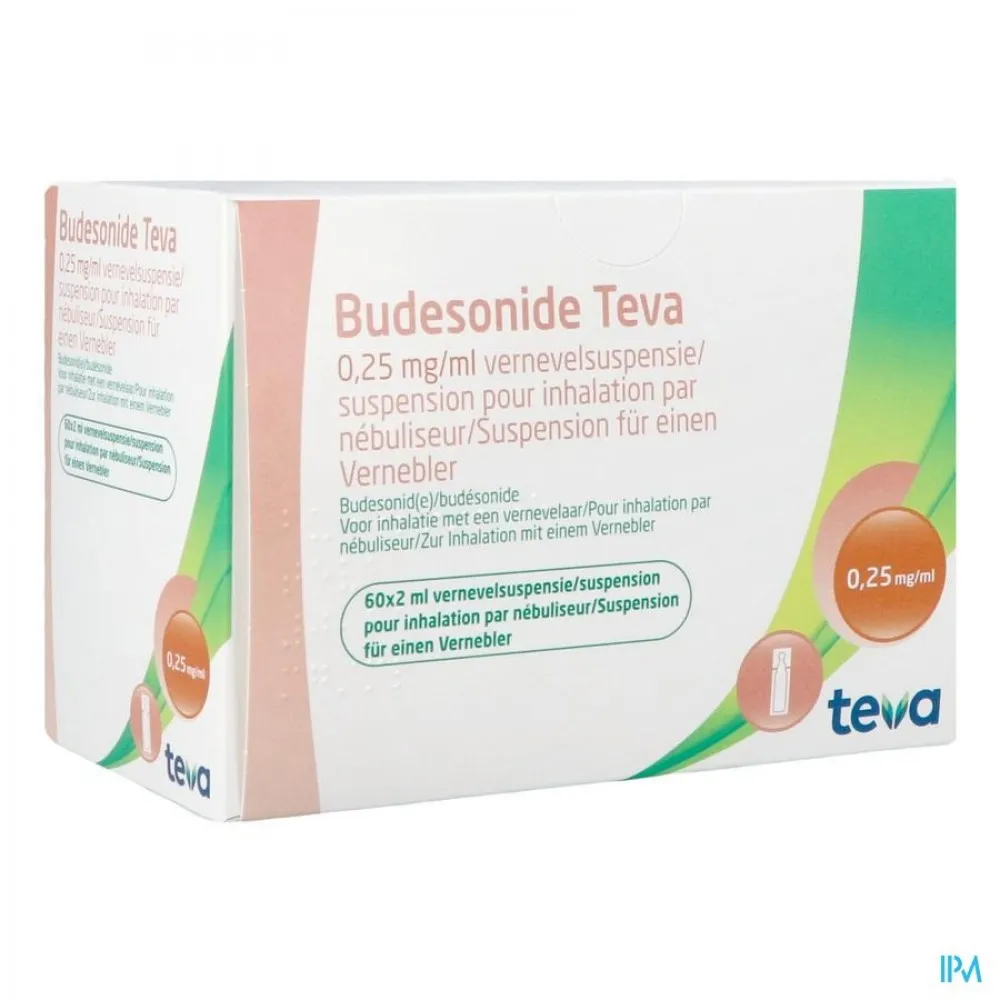
Table of Contents
- Package leaflet: Information for the patient
- Budesonide Teva 0.25 mg/ml suspension for nebuliser, 0.5 mg/ml suspension for nebuliser
- 1. What Budesonide Teva is and what it is used for
- 2. What you need to know before taking Budesonide Teva
- 3. How to take Budesonide Teva
- 4. Possible side effects
- 5. How to store Budesonide Teva
- 6. Package contents and other information
Package leaflet: Information for the patient
Budesonide Teva 0.25 mg/ml suspension for nebuliser, 0.5 mg/ml suspension for nebuliser
Budesonide
Equivalent medicine
Please read this leaflet carefully before using this medicine because it contains important information for you.
- Keep this leaflet. You may need to read it again.
- If you have any questions, ask your doctor or pharmacist.
- This medicine has been prescribed for you only. Do not give it to other people, even if their symptoms are the same as yours, because it may be harmful.
- If you experience any side effect, including those not listed in this leaflet, talk to your doctor or pharmacist. See section 4.
Contents of this leaflet:
- What Budesonide Teva is and what it is used for
- What you need to know before taking Budesonide Teva
- How to take Budesonide Teva
- Possible side effects
- How to store Budesonide Teva
- Contents of the pack and other information
1. What Budesonide Teva is and what it is used for
Budesonide Teva contains the active substance budesonide, an inhaled anti-asthma medicine that belongs to the group of medicines called glucocorticoids (corticosteroids and similar).
Budesonide Teva is indicated:
- for the treatment of bronchial asthma;
- for the treatment of severe croup (subglottic laryngitis, inflammation of the upper airways) requiring hospitalization.
Contact your doctor if you do not feel better or if you feel worse.
2. What you need to know before taking Budesonide Teva
Do not take Budesonide Teva
- if you are allergic to budesonide or to any of the other ingredients of this medicine (listed in section 6).
Warnings and precautions
Talk to your doctor or pharmacist before taking Budesonide Teva.
Budesonide Teva does not provide rapid improvement of acute asthma episodes, for which a short-acting bronchodilator is recommended.
Your doctor must carefully assess whether you are not benefiting from the use of short-acting bronchodilators or whether you are increasing the number of inhalations beyond the usual amount. In such cases, your doctor must evaluate the need to intensify anti-inflammatory therapy, for example by increasing the dose of inhaled budesonide or starting oral glucocorticosteroid therapy (corticosteroids such as cortisone or similar drugs).
If you have required emergency treatment with high-dose corticosteroids or prolonged treatment with inhaled corticosteroid doses higher than recommended, you may be at risk of adrenal suppression (inhibition of certain glands producing various hormones, including one similar to cortisone). If exposed to severe stress, you may develop signs and symptoms of adrenal insufficiency. Additional systemic corticosteroid treatment should be considered during periods of stress or surgical procedures.
Particular attention must be paid when switching from systemic glucocorticosteroid therapy to inhaled therapy, as the risk of adrenal impairment may persist for a long period of time.
During this period of suppression of the hypothalamic-pituitary-adrenal axis (the regulatory pathway controlling adrenal gland function), you may experience signs and symptoms of adrenal insufficiency if exposed to trauma, surgery, infections (especially gastroenteritis), or other conditions associated with significant electrolyte loss (salts). During such episodes, Budesonide Teva suspension for nebulization, at the recommended doses, is able to control asthma symptoms, but does not restore physiological levels of circulating glucocorticosteroids and does not provide sufficient mineralocorticoid activity (one of the functions of the adrenal glands) to cope with emergencies.
During the phase of tapering systemic glucocorticosteroid therapy, some patients may experience general malaise despite improved lung function, such as muscle and joint pain. General glucocorticosteroid insufficiency should be suspected in rare cases where symptoms such as fatigue, headache, nausea, and vomiting occur. In such cases, a temporary increase in oral glucocorticosteroid dose may sometimes be necessary. Your doctor will evaluate whether it is better for you to continue Budesonide Teva therapy while monitoring your health status, or, in case of evident adrenal insufficiency, to switch to Budesonide Teva suspension for nebulization more gradually. During periods of stress or during a severe asthma attack, if you are replacing oral steroid treatment with inhaled therapy, you may require additional systemic corticosteroid treatment.
Replacing systemic steroid therapy with inhaled therapy may sometimes unmask previously controlled allergies, such as rhinitis (cold-like symptoms with runny nose) or eczema (a type of dermatitis). These allergic manifestations can be symptomatically managed with antihistamines and/or locally applied preparations.
Systemic effects may occur with inhaled corticosteroids, particularly when prescribed at high doses over prolonged periods. These effects are less likely than with oral corticosteroid therapy. Possible systemic effects include: Cushing's syndrome (with obesity, increased blood pressure and blood sugar), Cushingoid appearance (facial swelling, abdominal obesity), adrenal suppression, growth retardation in children and adolescents, reduced bone mineral density, cataracts, and glaucoma (eye problems), and, more rarely, a range of psychological or behavioral effects including psychomotor hyperactivity, sleep disturbances, anxiety, depression, or aggression (particularly in children).
Therefore, the dose of inhaled corticosteroid should be the lowest possible dose that maintains effective asthma control.
Impaired liver function affects the elimination of corticosteroids, resulting in slower clearance and higher systemic exposure. Inform your doctor if your liver function is severely impaired. In such cases, the possibility of systemic side effects should be considered.
Concomitant use of ketoconazole (used for fungal infections), HIV protease inhibitors (used in the treatment of HIV infection), or other potent inhibitors of CYP3A4 (a liver enzyme involved in drug metabolism) should be avoided. If this is not possible, the longest possible interval should be maintained between the two treatments (see section “Other medicines and Budesonide Teva”).
During inhaled corticosteroid therapy, oral candidiasis (presence of "fungi" in the oral cavity, with appearance of whitish patches) may occur. This infection may require appropriate antifungal treatment, and in some patients, discontinuation of therapy may be necessary (see section “How to take Budesonide Teva”).
As with other inhaled therapies, budesonide administration may be associated with paradoxical bronchospasm (unexpected bronchial constriction), characterized by an immediate increase in wheezing shortly after inhaling budesonide. If this occurs, treatment with budesonide must be immediately stopped, the patient reassessed, and, if necessary, an alternative therapy prescribed.
Special caution is required if you have active or quiescent pulmonary tuberculosis, or if you have fungal or viral respiratory infections. Budesonide Teva should be used with caution in patients with fungal or viral infections (such as measles or chickenpox) and in those with glaucoma (an eye disease caused by increased pressure of the fluid inside the eye) or cataracts (clouding of the lens of the eye, which focuses images).
Contact your doctor if you experience blurred vision or other visual disturbances.
Children and adolescents
Budesonide Teva should be used with caution in children.
Effect on growth
Regular monitoring of height is recommended in children undergoing prolonged inhaled corticosteroid therapy. If growth is slowed, therapy should be re-evaluated with the aim of reducing the inhaled corticosteroid dose. The benefits of corticosteroid therapy and the potential risks of growth suppression must be carefully weighed. In addition, consideration should be given to referring the patient to a pediatric pulmonology specialist.
Other medicines and Budesonide Teva
Inform your doctor or pharmacist if you are taking, have recently taken, or might take any other medicines, including those obtained without a prescription.
In particular:
- certain medicines may increase the effects of Budesonide Teva, and your doctor may wish to monitor you closely if you are taking these medicines (including some HIV treatments: ritonavir, cobicistat);
- inhibitors of the CYP3A4 enzyme such as ketoconazole and itraconazole (used for fungal infections) and HIV protease inhibitors may increase systemic exposure to budesonide several-fold; see section “Warnings and precautions”. The combination of these medicines should be avoided. If this is not possible, the longest possible interval should be maintained between the two treatments, and a reduction in the budesonide dose may be considered;
- estrogens and steroid contraceptives. Women treated with estrogens and steroid contraceptives show no observed interaction when taking budesonide concomitantly with low-dose oral contraceptives.
No interactions have been observed between budesonide and any other drugs used in asthma treatment.
Due to adrenal suppression, the ACTH stimulation test, used to diagnose adrenal insufficiency, may yield false-negative results (low values).
Pregnancy and breastfeeding
If you are pregnant, think you may be pregnant, planning pregnancy, or breastfeeding, consult your doctor or pharmacist before taking this medicine.
It is important for both mother and fetus to maintain adequate asthma treatment during pregnancy.
Pregnancy
Taking budesonide during pregnancy requires a careful assessment of the therapeutic benefits for the mother against potential risks for the fetus.
Breastfeeding
Budesonide passes into breast milk.
However, at therapeutic doses of budesonide, effects on the breastfed infant are not expected.
Budesonide may be used during breastfeeding.
Budesonide Teva contains polysorbate 80: polysorbates may cause allergic reactions.
Driving and using machines
Budesonide Teva does not affect the ability to drive vehicles or operate machinery.
Caution for athletes: the product contains substances prohibited for doping. It is forbidden to take the medicine in a manner different from that indicated for therapeutic indications, dosage regimen, or route of administration as specified.
3. How to take Budesonide Teva
Take this medicine exactly as directed by your doctor or pharmacist. If you have
any doubts, consult your doctor or pharmacist.
Bronchial asthma
Initial dose
The dosage of Budesonide Teva nebulizer suspension is individual.
Children over 3 months and up to 12 years of age:
The recommended initial dose is 0.25–0.5 mg twice daily. In some cases, the dose may be further increased
up to 1 mg twice daily (this higher dose will be prescribed by the doctor only in case of severe asthma and for
limited periods of time).
Adults and elderly:
The recommended initial dose is 0.5–1 mg twice daily. If necessary, the dose may be further increased.
When a greater therapeutic effect is required, higher doses of Budesonide Teva nebulizer suspension may be administered; indeed, the risk of systemic effects is low compared to that observed with oral glucocorticosteroid therapy.
Maintenance dose:
The maintenance dose is individual.
Once the desired clinical response has been achieved, the maintenance dose should be gradually reduced to the lowest amount necessary to control symptoms.
Improvement in asthma may occur within 3 days of starting treatment, although maximum benefit is usually achieved after 2–4 weeks.
PATIENTS TREATED WITH ORAL STEROIDS (see “Warnings and precautions”)
Budesonide Teva may allow replacement or significant reduction of the dosage of oral glucocorticosteroids, while maintaining control of asthma. When switching from oral steroid therapy to Budesonide Teva, the patient should be in a relatively stable phase. A high dose of Budesonide Teva should be administered concomitantly with the previously used oral steroid dose for approximately 10 days. After this period, the oral steroid dose should be gradually reduced (for example, by 2.5 mg of prednisolone or equivalent per month) to the lowest possible level. In many cases, complete substitution of oral steroids with Budesonide Teva is possible.
For further information on corticosteroid withdrawal, see the section “Warnings and precautions”.
DOSE TABLE
| Dosage in mg | Volume of Budesonide Teva Suspension for nebulizer | |
| 0.25 mg/ml | 0.5 mg/ml | |
| 0.25 0.5 0.75 1 1.5 2 | 1 ml* 2 ml 3 ml - - - |
|
* The medicinal product must be mixed with 0.9% sodium chloride solution to obtain a volume of 2 ml.
Subglottic laryngitis (croup)
In infants and children affected by croup (inflammation of the upper respiratory tract), the commonly used dose is 2 mg of nebulized budesonide. This dose may be administered as a single dose or as two 1 mg doses given 30 minutes apart. Administration may be repeated every 12 hours for up to 36 hours or until clinical improvement occurs.
Information for the correct use of Budesonide Teva - To achieve optimal delivery of budesonide,
a compressor providing a flow rate of 5 to 8 l/min and a filling volume of 2–4 ml is required.
The medicinal product must be used with a jet nebulizer. The aerosol generated by the nebulizer should be inhaled through the mouth via a mouthpiece or an appropriate face mask.
For children, it is recommended to use a well-fitting, airtight face mask to optimize the delivered dose of budesonide.
Due to the low amount of budesonide, ultrasonic nebulizers should not be used for administering Budesonide Teva nebulizer suspension.
Instructions for using Budesonide Teva nebulizer suspension
Gently shake the vial with a rotating motion.
- Hold the container in an upright position and open it by twisting the tab until the container opens.
- Insert the open end of the container well into the nebulizer reservoir and press slowly.
In the Budesonide Teva 0.25 mg/ml nebulizer suspension and Budesonide Teva 0.5 mg/ml nebulizer suspension containers, a line is clearly visible. When the container is held upside down, this line indicates a volume of 1 ml.
If only 1 ml is required, empty the vial until the liquid surface reaches the marked line.
Store the container with the remaining suspension protected from light.
Use the remaining suspension within 12 hours.
Before using the remaining liquid, carefully shake the container with a rotating motion.
After opening the aluminum foil pouch, the containers remain stable for 3 months and must be kept in the pouch, protected from light.
Notes on the correct use of the medicinal product: - To reduce the risk of oral and pharyngeal candidiasis, rinse the mouth with water after each administration.
- If a face mask is used, ensure that the mask fits properly during nebulization. Wash the face with water after treatment to prevent irritation.
- Before turning on the nebulizer, carefully read the instructions for use provided in the package leaflet included in each nebulizer package. If you have any doubts about using the nebulizer, consult your doctor or pharmacist.
Cleaning the nebulizer after use of the medicinal product
The nebulizer chamber should be cleaned after each administration. Wash the nebulizer chamber, mouthpiece, or face mask with warm tap water using a mild detergent, or follow the manufacturer's instructions. Rinse thoroughly and dry the chamber by reassembling it with the compressor and inhaler.
If you use more Budesonide Teva than you should
Acute overdose with Budesonide Teva nebulizer suspension, even at high doses, is unlikely to cause clinical problems.
However, chronic use of excessive doses may lead to systemic glucocorticosteroid effects such as Cushing's syndrome (excessive levels in the blood of cortisone-like hormones) and adrenal suppression.
In case of accidental ingestion/overdose of Budesonide Teva, contact your doctor immediately or go to the nearest hospital.
If you have any doubts about the use of this medicinal product, consult your doctor or pharmacist.
4. Possible side effects
Like all medicines, this medicine can cause side effects, although not everybody gets them.
The following are the side effects listed in order of frequency of occurrence:
Common (may affect up to 1 in 10 people)
- Candida infections of the oropharynx (fungal infection of the mouth and throat) (see section “How to take Budesonide Teva”);
- cough, hoarseness (lowered voice), throat irritation;
- nausea;
- pneumonia (lung infection) in patients with COPD. Inform your doctor if you experience any of the following symptoms while taking budesonide, as they could be signs of a lung infection:
- fever or chills;
- increased mucus production, changes in mucus colour;
- worsening cough or increased breathing difficulties.
Uncommon (may affect up to 1 in 100 people)
- blurred vision;
- anxiety;
- depression;
- tremor;
- cataract (clouding of the lens of the eye, the structure responsible for focusing images);
- muscle spasms.
Rare (may affect up to 1 in 1,000 people)
- immediate and delayed hypersensitivity* reactions including rashes, contact dermatitis (skin inflammation typically presenting with redness, blisters, sores, abrasions, and crusts), urticaria (red, itchy skin eruptions), angioedema (localized swelling), and anaphylactic reactions (severe allergic reactions);
- restlessness, nervousness, behavioural disturbances;
- bronchospasm (narrowing of the airways), dysphonia (difficulty producing voice), hoarseness (when the voice sounds harsh or low);
- bruising, cutaneous striae (skin streaks resembling stretch marks, red-purple in colour);
- bronchospasm (narrowing of the bronchi causing breathing difficulties due to reduced airflow);
- signs and symptoms of systemic glucocorticoid effects (i.e. when taken orally, intramuscularly, or intravenously), including adrenal suppression (severe impairment of adrenal gland function).
Not known (cannot be estimated from the available data)
- sleep disorder, psychomotor hyperactivity, aggression;
- glaucoma (eye disease caused by increased pressure of the fluid inside the eye).
*Facial skin irritation, as an example of hypersensitivity reaction, has occurred in some cases following the use of a facial mask for nebulization. To prevent irritation, the facial skin should be washed with water after using the facial mask.
There is an increased risk of pneumonia in patients diagnosed with COPD (chronic obstructive pulmonary disease) who are being treated with inhaled corticosteroids.
Additional side effects in children and adolescents
Rare (may affect up to 1 in 10,000 patients)
- signs and symptoms of systemic corticosteroid effects, including hypothalamic-pituitary-adrenal (HPA) axis suppression and growth retardation**;
- dysphonia (difficulty producing voice), hoarseness (when the voice sounds harsh or low);
- behavioural disturbances.
** Due to the risk of growth retardation in the paediatric population, growth should be monitored as described in the section “Warnings and precautions”.
Reporting of side effects
If you experience any side effect, including those not listed in this leaflet, talk to your doctor, pharmacist, or nurse. You may also report side effects directly via the national reporting system at https://www.aifa.gov.it/content/segnalazioni-reazioni-avverse. By reporting side effects, you can help provide more information on the safety of this medicine.
5. How to store Budesonide Teva
Keep this medicine out of the sight and reach of children.
Do not use this medicine after the expiry date stated on the packaging. The expiry date refers to the product in its original intact packaging, correctly stored (containers enclosed in an aluminium pouch).
After opening the aluminium pouch, the containers contained therein are valid for 3 months.
The shelf life after first opening of the container is 12 hours.
Store in the original packaging to protect the medicine from light.
Do not refrigerate or freeze.
Do not dispose of medicines via wastewater or household waste. Ask your pharmacist how to dispose of medicines you no longer use. This will help protect the environment.
6. Package contents and other information
What Budesonide Teva contains
Budesonide Teva 0.25 mg/ml suspension for nebuliser
- The active substance is budesonide. One single-dose container contains 0.5 mg of budesonide.
- The other components are: citric acid monohydrate, polysorbate 80, disodium edetate, sodium chloride, sodium citrate, water for injections.
Budesonide Teva 0.5 mg/ml suspension for nebuliser
- The active substance is budesonide. One single-dose container contains 1 mg of budesonide.
- The other components are: citric acid monohydrate, polysorbate 80, disodium edetate, sodium chloride, sodium citrate, water for injections.
Description of the appearance of Budesonide Teva and package contents
Suspension for nebuliser
- Budesonide Teva 0.25 mg/ml: each pack contains 4 aluminium pouches; each pouch contains 5 single-dose containers of 2 ml, for a total of 20 containers.
- Budesonide Teva 0.5 mg/ml: each pack contains 4 aluminium pouches; each pouch contains 5 single-dose containers of 2 ml, for a total of 20 containers.
Marketing Authorisation Holder and Manufacturer
Marketing Authorisation Holder
Teva Italia S.r.l. - Piazzale Luigi Cadorna, 4 - 20123 Milano (Italy)
Manufacturer
Merckle GmbH
Ludwig-Merckle-Str. 3
89143 Blaubeuren
Germany