Brinzolamide Sandoz
Italy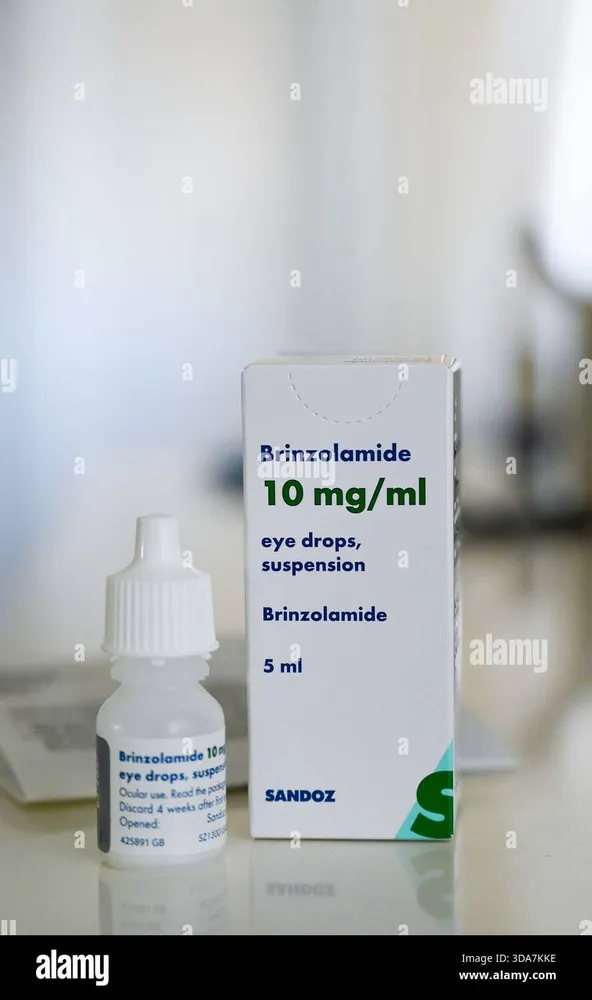
Table of Contents
- Patient Information Leaflet
- Brinzolamide Sandoz 10 mg/ml eye drops, suspension
- 1. What Brinzolamide Sandoz is and what it is used for
- 2. What you should know before using Brinzolamide Sandoz
- 3. How to use Brinzolamide Sandoz
- 4. Possible side effects
- 5. How to store Brinzolamide Sandoz
- 6. Package contents and other information
Patient Information Leaflet
Brinzolamide Sandoz 10 mg/ml eye drops, suspension
Read this entire leaflet carefully before using this medicine because it contains important information for you.
- Keep this leaflet. You may need to read it again.
- If you have any questions, ask your doctor or pharmacist.
- This medicine has been prescribed for you only. Do not give it to others, even if they have the same symptoms as yours, because it could be harmful.
- If you experience any side effects, including those not listed in this leaflet, tell your doctor or pharmacist. See section 4.
Contents of this leaflet:
- What Brinzolamide Sandoz is and what it is used for
- What you need to know before using Brinzolamide Sandoz
- How to use Brinzolamide Sandoz
- Possible side effects
- How to store Brinzolamide Sandoz
- Contents of the pack and other information
1. What Brinzolamide Sandoz is and what it is used for
Brinzolamide Sandoz contains brinzolamide, which belongs to a group of medicines called
carbonic anhydrase inhibitors. It reduces pressure in the eye.
Brinzolamide Sandoz eye drops is used to treat elevated pressure in the eye. This
condition can lead to a disease called glaucoma.
If the pressure in the eye is too high, it may damage vision.
2. What you should know before using Brinzolamide Sandoz
Do not use Brinzolamide Sandoz
- if you have severe kidney problems.
- if you are allergic to brinzolamide or to any of the other ingredients of this medicine (listed in section 6).
- if you are allergic to sulphonamide medicines. Examples include medicines used to treat diabetes, infections, and also diuretics (water tablets). Brinzolamide Sandoz may cause the same allergic reaction.
- if you have too much acid in your blood (a condition called hyperchloremic acidosis).
If you have any doubts, ask your doctor.
Warnings and precautions
Talk to your doctor or pharmacist before using Brinzolamide Sandoz
- if you have kidney or liver problems.
- if you have dry eyes or corneal problems.
- if you are taking other sulphonamide medicines.
Children and adolescents
Brinzolamide Sandoz must not be used in newborns, children or adolescents under 18 years of age unless advised by a doctor.
Other medicines and Brinzolamide Sandoz
Tell your doctor or pharmacist if you are taking, have recently taken or might take any other medicines, including medicines you have bought without a prescription.
If you are taking another carbonic anhydrase inhibitor (acetazolamide or dorzolamide, see section 1 “What Brinzolamide Sandoz is and what it is used for”), consult your doctor.
Pregnancy and breastfeeding
If you are pregnant, think you might be pregnant, planning to become pregnant, or breastfeeding, ask your doctor or pharmacist for advice before using this medicine.
Women of childbearing age are advised to use an effective method of contraception during treatment with Brinzolamide Sandoz. The use of Brinzolamide Sandoz is not recommended during pregnancy or breastfeeding. Do not use Brinzolamide Sandoz unless specifically instructed by your doctor.
Ask your doctor or pharmacist for advice before using any medicine.
Driving and using machines
Do not drive or operate machinery until your vision is clear. Your vision may be blurred for a short time after using Brinzolamide Sandoz.
Brinzolamide Sandoz may reduce your ability to perform tasks requiring mental alertness and/or physical coordination. If you experience such symptoms, take care when driving or using machinery.
Brinzolamide Sandoz contains benzalkonium chloride
This medicine contains 0.10 mg of benzalkonium chloride per ml.
Benzalkonium chloride may be absorbed by soft contact lenses and may cause a change in their colour. Remove contact lenses before using this medicine and wait 15 minutes before reinserting them.
Benzalkonium chloride may also cause eye irritation, especially if you have dry eyes or corneal disorders (the transparent outermost layer of the eye). If you experience any unusual sensation in the eye, such as burning or pain, after using this medicine, speak with your doctor.
3. How to use Brinzolamide Sandoz
Use this medicine exactly as directed by your doctor or pharmacist. If you have
any doubts, consult your doctor or pharmacist.
Use Brinzolamide Sandoz only in your eyes. Do not swallow it and do not inject it.
The recommended dose is 1 drop in the affected eye(s), twice daily – morning and evening.
Use this dose unless your doctor prescribes a different one. Use Brinzolamide
Sandoz in both eyes only if prescribed by your doctor. Use the medicine for the length of
time recommended by your doctor.
How to use it
Take the Brinzolamide Sandoz bottle and a mirror.
- Wash your hands.
- Shake the bottle and unscrew the cap. After removing the cap, if the safety ring has loosened, remove it before using the product.
- Hold the bottle between your thumb and middle finger, with the tip pointing downwards.
- Tilt your head backwards. Pull down the lower eyelid with a clean finger to create a "pocket" between the eyelid and the eye. The drop should fall into this pocket (figure 1).
- Hold the tip of the bottle close to the eye. Use the mirror if it helps.
- Do not touch the eye, eyelid, surrounding areas, or any other surfaces with the tip of the bottle. This could contaminate the eye drops.
- Gently press the base of the bottle to release one drop of Brinzolamide Sandoz at a time.
- Do not squeeze the bottle: it is specifically designed so that gentle pressure on the base is sufficient (figure 2).
- After using Brinzolamide Sandoz, press with your finger on the inner corner of the eye, near the nose (figure 3), for at least 1 minute. This prevents Brinzolamide Sandoz from spreading into the rest of the body.
- If you need to apply the eye drops to both eyes, repeat the steps for the other eye.
- Immediately replace the cap after use.
- Finish one bottle before opening the next.
If a drop does not enter the eye, try again.
If you are also using another eye drop at the same time, wait at least 5 minutes between instilling
Brinzolamide Sandoz and the other eye drop.
Ophthalmic ointments should be used last.
If you use more Brinzolamide Sandoz than you should
If you have instilled too many eye drops, rinse your eye immediately with lukewarm water. Do not use the drops again until it is time for your next scheduled dose.
If you forget to use Brinzolamide Sandoz
Instill one drop as soon as you remember, then return to your regular dosing schedule. Do not use
a double dose to make up for the missed dose.
If you stop using Brinzolamide Sandoz
If you stop using Brinzolamide Sandoz without consulting your doctor, your intraocular pressure may no longer be controlled and this could lead to loss of vision.
4. Possible side effects
Like all medicines, this medicine can cause side effects, although not everyone gets them.
The following side effects have been observed with Brinzolamide Sandoz.
Common side effects (may affect up to 1 in 10 people):
Eye-related effects: blurred vision, eye irritation, eye pain, eye discharge, eye itching, dry eyes, eye discomfort, eye redness.
General side effects: bitter taste in mouth.
Uncommon side effects (may affect up to 1 in 100 people):
Eye-related effects: light sensitivity, conjunctival inflammation or infection, eye swelling, itching, eyelid redness or swelling, abnormal growth on the eye surface, increased eye pigmentation, eye fatigue, crusting at the eyelid edge, or increased tearing.
General side effects: reduced or decreased cardiac function, palpitations, reduced heart rate, breathing difficulty, shortness of breath, cough, decreased number of red blood cells in the blood, increased blood chloride levels, dizziness, drowsiness, memory difficulty, depression, nervousness, generalized weakness, fatigue, abnormal sensation, pain, tremor, decreased sexual drive, male sexual dysfunction, cold-like symptoms, chest congestion, nasal cavity infection, throat irritation, sore throat, increased or decreased mouth sensitivity, esophagitis, abdominal pain, nausea, vomiting, stomach discomfort, frequent bowel movements, diarrhea, intestinal gas, indigestion, kidney pain, muscle pain, muscle spasms, back pain, nosebleed, runny nose, nasal congestion, sneezing, skin rash, abnormal skin sensation, itching, headache, dry mouth.
Rare side effects (may affect up to 1 in 1,000 people):
Eye-related effects: corneal swelling, double or reduced vision, abnormal vision, decreased eye sensation, swelling around the eye, increased intraocular pressure, optic nerve damage.
General side effects: memory disorders, drowsiness, chest pain, upper respiratory tract congestion, sinus congestion, nasal congestion, dry nose, ringing in the ears, hair loss, generalized itching, nervous sensation, irritability, irregular heartbeat, weakness, sleep disturbances.
Not known (frequency cannot be estimated from the available data)
Eye-related effects: eyelid abnormalities, visual disturbances, corneal disorders, eye allergy, decreased growth or number of eyelashes.
General side effects: increased allergic symptoms, decreased sensitivity, tremor, loss or decrease of taste sensation, decreased blood pressure, increased blood pressure, increased heart rate, joint pain, asthma, limb pain, skin redness, inflammation, or itching, changes in liver function blood tests, limb swelling, frequent urination, decreased appetite.
Reporting of side effects
If you experience any side effect, including those not listed in this leaflet, talk to your doctor or pharmacist. You can also report side effects directly via the national reporting system at www.aifa.gov.it/content/segnalazioni-reazioni-avverse.
By reporting side effects, you can help provide more information on the safety of this medicine.
5. How to store Brinzolamide Sandoz
Keep this medicine out of the sight and reach of children.
Do not use Brinzolamide Sandoz after the expiry date stated on the bottle and on the carton after
"Exp". The expiry date refers to the last day of that month.
This medicine does not require any special storage conditions.
The bottle should be discarded four weeks after first opening, to prevent infection.
Write in the space below and in the space on the label of the bottle and on the carton the opening date of each bottle. For the pack containing 1 bottle, write only one date.
Opening (1):
Opening (2):
Opening (3):
Do not dispose of any medicine via wastewater or household waste. Ask your pharmacist how to dispose of medicines you no longer use. This will help protect the environment.
6. Package contents and other information
What Brinzolamide Sandoz contains
The active substance is brinzolamide 0.33 mg per drop, equivalent to 10 mg/mL.
The other components are: benzalkonium chloride, disodium edetate, mannitol (E421), carbomer 974P,
tyloxapol, sodium chloride, sodium hydroxide and/or hydrochloric acid (to adjust pH), and purified water.
Description of the appearance of Brinzolamide Sandoz and contents of the pack
Brinzolamide Sandoz is a white to almost white suspension, contained in plastic bottles of 5 mL or 10 mL (LDPE bottles with LDPE dropper and tamper-evident polypropylene screw cap (DROPTAINER)).
Pack sizes available are: outer carton containing bottles of 1 x 5 mL, 3 x 5 mL, and 1 x 10 mL.
Not all pack sizes may be marketed.
Marketing Authorization Holder
Sandoz S.p.A., L.go U. Boccioni 1, 21040 Origgio (VA), Italy
Manufacturers
Lek Pharmaceuticals d.d.
Verovškova 57, 1526 Ljubljana
Slovenia
sa Alcon-Couvreur nv
Rijksweg 14, B-2870 Puurs
Belgium
Alcon Cusi S.A.
Camil Fabra 58, 08320 El Masnou, Barcelona
Spain
Aeropharm GmbH
Francois-mitterrand-allee 1, 07407 Rudolstadt
Germany
Salutas Pharma GmbH
Otto-von-Guericke-Allee 1, 39179 Barleben
Germany
This medicinal product is authorised in the Member States of the European Economic Area under the following names:
Netherlands: Brinzolamide Sandoz 10 mg/mL, oogdruppels, suspensie
Belgium: Brinzolamid Sandoz 10 mg/mL oogdruppels, suspensie
Austria: Brinzolamid Sandoz 10 mg/mL - Augentropfensuspension
Germany: Brinzolamid HEXAL 10 mg/mL Augentropfensuspension
Denmark: Brinzolamide “Sandoz”
Spain: Brinzolamida Sandoz 10 mg/mL colirio en suspensión
Finland: Brinzolamide Sandoz 10 mg/mL silmätipat, suspensio
France: BRINZOLAMIDE SANDOZ 10 mg/mL, collyre en suspension
Ireland: Brinzolomide Sandoz 10 mg/mL eye drops suspension
Italy: Brinzolamide Sandoz
Luxembourg: Brinzolamid Sandoz 10 mg/mL collyre en suspension
Norway: Brinzolamide Sandoz
Poland: Brinzolamide Sandoz
Portugal: Brinzolamida Sandoz 10 mg/mL, Colirio, suspensao
Sweden: Brinzolamide Sandoz 10 mg/mL ögondroppar, suspension
Slovakia: Brinzolamid Sandoz 10 mg/mL ocná suspenzná instilácia
Malta: Brinzolamide 10 mg/mL eye drops, suspension