Brinavess
Italy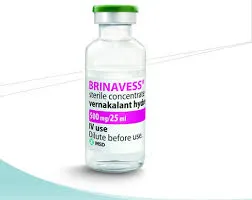
Table of Contents
- Package leaflet: Information for the user
- BRINAVESS 20 mg/ml concentrate for solution for infusion
- 1. What BRINAVESS is and what it is used for
- 2. What you should know before using BRINAVESS
- 3. How to use BRINAVESS
- 4. Possible side effects
- 5. How to store BRINAVESS
- 6. Package contents and other information
- The following information is intended exclusively for healthcare professionals:
Package leaflet: Information for the user
BRINAVESS 20 mg/ml concentrate for solution for infusion
vernakalant hydrochloride
Please read all of this leaflet carefully before you start using this medicine because it contains important information for you.
- Keep this leaflet. You may need to read it again.
- If you have any questions, ask your doctor.
- If you get any side effects, talk to your doctor. This includes any side effects not listed in this leaflet. See section 4.
Contents of this leaflet:
- What BRINAVESS is and what it is used for
- What you need to know before you are given BRINAVESS
- How to use BRINAVESS
- Possible side effects
- How to store BRINAVESS
- Contents of the pack and other information
1. What BRINAVESS is and what it is used for
BRINAVESS contains the active substance vernakalant hydrochloride. BRINAVESS works by converting irregular or rapid heartbeat into normal heart rhythm.
In adults, it is used when you have a recent onset of rapid, irregular heartbeat called atrial fibrillation, which has lasted for 7 days or less in non-surgical patients, and for 3 days or less in post-cardiac surgery patients.
2. What you should know before using BRINAVESS
Do not use BRINAVESS:
- if you are allergic to vernakalant hydrochloride or to any of the other ingredients of this medicine (listed in section 6)
- if you have had new-onset chest pain or worsening chest pain (angina), diagnosed by your doctor as acute coronary syndrome within the last 30 days, or if you have had a heart attack within the last 30 days
- if you have severe heart valve narrowing, systolic blood pressure below 100 mm Hg, or advanced heart failure with symptoms occurring with minimal exertion or at rest
- if you have abnormally slow heart rate or irregular heartbeats and do not have a pacemaker, or if you have a conduction disorder called QT prolongation – which your doctor can detect with an electrocardiogram (ECG)
- if you have received certain other intravenous medicines (Class I and III antiarrhythmics) used to normalize abnormal heart rhythm within 4 hours before using BRINAVESS
BRINAVESS must not be used if you have any of the conditions listed above. If you are unsure,
speak with your doctor before this medicine is administered.
Warnings and precautions
Talk to your doctor before BRINAVESS is used if you have:
- heart failure
- certain heart diseases affecting the heart, the lining around the heart, or severe narrowing of heart valves
- heart valve disease
- liver problems
- are taking other medicines to control heart rhythm.
If during treatment with this medicine you develop very low blood pressure or a slow heart rate,
or if certain changes occur in your ECG, your doctor will stop the treatment.
Your doctor will assess whether you need additional antiarrhythmic medicines 4 hours after
administration of BRINAVESS.
BRINAVESS may not be effective in treating certain other types of heart rhythm abnormalities;
however, your doctor will be familiar with these issues.
Inform your doctor if you have a pacemaker.
If you have any of the conditions listed above (or if you are unsure), talk to your doctor.
Detailed information on warnings and precautions related to possible adverse effects is provided in section 4.
Blood tests
Before administering this medicine, your doctor will decide whether you need a blood test
to check blood clotting and also to measure your potassium levels.
Children and adolescents
Do not administer this medicine to children and adolescents under 18 years of age, as there is
no experience with its use in this population.
Other medicines and BRINAVESS
Inform your doctor if you are taking, have recently taken, or might take any other medicines.
BRINAVESS must not be used if you are taking certain other intravenous medicines (Class I and III antiarrhythmics) used to normalize irregular heart rhythm within 4 hours before using BRINAVESS.
Pregnancy and breastfeeding
If you are pregnant, suspect you may be pregnant, planning to become pregnant, or are breastfeeding,
consult your doctor before using this medicine.
It is preferable to avoid using BRINAVESS during pregnancy.
It is not known whether BRINAVESS passes into human breast milk.
Driving and using machines
You should be aware that some people may experience dizziness after taking
BRINAVESS, usually within the first 2 hours after administration (see section
“Possible side effects”). If you feel dizzy after taking BRINAVESS, you should avoid
driving and operating machinery.
BRINAVESS contains sodium
This medicine contains 32 mg of sodium (a main component of table salt) in each
200 mg vial. This corresponds to 1.6% of the maximum recommended daily dietary intake
for an adult.
This medicine contains 80 mg of sodium (a main component of table salt) in each
500 mg vial. This corresponds to 4% of the maximum recommended daily dietary intake
for an adult.
3. How to use BRINAVESS
The amount of BRINAVESS you will be given depends on your body weight. The recommended initial dose is 3 mg/kg, with a maximum dose calculated based on a body weight of 113 kg. If you weigh more than 113 kg, you will be given a fixed dose of 339 mg. During administration of BRINAVESS, your breathing, heart rate, blood pressure, and heart's electrical activity will be monitored.
If your heart rhythm has not returned to normal within 15 minutes after completion of the first dose, a second dose may be administered. This slightly lower dose will be 2 mg/kg, with a maximum dose calculated based on a body weight of 113 kg. If you weigh more than 113 kg, you will be given a fixed dose of 226 mg. Total doses exceeding 5 mg/kg within 24 hours must not be administered.
BRINAVESS will be administered to you by a healthcare professional. BRINAVESS will be diluted before administration. Information on how to prepare the solution is provided at the end of this leaflet.
The medicine will be given to you intravenously over 10 minutes.
If you receive more BRINAVESS than you should
If you think you have been given too much BRINAVESS, inform your doctor immediately.
If you have any doubts about how to use this medicine, consult your doctor.
4. Possible side effects
Like all medicines, this medicine can cause side effects, although not everyone experiences them.
Your doctor may decide to stop the infusion if they observe any abnormal changes regarding:
- heart rate (such as very fast heartbeat (uncommon) or very slow heartbeat (common), skipped beats (uncommon), or a brief pause in the heart's normal activity (uncommon))
- blood pressure (such as very low blood pressure causing severe heart problems) (uncommon)
- electrical activity of the heart (uncommon)
Other side effects:
Very common (may affect more than 1 in 10 people)
- altered taste sensation
- sneezing
Common (may affect up to 1 in 10 people)
- fast heartbeat
- pain or numbness at the infusion site, numbness, reduced skin sensitivity, or tingling sensations
- nausea and vomiting
- feeling of warmth
- low blood pressure, slow heartbeat, dizziness
- cough, nasal pain
- excessive sweating, itching
- numbness or tingling occurring in the mucosa or tissues of the oral cavity
Uncommon (may affect up to 1 in 100 people)
- certain types of heart rhythm problems (such as awareness of heartbeat (palpitations) or extra beats)
- reduced sensitivity
- eye irritation, excessive tearing, or changes in vision
- altered sense of smell
- pain in the fingers and toes, burning sensation
- cold sweat, hot flushes
- urgent need to defecate, diarrhoea
- shortness of breath or chest tightness
- sensation of suffocation
- mouth or throat pain
- irritation, itching at the infusion site
- high blood pressure
- feeling of light-headedness or fainting, general feeling of discomfort, feeling of numbness or drowsiness
- runny nose, sore throat
- nasal congestion
- dry mouth
- pale skin
- generalized itching
- fatigue
- decreased mouth sensitivity
These effects, observed within 24 hours after administration of BRINAVESS, should pass quickly; however, if they do not, consult your doctor.
Reporting of side effects
If you experience any side effect, including those not listed in this leaflet, talk to your doctor. You can also report side effects directly via the national reporting system listed in Annex V. By reporting side effects, you can help provide more information on the safety of this medicine.
5. How to store BRINAVESS
Keep this medicine out of the sight and reach of children.
Do not use this medicine after the expiry date stated on the carton and on the label of the
vial after Exp. The expiry date refers to the last day of that month.
This medicine does not require any special storage conditions.
BRINAVESS must be diluted before use. The diluted sterile concentrate is chemically and
physically stable for 12 hours at temperatures equal to or below 25°C.
From a microbiological standpoint, the medicine should be used immediately. If not used
immediately, the storage times during use and the conditions prior to use are the responsibility of the user and should normally not exceed 24 hours at temperatures between 2°C and 8°C, unless the dilution was carried out under controlled and validated aseptic conditions.
Do not use this medicine if you notice the presence of particles or any change in colour.
Do not dispose of medicines via wastewater or household waste. Ask your pharmacist how to dispose of medicines no longer required. This will help protect the environment.
6. Package contents and other information
What BRINAVESS contains
- The active substance is vernakalant hydrochloride. Each ml of concentrate contains 20 mg of vernakalant hydrochloride, equivalent to 18.1 mg of vernakalant. Each vial containing 200 mg of vernakalant hydrochloride is equivalent to 181 mg of vernakalant. Each vial containing 500 mg of vernakalant hydrochloride is equivalent to 452.5 mg of vernakalant.
- The other components are citric acid, sodium chloride, sodium hydroxide (E524), and water for injections (see section 2 “BRINAVESS contains sodium”).
Description of the appearance of BRINAVESS and package contents
BRINAVESS is a concentrate for solution for infusion (sterile concentrate), which is clear and colourless to pale yellow.
BRINAVESS is available in packages containing 1 vial with either 200 mg or 500 mg of vernakalant hydrochloride.
Marketing Authorisation Holder:
Advanz Pharma Limited
Unit 17, Northwood House
Northwood Crescent
Dublin 9, D09 V504
Ireland
Manufacturer:
Geodis CL Netherlands B.V.
Columbusweg 16
5928 LC Venlo
The Netherlands
For further information on this medicinal product, please contact the local representative of the Marketing Authorisation Holder.
België/Belgique/Belgien
Advanz Pharma Limited
Tél/Tel: +32 (0)800 78 941
[email protected]
България (Bulgaria)
Advanz Pharma Limited
Тел.: +32 28088620
[email protected]
Česká republika (Czech Republic)
Advanz Pharma Limited
Tel: +32 28088620
[email protected]
Danmark (Denmark)
Abcur AB
Sverige
Tlf: +45 80 82 60 22
[email protected]
Deutschland (Germany)
Advanz Pharma Limited
Tel: +49 (0)800 180 20 91
[email protected]
Eesti (Estonia)
Advanz Pharma Limited
Tel: +32 28088620
[email protected]
Ελλάδα (Greece)
Advanz Pharma Limited
Τηλ: +32 28088620
[email protected]
España (Spain)
Advanz Pharma Spain S.L.U
Tel: +34 900 834 889
[email protected]
France (France)
Advanz Pharma Limited
Tél: +44 (0) 208 588 9131
[email protected]
Hrvatska (Croatia)
Advanz Pharma Limited
Tel: +32 28088620
[email protected]
Ireland (Ireland)
Advanz Pharma Limited
Tel: +353 1800 851 119
[email protected]
Ísland (Iceland)
Abcur AB
Svíþjóð
Sími: +46 20 088 02 36
[email protected]
Italia (Italy)
Advanz Pharma Limited
Tel: +39 800 909 792
[email protected]
Κύπρος (Cyprus)
Advanz Pharma Limited
Τηλ: +32 28088620
[email protected]
Latvija (Latvia)
Advanz Pharma Limited
Tel: +32 28088620
[email protected]
Lietuva (Lithuania)
Advanz Pharma Limited
Tel: +32 28088620
[email protected]
Luxembourg/Luxemburg (Luxembourg)
Advanz Pharma Limited
Tél/Tel: +32 28088620
[email protected]
Magyarország (Hungary)
Advanz Pharma Limited
Tel: +32 28088620
[email protected]
Malta (Malta)
Advanz Pharma Limited
Tel: +32 28088620
[email protected]
Nederland (Netherlands)
Advanz Pharma Limited
Tel: +31 (0)800 022 93 82
[email protected]
Norge (Norway)
Abcur AB
Sverige
Tlf: +47 800 16 689
[email protected]
Österreich (Austria)
Advanz Pharma Limited
Tel: +43 (0)800 298 022
[email protected]
Polska (Poland)
Advanz Pharma Limited
Tel: +32 28088620
[email protected]
Portugal (Portugal)
Advanz Pharma Limited
Tel: +351 800 819 926
[email protected]
România (Romania)
Advanz Pharma Limited
Tel: +32 28088620
[email protected]
Slovenija (Slovenia)
Advanz Pharma Limited
Tel: +32 28088620
[email protected]
Slovenská republika (Slovakia)
Advanz Pharma Limited
Tel: +32 28088620
[email protected]
Suomi/Finland (Finland)
Abcur AB
Ruotsi
Puh/Tel: +358 800 416231
[email protected]
Sverige (Sweden)
Abcur AB
Sverige
Tel: +46 (0)20 088 02 36
[email protected]
Other sources of information
More detailed information on this medicinal product is available on the website of the European Medicines Agency: http://www.ema.europa.eu.
The following information is intended exclusively for healthcare professionals:
Before using BRINAVESS, refer to the Summary of
Product Characteristics and educational materials for further information.
CLINICAL INFORMATION
Therapeutic indications
Brinavess is indicated in adults for the rapid conversion of recent-onset atrial fibrillation
to sinus rhythm.
- For non-surgical patients: atrial fibrillation of duration ≤ 7 days
- For post-cardiac surgery patients: atrial fibrillation of duration ≤ 3 days
Dosage and method of administration
Vernakalant must be administered in an appropriate clinical setting for cardioversion. It must be administered exclusively by a qualified healthcare professional.
Dosage
Vernakalant is dosed according to the patient's body weight, with a maximum dose calculated based on a weight of 113 kg. The recommended initial infusion is 3 mg/kg infused over a period of 10 minutes, with a maximum initial dose of 339 mg (84.7 ml of solution at a concentration of 4 mg/ml). If conversion to sinus rhythm has not occurred within 15 minutes after completion of the initial infusion, a second infusion of 2 mg/kg over 10 minutes may be administered (maximum dose of the second infusion: 226 mg (56.5 ml of solution at a concentration of 4 mg/ml)). Cumulative doses exceeding 5 mg/kg within 24 hours must not be administered.
The initial infusion is given as a dose of 3 mg/kg over 10 minutes. During this period, the patient must be closely monitored for signs or symptoms of sudden drop in blood pressure or heart rate. If such signs occur, with or without symptomatic hypotension or bradycardia, the infusion must be stopped immediately.
If conversion to sinus rhythm has not occurred, the patient's vital signs and cardiac rhythm must be observed for an additional 15 minutes.
If conversion to sinus rhythm has not occurred after the initial infusion or during the 15-minute observation period, a second infusion of 2 mg/kg over 10 minutes must be administered.
If conversion to sinus rhythm occurs during the initial or second infusion, that infusion must be continued until completion. If stable atrial flutter is observed after the initial infusion, the second infusion may be administered, as patients may still convert to sinus rhythm (see “Special warnings and precautions for use” and “Undesirable effects”).
Patients with body weight >113 kg
For patients weighing more than 113 kg, vernakalant has a fixed dose. The initial dose is 339 mg (84.7 ml of solution at a concentration of 4 mg/ml). If conversion to sinus rhythm has not occurred within 15 minutes after completion of the initial infusion, a second infusion of 226 mg (56.5 ml of solution at a concentration of 4 mg/ml) may be administered over 10 minutes. Cumulative doses exceeding 565 mg have not been evaluated.
Post-cardiac surgery
No dose adjustment is required.
Renal impairment
No dose adjustment is required (see “Pharmacokinetic properties”).
Hepatic impairment
No dose adjustment is required (see “Special warnings and precautions for use” and “Pharmacokinetic properties”).
Elderly (age ≥ 65 years)
No dose adjustment is required.
Paediatric population
There is no indication for the specific use of vernakalant for rapid conversion of recent-onset atrial fibrillation to sinus rhythm in children and adolescents under 18 years of age, and therefore it should not be used in this population.
Method of administration
For intravenous use.
Vernakalant must not be administered as an intravenous push or bolus.
Vials are for single use only and must be diluted before administration.
For instructions on dilution of the medicinal product before administration, see “Special precautions for disposal and handling”.
Contraindications
- Hypersensitivity to the active substance or to any of the excipients listed in the “List of excipients”.
- Patients with severe aortic stenosis, patients with systolic blood pressure < 100 mmHg, and patients with NYHA class III and NYHA class IV heart failure.
- Patients with baseline prolonged QT interval (uncorrected > 440 ms), or severe bradycardia, sinus node dysfunction, or second- or third-degree atrioventricular block in the absence of a pacemaker.
- Use of intravenous antiarrhythmic drugs for rhythm control (class I and class III) within 4 hours before, as well as within the first 4 hours after, administration of vernakalant.
- Acute coronary syndrome (including myocardial infarction) within the last 30 days.
Special warnings and precautions for use
Patient monitoring
Cases of severe hypotension have been reported during and immediately after infusion of vernakalant. Patients must be closely observed throughout the entire infusion period and for at least 15 minutes after completion of the infusion, with assessment of vital signs and continuous cardiac rhythm monitoring.
If any of the following signs or symptoms occur, administration of vernakalant must be discontinued and these patients must receive appropriate medical treatment:
- A sudden drop in blood pressure or heart rate, with or without symptomatic hypotension or bradycardia
- Hypotension
- Bradycardia
- Electrocardiogram (ECG) changes (such as clinically significant sinus pause, complete atrioventricular block, new bundle branch block, significant QRS or QT interval prolongation, changes consistent with ischemia or infarction, or ventricular arrhythmia)
If any of these events occur during the first infusion of vernakalant, the patient must not receive the second dose of vernakalant.
The patient must be further monitored for 2 hours after the start of the infusion and until clinical and electrocardiographic parameters are stabilized.
Pre-infusion precautions
Before attempting pharmacological cardioversion, patients must be adequately hydrated and hemodynamically stable. If necessary, patients should be treated with anticoagulant therapy in accordance with treatment guidelines. In patients with uncorrected hypokalemia (serum potassium levels below 3.5 mmol/l), potassium levels must be corrected before use of vernakalant.
A pre-infusion checklist is provided with the medicinal product. Prior to administration, the prescribing physician must determine patient eligibility using the provided checklist. The checklist must be attached to the infusion container for review by the healthcare professional administering the medicinal product.
Hypotension
Hypotension may occur in a small number of patients (vernakalant 5.7%, placebo 5.5% within the first two hours after dose administration). Typically, hypotension occurs early, during or immediately after the infusion, and is usually manageable with standard supportive measures. Severe hypotension has been observed uncommonly. Patients with congestive heart failure (CHF) have been identified as a higher-risk population for hypotension (see “Undesirable effects”).
Patients must be monitored for signs and symptoms of sudden drop in blood pressure or heart rate throughout the infusion and for at least 15 minutes after completion of the infusion.
Congestive heart failure
Patients with CHF showed a higher overall incidence of hypotensive events during the first 2 hours after dose administration in those treated with vernakalant compared to placebo (13.4% vs. 4.7%, respectively). Hypotension reported as a serious adverse event or leading to discontinuation of the medicinal product occurred in 1.8% of CHF patients exposed to vernakalant versus 0.3% in placebo patients.
Patients with a history of CHF showed a higher incidence of ventricular arrhythmia within the first two hours after dose administration (6.4% for vernakalant vs. 1.6% for placebo). These arrhythmias typically presented as asymptomatic, non-sustained monomorphic ventricular tachycardia (average 3–4 beats). Vernakalant must be used with caution in hemodynamically stable patients with CHF in NYHA functional class I or II due to the higher incidence of hypotension and ventricular arrhythmia in CHF patients. Experience with vernakalant in patients with previously documented left ventricular ejection fraction (LVEF) ≤ 35% is limited. Its use in these patients is not recommended. Use is contraindicated in patients with CHF in NYHA class III or IV (see “Contraindications”).
Valvular heart disease
In patients with valvular heart disease, there was a higher incidence of ventricular arrhythmia events in patients treated with vernakalant up to 24 hours after dose administration. Ventricular arrhythmia occurred in 6.4% of patients treated with vernakalant within the first 2 hours compared to no events in placebo-treated patients. These patients must be closely monitored.
Atrial flutter
Vernakalant has not been shown to be effective in converting typical primary atrial flutter to sinus rhythm. Patients treated with vernakalant have a higher incidence of conversion to atrial flutter within the first 2 hours after dosing. This risk is higher in patients taking Class I antiarrhythmics (see “Undesirable effects”). If atrial flutter is observed following treatment, continuation of the infusion should be evaluated (see “Dosage and method of administration”). Rare cases of atrial flutter with 1:1 atrioventricular conduction have been observed in post-marketing experience.
Other diseases and conditions not studied
Vernakalant has been administered to patients with uncorrected QT interval < 440 ms without increased risk of torsade de pointes.
Furthermore, it has not been evaluated in patients with clinically significant valvular stenosis, obstructive hypertrophic cardiomyopathy, restrictive cardiomyopathy, or constrictive pericarditis, and its use cannot be recommended in such cases. Experience with vernakalant in patients with pacemakers is limited.
As clinical experience in patients with advanced hepatic impairment is limited, vernakalant is not recommended in these patients.
There are no clinical data on repeated doses after the initial and second infusion.
Electrical cardioversion
In patients who do not respond to therapy, direct current cardioversion may be considered. There is no clinical experience with direct current cardioversion within two hours after dose administration.
Use of antiarrhythmic drugs before or after vernakalant
Vernakalant cannot be recommended in patients who have previously received intravenous antiarrhythmic drugs (class I and III) 4–24 hours before administration of vernakalant due to lack of data. It must not be administered to patients who have received intravenous antiarrhythmic drugs (class I and III) within 4 hours prior to administration of vernakalant (see “Contraindications”).
Vernakalant must be used with caution in patients receiving oral antiarrhythmic therapy (class I and III) due to limited experience. The risk of atrial flutter may be increased in patients receiving class I antiarrhythmic drugs (see above).
Experience with intravenous antiarrhythmic drugs for rhythm control (class I and class III) in the first 4 hours after administration of vernakalant is limited; therefore, these agents must not be used during this period (see “Contraindications”).
Resumption or initiation of oral antiarrhythmic maintenance therapy may be considered starting 2 hours after administration of vernakalant.
Sodium content
This medicinal product contains 32 mg of sodium in each 200 mg vial, equivalent to 1.6% of the maximum daily intake recommended by the WHO, corresponding to 2 g of sodium for an adult.
This medicinal product contains 80 mg of sodium in each 500 mg vial, equivalent to 4% of the maximum daily intake recommended by the WHO, corresponding to 2 g of sodium for an adult.
Interactions with other medicinal products and other forms of interaction
No interaction studies have been performed.
Vernakalant must not be administered to patients who have received intravenous antiarrhythmic drugs (class I and III) within 4 hours prior to administration of vernakalant (see “Contraindications”).
Within the clinical development program, oral antiarrhythmic maintenance therapy was interrupted for a minimum of 2 hours after administration of vernakalant. Resumption or initiation of oral antiarrhythmic maintenance therapy may be considered after this period (see “Contraindications” and “Special warnings and precautions for use”).
Although vernakalant is a substrate of CYP2D6, population pharmacokinetic studies have shown no substantial differences in acute exposure to vernakalant (Cmax and AUC) when weak or potent CYP2D6 inhibitors were administered the day before vernakalant infusion compared to patients not receiving concomitant CYP2D6 inhibitors. Additionally, acute exposure to vernakalant in CYP2D6 poor metabolizers differs only minimally from that in extensive metabolizers. No dose adjustment of vernakalant is required based on CYP2D6 metabolizer status, or when vernakalant is administered concomitantly with CYP2D6 inhibitors.
Vernakalant is a moderate competitive inhibitor of CYP2D6. However, due to the short half-life of vernakalant and the transient nature of 2D6 inhibition, acute intravenous administration of vernakalant is not expected to significantly impact the pharmacokinetics of chronically administered 2D6 substrates. Administration of vernakalant by infusion is not expected to result in significant pharmacological interactions due to rapid distribution and transient exposure, low protein binding, lack of inhibition of other tested CYP P450 enzymes (CYP3A4, 1A2, 2C9, 2C19, or 2E1), and lack of inhibition of P-glycoprotein in a digoxin transport assay.
Special precautions for disposal and handling
Read all steps before administration.
An infusion pump is the preferred device for administration. However, a syringe pump is acceptable provided the calculated volume can be accurately administered within the specified infusion time.
Preparation of BRINAVESS for infusion
Step 1:
Before administration, BRINAVESS vials must be visually inspected for presence of particles and discoloration. Do not use vials showing particles or discoloration. Note: BRINAVESS concentrate for solution for infusion ranges from colourless to pale yellow. Minor colour variations within this range do not affect potency.
Step 2: Dilution of concentrate
To ensure appropriate administration, prepare at the beginning of therapy a sufficient quantity of BRINAVESS 20 mg/ml to allow administration of both the initial and second infusion.
Prepare a solution with a concentration of 4 mg/ml following the dilution guidelines below:
Patients ≤ 100 kg: 25 ml of BRINAVESS 20 mg/ml added to 100 ml of diluent.
Patients > 100 kg: 30 ml of BRINAVESS 20 mg/ml added to 120 ml of diluent.
Recommended diluents are 9 mg/ml (0.9%) sodium chloride solution for injection, Ringer’s lactate solution for injection, or 5% glucose solution for injection.
Step 3: Inspection of solution
The diluted sterile solution must be clear, colourless to pale yellow. Visually inspect the solution again before administration for presence of particles and discoloration.
Any unused medicinal product and waste material derived from this medicinal product must be disposed of in accordance with local regulations.