Bosentan Accord
Italy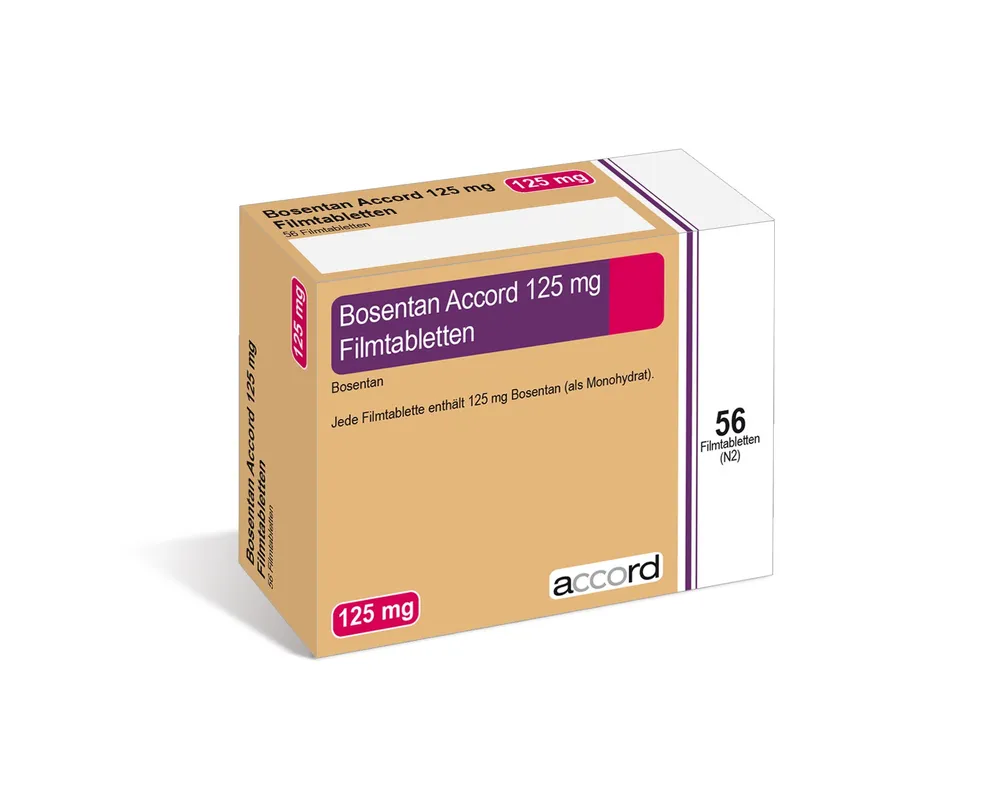
Table of Contents
- Patient Information Leaflet: Information for the User
- Bosentan Accord 62.5 mg film-coated tablets, 125 mg film-coated tablets
- 1. What Bosentan Accord is and what it is used for
- 2. What you need to know before taking Bosentan Accord
- 3. How to take Bosentan Accord
- 4. Possible side effects
- 5. How to store Bosentan Accord
- 6. Package contents and other information
Patient Information Leaflet: Information for the User
Bosentan Accord 62.5 mg film-coated tablets, 125 mg film-coated tablets
Generic medicine
Please read all of this leaflet carefully before you start taking this medicine because it contains important information for you.
- Keep this leaflet. You may need to read it again.
- If you have any questions, ask your doctor or pharmacist.
- This medicine has been prescribed for you only. Do not give it to other people, even if they have the same symptoms as yours, because it could be harmful.
- If you experience any side effects, including those not listed in this leaflet, tell your doctor or pharmacist. See section 4.
Contents of this leaflet:
- What Bosentan Accord is and what it is used for
- What you need to know before taking Bosentan Accord
- How to take Bosentan Accord
- Possible side effects
- How to store Bosentan Accord
- Contents of the pack and other information
1. What Bosentan Accord is and what it is used for
Bosentan Accord contains bosentan, which blocks a natural hormone called endothelin-1 (ET-1) that causes narrowing of blood vessels. Bosentan Accord therefore causes blood vessels to dilate and belongs to a class of medicines known as “endothelin receptor antagonists”.
Bosentan Accord is used to treat:
-
Pulmonary arterial hypertension (PAH): PAH is a disease characterized by severe narrowing of the blood vessels in the lungs, resulting in increased pressure in the blood vessels carrying blood from the heart to the lungs (pulmonary arteries). This pressure reduces the amount of oxygen that can pass into the blood through the lungs, making physical activity more difficult. Bosentan Accord widens the pulmonary arteries, making it easier for the heart to pump blood through them. This leads to a reduction in blood pressure and an improvement in symptoms. Bosentan Accord is used to treat patients with pulmonary arterial hypertension (PAH) in WHO functional class III to improve exercise capacity (the ability to perform physical activity) and symptoms. The “class” reflects the severity of the disease: “class III” means marked limitation in physical activity. Some benefits have also been observed in patients with PAH in class II. “Class II” means slight limitation in physical activity. The PAH for which Bosentan Accord is indicated may be:
-
idiopathic (without an identifiable cause) or heritable;
-
caused by scleroderma (also known as systemic sclerosis, a disease characterized by abnormal growth of connective tissue supporting the skin and other organs);
-
caused by congenital (inborn) heart defects with shunts (abnormal passages) leading to abnormal blood flow through the heart and lungs.
-
Digital ulcers (sores on the fingers and toes) in adult patients with a condition called scleroderma. Bosentan reduces the number of new digital ulcers on the fingers and toes.
2. What you need to know before taking Bosentan Accord
Do not take Bosentan Accord
- if you are allergic to bosentan or to any of the other ingredients of this medicine (listed in section 6)
- if you have liver problems (consult your doctor)
- if you are pregnant or could be pregnant because you are not using reliable contraceptive methods. Please read the information provided under “Contraceptives” and “Other medicines and Bosentan Accord”
- if you are being treated with cyclosporine A (a medicine used after organ transplantation or for the treatment of psoriasis). If any of these conditions applies to you, speak with your doctor. Warnings and precautions
Talk to your doctor or pharmacist before taking Bosentan Accord.
Tests required by your doctor before treatment
- a blood test to check your liver function
- a blood test to monitor for anaemia (low haemoglobin)
- a pregnancy test if you are a woman of childbearing potential
In some patients treated with bosentan, abnormalities in liver function tests and anaemia (low haemoglobin) have been observed.
Tests your doctor will prescribe during treatment
During treatment with Bosentan Accord, your doctor will regularly request blood tests to monitor any changes in liver function and haemoglobin levels.
For all these tests, refer also to the Patient Alert Card (included in your pack of Bosentan Accord tablets). It is important that you undergo these blood tests at regular intervals throughout the entire period of Bosentan Accord administration. It is recommended to record on the Patient Alert Card the date of your most recent test and also the date of your next scheduled test (ask your doctor for this date), so you do not forget when your next test is due.
Liver function blood tests:
These will be performed every month for the entire duration of treatment with Bosentan Accord. After a dose increase, an additional test will be performed after 2 weeks.
Blood tests for anaemia:
These will be performed every month for the first 4 months of treatment and then every 3 months, as patients taking Bosentan Accord may develop anaemia.
If these results are abnormal, your doctor may decide to reduce the dose or discontinue treatment with Bosentan Accord and carry out further tests to determine the cause.
Children and adolescents
There is limited clinical experience in children under 2 years of age with pulmonary arterial hypertension.
Bosentan Accord is not recommended in paediatric patients with systemic sclerosis and active digital ulcers. Please also refer to section 3. How to take Bosentan Accord.
Other medicines and Bosentan Accord
You should inform your doctor or pharmacist if you are taking, have recently taken or might take any other medicines, including those purchased without a prescription. It is especially important to inform your doctor if you are taking:
- cyclosporine A (a medicine used after organ transplants and for the treatment of psoriasis), which must not be used together with Bosentan Accord
- sirolimus or tacrolimus, which are medicines used after transplants; their use together with Bosentan Accord is not recommended
- glibenclamide (a medicine for diabetes), rifampicin (a medicine for tuberculosis), or fluconazole (a medicine for fungal infections), nevirapine (a medicine for HIV), as the use of these medicines together with Bosentan Accord is not recommended
- other medicines for the treatment of HIV infection, which may require special monitoring when used together with Bosentan Accord
- hormonal contraceptives, which are not effective as the sole method of contraception when you are taking Bosentan Accord. Inside the pack of Bosentan Accord tablets, you will find a Patient Alert Card which you should read carefully. Your treating doctor and/or gynaecologist will determine the appropriate contraceptive method for you.
Driving and using machines
Bosentan Accord has no effect or has a negligible effect on the ability to drive vehicles and use machines.
However, Bosentan Accord may cause hypotension (lowering of your blood pressure), which may make you feel unstable. Therefore, if you experience dizziness during treatment with Bosentan Accord, do not drive or operate tools or machinery of any kind.
Pregnancy, breast-feeding and fertility
Women of childbearing potential
DO NOT take Bosentan Accord if you are pregnant or planning a pregnancy.
Pregnancy test
Bosentan Accord may harm the unborn child conceived before or during treatment. If you are a woman of childbearing potential, your doctor will require you to take a pregnancy test before starting Bosentan Accord and regularly during treatment with Bosentan Accord.
Contraceptives
If you are a woman of childbearing potential, use a reliable method of birth control (contraception) during treatment with Bosentan Accord. Your doctor or gynaecologist will advise you on reliable contraceptive methods during treatment with Bosentan Accord. Since Bosentan Accord may reduce the effectiveness of hormonal contraception (e.g. oral contraceptives, injectables, implants, or skin patches), this method alone is not reliable. Therefore, if you use hormonal contraceptives, you must also use a barrier method (e.g. female condom, diaphragm, contraceptive sponge, or your partner must use a condom). Inside your pack of Bosentan Accord tablets, you will find a Patient Alert Card. You must complete this card and bring it to your next medical visit, so that your doctor or gynaecologist can assess whether you need additional or alternative reliable contraceptive methods. It is recommended to perform a pregnancy test every month during treatment with Bosentan Accord if you are of childbearing age.
If you are pregnant or breast-feeding, think you may be pregnant or are planning to become pregnant, consult your doctor or pharmacist before taking this medicine.
Breast-feeding
Inform your doctor immediately if you are breast-feeding. Breast-feeding is not recommended if Bosentan Accord is prescribed, as it is unknown whether the medicine is excreted in human breast milk.
Fertility
Fertility studies conducted in animals have not shown effects on spermatogenesis or fertility. If you are a man taking Bosentan, this medicine may reduce sperm count. It cannot be excluded that this may affect your ability to father a child. Consult your doctor if you have any questions or concerns about this.
3. How to take Bosentan Accord
Treatment with Bosentan Accord should be initiated and monitored only by a physician experienced
in the treatment of PAH or systemic sclerosis. Always take this medicine exactly as instructed by
your doctor. If you have any doubts, consult your doctor or pharmacist.
Bosentan Accord with food and drink
Bosentan Accord may be taken on an empty stomach or with food.
Recommended dose
Adults
In adults, treatment usually starts with one 62.5 mg tablet twice daily (morning and evening) for the
first 4 weeks; thereafter, your doctor will usually recommend increasing to one 125 mg tablet twice
daily, depending on your response to Bosentan Accord.
Use in children and adolescents
The recommended dose in children is only indicated for PAH. For children aged 2 years and older,
treatment usually starts with 2 mg per kg body weight twice daily (morning and evening); your
doctor will advise on any subsequent dose adjustments.
Please note that bosentan is available in other formulations, which allow for more accurate dosing in
children and patients with low body weight or difficulty swallowing coated tablets.
If you feel that the effects of Bosentan Accord are too strong or too weak, speak with your doctor to
evaluate whether a dose adjustment is necessary.
How to take Bosentan Accord
Take the tablets (morning and evening) with water. Tablets may be taken with or without food.
If you take more Bosentan Accord than you should
If you have taken more tablets than prescribed, contact your doctor immediately.
If you forget to take Bosentan Accord
If you forget to take Bosentan Accord, take one tablet as soon as you remember, then continue with
your regular dosing schedule. Do not take a double dose to make up for a missed dose.
If you stop taking Bosentan Accord
Stopping treatment with Bosentan Accord abruptly may lead to worsening of symptoms. Do not
discontinue this treatment unless instructed by your doctor. Your doctor may advise you to gradually
reduce the dose over several days before stopping treatment completely.
If you have further questions about the use of this medicine, consult your doctor or pharmacist.
4. Possible side effects
Like all medicines, this medicine can cause side effects, although not everyone gets them.
The most serious side effects with Bosentan Accord are:
- impaired liver function, which may affect more than 1 in 10 people
- anaemia (reduction in blood test values), which may affect 1 in 10 people. Anaemia may occasionally require a blood transfusion.
Your liver and blood values will be monitored during treatment with Bosentan Accord (see section 2). It is important that you attend these checks as prescribed by your doctor.
Signs of improper liver function include:
- nausea (feeling like vomiting)
- vomiting
- fever (high temperature)
- stomach (abdominal) pain
- jaundice (yellowing of the skin or sclera, the white part of the eye)
- dark-coloured urine
- skin itching
- lethargy or fatigue (unusual tiredness or weakness)
- flu-like symptoms (joint and muscle pain with fever)
If you experience any of these signs, contact your doctor immediately.
Other side effects:
Very common (may affect more than 1 in 10 people):
- Headache
- Oedema (swelling of the legs and ankles or other signs due to fluid retention)
Common (may affect up to 1 in 10 people):
- Flushed appearance or skin flushing
- Hypersensitivity reactions (including skin inflammation, itching, and skin rash)
- Gastro-oesophageal reflux disease (acid reflux)
- Diarrhoea
- Syncope (fainting)
- Palpitations (fast or irregular heartbeats)
- Low blood pressure
- Nasal congestion
Uncommon (may affect 1 in 100 people):
- Thrombocytopenia (low number of platelets in the blood)
- Neutropenia/leucopenia (low number of white blood cells)
- Increased liver function test values associated with hepatitis (liver inflammation), including possible worsening of underlying hepatitis and/or jaundice (yellowing of the skin or the white part of the eye)
Rare (may affect up to 1 in 1,000 people):
- Anaphylaxis (generalised allergic reaction), angioedema (swelling, most commonly around the eyes, lips, tongue, or throat)
- Liver cirrhosis (scarring), severe liver failure (severe impairment of liver function)
Additional side effects in children and adolescents
The side effects reported in children treated with Bosentan Accord are the same as those in adults.
Reporting of side effects
If you experience any side effect, including those not listed in this leaflet, talk to your doctor or pharmacist. You can also report side effects directly via the national reporting system at
www.agenziafarmaco.gov.it/it/responsabili. By reporting side effects, you can help provide more information on the safety of this medicine.
5. How to store Bosentan Accord
Keep this medicine out of the sight and reach of children.
Do not use this medicine after the expiry date stated on the carton and blister after "Exp". The expiry date refers to the last day of that month.
Aluminium-aluminium blisters
This medicine does not require any special storage conditions.
PVC/PE/PVDC/aluminium blisters
Do not store above 30°C.
Do not dispose of medicines via wastewater or household waste. Ask your pharmacist how to dispose of medicines you no longer use. This will help protect the environment.
6. Package contents and other information
What Bosentan Accord contains
- Bosentan Accord 62.5 mg film-coated tablets: The active substance is bosentan monohydrate. Each tablet contains 62.5 mg of bosentan (as monohydrate).
- Bosentan Accord 125 mg film-coated tablets: The active substance is bosentan monohydrate. Each tablet contains 125 mg of bosentan (as monohydrate).
- The other components in the tablet are: maize starch, pregelatinized starch (maize), sodium starch glycolate (type A), povidone, and magnesium stearate.
The film coating contains hypromellose, triacetin, talc, titanium dioxide (E171), yellow iron oxide (E172), red iron oxide (E172).
Description of the appearance of Bosentan Accord and pack contents
Bosentan Accord 62.5 mg film-coated tablets are film-coated, biconvex, light orange, round tablets, approximately 6.20 mm in diameter, with "IB1" embossed on one side and plain on the other side.
Bosentan Accord 125 mg film-coated tablets are film-coated, biconvex, light orange, oval tablets, approximately 11.00 mm long and 5.00 mm wide, with "IB2" embossed on one side and plain on the other side.
Bosentan Accord 62.5 mg film-coated tablets are packed in aluminium-aluminium blisters and PVC/PE/PVDC/aluminium blisters containing 14 film-coated tablets. Cartons contain 14, 56 or 112 film-coated tablets.
Bosentan Accord 125 mg film-coated tablets are packed in aluminium-aluminium blisters and PVC/PE/PVDC/aluminium blisters containing 14 film-coated tablets. Cartons contain 56 or 112 film-coated tablets.
It is possible that not all pack sizes are marketed.
Marketing Authorization Holder
Accord Healthcare S.L.U.
World Trade Center,
Moll de Barcelona,
s/n, Edifici Est 6ª planta,
08039 Barcelona,
Spain
Manufacturer
Accord Healthcare Limited
Sage House, 319 Pinner Road, North Harrow
Middlesex, HA1 4HF
United Kingdom
Pharmacare Premium Ltd.
HHF003, Hal Far Industrial Estate
BBG3000 Birzebbugia
Malta
This Patient Information Leaflet has been last revised on
This medicinal product is authorised in the European Economic Area Member States under the following names:
| Member States | Name | |---------------|------| | UK | Bosentan Accord 62.5/125 mg Film-coated Tablets | | AT | Bosentan Accord 62,5/125 mg Filmtabletten | | BE | Bosentan Accord 62.5/125 mg filmomhulde tabletten | | BG | Bosentan Акорд 62.5/125 мг филмирани таблетки | | CY | Bosentan Accord 62.5/125 mg Film-coated Tablets | | CZ | Bosentan Accord 62,5/125 mg potahované tablety | | DE | Bosentan Accord 62.5/125 mg filmtabletten | | DK | Bosentan Accord 62.5/125 mg filmovertrukne tabletter | | EE | Bosentan Accord | | ES | Bosentan Accord 62,5/125 mg comprimidos recubiertos con pelicula | | FI | Bosentan Accord 62.5/125 mg tabletti, kalvopäällysteinen | | FR | BOSENTAN ACCORD 62,5/125 mg comprimé pelliculé | | IS | Bosentan Accord 62.5/125 mg filmuhúðaðar töflur | | IT | Bosentan Accord | | LT | Bosentan Accord 62.5/125 mg plėvele dengtos tabletės | | MT | Bosentan Accord 62.5/125 mg Film-coated Tablets | | NL | Bosentan Accord 62,5/125 mg filmomhulde tabletten | | NO | Bosentan Accord | | PT | Bosentan Accord | | SE | Bosentan Accord 62.5/125 mg filmdragerad tablet | | SK | Bosentan Accord 62.5/125 mg filmom obalené tablety |
PATIENT INFORMATION LEAFLET
| (Cover) Important safety information for patients taking Bosentan Accord (Generic medicine) This card contains important information about Bosentan Accord. Please read this card carefully before taking Bosentan Accord. Patient's name: Prescribing doctor: Contact your doctor if you have any questions regarding Bosentan Accord. Marketing Authorization Holder: Accord Healthcare Limited | (Back side) Contraception Are you currently using or taking contraceptives? Yes No If yes, write their names here: ___________________________________________________ __________________________________________________ Please bring this card to your doctor at your next visit, so that your physician or gynecologist can assess whether you need additional or alternative reliable contraceptive methods. |
| (Inside 1) If you are a woman of childbearing potential, please read this page carefully. Pregnancy Bosentan Accord may harm fetal development. Therefore, you must not take Bosentan Accord during pregnancy and you must not become pregnant while taking Bosentan Accord. In addition, if you have pulmonary hypertension, pregnancy may severely worsen your disease symptoms. If you suspect you are pregnant, inform your doctor or gynecologist immediately. Contraception Hormonal contraception—such as oral contraceptives or birth control pills, injectable hormones, implants, or contraceptive skin patches—does not reliably prevent pregnancy in women taking Bosentan Accord. You must use a barrier contraceptive method—such as condoms, diaphragm, or vaginal sponge—in addition to any of these hormonal contraceptive methods. Be sure to discuss any questions with your doctor or gynecologist—complete the requested information on the back of this card and bring it to your doctor or gynecologist at your next visit. You must have a pregnancy test before starting Bosentan Accord and every month during treatment, even if you do not think you are pregnant. Date of first monthly test: | (Inside 2) Liver function blood tests Some patients treated with Bosentan Accord have shown abnormalities in liver function tests. Regular blood tests to monitor liver function will be performed during treatment with Bosentan Accord, as directed by your doctor. Remember to have your liver function blood tests every month. After a dose increase, an additional test will be performed after 2 weeks. Date of first monthly test: Your monthly liver blood test schedule: Jan May Sep Feb Jun Oct Mar Jul Nov Apr Aug Dec |