Bleoprim
Italy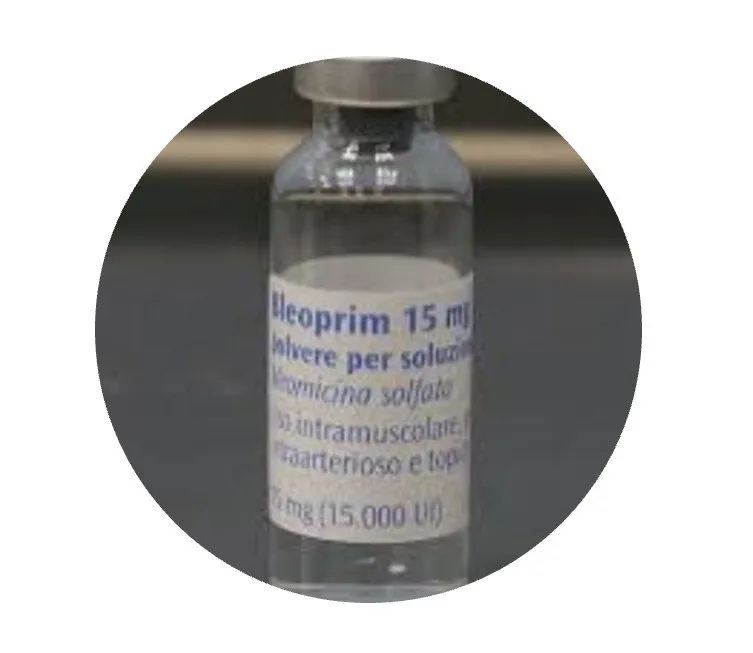
Table of Contents
Package leaflet: Information for the patient
Bleoprim 15 mg powder for injectable solution
bleomycin sulfate
Please read this leaflet carefully before you are given this medicine because it contains important information for you
- Keep this leaflet. You may need to read it again.
- If you have any questions, ask your doctor or pharmacist.
- This medicine has been prescribed for you only. Never give it to other people, even if they have the same symptoms as yours, because it may be harmful.
- If you experience any side effects, including those not listed in this leaflet, tell your doctor or pharmacist. See section 4.
Contents of this leaflet:
- What Bleoprim is and what it is used for
- What you need to know before using Bleoprim
- How to use Bleoprim
- Possible side effects
- How to store Bleoprim
- Contents of the pack and other information
1. What Bleoprim is and what it is used for
Bleoprim contains bleomycin, a medicine belonging to the class of cytostatic antibiotics (medicines
for cancer treatment).
Bleomycin is used in adults to inhibit the division and growth of cells (tumour cells),
thereby interfering with tumour growth in certain tissues, particularly the skin. Normal cells are less
sensitive to bleomycin than tumour cells, and therefore normal cells will continue to live while
tumour cells will be destroyed.
2. What you should know before using Bleoprim
Bleoprim must not be administered to you if:
- you are allergic to bleomycin;
- you have specific reactions related to bleomycin (idiosyncratic reactions);
- you have severe respiratory insufficiency;
- you have severe lung disease (severe respiratory insufficiency);
- you are pregnant (see section "Pregnancy and breastfeeding");
- you are breastfeeding (see section "Pregnancy and breastfeeding");
- you are receiving or have recently received a live attenuated vaccine, and for at least six months after discontinuation of chemotherapy;
- you are taking brentuximab (a medicine used to treat white blood cell cancer).
Warnings and precautions
Talk to your doctor before Bleoprim is administered to you if:
- you have kidney disease;
- you have lung disease: your doctor will monitor you closely and carry out tests during treatment;
- you have severe allergic reactions or specific reactions related to bleomycin (idiosyncratic reactions);
- you are elderly, as you may be more prone to developing allergic reactions;
- you have lymphoma (a tumour of immune system cells, the body's defence system), as you may be more prone to developing allergic reactions.
During treatment with Bleoprim:
- blood clots (thrombi) may form within small blood vessels (thrombotic microangiopathy), which can lead to serious kidney and blood disorders (so-called haemolytic uraemic syndrome).
- stomach and intestinal problems may occur, including inflammation or ulceration of the mucous membranes, inflammation of the mouth mucosa (stomatitis), intestinal ulcer, nausea, vomiting, diarrhoea, loss of appetite, weight loss.
Exercise particular caution with Bleoprim if:
- you have a lung infection;
- your lungs are not functioning properly;
- you have undergone radiotherapy, particularly to the chest.
Treatment with Bleoprim may have harmful effects on the lungs (pulmonary toxicity), which in the following cases may be fatal:
- if you are elderly;
- if your kidneys are not functioning properly (renal insufficiency);
- if you have received more Bleoprim than recommended;
- if you are receiving or have received lung irradiation;
- if you are receiving oxygen therapy;
- if you are undergoing chemotherapy.
If any of these apply to you, your doctor may decide to perform lung function tests more frequently to monitor potential harmful effects of Bleoprim.
Inform your doctor if you develop a dry cough and/or shortness of breath; your doctor may decide to discontinue treatment with Bleoprim.
During treatment, inform your doctor immediately if you experience signs of skin toxicity, including flagellate dermatitis, which may progress to toxic skin rashes. It may be necessary to delay or interrupt treatment.
If your kidneys are not functioning properly, your doctor may decide to perform regular kidney function tests.
Contact your doctor immediately and seek urgent medical help if you have experienced or develop problems due to blood clot formation in veins or arteries (types of blood vessels), including stroke, heart attack, embolism, or thrombosis. Symptoms include:
- chest pain or tightness,
- pain in the arms, back, neck, or jaw,
- shortness of breath,
- numbness or weakness on one side of the body,
- difficulty speaking,
- headache,
- changes in vision,
- dizziness,
- leg swelling.
Cases of blood cancer (acute myeloid leukaemia) and a syndrome characterised by insufficient production of platelets or healthy blood cells by the bone marrow (myelodysplastic syndrome) have been reported in patients treated simultaneously with bleomycin and other cytostatic agents (substances that inhibit cell growth/division).
Live attenuated vaccines
Live attenuated vaccines should be administered at least 4 weeks before starting immunosuppressive therapy (bleomycin as an immunosuppressant), and vaccination after bleomycin should not occur until at least 6 months after discontinuation of bleomycin therapy.
The combination of bleomycin with phenytoin and fosphenytoin is not recommended (see section "Other medicines and Bleoprim").
The combination of bleomycin with olaparib should be used with caution (see section "Other medicines and Bleoprim").
Other medicines and Bleoprim
Inform your doctor if you are taking, have recently taken, or might take any other medicine.
In particular, inform your doctor if you are taking:
- methotrexate (a medicine used to treat certain types of cancer, rheumatism, and severe skin diseases), as bleomycin may reduce its effectiveness;
- vincristine (a medicine used to treat certain types of cancer), as vincristine may increase the effectiveness of Bleoprim;
- vitamin K antagonists (anticoagulant medicines used to prevent or treat blood clot formation in arteries and veins);
- medicines containing, among others, cyclosporine, everolimus, tacrolimus, temsirolimus, sirolimus (immunosuppressive medicines used to reduce the body's immune responses);
- concomitant administration of this medicine with other antitumour agents such as, but not limited to, cisplatin, cyclophosphamide, carmustine, gemcitabine, and taxanes, and/or concomitant administration with oxygen are important factors increasing the incidence and severity of pulmonary toxicity such as interstitial pneumonia or pulmonary fibrosis;
- flucytosine (used to treat certain fungal infections), as flucytosine may increase the risk of haematological toxicity;
- a medicine that may affect kidney function, such as cisplatin (a medicine used to treat certain diseases of the ear, nose, and throat, genitourinary system, oesophagus, and stomach);
- olaparib (an antitumour agent), which may increase the risk of blood-related toxicity.
Do not use Bleoprim simultaneously with:
- a live attenuated vaccine, and for at least six months after discontinuation of chemotherapy;
- brentuximab (a medicine used to treat white blood cell cancer).
Unless otherwise directed by your doctor, do not use Bleoprim if:
- you have taken phenytoin or fosphenytoin (medicines used to treat epilepsy).
In case of severe allergic reactions or specific reactions related to bleomycin (idiosyncratic reactions), discontinue treatment and consult your doctor.
Inform your doctor if you experience stomach or intestinal disturbances (see "Undesirable effects"), as these may be early signs of severe gastrointestinal toxicity.
Pregnancy, breastfeeding, and fertility
Contraception in males and females
For women who could become pregnant:
use effective contraception during treatment with Bleoprim and for 6 months after discontinuation of treatment.
For men:
use effective contraception during treatment with Bleoprim and for 3 months after discontinuation of treatment.
Pregnancy and breastfeeding
Do not use this medicine under any circumstances during pregnancy or while breastfeeding.
Ask your doctor or pharmacist for advice before taking any medicine.
Fertility
Limited data are available on the effect of bleomycin on fertility. Cases of absence of sperm in semen (azoospermia) have been reported in males.
Individual genetic counselling is required for male and female patients before starting treatment with Bleoprim.
It is advisable to seek advice on sperm preservation before starting treatment.
Driving and using machines
Bleoprim has no effect on the ability to drive vehicles or operate machinery.
3. How to use Bleoprim
This medicine is available only in a hospital setting. Therefore, this medicine will be administered to you
exclusively under the close supervision of qualified medical personnel.
Your doctor will determine the most appropriate dose for you based on your health status.
Your doctor will administer Bleoprim to you via an injection that may be given:
- subcutaneously,
- into the muscles,
- into the veins,
- into the arteries, or
- by applying a solution-soaked swab to the skin.
If you are given more Bleoprim than you should
It is highly unlikely that you will be administered more infusion solution than required, as your doctor or
nurse will monitor you during treatment.
If you are administered high doses of Bleoprim, you may develop lung diseases (fibrosis).
4. Possible side effects
Like all medicines, Bleoprim can cause side effects, although not everybody experiences them.
Severe pulmonary reactions (pneumonitis and/or fibrosis), some with fatal outcome, have been reported.
If you experience any of the following respiratory side effects, consult your doctor immediately, as you may need to discontinue treatment:
- pulmonary toxicity,
- severe pulmonary reactions such as pneumonitis,
- damage to the lining tissue of the lung alveoli (interstitial lung disease), which may lead to scarring of lung tissue (pulmonary fibrosis) replacing normal lung tissue. This condition can be fatal.
Additionally, the following side effects have been observed and reported during treatment with Bleoprim, particularly when excessively high doses or too frequent administrations are used:
Common (may affect up to 1 in 10 people):
- nausea,
- vomiting,
- painful inflammation of the mucous membranes of the mouth and gastrointestinal tract (mucositis) (see also “Warnings and Precautions”),
- allergic (hypersensitivity) reactions and skin reactions (rash).
Not known (frequency cannot be estimated from the available data):
- inflammation of the mucous membrane of the mouth (stomatitis),
- excessive dryness of the mouth,
- diarrhoea, cessation of intestinal movements (paralytic ileus),
- gastrointestinal ulcers,
- difficulty or pain in swallowing (dysphagia),
- loss of appetite (anorexia),
- abdominal pain,
- skin and mucosal rash,
- pruritus,
- thickening and hardening of the skin (hyperkeratosis),
- hair loss (alopecia) in 10–15% of cases, which may resolve after treatment ends, loss of body hair and nails,
- skin changes resembling scleroderma, scleroderma (an autoimmune disease characterized by hardening and thickening of the skin in more or less extensive areas of the body surface),
- skin hyperpigmentation (flagellate dermatitis),
- toxic skin eruptions,
- absence of menstrual periods (amenorrhea),
- absence of sperm in semen (azoospermia),
- cell death at the injection site,
- allergic reactions at the injection site,
- fever,
- headache (cephalalgia),
- loss of appetite (anorexia),
- weight loss,
- mild reduction in bone marrow activity, the organ responsible for blood cell production (mild myelosuppression),
- inflammation and blockage of veins (thrombophlebitis),
- blockage of an artery leading to infarction or stroke (arterial thromboembolism), blockage of a vein (venous thromboembolism) resulting in blood clot formation (deep vein thrombosis) or obstruction of one or more branches of the pulmonary artery (pulmonary embolism), which may also be fatal. This effect generally occurs if you are also taking other anticancer medicines,
- formation of blood clots (thrombi) within small blood vessels (thrombotic microangiopathy), potentially fatal, which may lead to serious kidney and blood disorders (so-called haemolytic uraemic syndrome),
- decreased haemoglobin levels in the blood (anaemia),
- low levels of neutrophils, a type of white blood cells that fight infections (neutropenia),
- severe reduction in blood cells (pancytopenia),
- metabolic disturbances caused by the death of tumour cells releasing their contents into the bloodstream (tumour lysis syndrome),
- reduced number of white blood cells (leucopenia), which may lead to frequent infections,
- low platelet count in the blood (thrombocytopenia), which may lead to bleeding and bruising,
- suppression of bone marrow function (myelosuppression),
- circulation problems in fingers and toes (Raynaud's phenomenon), causing them to first turn white and then purple, which may even lead to tissue death (necrosis),
- increased or decreased sensitivity to stimuli such as touch, pain, and temperature throughout the body (hyperaesthesia or hypoesthesia),
- sensations such as numbness, tingling, prickling (paraesthesia),
- liver toxicity,
- kidney toxicity,
- allergic reactions including anaphylactic shock (potentially fatal),
- allergic (anaphylactoid) reactions and specific reactions (idiosyncratic reactions),
- increased body temperature (hyperpyrexia) and decreased blood pressure with severe reduction in heart function (cardiocirculatory collapse) in patients with lymphoma (a tumour of immune system cells, the body's defence system),
- skin deterioration (necrosis) at the injection site.
Reporting of side effects
If you experience any side effect, including those not listed in this leaflet, talk to your doctor or pharmacist. You can also report side effects directly via the national reporting system at https://www.aifa.gov.it/content/segnalazioni-reazioni-avverse.
By reporting side effects, you can help provide more information on the safety of this medicine.
5. How to store Bleoprim
Keep this medicine out of the sight and reach of children.
Store this medicine in the refrigerator (2°-8°C).
Do not use this medicine after the expiry date stated on the carton after the word EXP.
The expiry date refers to the last day of that month.
After reconstitution/dilution, the solution should be stored for a maximum of 24 hours at room temperature (15°-25°C).
Do not dispose of any medicine via wastewater or household waste. Ask your pharmacist how to dispose of medicines no longer required. This will help protect the environment.
6. Package contents and other information
What Bleoprim contains
- The active substance is bleomycin (as bleomycin sulfate).
- There are no other components.
Description of the appearance of Bleoprim and contents of the pack
The powder for injectable solution is contained in colorless glass vials with grey rubber stoppers.
Each vial contains 15 mg of powder.
Marketing Authorization Holder
Hikma Farmacêutica (Portugal), S.A.
Estrada do Rio da Mó, 8, 8A and 8B - Fervença
2705-906 Terrugem SNT
Portugal
Manufacturer
Thymoorgan Pharmazie GmbH
Schiffgraben 23
38690 Goslar
Germany
The following information is intended exclusively for physicians or healthcare professionals:
Dose and method of administration
The dose is strictly individual.
As a general guide—and subject to the necessary individual adjustments—administration of 5 to 15 mg of bleomycin per day, twice weekly, may be recommended until a total cumulative dose of 150–300 mg is reached. The scheduling of treatment cycles (regarding their number and the time interval between each cycle) must be determined based on achieved results, clinical course, and the occurrence of any adverse effects. The same criteria apply to maintenance therapy, which may be indicated at a dosage of 10–15 mg of bleomycin every 8–15 days.
Bleoprim is water-soluble and can therefore be dissolved using common physiological saline solution. Depending on the case, it may be administered:
- Intramuscularly: using 5 ml of solvent (to which lidocaine may optionally be added);
- Intravenously: using 5–20 ml of solvent, applying standard injection precautions;
- Intra-arterially: using 5–20 ml of solvent to dissolve the product, which must then be introduced into the bottle containing the perfusion fluid.
Bleomycin may also be injected locally into the area exhibiting metaplastic activity and may additionally be used topically by soaking an appropriate swab, which is then applied to the site using case-specific methods.