Blenrep
Italy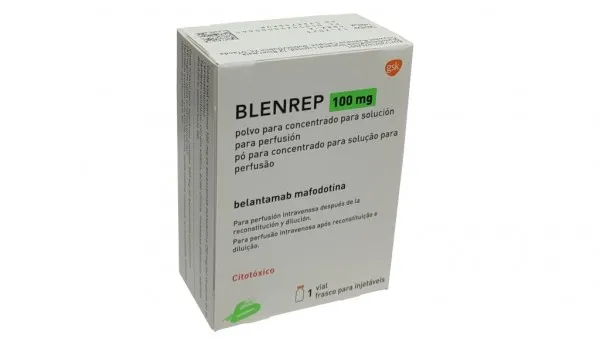
Table of Contents
- Patient Information Leaflet
- Blenrep 70 mg powder for concentrate for solution for infusion, 100 mg powder for concentrate for solution for infusion
- 1. What Blenrep is and what it is used for
- 2. What you should know before you are given Blenrep
- 3. How Blenrep is administered
- 4. Possible side effects
- 5. How to store BLENREP
- 6. Package contents and other information
- The following information is intended exclusively for healthcare professionals:
Patient Information Leaflet
Blenrep 70 mg powder for concentrate for solution for infusion, 100 mg powder for concentrate for solution for infusion
belantamab mafodotin
This medicinal product is subject to additional monitoring. This will allow for rapid identification of new safety information. You can help by reporting any side effects you experience while taking this medicine. See the end of section 4 for information on how to report side effects.
Please read this leaflet carefully before receiving this medicine, as it contains important information for you.
- Keep this leaflet. You may need to read it again.
- If you have any questions, ask your doctor or nurse.
- If you experience any side effects, including those not listed in this leaflet, talk to your doctor or pharmacist. See section 4.
Contents of this leaflet
- What Blenrep is and what it is used for
- What you need to know before you are given Blenrep
- How Blenrep is administered
- Possible side effects
- How to store Blenrep
- Contents of the pack and other information
1. What Blenrep is and what it is used for
Blenrep contains the active substance belantamab mafodotin. It is used in combination with other
anticancer medicines to treat adults who have a bone marrow tumour called
multiple myeloma.
Belantamab mafodotin consists of a monoclonal antibody linked to a cytotoxic agent (a type of
anticancer medicine). The monoclonal antibody is a protein designed to seek out multiple myeloma tumour cells in the body and bind to them. Once attached to the tumour cells,
the cytotoxic agent is released inside the cells and kills them.
Blenrep will be given to you together with other anticancer medicines used for the treatment of
multiple myeloma:
- bortezomib and dexamethasone, or
- pomalidomide and dexamethasone.
It is important that you read the package leaflets for these other medicines. If you have any questions about them, please consult your doctor.
2. What you should know before you are given Blenrep
You must not be given Blenrep:
- if you are allergic to belantamab mafodotin or to any of the other ingredients of this medicine (listed in section 6). ➔ Consult your doctor if you think this applies to you.
Warnings and precautions
Talk to your doctor or nurse before you are given Blenrep if you have:
Eye problems
This medicine can cause changes to the surface of the eye, which may lead to changes in vision, blurred vision, and dry eye.
You must have an eye examination by an ophthalmologist before each of the first 4 doses of this medicine. Your doctor may prescribe additional eye checks while you are being treated with Blenrep. Even if your vision seems normal, it is important to have your eyes checked during treatment with this medicine, because some changes may occur without symptoms and can only be detected by an eye examination.
➔ Do not use contact lenses during treatment, unless instructed otherwise by your ophthalmologist.
Your doctor will ask you to use eye drops called preservative-free artificial tears at least 4 times a day during treatment to hydrate and lubricate your eyes. You must use them as instructed.
Tell your doctor if you notice any changes in your vision. Your doctor may decide to reduce the dose or modify the dosing interval. Your doctor may also refer you again to an ophthalmologist.
➔ Contact your doctor if you experience blurred vision or other eye problems.
Bruising and abnormal bleeding
Blenrep can reduce the number of blood cells called platelets, which help blood to clot.
Symptoms of low platelet levels (thrombocytopenia) include:
- unusual bruising under the skin,
- bleeding for longer than usual after a blood draw or a skin cut,
- nosebleeds or bleeding from the gums, or more severe bleeding.
Your doctor will ask you to have a blood test before starting treatment and regularly during treatment with Blenrep to check that your platelet levels are within the normal range.
➔ Tell your doctor if you experience abnormal bleeding or bruising, or any symptom that concerns you.
Infusion-related reactions
Blenrep is given by intravenous infusion (infusion) into a vein. Some people receiving infusions develop infusion-related reactions. These reactions may occur during the infusion or within 24 hours afterwards. In rare cases, you may experience a severe allergic reaction, which may include swelling of the face, lips, mouth, tongue, or throat, difficulty swallowing or breathing, or the appearance of an itchy rash (urticaria).
➔ For further signs of an infusion-related reaction, see section 4.
➔ Seek immediate medical help if you think you are having an allergic reaction.
If you have previously had a reaction to an infusion of this medicine or to any other medicine:
➔ Tell your doctor or nurse before receiving another infusion.
Lung inflammation
A serious and potentially fatal inflammation of the lungs (pneumonitis) has occurred in some people who have received Blenrep.
Possible symptoms of lung inflammation include:
- shortness of breath,
- chest pain,
- new or worsening cough.
If you develop symptoms of pneumonitis, your doctor may decide to delay or permanently stop treatment with Blenrep.
➔ Tell your doctor if you develop lung problems or any breathing-related symptoms that concern you.
If you have or have previously had hepatitis B infection
Tell your doctor if you may have or have previously had hepatitis B infection. This medicine may cause reactivation of the infection. Your doctor may perform tests to check for signs of infection before and during treatment.
➔ Tell your doctor if you notice any of the following signs or symptoms: worsening fatigue, yellowing of the skin or the whites of the eyes, dark urine. If you develop symptoms of hepatitis B infection, your doctor may decide to delay or permanently stop treatment with Blenrep.
Children and adolescents
This medicine is not intended for use in children and adolescents under 18 years of age.
Other medicines and Blenrep
➔ Tell your doctor if you are taking, have recently taken, or might take any other medicines.
Pregnancy, breastfeeding, and fertility
Pregnancy
It is not known whether Blenrep has effects on an unborn child. Use of this medicine is not recommended during pregnancy.
If you are pregnant, suspect you may be pregnant, or are planning a pregnancy:
➔ Tell your doctor before you are given this medicine.
If you are a woman who could become pregnant:
- your doctor will ask you to take a pregnancy test before starting treatment with Blenrep.
- you must use effective birth control methods (contraception) during treatment and for 4 months after the last dose of Blenrep.
If you are a man who could father a child:
- you must use effective birth control methods (contraception) during treatment and for 6 months after the last dose of Blenrep.
Breastfeeding
It is not known whether Blenrep passes into breast milk. You must not breastfeed during treatment and for 3 months after the last dose of this medicine.
Talk to your doctor if you are breastfeeding or planning to breastfeed.
Fertility
It is recommended that men and women who are about to be treated with this medicine and who wish to have children consult a fertility specialist.
Driving and using machines
Blenrep can cause vision disturbances that may affect your ability to drive or operate machinery.
➔ Do not drive or use machinery unless you are certain that your vision is unaffected. If in doubt, consult your doctor.
Blenrep contains polysorbate and sodium
This medicine contains 0.28 mg of polysorbate 80 (E433) in each 70 mg vial and 0.4 mg of polysorbate 80 (E433) in each 100 mg vial, equivalent to 0.2 mg/mL per vial. Polysorbates may cause allergic reactions. Inform your doctor if you have known allergies.
This medicine contains less than 1 mmol (23 mg) of sodium per dose, i.e., essentially “sodium-free”.
3. How Blenrep is administered
Your doctor will determine the correct dose of Blenrep. The dose is calculated based on your body weight.
Blenrep is administered together with other medicines used for the treatment of multiple myeloma.
- When given with bortezomib and dexamethasone, the recommended starting dose of Blenrep is 2.5 mg per kilogram of body weight, every 3 weeks.
- When given with pomalidomide and dexamethasone, the recommended starting dose of Blenrep is 2.5 mg per kilogram of body weight for the first dose, followed by 1.9 mg per kilogram of body weight, every 4 weeks.
Your doctor or nurse will give you this medicine as an intravenous infusion (infusion) over 30 minutes.
Your doctor will decide with you the number of treatments needed. Treatment will continue until disease progression or the development of unacceptable side effects. Your doctor will discuss the duration of treatment with you.
Before the infusion, you must apply lubricating and hydrating eye drops (artificial tears without preservatives). You must continue using the eye drops at least 4 times a day during treatment with Blenrep.
➔ Read the information provided in section “Eye disorders” in paragraph 2 of this package leaflet.
If you receive more Blenrep than you should
Your doctor or nurse will administer this medicine to you. In the unlikely event that you receive an excessive dose (overdose), your doctor will monitor you for any possible side effects.
If you miss a dose of Blenrep
To ensure that treatment works, it is very important that you attend all your scheduled appointments. If you miss an appointment, make another one as soon as possible.
➔ Contact your doctor or hospital facility as soon as possible to reschedule an appointment.
4. Possible side effects
Like all medicines, this medicine can cause side effects, although not everyone gets them.
Serious side effects
Some side effects can be serious. Seek immediate medical attention before receiving your next scheduled dose if you experience any of the following serious side effects:
Very common: may affect more than 1 in 10 people
-
COVID-19. Symptoms may include: fever or chills or cough or sore throat or congestion or runny nose or new loss of taste or smell.
-
lung infections ( pneumonia ). Symptoms may include: shortness of breath or chest pain or new or worsening cough
-
bruising or unusual bleeding, due to a low number of a type of blood cell called platelets, which help blood to clot ( thrombocytopenia ) ➔ Read the information in section “Bruising and unusual bleeding” in paragraph 2 of this leaflet.
-
low white blood cell count ( neutropenia ), which may increase the risk of infections. Symptoms may include: fever or chills or feeling tired.
-
Fever ( pyrexia ). Symptoms may include: chills or flushing
Common: may affect up to 1 in 10 people -
Lung infection due to COVID-19 ( pneumonia ). Symptoms may include: shortness of breath or difficulty breathing or cough or chest pain or fever or extreme tiredness ( fatigue )
or confusion. -
Infusion-related reactions. After an infusion, some people may have allergic-like reactions. These usually occur within minutes or hours, but may appear up to 24 hours after treatment. Symptoms may include: flushing or chills or fever or difficulty breathing or rapid heartbeat or drop in blood pressure. ➔ Seek immediate medical help if you think you are having a reaction.
Uncommon: may affect up to 1 in 100 people -
blood vessel disorders in the liver ( porto-sinusoidal vascular disorder ). This may lead to: abnormal liver blood tests and long-term problems such as increased blood vessel pressure in the abdomen ( portal hypertension ) or swelling of blood vessels ( varices ) in the tube connecting the mouth to the stomach ( oesophagus ) or fluid buildup in the abdomen that may cause abdominal pain, weight gain, or abdominal swelling ( ascites ).
Other side effects
The following side effects have been reported with Blenrep administered in combination with bortezomib and dexamethasone, and with Blenrep administered in combination with pomalidomide and dexamethasone. Inform your doctor or nurse if you notice any of the following side effects:
Very common: may affect more than 1 in 10 people
- eye disorders, including: blurred vision or changes to the eye surface or dry eye or sensitivity to light ( photophobia ) or sensation of having something in the eye (foreign body sensation in eyes) or eye irritation or eye pain or reduced vision or clouding of the lens ( cataract ) ➔ Read the information in section “Eye disorders” in paragraph 2 of this leaflet.
- cold or flu-like symptoms such as cough, runny nose, or sore throat ( upper respiratory tract infection )
- low red blood cell count, which carry oxygen in the blood ( anaemia ), causing weakness and tiredness ( fatigue )
- low white blood cell count in the blood that help fight infections ( lymphopenia )
- difficulty falling asleep, staying asleep, or poor quality of sleep ( insomnia )
- nerve damage ( neuropathies )
- cough
- diarrhoea
- nausea
- constipation
- abnormal blood tests indicating liver problems ( alanine aminotransferase, aspartate aminotransferase and gamma-glutamyltransferase )
- joint pain
- back pain
- feeling of tiredness ( fatigue )
Common: may affect up to 1 in 10 people
- other eye disorders, including: increased tear production ( lacrimation ), double vision ( diplopia ), itchy eyes, eye discomfort, eye ulcers with possible infection ( infectious keratitis ) or vision problems
- infection in parts of the body where urine collects and passes ( urinary tract infection )
- inflammation of the airways in the lungs ( bronchitis )
- low levels of white blood cells that help fight infections ( leucopenia )
- low levels of white blood cells with fever ( febrile neutropenia )
- low levels of antibodies in the blood called “immunoglobulins” that help fight infections ( hypogammaglobulinemia )
- reduced appetite
- difficulty breathing ( dyspnoea )
- vomiting
- rash
- abnormal levels of creatine phosphokinase in the blood
- foamy, bubbly or frothy-looking urine, indicating high levels of protein in the urine ( albuminuria )
- weakness ( asthenia )
Uncommon: may affect up to 1 in 100 people
- Reactivation of hepatitis B infection if you have previously had hepatitis B ➔ Read the information under “If you have or have had hepatitis B infection” in paragraph 2 of this leaflet.
- shortness of breath, chest pain and cough due to inflammation of the lungs ( pneumonia ) ➔ Read the information in section “Lung inflammation” in paragraph 2 of this leaflet.
Other reported side effects (frequency not known):
- reduced sensitivity ( hypoesthesia ) of the cornea (the transparent front layer of the eye covering the pupil and iris).
Reporting of side effects
If you experience any side effect, including those not listed in this leaflet, talk to your doctor or pharmacist. You can also report side effects directly via the national reporting system listed in Annex V. By reporting side effects, you can help provide more information on the safety of this medicine.
5. How to store BLENREP
Your doctor, pharmacist, or nurse is responsible for the storage of this medicinal product and the proper disposal of any unused product. The following information is intended for healthcare professionals.
Keep this medicine out of the sight and reach of children.
Do not use this medicine after the expiry date stated on the label and carton after "Exp.". The expiry date refers to the last day of that month.
Store in a refrigerator (2 °C – 8 °C).
The reconstituted solution may be stored for up to 4 hours at room temperature (20 °C – 25 °C) or in the refrigerator (2 °C – 8 °C) for up to 4 hours. Do not freeze.
The diluted solution may be stored in the refrigerator (2 °C – 8 °C) for up to 24 hours prior to administration. Do not freeze. If refrigerated, allow the diluted solution to reach room temperature before administration. The diluted infusion solution may be kept at room temperature (20 °C – 25 °C) for a maximum of 6 hours.
Do not dispose of any medicinal product via wastewater or household waste. Unused medicines will be disposed of by healthcare professionals. This will help protect the environment.
6. Package contents and other information
What Blenrep contains
The active substance is belantamab mafodotin. One vial of powder contains 70 mg or 100 mg of
belantamab mafodotin, respectively. After reconstitution, the solution contains 50 mg of
belantamab mafodotin per mL.
The other components are sodium citrate dihydrate, citric acid monohydrate (E330), trehalose dihydrate,
disodium edetate, and polysorbate 80 (E433) (see section 2 “Blenrep contains polysorbate and sodium”).
Description of the appearance of Blenrep and contents of the pack
Blenrep 70 mg powder for concentrate for solution for infusion (powder for concentrate) and Blenrep
100 mg powder for concentrate for solution for infusion (powder for concentrate) are presented as a
white to yellow powder in a glass vial with a rubber stopper and an aluminium cap. Each carton contains one vial.
Marketing Authorisation Holder
GlaxoSmithKline Trading Services Limited
12 Riverwalk
Citywest Business Campus
Dublin 24
Ireland
D24 YK11
Manufacturer
GlaxoSmithKline Manufacturing SpA
Strada Provinciale Asolana, 90
San Polo di Torrile, Parma 43056
Italy
For further information about this medicinal product, please contact the local representative of the Marketing Authorisation Holder:
België/Belgique/Belgien Lietuva
GlaxoSmithKline Pharmaceuticals s.a./n.v. GlaxoSmithKline Trading Services Limited
Tél/Tel: + 32 (0) 10 85 52 00 Tel: + 370 80000334
България Luxembourg/Luxemburg
GlaxoSmithKline Trading Services Limited GlaxoSmithKline Pharmaceuticals s.a./n.v.
Teл.: + 359 80018205 Belgique/Belgien
Tél/Tel: + 32 (0) 10 85 52 00
Česká republika Magyarország
GlaxoSmithKline, s.r.o. GlaxoSmithKline Trading Services Limited
Tel: + 420 222 001 111 Tel.: + 36 80088309
[email protected]
Danmark Malta
GlaxoSmithKline Pharma A/S GlaxoSmithKline Trading Services Limited
Tlf: + 45 36 35 91 00 Tel: + 356 80065004
[email protected]
Deutschland Nederland
GlaxoSmithKline GmbH & Co. KG GlaxoSmithKline BV
Tel.: + 49 (0)89 36044 8701 Tel: + 31 (0) 33 2081100
[email protected]
Eesti Norge
GlaxoSmithKline Trading Services Limited GlaxoSmithKline AS
Tel: + 372 8002640 Tlf: + 47 22 70 20 00
Ελλάδα Österreich
GlaxoSmithKline Μονοπρόσωπη A.E.B.E. GlaxoSmithKline Pharma GmbH
Τηλ: + 30 210 68 82 100 Tel: + 43 (0)1 97075 0
[email protected]
España Polska
GlaxoSmithKline, S.A. GSK Services Sp. z o.o.
Tel: + 34 900 202 700 Tel.: + 48 (0)22 576 9000
[email protected]
France Portugal
Laboratoire GlaxoSmithKline GlaxoSmithKline – Produtos Farmacêuticos, Lda.
Tél: + 33 (0)1 39 17 84 44 Tel: + 351 21 412 95 00
[email protected] [email protected]
Hrvatska România
GlaxoSmithKline Trading Services Limited GlaxoSmithKline Trading Services Limited
Tel: +385 800787089 Tel: + 40 800672524
Ireland Slovenija
GlaxoSmithKline Trading Services Limited GlaxoSmithKline Trading Services Limited
Tel: + 353 (0)1 4955000 Tel: + 386 80688869
Ísland Slovenská republika
Vistor hf. GlaxoSmithKline Trading Services Limited
Sími: + 354 535 7000 Tel: + 421 800500589
Italia Suomi/Finland
GlaxoSmithKline S.p.A. GlaxoSmithKline Oy
Tel: + 39 (0)45 7741111 Puh/Tel: + 358 (0)10 30 30 30
Κύπρος Sverige
GlaxoSmithKline Trading Services Limited GlaxoSmithKline AB
Τηλ: + 357 80070017 Tel: + 46 (0)8 638 93 00
[email protected]
Latvija
GlaxoSmithKline Trading Services Limited
Tel: + 371 80205045
Other sources of information
More detailed information on this medicinal product is available on the website of the European Medicines Agency: https://www.ema.europa.eu
The following information is intended exclusively for healthcare professionals:
Step-by-step instructions for use, handling, reconstitution, and administration
The trade name and batch number of the administered product must be clearly
recorded in the patient's medical record.
Care must be taken when handling and preparing Blenrep. Appropriate procedures for handling and disposal of cytotoxic anticancer medicinal products must be followed.
Preparation of infusion solution
Blenrep is a cytotoxic anticancer medicinal product. Appropriate handling procedures must be followed. Use aseptic technique for reconstitution and dilution of the solution for administration.
Calculate the dose (mg), the total volume (mL) of solution required, and the number of vials needed based on the patient’s actual body weight (kg).
Reconstitution
- Remove the Blenrep vial(s) from the refrigerator and allow them to stand for approximately 10 minutes to reach room temperature.
- Reconstitute each 70 mg vial with 1.4 mL of sterile water for injections to obtain a concentration of 50 mg/mL. Gently rotate the vial to aid dissolution. Do not shake.
- Reconstitute each 100 mg vial with 2 mL of sterile water for injections to obtain a concentration of 50 mg/mL. Gently rotate the vial to aid dissolution. Do not shake.
- Visually inspect the reconstituted solution for particles and discoloration. The reconstituted solution should be clear to opalescent, colourless or yellow-brown. Discard the reconstituted solution if foreign particulate matter other than translucent to white protein particles is observed.
Instructions for dilution for intravenous use
- Withdraw from each vial the volume required for the calculated dose.
- Add the required amount of Blenrep to an infusion bag containing 250 mL of 0.9% sodium chloride solution (9 mg/mL) for injection. Mix the diluted solution by gently inverting the bag. The final concentration of the diluted solution must be between 0.2 mg/mL and 2 mg/mL. Do not shake.
- Discard any unused reconstituted Blenrep solution remaining in the vial.
If the diluted solution is not used immediately, it may be stored refrigerated (2 °C – 8 °C)
for up to 24 hours prior to administration. If refrigerated, allow the diluted solution to reach room temperature before administration. The diluted solution may be kept at room temperature (20 °C – 25 °C) for a maximum of 6 hours (including infusion time).
Instructions for administration
- Administer the diluted solution only via intravenous infusion over approximately 30 minutes using a polyvinyl chloride or polyolefin infusion set. If the administration time may exceed 30 minutes, the maximum permitted duration of 6 hours for the solution’s use must not be exceeded, including both preparation and administration time.
- Filtration of the diluted solution is not required. However, if filtration is performed, a 0.2 µm or 0.22 µm polyethersulfone (PES) filter is recommended.
Disposal
Any unused medicinal product and waste material derived from this medicinal product must be disposed of in accordance with local regulations.