Bevespi Aerosphere
Italy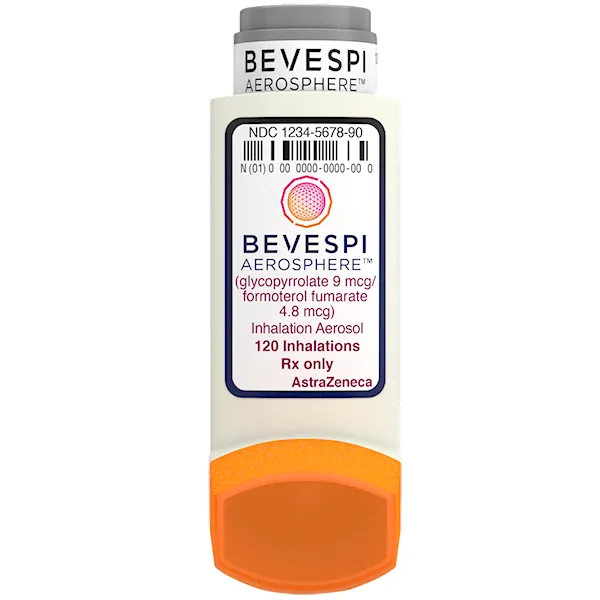
Table of Contents
- Package leaflet: Information for the user
- Bevespi Aerosphere 7.2 micrograms/5 micrograms pressurised suspension for inhalation
- 1. What Bevespi Aerosphere is and what it is used for
- 2. What you should know before using Bevespi Aerosphere
- 3. How to use Bevespi Aerosphere
- 4. Possible side effects
- 5. How to store Bevespi Aerosphere
- 6. Package contents and other information
- Instructions for use
- Bevespi Aerosphere 7.2 micrograms/5 micrograms pressurized suspension for inhalation
Package leaflet: Information for the user
Bevespi Aerosphere 7.2 micrograms/5 micrograms pressurised suspension for inhalation
glycopyrronium/formoterol fumarate dihydrate
Please read all of this leaflet carefully before you start using this medicine, because it contains important information for you.
- Keep this leaflet. You may need to read it again.
- If you have any questions, ask your doctor, pharmacist or nurse.
- This medicine has been prescribed for you only. Do not give it to other people, even if they have the same symptoms as yours, because it may be harmful.
- If you experience any side effects, including those not listed in this leaflet, tell your doctor, pharmacist or nurse. See section 4.
Contents of this leaflet
- What Bevespi Aerosphere is and what it is used for
- What you need to know before using Bevespi Aerosphere
- How to use Bevespi Aerosphere
- Possible side effects
- How to store Bevespi Aerosphere
- Contents of the pack and other information
Instructions for use
1. What Bevespi Aerosphere is and what it is used for
Bevespi Aerosphere contains two active substances called glycopyrronium and formoterol fumarate dihydrate, which belong to a class of medicines known as long-acting bronchodilators.
Bevespi Aerosphere is used to make breathing easier in adult patients suffering from a lung disease called chronic obstructive pulmonary disease (COPD), a long-term condition of the airways in the lungs often caused by cigarette smoking. In people with COPD, the muscles around the airways tighten, making it difficult to breathe.
This medicine prevents the tightening of the airway muscles, thereby helping air to move in and out of the lungs more easily.
Bevespi Aerosphere delivers the active substances directly into the airways of the lungs during inhalation. It helps reduce the impact of COPD on daily life.
2. What you should know before using Bevespi Aerosphere
Do not use Bevespi Aerosphere if
- you are allergic to glycopyrronium, formoterol fumarate dihydrate, or any of the other ingredients of this medicine (listed in section 6). If you have any doubts, consult your doctor or pharmacist before using Bevespi Aerosphere.
Warnings and precautions
Bevespi Aerosphere is used regularly for the long-term treatment of COPD. Do not use
this medicine to treat an acute episode of breathing difficulty or wheezing.
Immediate breathing difficulties
If you experience chest tightness, cough, shortness of breath, or difficulty breathing immediately after using
Bevespi Aerosphere:
Stop using this medicine and consult a doctor immediately, as you may be experiencing a serious condition called paradoxical bronchospasm.
Consult your doctor or pharmacist before using Bevespi Aerosphere if
- you have asthma. This medicine must not be used for the treatment of asthma
- you have heart problems
- you have diabetes
- you have low levels of potassium in your blood
- you have thyroid problems (called 'thyrotoxicosis')
- you have a condition affecting the eyes called narrow-angle glaucoma (also known as closed-angle glaucoma)
- you have prostate problems or difficulty urinating
- you have kidney or liver problems
Always inform your doctor about any other health conditions.
Children and adolescents
Do not administer Bevespi Aerosphere to children and adolescents under 18 years of age.
Other medicines and Bevespi Aerosphere
Inform your doctor or pharmacist if you are taking, have recently taken, or might take
any other medicines.
Some medicines may affect how this medicine works or may increase the likelihood of side effects. These include:
- medicines similar to Bevespi Aerosphere, such as those containing similar active substances including tiotropium, ipratropium, aclidinium, umeclidinium, salmeterol, vilanterol, olodaterol, or indacaterol. If in doubt, consult your doctor or pharmacist. The use of Bevespi Aerosphere with these medicines is not recommended;
- medicines that reduce the amount of potassium in the blood. These include: o oral corticosteroids (e.g. prednisolone), o diuretics (such as furosemide or hydrochlorothiazide) used for high blood pressure, o certain medicines used to treat respiratory diseases called methylxanthines (e.g. theophylline);
- medicines called beta-blockers, which may be used to treat high blood pressure or other heart problems (including atenolol or propranolol), or to treat glaucoma (e.g. timolol);
- medicines that may prolong the QT interval (a change in the heart's electrical activity). These include medicines used to treat: o depression (such as monoamine oxidase inhibitors or tricyclic antidepressants), o bacterial infections (such as erythromycin, clarithromycin, telithromycin), o allergic reactions (antihistamines).
If you are in any of these situations or have any doubts, consult your doctor or pharmacist before
using Bevespi Aerosphere.
Pregnancy and breastfeeding
If you are pregnant, think you may be pregnant, planning to become pregnant, or are breastfeeding,
ask your doctor or pharmacist for advice before using Bevespi Aerosphere.
Bevespi Aerosphere must not be used during pregnancy unless prescribed by your doctor.
Bevespi Aerosphere must not be used during breastfeeding unless prescribed by your doctor.
Driving and using machines
It is unlikely that this medicine will affect your ability to drive or operate machinery.
However, common adverse reactions such as dizziness and nausea may occur. If this happens, do not drive or operate machinery.
3. How to use Bevespi Aerosphere
Use this medicine exactly as your doctor has told you. If you are unsure, consult your doctor or pharmacist.
Dosage of Bevespi Aerosphere
The recommended dose is two inhalations twice daily.
It is important to use Bevespi Aerosphere every day, even if you do not currently have symptoms of COPD.
How to use Bevespi Aerosphere
Bevespi Aerosphere is for inhalation use only.
Read the instructions for use provided at the end of this leaflet. If you have any doubts about how to use Bevespi Aerosphere, consult your doctor or pharmacist.
Use of Bevespi Aerosphere with a spacer
If you have difficulty inhaling and actuating the inhaler at the same time, inform your doctor or pharmacist. You may use a spacer device with the inhaler.
If you use more Bevespi Aerosphere than you should
If you have used more Bevespi Aerosphere than the recommended dose, contact your doctor or pharmacist immediately. You may require medical treatment. You may notice an increased heart rate, tremor, visual disturbances, dry mouth, headache, or nausea (feeling unwell).
If you forget to use Bevespi Aerosphere
Do not take a double dose to make up for a forgotten dose. Take the missed dose as soon as you remember. However, if it is almost time for your next dose, skip the missed dose. Do not exceed two inhalations twice daily.
If you stop using Bevespi Aerosphere
This medicine is for long-term use. It will only be effective as long as you continue to use it.
Do not stop treatment unless instructed by your doctor, even if you feel better, as symptoms may worsen. If you plan to stop treatment, inform your doctor first.
If you have any questions about using this medicine, consult your doctor or pharmacist.
4. Possible side effects
Like all medicines, this medicine can cause side effects, although not everybody gets them.
Serious side effects
Stop treatment with Bevespi Aerosphere and contact your doctor immediately if you notice any of the
following symptoms:
Uncommon (may affect up to 1 in 100 people)
o swelling of the face, particularly around the mouth (swelling of the tongue or throat,
which may cause difficulty swallowing),
o skin rash or hives associated with difficulty breathing,
o sudden feeling of fainting.
These symptoms may be signs of an allergic reaction which could become serious.
Other possible side effects
Common (may affect up to 1 in 10 people)
- headache
- dry mouth
- nausea
- painful and frequent urination (may be symptoms of a urinary tract infection)
- muscle cramps
- chest pain
- anxiety
- dizziness
Uncommon (may affect up to 1 in 100 people)
- tremor or shaking
- high blood sugar levels
- agitation
- restlessness
- difficulty sleeping
- fast or irregular heartbeat
- difficulty urinating (urinary retention)
Reporting of side effects
If you get any side effects, including ones not listed in this leaflet, talk to your doctor or pharmacist. You can also report side effects directly via the national reporting system referred to in Annex V. By reporting side effects, you can help provide more information on the safety of this medicine.
5. How to store Bevespi Aerosphere
Keep this medicine out of the sight and reach of children.
Do not use this medicine after the expiry date which is stated on the carton, on the bag, and on the
pressurised container after 'Exp.'. The expiry date refers to the last day of that month.
Once the bag has been opened, the inhaler can be used for a maximum of 3 months.
Write the date of opening of the bag in the designated space on the inhaler label.
Do not store above 30°C.
Warning: Do not pierce, puncture, or burn the pressurised container, even if it appears to be empty.
Do not expose to temperatures above 50°C.
Do not dispose of any medicine via wastewater or household waste. Ask your pharmacist how to
dispose of medicines no longer required. This will help protect the environment.
6. Package contents and other information
What Bevespi Aerosphere contains
The active substances are glycopyrronium and formoterol fumarate dihydrate.
Each single inhalation delivers a dose of 9 micrograms of glycopyrronium bromide (equivalent to
7.2 micrograms of glycopyrronium) and 5 micrograms of formoterol fumarate dihydrate.
This corresponds to a metered dose (i.e. the dose delivered from the valve) of 10.4 micrograms of
glycopyrronium bromide, equivalent to 8.3 micrograms of glycopyrronium, and 5.8 micrograms of
formoterol fumarate dihydrate.
The other components are norflurane, 1,2-distearoyl-sn-glycero-3-phosphocholine and calcium chloride.
This medicinal product contains fluorinated greenhouse gases. Each inhaler contains 10.6 g of norflurane
(HFC-134a), corresponding to 0.015 tonnes of CO\ equivalent (global warming potential = 1,430).
Description of the appearance of Bevespi Aerosphere and contents of the pack
Bevespi Aerosphere is a pressurised suspension for inhalation.
Bevespi Aerosphere is supplied as a pressurised canister with a dose indicator, equipped with a white plastic actuator body and a mouthpiece (see Figure 1 of the Instructions for Use at the end of this leaflet). The mouthpiece is covered with an orange protective cap. Bevespi Aerosphere is supplied in an aluminium pouch containing a desiccant (drying agent) and is packaged in a carton.
The active substances are present as a pressurised suspension inside the pressurised canister.
Bevespi Aerosphere is available in packs containing 1 inhaler with 120 doses and in multiple packs containing 3 inhalers, each with 120 doses.
Not all pack sizes may be marketed.
Marketing Authorisation Holder
AstraZeneca AB
SE-151 85 Södertälje
Sweden
Manufacturer
AstraZeneca Dunkerque Production
224 Avenue de la Dordogne
59640 Dunkerque
France
For further information about this medicinal product, please contact the local representative of the Marketing Authorisation Holder:
België/Belgique/Belgien Lietuva
AstraZeneca S.A./N.V. UAB AstraZeneca Lietuva
Tel: +32 2 370 48 11 Tel: +370 5 2660550
България Luxembourg/Luxemburg
АстраЗенека България ЕООД AstraZeneca S.A./N.V.
Тел.: +359 24455000 Tél/Tel: +32 2 370 48 11
Česká republika Magyarország
AstraZeneca Czech Republic s.r.o. AstraZeneca Kft.
Tel: +420 222 807 111 Tel.: +36 1 883 6500
Danmark Malta
AstraZeneca A/S Associated Drug Co. Ltd
Tlf: +45 43 66 64 62 Tel: +356 2277 8000
Deutschland Nederland
AstraZeneca GmbH AstraZeneca BV
Tel: +49 40 809034100 Tel: +31 85 808 9900
Eesti Norge
AstraZeneca AstraZeneca AS
Tel: +372 6549 600 Tlf: +47 21 00 64 00
Ελλάδα Österreich
AstraZeneca A.E. AstraZeneca Österreich GmbH
Τηλ: +30 210 6871500 Tel: +43 1 711 31 0
España Polska
AstraZeneca Farmacéutica Spain, S.A. AstraZeneca Pharma Poland Sp. z o.o.
Tel: +34 91 301 91 00 Tel.: +48 22 245 73 00
France Portugal
AstraZeneca Tecnimede - Sociedade Técnico Medicinal, S.A.
Tél: +33 1 41 29 40 00 Tel: +351 21 041 41 00
Hrvatska România
AstraZeneca d.o.o. AstraZeneca Pharma SRL
Tel: +385 1 4628 000 Tel: +40 21 317 60 41
Ireland Slovenija
AstraZeneca Pharmaceuticals (Ireland) Ltd AstraZeneca UK Limited
Tel: +353 1609 7100 Tel: +386 1 51 35 600
Ísland Slovenská republika
Vistor hf. AstraZeneca AB, o.z.
Sími: +354 535 7000 Tel: +421 2 5737 7777
Italia Suomi/Finland
AstraZeneca S.p.A. AstraZeneca Oy
Tel: +39 02 00704500 Puh/Tel: +358 10 23 010
Κύπρος Sverige
Αλέκτωρ Φαρµακευτική Λτδ AstraZeneca AB
Τηλ: +357 22490305 Tel: +46 8 553 26 000
Latvija United Kingdom (Northern Ireland)
SIA AstraZeneca Latvija AstraZeneca UK Ltd
Tel: +371 67377100 Tel: +44 1582 836 836
Other sources of information
More detailed information on this medicinal product is available on the European Medicines Agency website: http://www.ema.europa.eu
Instructions for use
Bevespi Aerosphere 7.2 micrograms/5 micrograms pressurized suspension for inhalation
glycopyrronium/formoterol fumarate dihydrate
Read this user manual and the package leaflet carefully before starting to use Bevespi Aerosphere and each time you get a new inhaler, as they may contain new information. These instructions should be used together with your doctor’s advice regarding your condition and treatment.
Important information:
For inhalation use only
Use Bevespi Aerosphere exactly as prescribed by your doctor.
If you have any questions about how to use the inhaler, consult your doctor or pharmacist.
Parts of the Bevespi Aerosphere inhaler (See Figure 1):
Bevespi Aerosphere is supplied as a pressurized canister with a dose indicator, inserted into an actuator.
- Do not use the Bevespi Aerosphere actuator with other medicines.
- Do not use the Bevespi Aerosphere pressurized canister with an actuator from any other inhaler.
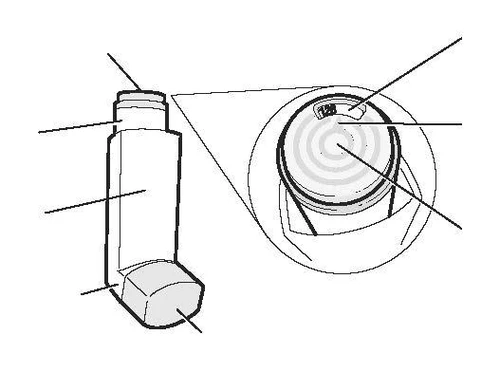
SIDE VIEW TOP VIEW
Dose indicator window
Dose indicator
Canister
Pointer
Actuator
Press here
Mouthpiece
Cap
Figure 1
Bevespi Aerosphere is equipped with a dose indicator located at the top of the pressurized canister (See Figure 1). The dose indicator window shows how many inhalations remain. One dose is delivered each time you press the center of the dose indicator.
Before using Bevespi Aerosphere for the first time:
Before first use, ensure that the pointer on the dose indicator is positioned to the right of the "120" mark in the dose indicator window (See Figure 1).
After 10 inhalations with Bevespi Aerosphere, the pointer will indicate 120, meaning 120 doses remain in the pressurized canister (See Figure 2a).
After another 10 inhalations, the pointer will indicate between 100 and 120, meaning 110 doses remain (See Figure 2b).
After another 10 inhalations, the pointer will indicate 100, meaning 100 doses remain in the pressurized canister (See Figure 2c).
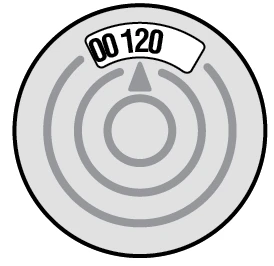
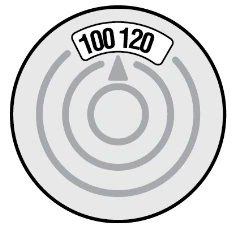
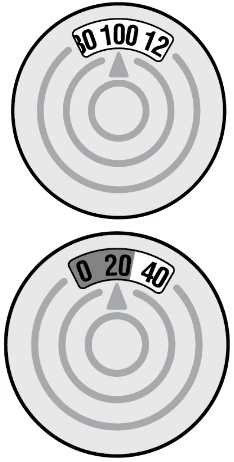
Figure 2a Figure 2b Figure 2c
120 doses 110 doses 100 doses
The dose indicator window advances every 10 inhalations. The number displayed in this window changes every 20 inhalations.
Figure 2d
The color in the dose indicator window will turn red, as shown in the shaded area, when only 20 doses remain in the inhaler (See Figure 2d).
When the arrow reaches "0", stop using the inhaler. The inhaler may not appear empty and may still seem to work, but continuing to use it will not deliver the correct amount of medicine.
Preparing the Bevespi Aerosphere inhaler for use:
The Bevespi Aerosphere inhaler is supplied in an aluminum pouch containing a desiccant packet (drying agent).
Remove the Bevespi Aerosphere inhaler from the aluminum pouch.
Discard the pouch and the desiccant packet. Do not use the inhaler if the drying agent has leaked out of the packet.
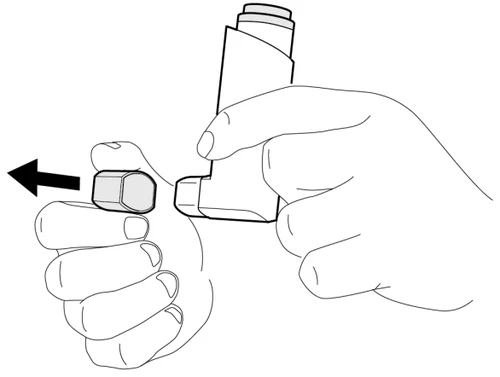
Figure 3
Loading the Bevespi Aerosphere inhaler:
Before using Bevespi Aerosphere for the first time, the inhaler must be primed.
Remove the cap from the mouthpiece (See Figure 3). Check the inside of the mouthpiece to make sure it is clean before using the inhaler.
Hold the inhaler upright, away from your face, and shake it well (See Figure 4).
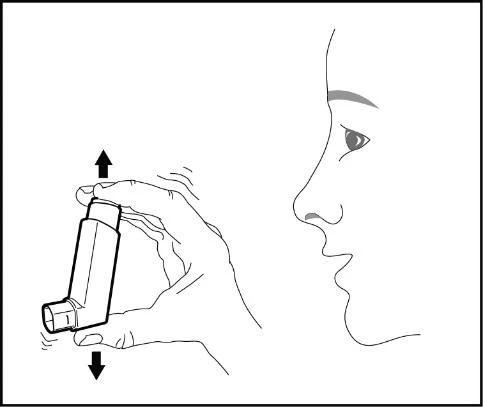
Figure 4
Firmly press the center of the dose indicator until movement of the pressurized canister inside the actuator stops. This releases one dose of medicine through the mouthpiece (See Figure 5). You may hear a soft click from the dose indicator as the dose count decreases during use.
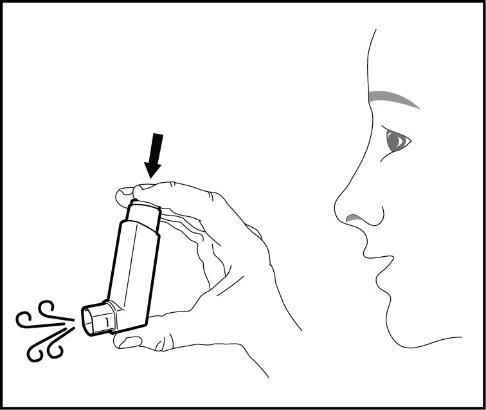
Figure 5
Repeat the priming steps 3 more times (See Figure 4 and Figure 5). Shake the inhaler well before each inhalation.
After priming the inhaler 4 times, the dose indicator should be positioned to the right of "120", and the inhaler is now ready for use.
Using the Bevespi Aerosphere inhaler:
Step 1: Remove the cap from the mouthpiece (See Figure 6).
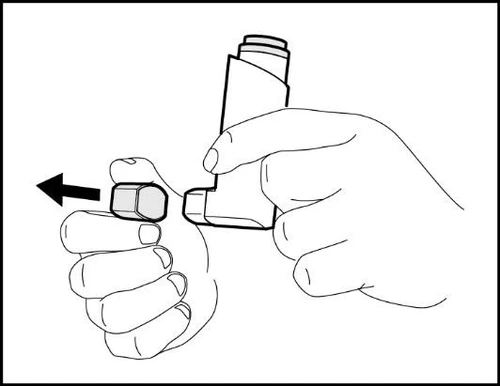
Figure 6
Step 2: Shake the inhaler well before use (See Figure 7).
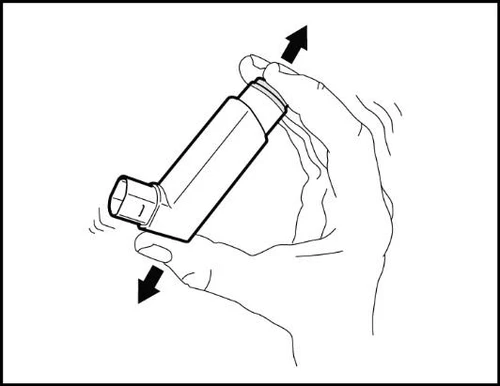
Figure 7
Step 3: Hold the inhaler with the mouthpiece facing toward you and breathe out as deeply as possible through your mouth (See Figure 8).
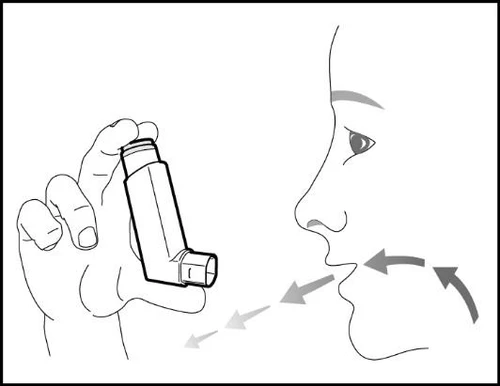
Figure 8
Step 4: Place your lips tightly around the mouthpiece and tilt your head slightly backward, keeping your tongue under the mouthpiece (See Figure 9).
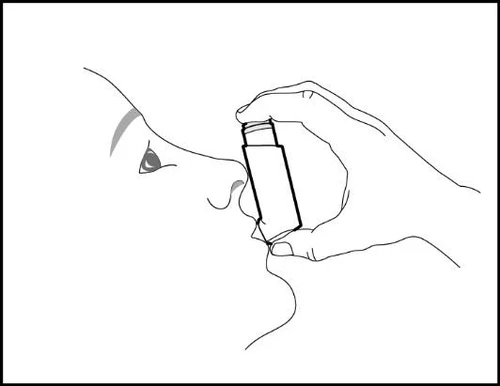
Figure 9
Step 5: While breathing in deeply and slowly, press firmly on the center of the dose indicator until movement of the pressurized canister inside the actuator stops and a dose of medicine is released (See Figure 10). Then release the dose indicator.
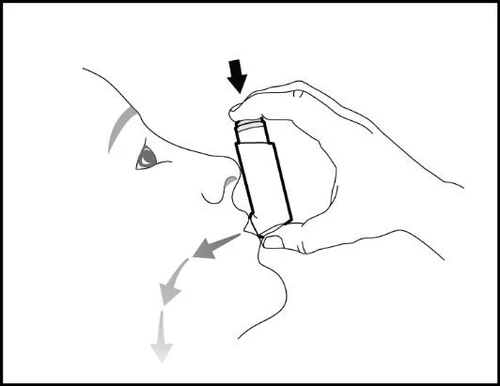
Figure 10
Step 6: After completing inhalation, remove the mouthpiece from your mouth. Hold your breath for as long as possible, up to 10 seconds (See Figure 11).
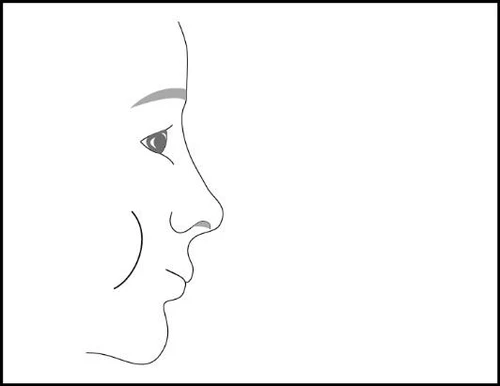
Figure 11
Step 7: Breathe out slowly (See Figure 12). Repeat Steps 2 to 7 to inhale the second dose of Bevespi Aerosphere.
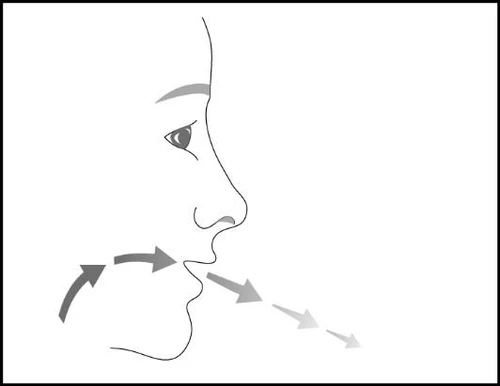
Figure 12
Step 8: Immediately replace the cap on the mouthpiece after use (See Figure 13).
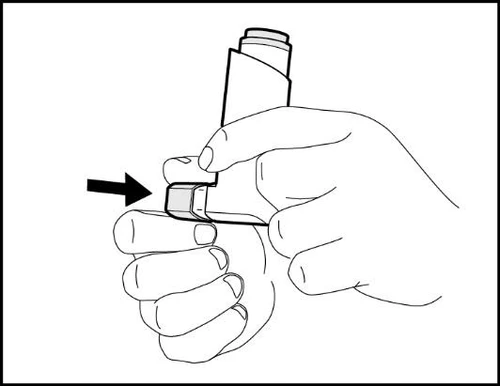
Figure 13
Cleaning the Bevespi Aerosphere inhaler:
Clean the inhaler once a week during the first 3 weeks. It is very important to keep the inhaler clean so that medicine does not build up and block the spray through the mouthpiece (See Figure 14).
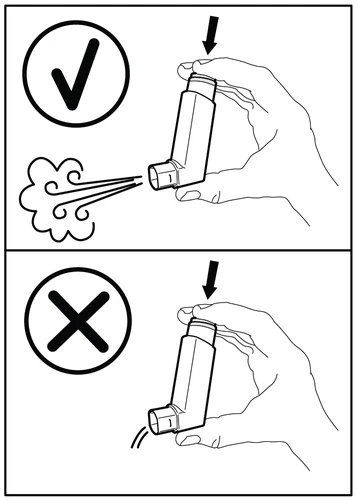
Figure 14
Step 1: Remove the pressurized canister from the actuator (See Figure 15). Do not clean or wet the pressurized canister.
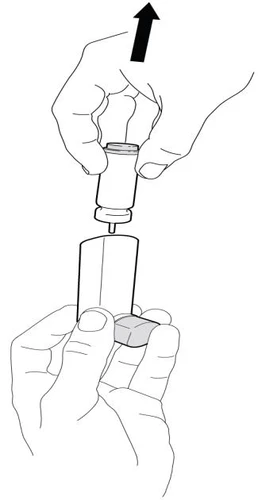
Figure 15
Step 2: Remove the cap from the mouthpiece.
Step 3: Hold the actuator under running tap water and rinse warm water through the actuator for about 30 seconds. Turn the actuator upside down and rinse again through the mouthpiece for about 30 seconds (See Figure 16).
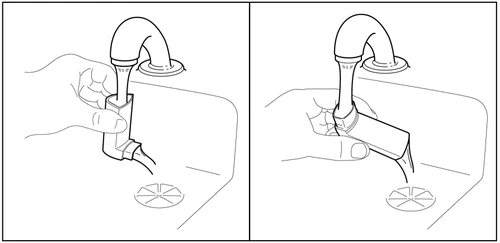
Figure 16
Step 4: Shake off as much water as possible from the actuator.
Step 5: Look inside the actuator and mouthpiece to ensure any accumulated medicine has been completely removed by rinsing. If not, repeat Steps 3 to 5 in this section.
Step 6: Allow the actuator to air-dry completely overnight (See Figure 17). Do not reinsert the pressurized canister into the actuator while it is still wet.
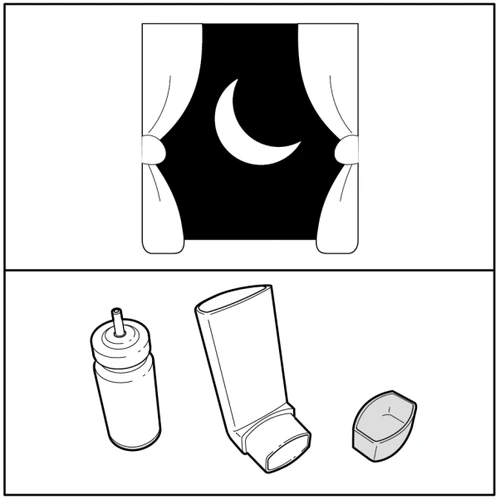
Figure 17
Step 7: When the actuator is completely dry, gently push the pressurized canister back into the actuator (See Figure 18). Do not press too hard on the canister, as this may cause a dose of medicine to be released.
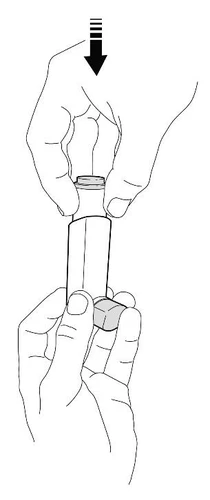
Figure 18
Step 8: Re-prime the Bevespi Aerosphere inhaler after each cleaning. To re-prime, shake the inhaler well and press the center of the dose indicator twice to release a total of 2 doses into the air, away from your face. The inhaler is now ready for use.
If you have not used Bevespi Aerosphere for more than 7 days, if it has been exposed to cold temperatures, or if it has been dropped:
If Bevespi Aerosphere has not been used for more than 7 days, if the inhaler has been exposed to low temperatures, or if it has been dropped, you must re-prime it before use.
To re-prime the inhaler, shake it well and press the center of the dose indicator twice to release a total of 2 doses into the air, away from your face. The inhaler is now ready for use.