Betaseron
Italy
Table of Contents
- Package leaflet: Information for the user
- Betaferon 250 micrograms/ml, powder and solvent for injectable solution
- 1. What Betaferon is and what it is used for
- 2. What you should know before using Betaferon
- 3. How to use Betaferon
- 4. Possible side effects
- 5. How to store Betaferon
- 6. Package Contents and Other Information
Package leaflet: Information for the user
Betaferon 250 micrograms/ml, powder and solvent for injectable solution
interferon beta-1b
Please read all of this leaflet carefully before you start using this medicine because it contains important information for you.
- Keep this leaflet. You may need to read it again.
- If you have any questions, ask your doctor, pharmacist, or nurse.
- This medicine has been prescribed for you only. Do not give it to others, even if their symptoms are the same as yours, as it may be harmful.
- If you experience any side effect, including those not listed in this leaflet, inform your doctor, pharmacist, or nurse. See section 4.
Contents of this leaflet
- What Betaferon is and what it is used for
- What you need to know before using Betaferon
- How to use Betaferon
- Possible side effects
- How to store Betaferon
- Contents of the pack and other information
Annex – Instructions for self-injection
1. What Betaferon is and what it is used for
What Betaferon is
Betaferon is a type of medicine called an interferon, used in the treatment of multiple sclerosis.
Interferons are proteins produced by our body that help defend against immune system attacks, such as viral infections.
How Betaferon works
Multiple sclerosis (MS) is a chronic disease affecting the central nervous system (CNS), particularly the functions of the brain and spinal cord. In MS, inflammation destroys the protective covering (called myelin) surrounding the nerves of the CNS, impairing normal nerve function. This process is known as demyelination.
The exact cause of MS is unknown. It is believed that an abnormal immune response plays a key role in damaging the CNS.
Damage to the CNS can occur during an MS attack (relapse). An attack may lead to temporary disability, for example difficulty walking. Symptoms may disappear completely or partially.
Interferon beta-1b has been shown to modify the immune system response and helps reduce disease activity.
How Betaferon helps fight the disease
Single clinical event suggestive of a high risk of developing multiple sclerosis: Betaferon delays progression to definite multiple sclerosis.
Relapsing-remitting multiple sclerosis: Patients with relapsing-remitting MS experience occasional attacks or relapses, during which symptoms significantly worsen. Betaferon reduces the number and severity of relapses. The medicine reduces the frequency of hospitalizations due to the disease and prolongs the time between relapses.
Secondary progressive multiple sclerosis: In some patients with relapsing-remitting MS, symptoms worsen and the disease progresses to another form of MS called secondary progressive MS. Patients with this condition experience a progressive decline in physical function, even in the absence of relapses. Betaferon can reduce the frequency and severity of relapses and slow the progression of disability.
What Betaferon is used for
Betaferon is indicated
► for patients who have experienced symptoms for the first time suggestive of a high risk of developing multiple sclerosis. Prior to treatment, the physician will exclude any other possible causes responsible for the symptoms.
► for patients with relapsing-remitting multiple sclerosis who have had at least two relapses in the last two years.
► for patients with active secondary progressive multiple sclerosis characterized by relapses.
2. What you should know before using Betaferon
Do not use Betaferon
- if you are allergic (hypersensitive) to natural or recombinant interferon beta, human albumin, or to any of the other ingredients of this medicine (listed in section 6).
- if you currently suffer from severe depression and/or have suicidal thoughts (see “Warnings and precautions” and section 4 “Possible side effects”).
- if you have severe liver disease (see “Warnings and precautions”, “Other medicines and Betaferon”, and section 4 “Possible side effects”).
► Inform your doctor if you experience any of the conditions described above.
Warnings and precautions
Talk to your doctor before using Betaferon:
- if you have monoclonal gammopathy , an immune system disorder in which abnormal proteins are found in the blood. When using medicines such as Betaferon, problems affecting small blood vessels (capillaries) may develop, known as capillary leak syndrome, which may lead to shock (collapse), even fatal.
- if you have had or currently suffer from depression, or if you have had suicidal thoughts. During treatment, your doctor will closely monitor you. If depression and/or suicidal thoughts are severe, Betaferon will not be prescribed (see also section “Do not use Betaferon”).
- if you have previously had seizures, or if you are taking medicines for epilepsy (antiepileptics) , your doctor will monitor your treatment closely (see also “Other medicines and Betaferon” and section 4 “Possible side effects”).
- if you have severe kidney problems, during treatment your doctor may monitor kidney function.
Additionally, during treatment with Betaferon, your doctor needs to know the following:
- if you experience symptoms such as itching all over the body, swelling of the face and/or tongue, or sudden shortness of breath. These symptoms may indicate a severe allergic reaction (hypersensitivity), which could be life-threatening.
- if, during treatment with Betaferon, you feel significantly sadder or more hopeless than before starting therapy, or if you develop suicidal thoughts. If you become depressed during Betaferon treatment, you may require specific treatment; your doctor will monitor you closely and may consider stopping therapy. If you suffer from severe depression and/or suicidal thoughts, you should not be treated with Betaferon (see also section “Do not use Betaferon”).
- if you notice unusual bruising, excessive bleeding after injury, or if you seem to have frequent infections. These symptoms may indicate a reduced number of platelets in the blood (cells that help blood to clot). Close medical monitoring may be required.
- if you experience loss of appetite, fatigue, nausea, repeated vomiting, especially if you also notice widespread itching, yellowing of the skin or whites of the eyes, or frequent bruising. These symptoms may indicate liver problems. In clinical studies, changes in liver function tests have been observed in patients treated with Betaferon. As with other beta interferons, rare cases of severe liver damage, including liver failure, have been observed in patients treated with Betaferon. The most severe cases occurred in patients also taking other medicines or with conditions that may affect the liver (e.g. alcohol abuse, severe infections).
- if you notice symptoms such as irregular heartbeat, swelling in the ankles or legs, or shortness of breath. These may indicate heart muscle disease (cardiomyopathy), which has rarely been observed in patients treated with Betaferon.
- if you experience abdominal pain radiating to the back, and/or nausea or fever. These may indicate inflammation of the pancreas (pancreatitis), which has been observed in patients treated with Betaferon. This is often associated with elevated levels of certain fats in the blood (triglycerides).
► Stop using Betaferon and inform your doctor immediately if any of the situations described above occur.
Other considerations during use of Betaferon
- Blood tests will be required to determine blood cell counts, blood chemistry, and liver enzymes. These will be performed before you start taking Betaferon, at regular intervals after starting treatment, and periodically during treatment with Betaferon, even if you do not have specific symptoms. These blood tests are in addition to those normally performed for monitoring MS.
- If you have heart disease, flu-like symptoms, which often occur at the beginning of treatment, may be particularly bothersome. Betaferon should be used with caution, and your doctor will monitor for any worsening of heart conditions, especially at the beginning of treatment. Betaferon does not act directly on the heart.
- At regular intervals, or if your doctor considers it necessary for other reasons, thyroid gland function will be checked.
- Betaferon contains human albumin, and therefore there is a potential risk of transmission of viral diseases. The risk of transmission of Creutzfeldt-Jakob disease (CJD) cannot be excluded.
- During treatment with Betaferon, your body may produce substances called neutralizing antibodies , which may react with Betaferon (neutralizing activity). It is not yet clear whether these neutralizing antibodies reduce the effectiveness of treatment. Not all patients produce neutralizing antibodies. Currently, it is not possible to predict which patients belong to this group.
- During treatment with Betaferon, kidney problems may occur that can reduce kidney function, including scarring ( glomerulosclerosis ). Your doctor may perform tests to assess kidney function.
- During treatment, blood clots (thrombi) may form within small blood vessels. These clots may affect the kidneys. Clot formation may occur from several weeks to several years after starting Betaferon treatment. Your doctor may decide to monitor your blood pressure, blood tests (platelet count), and kidney function.
- During treatment, you may experience paleness, yellow skin, or dark urine, possibly accompanied by unusual dizziness, fatigue, or shortness of breath. These may be symptoms of red blood cell breakdown. This may occur several weeks to several years after starting Betaferon. Your doctor may perform blood tests. Inform your doctor about any other medicines you are taking concurrently with Betaferon.
Injection site reactions
During treatment with Betaferon, injection site reactions are likely to occur.
Symptoms include redness, swelling, skin discoloration, inflammation, pain, and hypersensitivity. Infections, skin lesions, and tissue damage (necrosis) at the injection site occur less frequently. Injection site reactions usually become less frequent over time.
Destructive skin and tissue lesions at the injection site may lead to scarring. In severe cases, removal of foreign material and necrotic tissue (debridement) may be required, and less frequently, a skin graft; healing may take up to 6 months.
To reduce the risk of injection site reactions, such as infections or necrosis, you must:
- use a sterile (aseptic) injection technique,
- alternate injection sites with each administration (see Annex: “Instructions for self-injection”, Part II, in the second part of this leaflet).
Injection site reactions may be reduced by using an auto-injector and rotating injection sites. Your doctor or nurse can provide further information on this.
If you develop skin breakdown that may be associated with swelling or fluid leakage from the injection site:
► stop Betaferon injections and inform your doctor
► if you have only one irritated injection site (lesion) and tissue damage (necrosis) is not too extensive, you may continue using Betaferon.
► if you have more than one irritated injection site (multiple lesions) , you must stop using Betaferon until the skin has healed.
Your doctor will regularly check your self-injection technique, especially if you have experienced injection site reactions.
Children and adolescents
Formal clinical studies have not been conducted in children or adolescents.
However, some data are available for children and adolescents aged between 12 and 16 years, suggesting that the safety profile in this age group is the same as that observed in adults when Betaferon is administered subcutaneously at a dose of 8.0 million IU on alternate days.
There is no information on the use of Betaferon in children under 12 years of age. Therefore, Betaferon should not be used in this population.
Other medicines and Betaferon
Inform your doctor or pharmacist if you are using, have recently used, or might use any other medicines, including those without a prescription.
Formal interaction studies have not been conducted to determine whether Betaferon affects other medicines or is affected by them.
The use of Betaferon with other medicines that modify the immune response is not recommended, except for anti-inflammatory medicines called corticosteroids or adrenocorticotropic hormone (ACTH).
Caution is recommended when using Betaferon with:
- medicines that rely on a specific liver enzyme system (known as the cytochrome P450 system) for elimination from the body, for example, medicines used to treat epilepsy (such as phenytoin).
- medicines that interfere with blood cell production.
Betaferon with food and drink
Betaferon is administered by subcutaneous injection; therefore, food and drink are not expected to affect Betaferon.
Pregnancy and breastfeeding
If you are pregnant, think you may be pregnant, are planning a pregnancy, or are breastfeeding, consult your doctor or pharmacist before taking this medicine.
No harmful effects on the newborn/breastfed infant are expected. Betaferon may be used during breastfeeding.
Driving and using machines
Betaferon may cause side effects affecting the central nervous system (see section 4 “Possible side effects”). If you are particularly sensitive, your ability to drive vehicles or operate machinery may be impaired.
Betaferon contains mannitol, human albumin, and sodium
The excipients in Betaferon include:
- small amounts of mannitol, a natural sugar, and human albumin, a protein.
- sodium – this medicine contains less than 1 mmol (23 mg) of sodium per ml, i.e. essentially ‘sodium-free’.
If you are known to be allergic (hypersensitive) to any of the excipients or become hypersensitive, do not use Betaferon.
3. How to use Betaferon
Betaferon therapy should be initiated under the supervision of a physician experienced in the treatment of multiple sclerosis.
Use this medicine exactly as directed by your doctor. If you have any doubts, consult your doctor, pharmacist, or nurse.
Recommended dose:
On alternate days (every two days), inject 1.0 ml of the prepared Betaferon solution subcutaneously (under the skin) (see the Appendix “Instructions for self-injection” in the second part of this leaflet). This dosage corresponds to 250 micrograms (8.0 million IU) of interferon beta-1b.
At the beginning of treatment, Betaferon is better tolerated if the dose is gradually increased, e.g. starting with only 0.25 ml, then increasing the dose after every three injections first to 0.5 ml, then to 0.75 ml, and finally to the full dose (1 ml) of Betaferon. Your doctor may decide together with you to adjust the intervals between dose increases, depending on any adverse effects that may occur at the beginning of treatment. To facilitate dose escalation during the first 12 injections, you may receive a special titration pack consisting of four differently colored packages, containing syringes with special markings and a dedicated introductory leaflet with detailed instructions.
How to prepare the injection
Before injection, the Betaferon solution to be injected must be prepared using a vial containing Betaferon powder and 1.2 ml of liquid from the pre-filled solvent syringe. This can be done by the doctor, nurse, or by the patient themselves, after thorough training. For detailed information on the preparation of the injectable Betaferon solution, refer to the Appendix “Instructions for self-injection”, Part I.
Detailed instructions for self-injecting Betaferon subcutaneously are provided in section IE of the Appendix “Instructions for self-injection”.
Injection sites should be rotated regularly. See section 2 “Warnings and precautions” and follow the instructions in Part II “Rotating injection sites” and Part III (Betaferon Treatment Schedule) of the Appendix “Instructions for self-injection”.
Duration of treatment
Currently, it is not known how long Betaferon treatment should continue. The duration of treatment must be decided by the doctor together with the patient.
If you use more Betaferon than you should
Administration of a Betaferon dose many times higher than the recommended dose for the treatment of multiple sclerosis has not caused life-threatening conditions.
► Inform your doctor if you have injected an excessive amount of Betaferon or if you have injected it too frequently.
If you forget to use Betaferon
If you have forgotten to administer the injection at the scheduled time, do so as soon as you remember.
The next injection should be given 48 hours after the missed dose.
Do not inject a double dose to make up for a forgotten single dose.
If you stop using Betaferon
Inform your doctor if you stop or wish to stop treatment. Discontinuation of Betaferon treatment does not cause acute withdrawal symptoms.
► If you have any questions about the use of this medicine, consult your doctor, pharmacist, or nurse.
4. Possible side effects
Like all medicines, this medicine can cause side effects, although not everyone gets them.
Betaferon may cause serious side effects. If any of the side effects worsen, or if you notice any side effects not listed in this leaflet, inform your doctor, pharmacist, or nurse.
► Contact your doctor immediately and stop using Betaferon:
- if you experience symptoms such as itching all over the body, swelling of the face and/or tongue, or sudden shortness of breath.
- if you feel markedly sadder or more hopeless than before starting treatment with Betaferon, or if you develop suicidal thoughts.
- if you notice unusual bruising, excessive bleeding after injuries, or if you seem to have frequent infections.
- if you suffer from loss of appetite, fatigue, nausea, repeated vomiting, especially if you also notice widespread itching, yellowing of the skin or whites of the eyes, or frequent bruising.
- if you experience symptoms such as irregular heartbeat, swelling in the ankles or legs, or shortness of breath.
- if you have abdominal pain radiating to the back and/or experience nausea or fever.
► Contact your doctor immediately:
- if you have one or more of the following symptoms: foamy urine, fatigue, swelling mainly in the ankles and eyelids, and weight gain – these may be signs of a possible kidney problem.
Side effects are common at the beginning of treatment, but usually decrease with continued treatment.
The most common side effects include
► flu-like symptoms, such as fever, chills, joint pain, general malaise, sweating, headache, or muscle pain. These symptoms can be relieved with paracetamol or non-steroidal anti-inflammatory drugs such as ibuprofen.
► reactions at the injection site. Symptoms include redness, swelling, discoloration, inflammation, infection, pain, hypersensitivity, or tissue damage ( necrosis ). See section 2, “Warnings and precautions”, for further information and steps to take in case of injection site reactions. These reactions can be reduced by using an auto-injector and rotating injection sites. Speak to your doctor, pharmacist, or nurse for further advice.
To reduce side effects at the beginning of treatment, your doctor will start with a low dose of Betaferon and gradually increase it (see section 3, “How to use Betaferon”).
The following list of side effects is based on results from clinical trials with Betaferon and data from the post-marketing period.
► Very common (may affect more than 1 in 10 people):
- decrease in white blood cells
- headache
- sleep disturbances ( insomnia )
- abdominal pain
- possible increase in a specific liver enzyme ( alanine aminotransferase or ALT ) (this will be visible in blood tests)
- skin rash
- skin disorders
- muscle pain ( myalgia )
- muscle stiffness ( hypertonia )
- joint pain ( arthralgia )
- urgency to urinate
- reactions at the injection site (including redness, swelling, discoloration, inflammation, pain, infection, allergic reactions ( hypersensitivity ))
- flu-like symptoms, pain, fever, chills, fluid accumulation in one arm or leg ( peripheral edema ), decrease/loss of strength ( asthenia )
► Common (may affect up to 1 in 10 people):
- swelling of the lymph glands ( lymphadenopathy )
- number of red blood cells in the blood may decrease ( anemia )
- thyroid gland not working properly (insufficient hormone production) ( hypothyroidism )
- increase or decrease in body weight
- confusion
- rapid heartbeat ( tachycardia )
- increase in blood pressure ( hypertension )
- possible increase in a specific liver enzyme ( aspartate aminotransferase or AST ) (this will be visible in blood tests)
- shortness of breath ( dyspnea )
- a yellowish-red pigment ( bilirubin ), produced by the liver, may increase (detectable in blood tests)
- swollen, usually itchy areas of skin or mucous membranes ( urticaria )
- itching
- hair loss ( alopecia )
- menstrual disorders ( menorrhagia )
- heavy uterine bleeding ( metrorrhagia ), especially between menstrual periods
- impotence
- skin breakdown and tissue damage ( necrosis ) at the injection site (see section 2 “Warnings and precautions”)
- chest pain
- malaise
► Uncommon (may affect up to 1 in 100 people):
- number of platelets (which help blood to clot) may decrease ( thrombocytopenia )
- certain blood fats ( triglycerides ) may increase (detectable in blood tests); see section 2 “Warnings and precautions”
- suicide attempt
- mood swings
- seizures
- a particular liver enzyme ( gamma GT ), produced by the liver, may increase (detectable in blood tests)
- inflammation of the liver ( hepatitis )
- skin discoloration
- kidney problems, including scarring ( glomerulosclerosis ), which may reduce kidney function
► Rare (may affect up to 1 in 1,000 people):
- blood clots ( thrombi ) in small blood vessels, which may affect the kidneys ( thrombotic thrombocytopenic purpura or haemolytic uraemic syndrome ). Symptoms may include increased bruising, bleeding, fever, extreme weakness, dizziness, or a feeling of emptiness in the head. Your doctor is likely to find abnormalities in your blood and kidney function.
- severe allergic reactions ( anaphylactic reactions )
- thyroid gland not working properly ( thyroid disorders ), excessive hormone production ( hyperthyroidism )
- severe loss of appetite leading to weight loss ( anorexia )
- heart muscle disease ( cardiomyopathy )
- sudden shortness of breath ( bronchospasm )
- inflammation of the pancreas ( pancreatitis ); see section 2 “Warnings and precautions”
- liver not functioning properly ( hepatic damage including hepatitis, liver failure )
► Not known (frequency cannot be estimated from available data)
- breakdown of red blood cells ( haemolytic anaemia )
- problems in small blood vessels ( systemic capillary leak syndrome ) may occur during treatment with medicines like Betaferon
- depression, anxiety
- dizziness
- irregular, rapid, or pounding heartbeat ( palpitations ), redness and/or flushing of the face due to widening of blood vessels ( vasodilation )
- severe narrowing of blood vessels in the lungs, leading to high blood pressure in the vessels carrying blood from the heart to the lungs (pulmonary arterial hypertension). Pulmonary arterial hypertension has been observed at various times during treatment, including several years after starting Betaferon.
- nausea
- vomiting
- diarrhoea
- rash, redness of the facial skin, joint pain, fever, weakness, and other symptoms caused by the medicine ( drug-induced lupus erythematosus )
- menstrual disorder
- sweating
Reporting of side effects
If you experience any side effects, including those not listed in this leaflet, talk to your doctor, pharmacist, or nurse. You can also report side effects directly via the national reporting system listed in Annex V. By reporting side effects, you can help provide more information on the safety of this medicine.
5. How to store Betaferon
Keep this medicine out of the sight and reach of children.
Do not use this medicine after the expiry date stated on the pack. The expiry date refers to the last day of that month.
Do not store above 25°C. Do not freeze.
Use the solution immediately after preparation. However, the product may be used for up to 3 hours if stored at 2–8°C (in the refrigerator).
Do not use Betaferon if you notice particles or discoloration.
Do not dispose of medicines via wastewater or household waste. Ask your pharmacist how to dispose of medicines you no longer use. This will help protect the environment.
6. Package Contents and Other Information
What Betaferon Contains
The active substance is interferon beta-1b, 250 micrograms per millilitre after reconstitution.
The other components are
- in the powder: mannitol and human albumin,
- in the solvent (sodium chloride solution 5.4 mg/ml (0.54% w/v)): sodium chloride, water for injections.
Betaferon powder is supplied in a 3-millilitre vial containing 300 micrograms (9.6 million IU) of interferon beta-1b per vial. After reconstitution, each millilitre contains 250 micrograms (8.0 million IU) of interferon beta-1b.
The Betaferon solvent is supplied in a pre-filled syringe of 2.25 millilitres and contains 1.2 ml of sodium chloride solution 5.4 mg/ml (0.54% w/v).
Description of the Appearance of Betaferon and Contents of the Pack
Betaferon is a sterile white to off-white powder for injectable solution.
Betaferon is available in packs of:
- multiple packs containing 5 single packs, each containing 1 vial with powder, 1 pre-filled syringe with solvent, 1 vial adapter with needle, 2 alcohol swabs, or
- multiple packs containing 12 single packs, each containing 1 vial with powder, 1 pre-filled syringe with solvent, 1 vial adapter with needle, 2 alcohol swabs, or
- multiple packs containing 14 single packs, each containing 1 vial with powder, 1 pre-filled syringe with solvent, 1 vial adapter with needle, 2 alcohol swabs, or
- multiple packs containing 15 single packs, each containing 1 vial with powder, 1 pre-filled syringe with solvent, 1 vial adapter with needle, 2 alcohol swabs, or
- bimonthly pack of 2x14 single packs, each containing 1 vial with powder, 1 pre-filled syringe with solvent, 1 vial adapter with needle, 2 alcohol swabs, or
- quarterly pack of 3x15 single packs, each containing 1 vial with powder, 1 pre-filled syringe with solvent, 1 vial adapter with needle, 2 alcohol swabs, or
- quarterly pack of 3x14 single packs, each containing 1 vial with powder, 1 pre-filled syringe with solvent, 1 vial adapter with needle, 2 alcohol swabs, or
- titration pack for the first 12 injections, consisting of 4 triple packs, each containing 3 vials with powder, 3 pre-filled syringes with solvent, 3 vial adapters with needles, and 6 alcohol swabs.
Not all pack sizes may be marketed.
Marketing Authorisation Holder and Manufacturer
Marketing Authorisation Holder
Bayer AG
51368 Leverkusen
Germany
Manufacturer
Bayer AG
Müllerstraße 178
13353 Berlin
Germany
For further information on this medicinal product, please contact the local representative of the Marketing Authorisation Holder.
België / Belgique / Belgien Lietuva
Bayer SA-NV UAB Bayer
Tél/Tel: +32-(0)2-535 63 11 Tel. +370 5 23 36 868
България Luxembourg / Luxemburg
Байер България ЕООД Bayer SA-NV
Тел. +359 02 4247280 Tél/Tel: +32-(0)2-535 63 11
Česká republika Magyarország
Bayer s.r.o. Bayer Hungária Kft.
Tel: +420 266 101 111 Tel.:+36-14 87-41 00
Danmark Malta
Bayer A/S Alfred Gera and Sons Ltd.
Tlf: +45-45 23 50 00 Tel: +356-21 44 62 05
Deutschland Nederland
Bayer Vital GmbH Bayer B.V.
Tel: +49-(0)214-30 513 48 Tel: +31-(0) 23 799 1000
Eesti Norge
Bayer OÜ Bayer AS
Tel: +372 655 85 65 Tlf. +47 23 13 05 00
Ελλάδα Österreich
Bayer Ελλάς ΑΒΕΕ Bayer Austria Ges. m. b. H.
Τηλ:+30 210 618 75 00 Tel: +43-(0)1-711 46-0
España Polska
Bayer Hispania S.L. Bayer Sp. z o.o.
Tel: +34-93-495 65 00 Tel.: +48-22-572 35 00
France Portugal
Bayer HealthCare Bayer Portugal, Lda.
Tél (N° vert): +33 (0)800 87 54 54 Tel: +351-21-416 42 00
Hrvatska România
Bayer d.o.o. SC Bayer SRL
Tel: +385-(0)1-6599 900 Tel: +40 21 529 59 00
Ireland Slovenija
Bayer Limited Bayer d. o. o.
Tel: +353 1 216 3300 Tel.: +386-(0)1-58 14 400
Ísland Slovenská republika
Icepharma hf. Bayer, spol. s r.o.
Sími: +354 540 80 00 Tel: +421 2 59 21 31 11
Italia Suomi/Finland
Bayer S.p.A. Bayer Oy
Tel: +39-02-397 81 Puh/Tel: +358-20 785 21
Κύπρος Sverige
NOVAGEM Limited Bayer AB
Τηλ: +357 22 48 38 58 Tel: +46-(0)8-580 223 00
Latvija United Kingdom (Northern Ireland)
SIA Bayer Bayer AG
Tel: +371 67 84 55 63 Tel: +44-(0) 118 206 3000
Other Sources of Information
More detailed information on this medicinal product is available on the website of the European Medicines Agency: http://www.ema.europa.eu.
Annex: SELF-INJECTION INSTRUCTIONS
Your doctor has prescribed Betaferon for the treatment of multiple sclerosis. At the beginning of treatment, Betaferon is better tolerated if started at a low dose and gradually increased to the final standard dose (see the first part of this leaflet, section 3. “How to use Betaferon”). To help you gradually increase the dose during the first 12 injections, you may receive a special titration pack consisting of four differently coloured triple packs, containing syringes with specific markings and a separate introductory leaflet with detailed instructions. The syringes in the titration pack are marked corresponding to the appropriate doses (0.25, 0.5, 0.75 or 1.0 ml).
The following instructions and illustrations explain how to prepare Betaferon for injection and how to self-administer it. Read the instructions carefully and follow them step by step. Your doctor or nurse will provide guidance and support to help you learn the self-administration process. Do not attempt self-injection until you are confident you understand how to prepare the solution and how to administer it correctly.
PART I: STEP-BY-STEP INSTRUCTIONS
The instructions include the following main sections:
A) General Warning
B) How to Prepare for Injection
C) Reconstitution of the Solution, Step by Step
D) Drawing Up the Injectable Solution
E) How to Perform the Injection
F) Quick Summary
A) General Warning
► To Get Started Optimally
You will find that within a few weeks, treatment will become part of your daily routine. To get started, the following tips may be helpful:
- Organize a suitable area for the permanent storage of the medicine, out of sight and reach of children, so you can easily find Betaferon and the other necessary materials. For detailed storage information, see section 5 of the leaflet “How to store Betaferon” in the first part of this leaflet.
- Try to perform the injection at the same time each day. This will make it easier to remember and to schedule a time when you will not be disturbed.
- Prepare each dose only when you are ready for injection. After preparing Betaferon, perform the self-injection immediately (for non-immediate use, see section 5 “How to store Betaferon” in the first part of this leaflet).
► Important Tips to Remember
- Be consistent – use Betaferon as described in section 3 of the leaflet “How to use Betaferon” in the first part of this leaflet. Always double-check the dose.
- Keep syringes and disposal containers out of sight and reach of children; if possible, store materials locked away.
- Never reuse syringes or needles.
- Always use a sterile (aseptic) technique as described here.
- Always dispose of used syringes in the designated disposal container.
B) How to Prepare for Injection
► Choosing the Injection Site
Before preparing the injection, decide where to inject the medicine. Inject Betaferon into the fatty layer between the skin and muscles (i.e., subcutaneously, approximately 8–12 mm under the skin). Suitable sites are where the skin is soft and relaxed, away from joints, nerves, and bones, such as on the abdomen, arm, thigh, or buttocks.
Important: Do not inject into areas with lumps, swelling, hard nodules, pain, or areas with altered, rough, scaly, or damaged skin. Inform your doctor or nurse about these conditions or any other unusual situations.
Change the injection site each time. If some areas are difficult to reach, ask a relative or friend for help. Follow the steps shown in the diagram at the end of this Annex (see Part II, Rotation of Injection Sites): this way, you will return to the site of the first injection after 8 injections (16 days). This allows each injection site to regenerate before another injection is given.
Refer to the diagram at the end of this Annex to learn how to choose the injection site. The Annex also includes an example of a treatment calendar (see Annex Part III), which will help you record injection sites and dates.
► Checking the Package Contents
In the Betaferon pack, you will find:
- 1 Betaferon vial (powder for injectable solution)
- 1 pre-filled syringe containing solvent for Betaferon (sodium chloride solution 5.4 mg/ml (0.54% w/v))
- 1 vial adapter with pre-inserted needle
- 2 alcohol swabs
Additionally, you will need a container for the disposal of used syringes and needles.
For skin disinfection, use an appropriate disinfectant.
In the Betaferon titration pack, you will find 4 differently coloured numbered triple packs, each containing:
- 3 Betaferon vials (powder for injectable solution)
- 3 pre-filled syringes with solvent for Betaferon powder (sodium chloride solution 5.4 mg/ml (0.54% w/v))
- 3 vial adapters with pre-inserted needles
- 6 alcohol swabs
Additionally, you will need a container for the disposal of used syringes and needles. For skin disinfection, use an appropriate disinfectant.
Start with the yellow triple pack No. 1, containing 3 syringes marked at 0.25 ml, for treatment days 1, 3, and 5.
Then use the red triple pack No. 2, containing 3 syringes marked at 0.5 ml, for treatment days 7, 9, and 11.
Continue with the green triple pack No. 3, containing 3 syringes marked at 0.75 ml, for treatment days 13, 15, and 17.
Finally, use the blue triple pack No. 4, containing 3 syringes marked at 0.25, 0.5, 0.75, and 1.0 ml, for treatment days 19, 21, and 23.
C) Reconstitution of the Solution, Step by Step
1- Wash your hands thoroughly with soap and water before preparing the medicine.

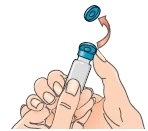
2 - Open the Betaferon vial and place it on the table. Use your thumb, not your fingernail, to avoid breaking it.
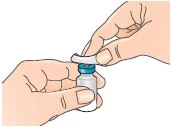
3 - Clean the top of the vial with an alcohol swab, moving in one direction only. Leave the swab on the vial.
4 – Open the blister containing the vial adapter, but do not remove it yet.
Do not remove the adapter from the blister yet.
Do not touch the vial adapter to keep it sterile.
5 – Before connecting the adapter, remove and discard the alcohol swab and place the vial on a flat surface.
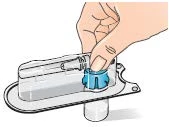
6 - Hold the outer edge of the blister and place it on top of the vial. Press firmly downward until it clicks into place on the vial.
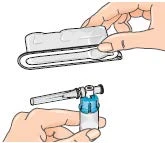
7 - Holding the blister by the edges, remove it from the vial adapter. You can now connect the pre-filled solvent syringe to the vial adapter.
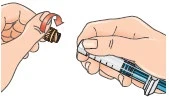
8 – Take the syringe. Ensure the orange closure cap is securely attached to the syringe containing the solvent! Unscrew and remove the closure cap. Discard the closure cap.
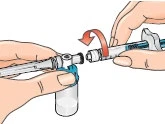
9 – Connect the syringe by inserting its tip into the opening on the side of the vial adapter and firmly twist clockwise (see arrow). This creates a secure connection.
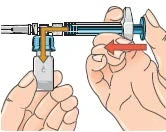
10 - Hold the bottom of the vial. Slowly push the plunger fully to transfer all the solvent into the vial. Release the plunger, which may return to its original position.
These instructions also apply to the titration pack.
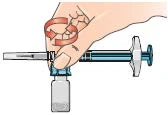
11 – With the assembly still connected, gently rotate the vial to completely dissolve the Betaferon powder.
Do not shake the vial.
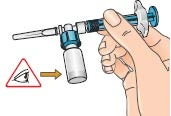
12 - Examine the solution carefully. The solution should be clear and particle-free. If the colour is altered or particles are present, discard the solution and restart the procedure with a new pack. If foam is present – which may form if the vial was shaken too vigorously – let the vial stand until the foam settles.
D) Drawing Up the Injectable Solution
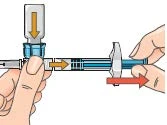
13 – If the plunger has returned to its original position, push it again and hold it steady. To prepare the injection, invert the assembly so the vial is on top and the cap end is facing downward. This allows the solution to flow into the syringe.
Keep the syringe in a horizontal position.
Slowly pull back the plunger to draw all the solution from the vial into the syringe.
With the titration pack, draw up the solution only to the corresponding mark on the syringe:
0.25 ml for the first three injections (on treatment days 1, 3, and 5), or
0.5 ml for injections on treatment days 7, 9, and 11, or
0.75 ml for injections on treatment days 13, 15, and 17.
Discard the vial with any remaining solution.
From day 19, you will inject the full dose of 1.0 ml.
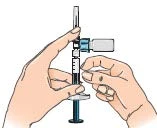
14 – After drawing up the solution, rotate the syringe so the needle points upward. This causes air bubbles to rise to the surface.
15 - Remove air bubbles by gently tapping the syringe and pushing the plunger to the mark corresponding to 1 ml or the volume prescribed by your doctor.
If injecting less than 1 ml with the titration pack, there may be no air bubbles, which may appear with the full dose. Remove air bubbles by gently tapping the syringe and pushing the plunger to the syringe's mark.
If excess solution enters the vial with air bubbles, return the syringe to a horizontal position (see Fig. 13) and slightly retract the plunger to draw the solution back into the syringe.
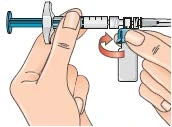
16 – Next, grasp the blue adapter with the attached vial and remove it from the syringe by rotating and pulling downward.
Grasp only the blue plastic adapter for removal. Keep the syringe horizontal and the vial below it.
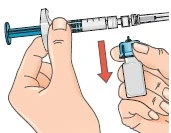
Detaching the vial and adapter from the syringe ensures solution flows out of the needle during injection.
17 - Discard the vial and any unused solution in the designated container.
18 - The injection is now ready for use.
If, for any reason, you cannot inject immediately, you may store the reconstituted solution in the syringe in the refrigerator for up to three hours. Do not freeze the solution and do not wait more than three hours before injecting. If more than three hours pass, discard the reconstituted Betaferon solution and prepare a new one. Before use, warm the solution in your hands to avoid causing pain during injection.
E) How to Perform the Injection
1 - Choose an injection site (see the warning at the beginning and the diagrams at the end of this Annex) and record it in the treatment calendar.
2 - Disinfect the skin at the injection site with
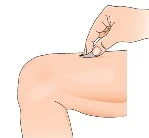
an alcohol swab. Let the skin dry in the air. Discard the swab.
For skin disinfection, use an appropriate disinfectant.
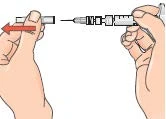
3 - Remove the needle cap by pulling straight off, without twisting.
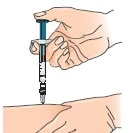
4 - Gently press the skin on both sides of the disinfected injection site (to slightly lift it).
5 - Hold the syringe like a pencil or dart and, with a quick, firm motion, insert the needle into the skin at a 90° angle. Warning: Betaferon may also be administered using a suitable auto-injector.
6 - Inject the medicine by slowly and steadily pushing the plunger. (Push the plunger fully until the syringe is completely empty.)
7 - Discard the syringe in the designated container.
F) Quick Summary
- Gather all materials needed for one injection.
- Connect the adapter to the vial.
- Connect the syringe to the adapter.
- Push the syringe plunger to transfer all solvent into the vial.
- Invert the assembly and draw up the required amount of solution.
- Detach the vial from the syringe – now everything is ready for injection.
NOTE: Inject the solution immediately after preparation (if injection is delayed, store the solution in the refrigerator and inject within 3 hours). Do not freeze.
PART II: ROTATION OF INJECTION SITES
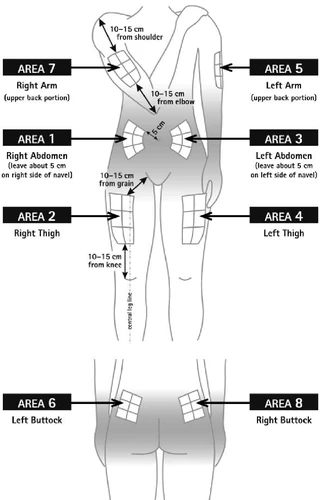
For each injection, choose a different site to allow the area to regenerate and prevent infections. The recommended injection sites are shown in the first part of this Annex. Before preparing the syringe, select the new injection site. The diagram below will help you rotate injection sites. For example, perform the first injection on the right side of the abdomen, the second on the left side, then the third on the right thigh, and so on, following the diagram until all suitable areas are used. Record the site and date of the last injection. You may use the attached treatment calendar to record injections.
Following the diagram, you return to the first injection site (i.e., the right side of the abdomen) after 8 injections (16 days). This procedure is called the Rotation Cycle. In our example, each area is divided into 6 injection sites (total of 48 injection sites), on the left and right: upper, middle, and lower sections of each respective zone. When returning to a zone after completing a Rotation Cycle, choose the section farthest from the previous one within that area. If an area shows irritation, consult your doctor or nurse for alternative injection sites.
ROTATION SCHEME
To facilitate correct rotation of injection sites, we recommend recording the date and site of each injection. For this purpose, use the following rotation scheme.
Follow the rotation cycle in the prescribed order. Each cycle consists of 8 injections (16 days), starting from Area 1 and ending at Area 8. This allows each injection site to regenerate before another injection is given.
Rotation Cycle 1: upper left part of each area
Rotation Cycle 2: lower right part of each area
Rotation Cycle 3: central left part of each area
Rotation Cycle 4: upper right part of each area
Rotation Cycle 5: lower left part of each area
Rotation Cycle 6: central right part of each area
ROTATION SCHEME:
10-15 cm from shoulder
AREA 1
AREA 2
Right arm 10-15 cm from Left arm
(back upper part) elbow (back upper part)
5 cm
AREA 3 AREA 4
Right abdomen Left abdomen
(leave about 5 cm to the right (leave about 5 cm to the left
of navel) of navel)
AREA 5 AREA 6
Left thigh
Right thigh
10-15 cm from knee
central line
of leg
AREA 8 AREA 7
Left buttock Right buttock
PART III: BETAFERON TREATMENT CALENDAR
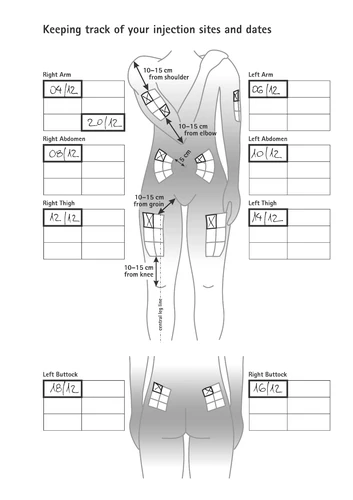
Instructions for Recording Injection Site and Date
- Choose a suitable injection site for the first injection.
- Disinfect the skin with an alcohol swab and let it dry in the air.
- After the injection, record the injection site and date in the calendar (see example: “Recording Injection Site and Date”).
EXAMPLE OF A TREATMENT RECORDING CALENDAR:
Recording Injection Site and Date
10-15 cm
Right arm Left arm
from shoulder
10-15 cm
from elbow
Right abdomen Left abdomen
5 cm
10-15 cm
Right thigh from groin Left thigh
10-15 cm
from knee
Central line of leg
Right buttock
Left buttock
Separate Annex: INTRODUCTORY LEAFLET FOR THE TITRATION PACK
Your doctor has prescribed Betaferon for the treatment of multiple sclerosis. At the beginning of treatment, Betaferon is better tolerated if started at a low dose and gradually increased to the final standard dose (see the first part of the leaflet, section 3. “How to use Betaferon”). The syringes in this titration pack are marked corresponding to the appropriate doses (0.25, 0.5, 0.75 or 1.0 ml).
► Checking the Package Contents
In the Betaferon titration pack, you will find 4 differently coloured numbered triple packs, each containing:
- 3 Betaferon vials (powder for injectable solution)
- 3 pre-filled syringes with solvent for Betaferon powder (sodium chloride solution 5.4 mg/ml (0.54% w/v))
- 3 vial adapters with pre-inserted needles
- 6 alcohol swabs
Each triple pack contains the syringes needed to prepare each dose. The syringes have specific markings for each dose. Follow the instructions below carefully. For each titration step, use all the solvent to reconstitute the Betaferon powder, then draw up the required dose into the syringe.
Start with the yellow triple pack, clearly marked with the number “1” on the top right of the box.
The first triple pack should be used for treatment days 1, 3, and 5 and contains syringes marked at 0.25 ml. This will make it easier to inject only the required dose.
After completing the yellow pack, use the red triple pack, clearly marked with the number “2” on the top right of the box.
The second triple pack should be used for treatment days 7, 9, and 11 and contains syringes marked at 0.50 ml. This will make it easier to inject only the required dose.
After completing the red pack, use the green triple pack, clearly marked with the number “3” on the top right of the box.
The third triple pack should be used for treatment days 13, 15, and 17 and contains syringes marked at 0.75 ml. This will make it easier to inject only the required dose.
Finally, after completing the green pack, use the blue triple pack, clearly marked with the number “4” on the top right of the box. This final triple pack should be used for treatment days 19, 21, and 23 and contains syringes marked at 0.25, 0.5, 0.75, and 1.0 ml. With triple pack “4”, you can inject the full dose of 1.0 ml.
For detailed information on the preparation and use of Betaferon powder, refer to section 3. “How to use Betaferon” in the first part of the leaflet and the Annex “Instructions for Self-Injection”, in the second part of the leaflet.
Additionally, you will need a container for the disposal of used syringes and needles.