Betamethasone dipropionate Sandoz
Italy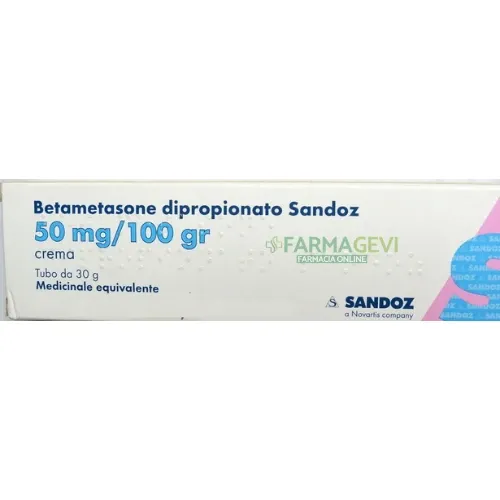
Table of Contents
- Package leaflet: Information for the user
- Betametasone dipropionate Sandoz 50mg/100g cream
- 1. What Betametasone Dipropionate Sandoz is and what it is used for
- 2. What you need to know before using Betametasone dipropionate Sandoz
- 3. How to use Betametasone dipropionate Sandoz
- 4. Possible side effects
- 5. How to store Betametasone dipropionate Sandoz
- 6. Package contents and other information
Package leaflet: Information for the user
Betametasone dipropionate Sandoz 50mg/100g cream
Generic medicine
Please read all of this leaflet carefully before you start using this medicine because it contains important information for you.
- Keep this leaflet. You may need to read it again.
- If you have any questions, ask your doctor or pharmacist.
- This medicine has been prescribed for you only. Do not give it to other people, even if they have the same symptoms as yours, because it could be harmful.
- If you experience any side effects, including those not listed in this leaflet, tell your doctor or pharmacist. See section 4.
Contents of this leaflet:
- What Betametasone dipropionate Sandoz is and what it is used for
- What you need to know before using Betametasone dipropionate Sandoz
- How to use Betametasone dipropionate Sandoz
- Possible side effects
- How to store Betametasone dipropionate Sandoz
- Contents of the pack and other information
1. What Betametasone Dipropionate Sandoz is and what it is used for
Betametasone Dipropionate Sandoz is a topical cream containing the active substance
betametasone dipropionate, belonging to a group of medicines called corticosteroids, used
to treat inflammation and allergies.
Betametasone Dipropionate Sandoz is indicated for inflammatory skin conditions, particularly those located in areas where the skin is thinner and more delicate:
- skin inflammation due to external causes such as contact eczema caused by detergents or cosmetics, or directly related to the working environment (occupational irritations);
- inflammatory skin reactions (eczema) of various types (constitutional, stasis-related);
- seborrheic eczema, an inflammatory skin condition mainly affecting areas rich in sebaceous glands such as the scalp, ears, and face, both in adults and children (cradle cap);
- irritation with blister formation on the hands and feet (dyshidrosis);
- skin inflammation caused by generalized itching, in the anal area (anal) and genital region;
- skin inflammation caused by constant friction between two body parts (intertrigo);
- solar erythema, an inflammatory skin reaction caused by exposure to sunlight;
- irritations caused by allergies to plants, chemicals, or insect bites;
- psoriasis, a chronic inflammatory skin disease involving the immune system, and other inflammatory skin diseases ( lichen simplex Vidal-Brocq, lichen ruber planus ).
2. What you need to know before using Betametasone dipropionate Sandoz
Do not use Betametasone dipropionate Sandoz
- if you are allergic to the active substance or to any of the other ingredients of this medicine (listed in section 6);
- if you have a type of skin infection called cutaneous tuberculosis or other untreated infections;
- if you have a viral skin infection (e.g. herpes simplex, chickenpox);
- if you have a fungal or bacterial skin infection;
- if you suffer from rosacea, a skin condition characterized by irritation and redness on the face;
- if you have acne vulgaris, a skin inflammation associated with pimples;
- if you have inflammation around the mouth (perioral dermatitis);
- to treat itching without inflammation;
- genital or anal itching (perianal and genital pruritus);
- if you have skin lesions (cutaneous ulcers) or infected fungal or bacterial lesions;
- if the person who is to use this medicine is a child under 1 year of age, even in case of diaper dermatitis or diaper rash.
Do not apply occlusive dressings over infected skin or skin with exuding lesions.
Warnings and precautions
Talk to your doctor or pharmacist before using Betametasone dipropionate Sandoz.
Betametasone dipropionate Sandoz must not be applied to the eyes.
Use this medicine with caution and inform your doctor in the following cases:
- if you are elderly; in this case, you should use the lowest possible dose;
- if you have liver or kidney problems (hepatic or renal insufficiency); in this case, you should use the lowest possible dose;
- if you need to apply the medicine using an occlusive dressing;
- if you suffer from a skin disease called psoriasis;
- if you need to apply the cream to the face or eyelids, to avoid contact with the eyes.
Avoid long-term treatment and high doses, as systemic absorption through the skin (systemic absorption) may occur. This is even more likely if the cream is applied under an occlusive (non-breathable) dressing or under a child's diaper, or if the medicine is applied to damaged skin or areas where the skin is thin, such as the face.
If you are using this medicine to treat dermatitis near ulcers, you may be more likely to develop hypersensitivity reactions and local infections.
Stop treatment and inform your doctor if you develop irritation or an allergic reaction (sensitization) after using this medicine, especially after prolonged use. Prolonged and repeated use may increase your susceptibility to bacterial, viral, or fungal skin infections. If you develop skin infections, use this medicine in combination with another medicine effective against fungi (antifungal) or bacteria (antibacterial). If you do not notice improvement, consult your doctor, who may advise you to stop treatment and prescribe an appropriate therapy.
To avoid side effects caused by excessive corticosteroid exposure, it is good practice to use the lowest dose necessary to control disease symptoms and for the shortest possible time. If you experience adverse effects due to the active substance's influence on the body's glands (Cushing's syndrome, reversible suppression of the hypothalamic-pituitary-adrenal axis), consult your doctor, who may advise you to gradually discontinue the medicine or prescribe a less potent corticosteroid.
Children
Administer this medicine to children only when strictly necessary and under close medical supervision, as this may increase the risk of adverse effects due to higher absorption of the active substance, especially in newborns (see section 4 "Possible side effects"). The use of this medicine in children should not exceed 5 days of treatment, using the minimum amount required, and occlusive dressings should be avoided, including the use of diapers in newborns.
Other medicines and Betametasone dipropionate Sandoz
Inform your doctor or pharmacist if you are taking, have recently taken, or might take any other medicines.
Use Betametasone dipropionate Sandoz with caution and inform your doctor if you are taking medicines that affect betamethasone metabolism, such as itraconazole (used for fungal infections) or ritonavir (used to treat HIV).
Pregnancy and breastfeeding
If you are pregnant, think you might be pregnant, are planning to become pregnant, or are breastfeeding, consult your doctor or pharmacist before using this medicine.
If you are pregnant or breastfeeding, use this medicine only when strictly necessary and under direct medical supervision.
Driving and using machines
This medicine does not affect the ability to drive or operate machinery.
Betametasone dipropionate Sandoz contains cetostearyl alcohol, parahydroxybenzoates, and propylene glycol
This medicine contains cetostearyl alcohol, which may cause local skin reactions (e.g. contact dermatitis).
This medicine contains methyl parahydroxybenzoate and propyl parahydroxybenzoate, which may cause allergic reactions (including delayed reactions).
This medicine contains propylene glycol, which may cause skin irritation.
3. How to use Betametasone dipropionate Sandoz
Use this medicine exactly as directed by your doctor or pharmacist. If you have
any doubts, ask your doctor or pharmacist.
Do NOT apply Betametasone dipropionate Sandoz to the eyes.
Apply the cream once or twice daily to the affected area and gently massage to promote absorption.
If you use more Betametasone dipropionate Sandoz than you should
If Betametasone dipropionate Sandoz is accidentally ingested or swallowed, contact your doctor immediately or go to the nearest hospital.
Excessive or prolonged use of this medicine may cause corticosteroid-related side effects such as: impaired adrenal gland function and increased steroid levels in the body (hyperadrenocorticism). These symptoms may resolve after discontinuation of treatment, reducing the frequency of application, or switching to another similar medicine.
If you have any doubts about how to use this medicine, consult your doctor or pharmacist.
4. Possible side effects
Like all medicines, this medicine can cause side effects, although not everybody will experience them.
Prolonged use and/or use at high doses may lead to a condition of excess, which manifests with the following symptoms:
- increased blood pressure (arterial hypertension);
- loss of muscle strength (asthenia, adynamia);
- changes in heart rhythm (cardiac arrhythmias);
- reduced potassium levels in the blood (hypokalaemia) and increased blood pH (metabolic alkalosis).
The following side effects may occur:
Common (may affect up to 1 in 10 people):
- burning and pain of the skin;
- itching.
Very rare (may affect up to 1 in 10,000 people):
- allergic reactions;
- infections occurring as a result of weakened immune defences (opportunistic infections);
- thinning of the skin (atrophy) and stretch marks (striae), dry skin;
- dilation of superficial capillaries (telangiectasia) and changes in skin pigmentation;
- increased hair growth (hypertrichosis);
- skin irritations (allergic contact dermatitis/dermatitis, erythema, rash, urticaria);
- skin inflammation with pustule formation (pustular psoriasis);
- wrinkling of the skin;
- worsening of pre-existing symptoms;
- irritation and pain at the application site;
- increased levels of cortisol in the blood, resulting in suppression of its release system by the adrenal gland (hypothalamic-pituitary-adrenal axis suppression), manifesting with characteristic symptoms such as central obesity and moon-shaped face (Cushing's syndrome), growth retardation in children, bone problems (osteoporosis), eye disorders (glaucoma, cataract), increased blood and urine sugar levels (hyperglycaemia/glycosuria), increased blood pressure (hypertension), hair loss (alopecia), weight gain, hair fragility (trichorrhexis). These effects are more frequent in children, with prolonged use, application over large areas, or when using an occlusive dressing (non-breathable dressing) or diaper.
Not known (frequency cannot be estimated from the available data):
- redness, swelling (oedema), desquamation;
- itching with signs of hypersensitivity to the product;
- acne-like skin inflammation (acneiform eruptions);
- fragility of blood vessels, red spots caused by rupture of blood vessels (purpura), particularly on the face after prolonged treatment;
- skin irritation and pustular lesions (rebound pustular dermatitis) occurring upon discontinuation of treatment.
Reporting of side effects
If you experience any side effect, including those not listed in this leaflet, please inform your doctor or pharmacist. You may also report side effects directly via the national reporting system at www.agenziafarmaco.gov.it/it/responsabili.
By reporting side effects, you can help provide more information on the safety of this medicine.
5. How to store Betametasone dipropionate Sandoz
Keep this medicine out of sight and reach of children.
Do not use this medicine after the expiry date stated on the packaging after "Exp".
The expiry date refers to the last day of that month.
Store in the original packaging to protect the medicine from light.
Do not dispose of any medicine via wastewater or household waste. Ask your pharmacist how to
dispose of medicines no longer required. This will help protect the environment.
6. Package contents and other information
What Betametasone Dipropionate Sandoz contains
- The active substance is betametasone dipropionate. Each 100 g of cream contains 0.05 g of betametasone dipropionate.
- The other ingredients are: purified water; cetearyl alcohol; glycerin; mineral oil; emulgade 1000 NI; propylene glycol; methyl p-hydroxybenzoate; propyl p-hydroxybenzoate.
Description of the appearance of Betametasone Dipropionate Sandoz and contents of the pack
Pack containing one 30 g tube of cream.
Marketing Authorization Holder
Sandoz S.p.A. – Largo U. Boccioni, 1 – 21040 Origgio (VA) – Italy
Manufacturer
Mipharm S.p.A. – Via B. Quaranta, 12 – 20141, Milan – Italy