Betamesol
Italy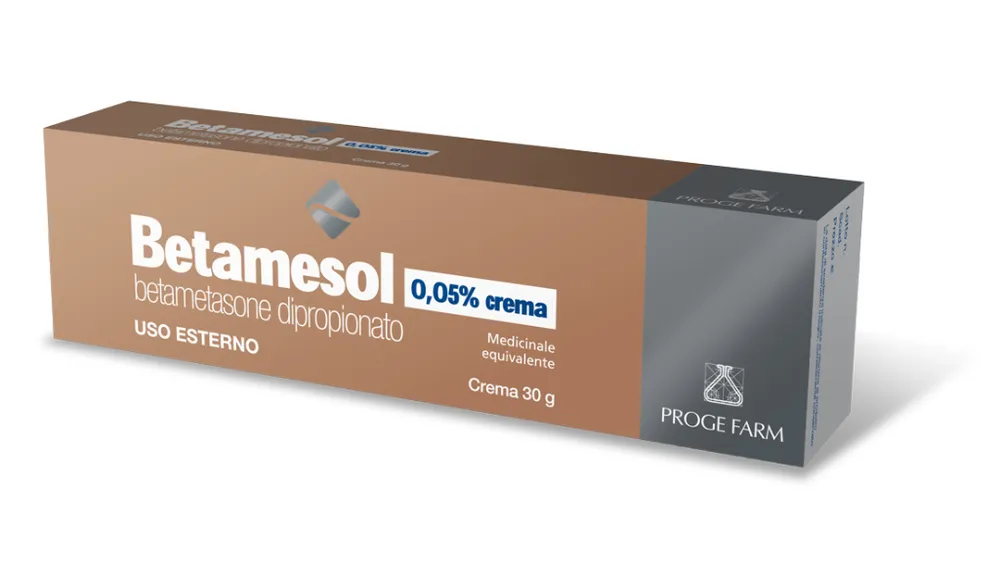
Table of Contents
Package leaflet: Information for the patient
BETAMESOL 0,05% cream
betamethasone dipropionate
Equivalent medicinal product
Read this entire leaflet carefully before using this medicine because it contains important information for you.
- Keep this leaflet. You may need to read it again.
- If you have any questions, consult your doctor or pharmacist.
- This medicine has been prescribed for you only. Do not give it to other people, even if they have the same symptoms as yours, because it may be harmful.
- If you experience any side effects, including those not listed in this leaflet, contact your doctor or pharmacist. See section 4.
Contents of this leaflet:
- What BETAMESOL is and what it is used for
- What you need to know before using BETAMESOL
- How to use BETAMESOL
- Possible side effects
- How to store BETAMESOL
- Package contents and other information
1. What BETAMESOL is and what it is used for
BETAMESOL contains the active substance betamethasone dipropionate, which belongs to a class of medicines called corticosteroids.
Corticosteroids are hormones that perform numerous functions, with an important role in controlling inflammation.
BETAMESOL is indicated for the treatment of the following skin diseases (dermatoses):
- Contact eczema, characterized by redness, desquamation, small blisters, vesicles, small superficial wounds, caused by contact with certain substances such as detergents, cosmetics, or substances used at work;
- Constitutional eczema, characterized by redness and blisters, often accompanied by intense itching;
- Seborrheic eczema in adults and infants (cradle cap), characterized by yellowish, greasy scales, redness, small crusts, and sometimes itching, affecting the scalp, face, ears, and chest;
- Stasis eczema, characterized by darker areas of skin, red, thin, sometimes thickened patches, with itching and pain;
- Dyshidrosis, characterized by small, often itchy vesicles containing clear fluid;
- Generalized and anogenital pruritus;
- Intertrigo, characterized by redness, desquamation, irritation, and itching due to friction between adjacent body parts;
- Solar erythema, characterized by itching, pain, burning sensation, and blistering;
- Irritative conditions caused by plants, chemical substances, or insect bites;
- Psoriasis, characterized by red patches, thickening, silvery-white scaling, and sometimes itching;
- Other inflammatory skin diseases such as Vidal-Brocq lichen simplex, characterized by intense itching and skin thickening, and lichen ruber planus, characterized by itchy, dark red, round or polygonal skin papules;
- Dermatoses associated with bacterial infection. In this case, BETAMESOL should be combined with a specific antibiotic.
2. What you need to know before using BETAMESOL
Do not use BETAMESOL
- if you are allergic to the active substance, to other corticosteroids, or to any of the other ingredients of this medicine (listed in section 6);
- if you have cutaneous tuberculosis, a form of tuberculosis affecting the skin;
- if you have viral skin infections (herpes simplex, smallpox, varicella). If you have atopic dermatitis, characterized by itching, redness, scaling, and skin elevations, do not use an occlusive dressing (non-breathable, e.g. polyethylene) with BETAMESOL.
Warnings and precautions
Talk to your doctor or pharmacist before using BETAMESOL.
Do not let BETAMESOL come into contact with your eyes.
It is recommended not to apply this medicine under an occlusive (non-breathable) dressing.
Your doctor will pay particular attention when BETAMESOL is used for prolonged periods, over a large area of skin, and especially if it is applied under an occlusive (non-breathable, e.g. polyethylene) dressing. This is because the medicine may pass into the bloodstream and may affect certain hormones, blood and urine sugar levels, and reduce the urinary excretion of certain hormones (17-KS and 17-OHCS).
If you develop irritation after applying the medicine, stop treatment and contact your doctor immediately, who will prescribe appropriate therapy.
If you develop a skin infection while using BETAMESOL, consult your doctor, who will recommend suitable treatment. If the treatment is not effective, your doctor will suspend therapy with BETAMESOL until the infection resolves.
The use, especially if prolonged, of medicines applied to the skin may cause allergic reactions. In such cases, your doctor will stop treatment and prescribe appropriate therapy.
As with all potent topical corticosteroid preparations, your doctor will discontinue treatment with BETAMESOL as soon as the condition is under control.
Any maintenance therapy will be performed with BETAMESOL.
Due to the characteristics of BETAMESOL, application under an occlusive dressing is not recommended.
All adverse effects reported after systemic use of corticosteroids (e.g. administered orally) may also occur with corticosteroids applied locally to the skin (topical use), especially in infants and children.
Contact your doctor if you experience blurred vision or other visual disturbances.
Children and adolescents
In early infancy, this medicine should only be administered when strictly necessary.
All adverse effects, including effects on certain hormones, may occur especially in infants and children, including growth retardation affecting both height and body weight.
In newborns, diapers may act as an occlusive dressing.
Other medicines and BETAMESOL
Inform your doctor or pharmacist if you are currently taking, have recently taken, or might take any other medicines.
The effectiveness of BETAMESOL is reduced by:
- barbiturates (medicines mainly used to treat anxiety and to induce sleep);
- antihistamines (medicines used to treat allergies);
- phenytoin (medicines used to treat epilepsy).
The effectiveness of BETAMESOL is increased by:
- salicylates and phenylbutazone (medicines used to treat inflammation).
BETAMESOL reduces the effectiveness of:
- oral hypoglycemics and insulin (medicines used to treat diabetes).
Pregnancy and breastfeeding
If you are pregnant, think you may be pregnant, planning a pregnancy, or breastfeeding, consult your doctor or pharmacist before using this medicine.
Pregnancy:
If you are pregnant or breastfeeding, use this medicine only if clearly needed and under direct medical supervision.
Breastfeeding:
It is not known whether the medicine passes into breast milk. Your doctor will decide whether to discontinue BETAMESOL, taking into account how important treatment with this medicine is for you.
Driving and using machines
This medicine does not impair the ability to drive or use machinery.
BETAMESOL contains :
- cetostearyl alcohol, which may cause skin reactions (e.g. contact dermatitis);
- chlorocresol, which may cause allergic reactions.
3. How to use BETAMESOL
Use this medicine exactly as directed by your doctor or pharmacist. If you have any doubts,
ask your doctor or pharmacist.
Apply the cream once or twice daily. Apply a sufficient amount to cover the entire affected area and
gently massage until completely absorbed.
Do not exceed the recommended doses.
If you use more BETAMESOL than you should
In case of accidental ingestion or excessive application of BETAMESOL, contact your doctor immediately or go to the nearest hospital.
Avoid excessive and prolonged use of BETAMESOL, as it may cause adrenal gland dysfunction, which is usually reversible. In such a case, your doctor will advise you to stop treatment, reduce the frequency of applications, or replace BETAMESOL with another medicine.
If you forget to use BETAMESOL
Do not apply a double dose to make up for a missed dose.
If you stop using BETAMESOL
If you have any doubts about the use of this medicine, consult your doctor or pharmacist.
4. Possible side effects
Like all medicines, this medicine can cause side effects, although not everybody will experience them.
During corticosteroid treatment on the skin, especially with intensive and prolonged use, the following side effects may occur:
Uncommon frequency (may affect up to 1 in 100 people)
- Blurred vision
Frequency not known (frequency cannot be estimated from the available data)
- Burning sensation;
- Itching;
- Irritation;
- Dryness of the skin;
- Thinning of the skin (cutaneous atrophy);
- Acne;
- Change in skin colour (hypopigmentation);
- Inflammation with red skin rashes around the mouth (perioral dermatitis);
- Skin reaction due to contact (contact dermatitis);
- Skin maceration;
- Fungal, bacterial, and viral infections;
- Atrophy, itchy rash with sweat retention (miliaria), and localized streaking in areas repeatedly rubbed and treated over long periods with occlusive dressing.
Reporting of side effects
If you experience any side effect, including those not listed in this leaflet, talk to your doctor or pharmacist.
You may also report side effects directly via the national reporting system at www.aifa.gov.it/content/segnalazioni-reazioni-avverse.
By reporting side effects, you can help provide more information on the safety of this medicine.
5. How to store BETAMESOL
This medicine does not require any special storage conditions. Keep this medicine out of the sight and reach of children.
Do not use this medicine after the expiry date stated on the packaging after "Exp.".
The expiry date refers to the last day of that month.
The indicated expiry date applies to the product in its original, undamaged packaging, stored correctly.
Do not dispose of any medicine via wastewater or household waste. Ask your pharmacist how to dispose of medicines you no longer use. This will help protect the environment.
6. Package contents and other information
What BETAMESOL contains
- The active substance is betamethasone dipropionate. 100 g of cream contain 0.064 g of betamethasone dipropionate (equivalent to 0.05 g of betamethasone alcohol).
- The other ingredients are: chlorocresol, monobasic sodium phosphate, phosphoric acid, white soft paraffin, liquid paraffin, polyethylene glycol monostearyl ether (cetomacrogol 1000), cetostearyl alcohol, deionized water.
Description of the appearance of BETAMESOL and the contents of the pack
Pack containing one tube of 30 g of cream.
Marketing Authorization Holder
PROGE FARM S.r.l. – Largo Donegani, 4/A – 28100 Novara – Italy
Manufacturers
Beltapharm S.r.l. – Via Stelvio, 66 – 20095 Cusano Milanino (MI) – Italy