Besponsa
Italy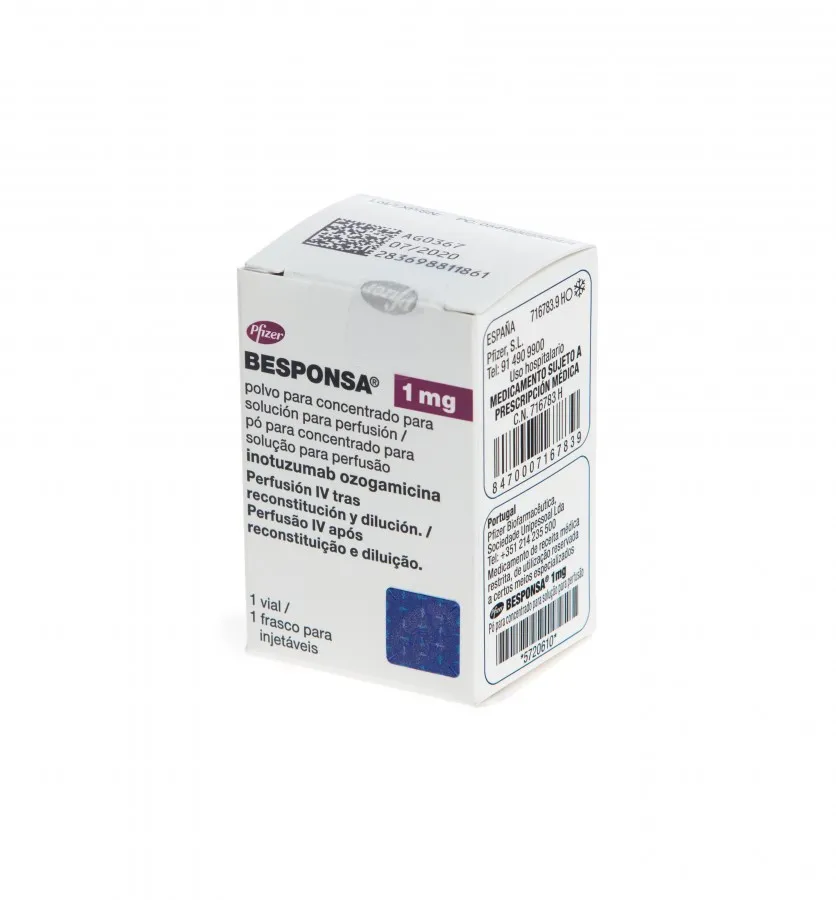
Table of Contents
- Package leaflet: Information for the user
- BESPONSA 1 mg powder for concentrate for solution for infusion
- 1. What BESPONSA is and what it is used for
- 2. What you should know before being given BESPONSA
- 3. How BESPONSA is administered
- 4. Possible side effects
- 5. How to store BESPONSA
- 6. Pack contents and other information
Package leaflet: Information for the user
BESPONSA 1 mg powder for concentrate for solution for infusion
inotuzumab ozogamicin
Please read all of this leaflet carefully before you are given this medicine because it contains important information for you.
- Keep this leaflet. You may need to read it again.
- If you have any further questions, ask your doctor, pharmacist or nurse.
- If you get any side effects, talk to your doctor, pharmacist or nurse. This includes any possible side effects not listed in this leaflet. See section 4.
What is in this leaflet
- What BESPONSA is and what it is used for
- What you need to know before you are given BESPONSA
- How BESPONSA is given
- Possible side effects
- How to store BESPONSA
- Contents of the pack and other information
1. What BESPONSA is and what it is used for
The active substance of BESPONSA is inotuzumab ozogamicin. It belongs to a group of medicines
that target cancer cells. These medicines are called antineoplastic agents.
BESPONSA is used to treat acute lymphoblastic leukaemia in adults. Acute lymphoblastic leukaemia
is a blood cancer that causes an excessive number of white blood cells.
BESPONSA is intended for the treatment of acute lymphoblastic leukaemia in adult patients who have
previously received other treatments that were not successful.
BESPONSA works by binding to cells expressing a protein called CD22. Cells of acute lymphoblastic
leukaemia carry this protein. Once bound to the leukaemia cells, the medicine delivers a substance
into the cells that interferes with their DNA, ultimately killing the cells.
2. What you should know before being given BESPONSA
Do not use BESPONSA if
- you are allergic to inotuzumab ozogamicin or to any of the other ingredients of this medicine (listed in section 6).
- you have previously had a severe veno-occlusive disease (a condition in which the blood vessels in the liver are damaged and blocked by blood clots) confirmed, or you currently have veno-occlusive disease.
- you currently have severe liver disease, for example, cirrhosis (a condition in which the liver does not function properly due to long-term damage), nodular regenerative hyperplasia (a condition with signs and symptoms of portal hypertension, which may be caused by chronic use of medications), or active hepatitis (a disease characterized by inflammation of the liver).
Warnings and precautions
Talk to your doctor, pharmacist, or nurse before you are given BESPONSA if:
- you have a history of liver problems or liver diseases, or if you experience signs and symptoms of a serious condition called hepatic veno-occlusive disease, a condition in which blood vessels in the liver become damaged and blocked by blood clots. Hepatic veno-occlusive disease can be fatal and is associated with rapid weight gain, pain in the upper right part of the abdomen (belly), enlargement of the liver, fluid accumulation causing abdominal swelling, and blood tests showing increases in bilirubin and/or liver enzymes (which may cause yellowing of the skin or eyes). This condition may occur during treatment with BESPONSA or following a subsequent stem cell transplant procedure, a procedure used to transplant stem cells from another person (cells capable of developing into new blood cells) into your bloodstream. This procedure may be used if your disease completely responds to treatment.
- you have signs or symptoms of low levels of certain blood cells such as neutrophils (sometimes accompanied by fever), red blood cells, white blood cells, lymphocytes, or low levels of blood components called platelets; these signs and symptoms include developing infections or fever, easy bruising, or frequent nosebleeds.
- you have signs and symptoms of an infusion-related reaction, such as fever and chills or breathing problems during or shortly after the infusion of BESPONSA.
- you have signs and symptoms of tumor lysis syndrome, which may be associated with gastrointestinal symptoms (e.g., nausea, vomiting, diarrhea), heart symptoms (e.g., changes in heart rhythm), kidney symptoms (e.g., decreased urine output, blood in urine), and nerve and muscle symptoms (e.g., muscle spasms, weakness, cramps), during or shortly after the infusion of BESPONSA.
- you have a history of, or are predisposed to, QT interval prolongation (an alteration in the heart's electrical activity that can cause serious heart rhythm disturbances), if you are taking medicines known to cause QT interval prolongation and/or if you have abnormal levels of electrolytes (e.g., calcium, magnesium, potassium).
- you have elevated levels of amylase or lipase enzymes, which may indicate problems related to the pancreas, liver, gallbladder, or bile ducts.
Inform your doctor, pharmacist, or nurse immediately if you become pregnant during
treatment with BESPONSA or within 8 months after treatment ends.
Your doctor will perform regular blood tests to monitor your blood cell counts during
treatment with BESPONSA. See also section 4.
During treatment, especially in the first few days after starting treatment, your white blood cell count may drop significantly (neutropenia), and this condition may be accompanied by fever (febrile neutropenia).
During treatment, especially in the first few days after starting treatment, you may experience an increase in liver enzymes. During treatment with BESPONSA, your doctor will perform regular blood tests to monitor your liver enzymes.
Treatment with BESPONSA may prolong the QT interval (a change in the heart's electrical activity that may cause serious heart rhythm disturbances). Your doctor will perform an electrocardiogram (ECG) and blood tests to measure electrolytes (e.g., calcium, magnesium, potassium) before your first dose of BESPONSA and will repeat these tests during treatment. See also section 4.
Your doctor will also monitor for signs and symptoms of tumor lysis syndrome after you receive BESPONSA. See also section 4.
Children and adolescents
BESPONSA must not be used in children and adolescents under 18 years of age because limited data are available in this population.
Other medicines and BESPONSA
Tell your doctor or pharmacist if you are taking, have recently taken, or might take any other medicines. This includes over-the-counter and herbal medicines.
Pregnancy, breastfeeding, and fertility
If you are pregnant, suspect you may be pregnant, plan to become pregnant, or are breastfeeding, consult your doctor or nurse before taking this medicine.
Contraception
You must avoid becoming pregnant or fathering a child. Women must use an effective method of contraception during treatment and for at least 8 months after the final dose. Men must use an effective method of contraception during treatment and for at least 5 months after the final dose.
Pregnancy
The effects of BESPONSA in pregnant women are unknown, but based on its mechanism of action, BESPONSA may cause harm to the fetus. You must not use BESPONSA during pregnancy unless your doctor considers it the most appropriate treatment for your condition.
Contact your doctor immediately if you or your partner become pregnant during treatment with this medicine.
Fertility
Male and female patients should seek medical advice regarding fertility preservation before starting treatment.
Breastfeeding
If you need to receive treatment with BESPONSA, you must stop breastfeeding during treatment and for at least 2 months after treatment ends. Inform your doctor.
Driving and using machines
If you experience unusual tiredness (a very common side effect of BESPONSA), you must not drive or operate machinery.
BESPONSA contains sodium
This medicine contains less than 1 mmol (23 mg) of sodium per 1 mg of inotuzumab ozogamicin, i.e., essentially 'sodium-free.'
3. How BESPONSA is administered
Use this medicine exactly as instructed by your doctor, pharmacist, or nurse. If you have any doubts, consult your doctor, pharmacist, or nurse.
How BESPONSA is administered
- Your doctor will determine the correct dose.
- A doctor or nurse will administer BESPONSA to you through an intravenous infusion (IV infusion) lasting 1 hour.
- Each dose is given weekly, and each treatment cycle consists of 3 doses.
- If the medicine is working well and you are going to undergo a stem cell transplant (see section 2), you may receive 2 cycles or up to 3 cycles of treatment.
- If the medicine is working well but you are not going to undergo a stem cell transplant (see section 2), you may receive up to 6 cycles of treatment.
- If you do not respond to the medicine within 3 cycles, treatment will be discontinued.
- Your doctor may adjust the dose, suspend it, or completely stop treatment with BESPONSA if you experience certain adverse reactions.
- Your doctor may reduce the dose based on your response to treatment.
- Your doctor will perform blood tests during treatment to monitor for adverse effects and to assess your response to treatment.
If you have any questions about how to use this medicine, speak to your doctor, pharmacist, or nurse.
Medicines administered before treatment with BESPONSA
Before treatment with BESPONSA, you will be given other medicines (premedications) to help reduce infusion-related reactions and other possible side effects. These may include corticosteroids (e.g., dexamethasone), antipyretics (medicines to reduce fever), and antihistamines (medicines to reduce allergic reactions).
Before treatment with BESPONSA, you may also be given medications and fluids to prevent tumor lysis syndrome. Tumor lysis syndrome is associated with a variety of symptoms affecting the stomach and intestines (e.g., nausea, vomiting, diarrhea), the heart (e.g., changes in heart rhythm), the kidneys (e.g., decreased urine output, blood in urine), and nerves and muscles (e.g., muscle spasms, weakness, cramps).
4. Possible side effects
Like all medicines, this medicine can cause side effects, although not everybody gets them. Some of these side effects can be serious.
Contact your doctor immediately if you experience signs and symptoms of any of the following serious side effects:
- Infusion-related reaction (see section 2); signs and symptoms include fever and chills or difficulty breathing during or shortly after the infusion of BESPONSA.
- Hepatic veno-occlusive disease (see section 2); signs and symptoms include rapid weight gain, pain in the upper right area of the abdomen, liver enlargement, fluid accumulation causing abdominal swelling, and increases in bilirubin and/or liver enzyme levels (which may cause yellowing of the skin or eyes).
- Low number of cells known as neutrophils (sometimes accompanied by fever), red blood cells, white blood cells, lymphocytes, or low levels of blood components called platelets (see section 2); signs and symptoms include development of infection or fever, or easy bruising and recurrent nosebleeds.
- Tumour lysis syndrome (see section 2); may be associated with a variety of gastrointestinal symptoms (e.g., nausea, vomiting, diarrhoea), heart-related symptoms (e.g., changes in heartbeat), kidney-related symptoms (e.g., decreased urine output, blood in urine), and symptoms affecting nerves and muscles (e.g., muscle spasms, weakness, cramps).
- QT interval prolongation (see section 2); signs and symptoms include changes in the electrical activity of the heart that may lead to serious heart rhythm abnormalities. Inform your doctor if you experience symptoms such as dizziness, weakness, or fainting.
Other possible side effects include:
Very common: may affect more than 1 in 10 people
- Infections
- Reduced number of white blood cells, which may cause general weakness and increased susceptibility to infections
- Reduced number of lymphocytes (a type of white blood cell), which may increase the risk of developing infections
- Reduced number of red blood cells, which may cause fatigue and shortness of breath
- Decreased appetite
- Headache
- Bleeding
- Abdominal pain
- Vomiting
- Diarrhoea
- Nausea
- Inflammation of the mouth
- Constipation
- Increased bilirubin levels, which may cause yellowing of the skin, eyes, and other tissues
- Fever
- Chills
- Fatigue
- Elevated liver enzyme levels (which may indicate liver damage) in the blood
Common: may affect up to 1 in 10 people
- Reduction in the number of various types of blood cells
- Excess uric acid in the blood
- Excessive fluid accumulation in the abdomen
- Abdominal swelling
- Changes in heart rhythm (may be detected by electrocardiogram)
- Abnormally high levels of amylase (an enzyme necessary for digestion and conversion of starch into sugars) in the blood
- Abnormally high levels of lipase (an enzyme necessary for fat metabolism) in the blood
- Hypersensitivity
Reporting of side effects
If you experience any side effect, including those not listed in this leaflet, talk to your doctor, pharmacist, or nurse. You can also report side effects directly through the national reporting system referred to in Annex V. By reporting side effects, you can help provide more information on the safety of this medicine.
5. How to store BESPONSA
Keep this medicine out of the sight and reach of children.
Do not use this medicine after the expiry date stated on the vial label and on the
carton after Exp. The expiry date refers to the last day of that month.
Closed vial
- Store in a refrigerator (2°C - 8°C).
- Keep in the original carton to protect the medicine from light.
- Do not freeze.
Reconstituted solution
- Use immediately or store in a refrigerator (2°C - 8°C) for a maximum of 4 hours.
- Protect from light.
- Do not freeze.
Diluted solution
- Use immediately or store at room temperature (20°C - 25°C) or in a refrigerator (2°C - 8°C). The total time from reconstitution to the end of administration must be ≤ 8 hours, and the time between reconstitution and dilution must be ≤ 4 hours.
- Protect from light.
- Do not freeze.
Before administration, the medicine should be visually inspected for the presence of any foreign particulate matter and discoloration. If you observe particles or color changes, do not use the medicine.
Do not dispose of medicines via wastewater or household waste. Ask your doctor how to dispose of medicines no longer used. This will help protect the environment.
6. Pack contents and other information
What BESPONSA contains
- The active substance is inotuzumab ozogamicin. Each vial contains 1 mg of inotuzumab ozogamicin. After reconstitution, 1 mL of solution contains 0.25 mg of inotuzumab ozogamicin.
- The excipients are sucrose, polysorbate 80, sodium chloride and tromethamine (see section 2).
Description of the appearance of BESPONSA and contents of the pack
BESPONSA is a powder for concentrate for solution for infusion (lyophilised powder).
Each BESPONSA pack contains:
- 1 glass vial containing a tablet or white to off-white lyophilised powder.
Marketing Authorisation Holder
Pfizer Europe MA EEIG
Boulevard de la Plaine 17
1050 Brussels
Belgium
Manufacturer
Pfizer Service Company BV
Hoge Wei 10
B-1930, Zaventem
Belgium
For further information about this medicinal product, please contact the local representative of the Marketing Authorisation Holder:
Belgique/België/Belgien Lietuva
Luxembourg/Luxemburg Pfizer Luxembourg SARL filialas Lietuvoje
Pfizer NV/SA Tel: + 370 52 51 4000
Tél/Tel: +32 (0)2 554 62 11
България Magyarország
Пфайзер Люксембург САРЛ, Клон Pfizer Kft.
България Tel: +36-1-488-37-00
Тел.: +359 2 970 4333
Česká republika Malta
Pfizer, spol. s r.o. Vivian Corporation Ltd.
Tel: +420 283 004 111 Tel: +356 21344610
Danmark Nederland
Pfizer ApS Pfizer bv
Tlf: +45 44 20 11 00 Tel: +31 (0)800 63 34 636
Deutschland Norge
Pfizer Pharma GmbH Pfizer AS
Tel: +49 (0)30 550055 51000 Tlf: +47 67 52 61 00
Eesti Österreich
Pfizer Luxembourg SARL Eesti filiaal Pfizer Corporation Austria Ges.m.b.H.
Tel: +372 666 7500 Tel: +43 (0)1 521 15-0
Ελλάδα Polska
Pfizer Ελλάς A.E. Pfizer Polska Sp. z o.o.
Τηλ: +30 210 6785 800 Tel: +48 22 335 61 00
España Portugal
Pfizer, S.L. Laboratórios Pfizer, Lda.
Tel: +34 91 490 99 00 Tel: +351 21 423 5500
France România
Pfizer Pfizer Romania S.R.L.
Tel: +33 (0)1 58 07 34 40 Tel: +40 (0) 21 207 28 00
Hrvatska Slovenija
Pfizer Croatia d.o.o. Pfizer Luxembourg SARL
Tel: + 385 1 3908 777 Pfizer, podružnica za svetovanje s področja farmacevtske dejavnosti, Ljubljana
Tel: + 386 (0)1 52 11 400
Ireland Slovenská republika
Pfizer Healthcare Ireland Pfizer Luxembourg SARL, organizačná zložka
Tel: 1800 633 363 (toll free) Tel: + 421 2 3355 5500
+44 (0)1304 616161
Ísland Suomi/Finland
Icepharma hf. Pfizer Oy
Sími: +354 540 8000 Puh/Tel: +358 (0)9 43 00 40
Italia Sverige
Pfizer S.r.l. Pfizer AB
Tel: +39 06 33 18 21 Tel: +46 (0)8 550-520 00
Κύπρος United Kingdom (Northern Ireland)
Pfizer Ελλάς Α.Ε. (Cyprus Branch) Pfizer Limited
Τηλ: +357 22 817690 Tel: +44 (0) 1304 616161
Latvija
Pfizer Luxembourg SARL filiāle Latvijā
Tel: + 371 670 35 775
Other sources of information
More detailed information on this medicinal product is available on the website of the European Medicines Agency: http://www.ema.europa.eu. In addition, links to other websites on rare diseases and their treatments are provided.
This leaflet is available in all languages of the European Union/European Economic Area on the European Medicines Agency website.
The following information is intended for healthcare professionals only. For further information on dosing and dose modifications, refer to the Summary of Product Characteristics.
Method of administration
BESPONSA is for intravenous use. The infusion must be administered over 1 hour.
Do not administer BESPONSA as an intravenous push or bolus.
BESPONSA must be reconstituted and diluted before administration.
BESPONSA is administered in 3- to 4-week cycles.
For patients proceeding to haematopoietic stem cell transplantation (HSCT), the recommended duration of treatment is 2 cycles. A third cycle may be considered for patients who do not achieve CR/CRi and MRD negativity after 2 cycles. For patients not proceeding to HSCT, up to a maximum of 6 cycles may be administered. All patients who do not achieve CR/CRi within 3 cycles should discontinue treatment (see section 4.2 of the Summary of Product Characteristics).
The table below shows the recommended dosing regimens.
For Cycle 1, the recommended total dose for all patients is 1.8 mg/m² per cycle, administered as 3 separate doses on Day 1 (0.8 mg/m²), Day 8 (0.5 mg/m²) and Day 15 (0.5 mg/m²). Cycle 1 lasts 3 weeks but may be extended to 4 weeks if the patient achieves CR/CRi and/or to allow recovery from toxicity.
For subsequent cycles, the recommended total dose is 1.5 mg/m² per cycle, administered as 3 separate doses on Day 1 (0.5 mg/m²), Day 8 (0.5 mg/m²) and Day 15 (0.5 mg/m²) for patients who achieve CR/CRi, or 1.8 mg/m² per cycle administered as 3 separate doses on Day 1 (0.8 mg/m²), Day 8 (0.5 mg/m²) and Day 15 (0.5 mg/m²) for patients who do not achieve CR/CRi. Subsequent cycles last 4 weeks.
Dosing regimen for Cycle 1 and subsequent cycles based on response to treatment
| Day 1 | Day 8a | Day 15a | |
| Dosing regimen for Cycle 1 | |||
| All patients: | |||
| Dose (mg/m2) | 0.8 | 0.5 | 0.5 |
| Cycle duration | 21 daysb | ||
| Dosing regimen for subsequent cycles based on response to treatment | |||
| Patients who achieved CRc or CRid: | |||
| Dose (mg/m2) | 0.5 | 0.5 | 0.5 |
| Cycle duration | 28 dayse | ||
| Patients who did not achieve CRc or CRid: | |||
| Dose (mg/m2) | 0.8 | 0.5 | 0.5 |
| Cycle duration | 28 dayse | ||
Instructions for reconstitution, dilution, and administration
Use proper aseptic technique during reconstitution and dilution procedures. Inotuzumab
ozogamicin (with a density of 1.02 g/mL at 20°C) is light-sensitive and must be protected from
ultraviolet light during reconstitution, dilution, and administration.
The maximum time from reconstitution to completion of administration must be ≤ 8 hours, and the time between reconstitution and dilution must be ≤ 4 hours.
Reconstitution:
- Calculate the required dose (mg) and the number of BESPONSA vials needed.
- Reconstitute each 1 mg vial with 4 mL of water for injections to obtain a single-use solution of 0.25 mg/mL of BESPONSA.
- Gently swirl the vial to aid dissolution. Do not shake.
- Inspect the reconstituted solution for the presence of particles and discoloration. The reconstituted solution should be from clear to slightly opalescent, colorless, and essentially free of visible extraneous matter. Do not use if particles or discoloration are observed.
- BESPONSA does not contain bacteriostatic preservatives. The reconstituted solution must be used immediately. If immediate use is not possible, the reconstituted solution may be stored for up to 4 hours under refrigeration (2°C – 8°C). Protect from light and do not freeze.
Dilution:
- Calculate the volume of reconstituted solution required to achieve the appropriate dose based on the patient's body surface area. Withdraw this volume from the vial(s) using a syringe. Protect from light. Discard any unused reconstituted solution remaining in the vial.
- Add the reconstituted solution to an infusion container containing 9 mg/mL (0.9%) sodium chloride for injections, to a total nominal volume of 50 mL. The final concentration should be between 0.01 and 0.1 mg/mL. Protect from light. Use of an infusion container made of polyvinyl chloride (PVC) (containing di(2-ethylhexyl)phthalate [DEHP] or DEHP-free), polyolefins (polypropylene and/or polyethylene), or ethylene vinyl acetate (EVA) is recommended.
- Gently invert the infusion container to mix the diluted solution. Do not shake.
- The diluted solution must be used immediately or stored at room temperature (20°C – 25°C) or under refrigeration (2°C – 8°C). The maximum time from reconstitution to completion of administration must be ≤ 8 hours, and the time between reconstitution and dilution must be ≤ 4 hours. Protect from light and do not freeze.
Administration:
- If the diluted solution has been stored under refrigeration (2°C – 8°C), allow it to equilibrate to room temperature (20°C – 25°C) for approximately 1 hour before administration.
- Filtration of the diluted solution is not required. However, if filtration is performed, filters made of polyethersulfone (PES), polyvinylidene fluoride (PVDF), or hydrophilic polysulfone (HPS) are recommended. Do not use nylon or mixed cellulose ester (MCE) filters.
- Protect the intravenous administration bag from light by using a light-protective covering that blocks ultraviolet light penetration (e.g., amber, dark brown, or green bags or aluminum foil) during infusion. Protection of the infusion line from light is not required.
- Infuse the diluted solution over 1 hour at a rate of 50 mL/hour at room temperature (20°C – 25°C). Protect from light. PVC (with or without DEHP), polyolefin (polypropylene and/or polyethylene), or polybutadiene infusion sets are recommended.
Do not mix BESPONSA or co-infuse it with other medicinal products.
The storage times and conditions for reconstituted and diluted BESPONSA solution are provided below.
Storage times and conditions for reconstituted and diluted BESPONSA solution
| Maximum time from reconstitution to end of administration ≤ 8 hours | ||
| Reconstituted solution | Diluted solution | |
| After start of dilution | Administration | |
| Use the reconstituted solution immediately or after storage in the refrigerator (2°C - 8°C) for up to 4 hours. Protect from light. Do not freeze. | Use the diluted solution immediately or after storage at room temperature (20°C - 25°C) or in the refrigerator (2°C - 8°C). The maximum time from reconstitution to end of administration must be ≤8 hours, and the time between reconstitution and dilution must be ≤4 hours. Protect from light. Do not freeze. | If the diluted solution is stored in the refrigerator (2°C - 8°C), allow it to reach room temperature (20°C - 25°C) for approximately 1 hour before administration. Administer the diluted solution as a 1-hour infusion at a rate of 50 mL/h at room temperature (20°C - 25°C). Protect from light. |
Storage conditions and shelf life
Unopened vials
5 years.
Reconstituted solution
BESPONSA does not contain bacteriostatic preservatives. The reconstituted solution must be used
immediately. If the reconstituted solution cannot be used immediately, it may be stored in the
refrigerator (2°C - 8°C) for up to 4 hours. Do not expose to light and do not freeze.
Diluted solution
The diluted solution must be used immediately or stored at room temperature (20°C - 25°C) or in
the refrigerator (2°C - 8°C). The maximum time from reconstitution to the end of administration must
be ≤ 8 hours, and the time between reconstitution and dilution must not exceed 4 hours.
Protect from light and do not freeze.