Beromun
Italy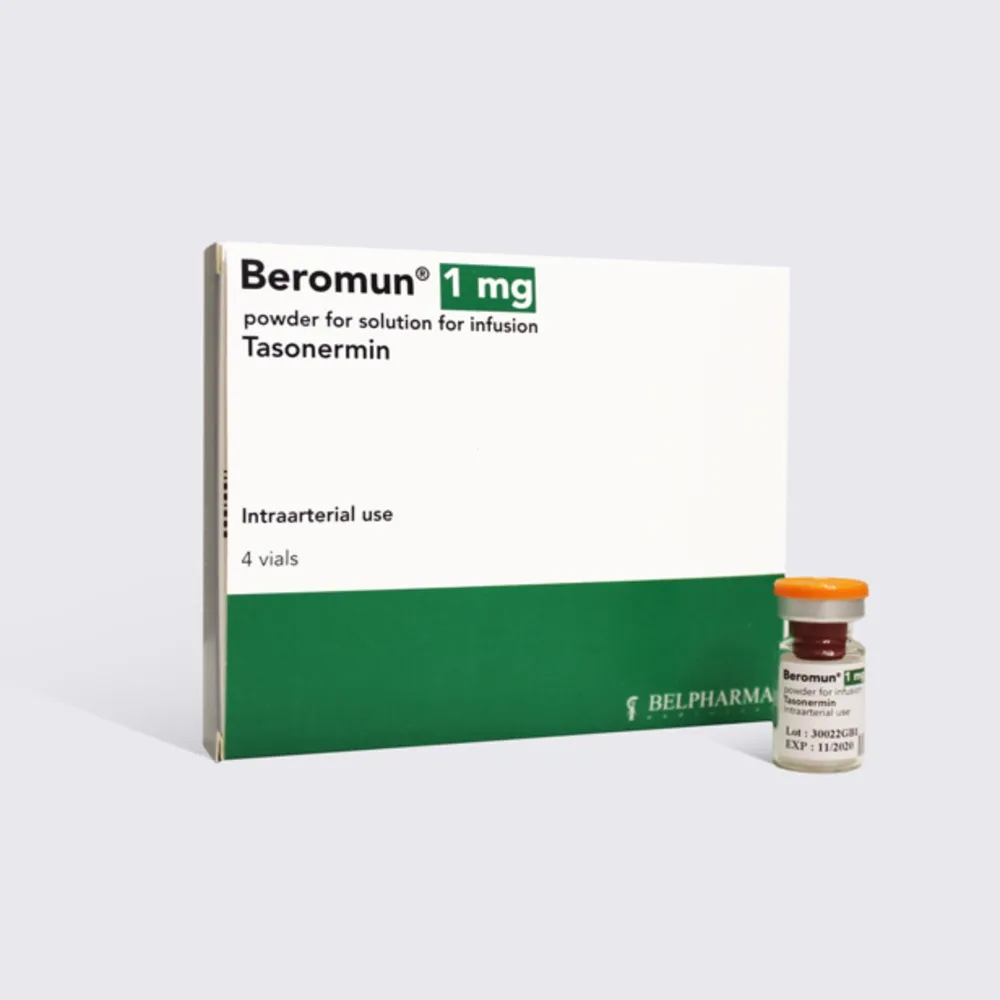
Table of Contents
Package leaflet: Information for the user
Beromun 1 mg powder for solution for infusion
Tasonermin
Please read this leaflet carefully before using this medicine because it contains important information for you.
- Keep this leaflet. You may need to read it again.
- If you have any questions, ask your doctor.
- If you get any side effects, talk to your doctor. This includes any side effects not listed in this leaflet.
Contents of this leaflet
- What Beromun is and what it is used for
- What you need to know before using Beromun
- How to use Beromun
- Possible side effects
- How to store Beromun
- Contents of the pack and other information
1. What Beromun is and what it is used for
Beromun contains the active substance tasonermin (tumor necrosis factor alpha-1a), produced
using recombinant DNA technology. It belongs to a class of medicines known as
immunostimulants, which help your body's immune system to fight cancer cells.
Beromun is used in combination with the medicine containing melphalan for the treatment of
soft tissue sarcomas of the leg and arm. By reducing the size of the tumour, the treatment aims to
facilitate surgical removal of the tumour or to prevent serious damage to the surrounding healthy
tissues, thereby delaying or avoiding the need for amputation of the arm or leg.
2. What you need to know before using Beromun
Do not use Beromun
- if you are allergic to tasonermin or to any of the other ingredients of this medicine (listed in section 6)
- if you have severe heart problems
- if you have severe lung diseases
- if you have or have recently had a peptic ulcer
- if you have a reduced number of blood cells or bleeding problems
- if you have moderate to severe liver or kidney disease
- if you cannot take vasoconstrictor medicines (medicines used to increase blood pressure), anticoagulants (medicines used to prevent blood clotting), or radioactive tracers
- if you are taking medicines known as cardiotoxic agents
- if you have high levels of calcium in your blood
- if you have infections that do not respond to antibiotic therapy
- if the affected leg or arm is severely swollen due to local edema, or if you have severe fluid accumulation in the abdomen
- if you are pregnant or planning to become pregnant
- if you are breastfeeding; after treatment with Beromun, you must stop breastfeeding for at least 7 days
Warnings and precautions
Beromun will be administered by an experienced and qualified physician using the technique of
locoregional limb perfusion. This technique ensures that Beromun remains confined to the affected
arm or leg. It is important that it does not reach other parts of the body, as this so-called systemic
leak may cause serious adverse effects in other organs.
During locoregional perfusion and for the following seven to ten days, you will need to remain in
hospital. Your doctor will closely monitor your blood pressure, circulation, and any adverse effects.
Hospitalization in an intensive care unit immediately after locoregional perfusion may be required for
a short period.
Within three days after administration of Beromun, you may develop a condition called
"compartment syndrome." Symptoms of muscle damage in the perfused limb—including pain, edema,
as well as neurological symptoms (e.g., paresthesia, paralysis)—must all be reported immediately
to your doctor.
Other medicines and Beromun
Inform your doctor if you are taking, have recently taken, or might take any other medicines. In
particular, inform your doctor if you are taking medicines to lower blood pressure (for treatment of
hypertension).
For locoregional perfusion, you will also receive other medicines to control pain, fever, blood pressure,
and blood coagulation, as well as general anesthesia.
Pregnancy and breastfeeding
You must not use Beromun if you are pregnant.
You must not breastfeed for at least seven days after treatment with Beromun.
Driving and using machines
Not applicable
Beromun contains sodium
The reconstituted medicine contains up to 151.27 mg (6.58 mmol) of sodium per recommended dose.
This should be taken into consideration in patients on a low-sodium diet.
The container is made of latex rubber
The container of this medicine is made of latex rubber. It may cause severe allergic reactions.
3. How to use Beromun
Beromun will be administered to you by your doctor using the technique of regional perfusion of the limb, in combination with the anticancer drug melphalan. This will take place while you are unconscious, under general anaesthesia.
Blood circulation to and from the affected limb will be interrupted using a tourniquet. With a heart-lung machine, oxygen-rich blood is pumped into the main artery of the affected limb through a catheter, while it is drained (pumped out) from the main vein. Beromun and then melphalan are injected into this circuit; the affected limb will be exposed to Beromun for a total of 90 minutes.
The recommended dose of Beromun depends on the affected limb, usually 3 mg for the arm and 4 mg for the leg. Beromun powder must be dissolved before use. The resulting solution will be administered into an artery of the affected arm or leg by regional perfusion over an initial period of 30 minutes.
Melphalan will then be added, and the regional perfusion will continue for a further 60 minutes. Finally, the limb will be washed out to completely remove Beromun and melphalan.
Regional perfusion allows tumour cells in the limb to be exposed to a very high dose of Beromun and melphalan, increasing their anticancer effect, while preventing these substances from reaching the rest of the body where they could cause serious side effects.
You will normally not undergo a second regional perfusion with Beromun. If this were to happen, it would not occur until at least six weeks after the previous treatment.
If you use more Beromun than you should
Since Beromun is always administered by experienced and qualified hospital doctors, accidental overdose is extremely unlikely. However, if it were to occur, your doctor will immediately wash out the affected limb to remove Beromun, and perfusion will be stopped.
In case of any risk of serious side effects, your doctor will immediately transfer you to the intensive care unit for closer monitoring and initiation of appropriate treatment.
If systemic leakage of Beromun occurs
If more than 10% of the administered dose of Beromun reaches the main part of the body, your doctor will take similar measures as in the case of overdose.
If you have any further questions about the use of this medicine, ask your doctor.
4. Possible side effects
Like all medicines, this medicine can cause side effects, although not everyone gets them.
Side effects may be caused by Beromun, by melphalan, by the perfusion technique, or by a combination of these factors. Some of these side effects can be serious, particularly if Beromun reaches other parts of the body (systemic leakage). In approximately 2% of cases, Beromun may cause damage to the tissue of the affected arm or leg severe enough to require amputation. If there is any risk of a serious side effect, your doctor will immediately transfer you to an intensive care unit for closer monitoring and to start appropriate treatment.
The following side effects have been observed during treatment with this medicine (grouped according to how likely they are to occur).
Very common (may affect more than 1 in 10 people)
- disturbances in heart rhythm (cardiac arrhythmia)
- nausea, vomiting
- liver damage
- skin blisters
- fever (usually mild to moderate), chills
- pain in the treated arm or leg
- tiredness (fatigue)
Common (may affect up to 1 in 10 people)
- infections
- local wound infection
- decrease in white blood cells and platelets in the blood
- hypersensitivity reactions (allergy)
- neurological damage
- loss of consciousness
- headache
- heart problems that may cause shortness of breath and swelling of the ankles
- blood clot formation in an artery or vein of the treated limb (thrombosis)
- drop in blood pressure (shock)
- severe breathing difficulties
- constipation, diarrhoea
- skin necrosis (death of skin cells) in the treated limb
- swelling of ankles, feet or fingers due to fluid accumulation in the treated limb
- “compartment syndrome”, a medical condition characterised by pain, swelling and neurological symptoms, as well as muscle damage in the treated limb
- muscle pain
- protein in the urine
- night sweats
- tissue necrosis (death of tissue cells) in the treated limb, which may be severe enough to require amputation
Uncommon (may affect up to 1 in 100 people)
- blood infection (septicaemia)
- fluid in the lungs
- stomach ache
- inflammation of the stomach lining (gastritis)
- temporary loss of fingernails or toenails of the treated limb
- kidney failure
- blood laboratory test results showing impaired kidney function
- narrowing or blockage of blood vessels in the limb carrying blood from the heart
Reporting of side effects
If you get any side effects, including those not listed in this leaflet, talk to your doctor. You can also report side effects directly via the national reporting system listed in Annex V. By reporting side effects, you can help provide more information on the safety of this medicine.
5. How to store Beromun
Keep this medicine out of sight and reach of children.
Do not use this medicine after the expiry date stated on the carton and label of the vial after Exp. The expiry date refers to the last day of that month.
Store in a refrigerator (2°C-8°C). After reconstitution, the product must be used immediately.
6. Package contents and other information
What Beromun contains
- The active substance is tasonermin. Each vial contains 1 mg of tasonermin. The contents of one Beromun powder vial must be reconstituted with 5.3 mL of sterile 0.9% sodium chloride injectable solution.
- The other components are disodium hydrogen phosphate dihydrate, dodecahydrate disodium phosphate, human serum albumin.
Description of the appearance of Beromun and package contents
Beromun is a white to almost white powder for solution for infusion supplied in a glass vial with a rubber stopper and sealed with an aluminium flip-off cap.
Each pack contains 4 powder vials.
Marketing Authorization Holder
BELPHARMA s.a.
2, Rue Albert 1er
L-1117 Luxembourg
Grand Duchy of Luxembourg
Manufacturer
Eumedica NV
Chemin de Nauwelette 1
B-7170 Manage
Belgium
For information about this medicinal product, contact the Marketing Authorization Holder:
BELPHARMA s.a.
2, Rue Albert 1er
L-1117 Luxembourg
Grand Duchy of Luxembourg
Tel: +352 27403070
This leaflet was last updated on
Other sources of information
More detailed information on this medicinal product is available on the website of the European Medicines Agency: http://www.ema.europa.eu.
This leaflet is available in all languages of the European Union/European Economic Area on the European Medicines Agency website.