Benlysta
Italy
Table of Contents
- Package leaflet: Information for the user
- Benlysta 200 mg solution for injection in pre-filled pen
- 1. What Benlysta is and what it is used for
- 2. What you need to know before using Benlysta
- 3. How to use Benlysta
- 4. Possible side effects
- 5. How to store Benlysta
- 6. Package contents and other information
- 1. Prepare and check the materials
- 2. Prepare and inspect the prefilled pen
- 3. Choose and clean the injection site
- 4. Preparing for the injection
- 5. Inject Benlysta and inspect
- 6. Disposal of the used pen
- Package leaflet: Information for the user
- Benlysta 200 mg solution for injection in pre-filled syringe
- 1. What Benlysta is and what it is used for
- 2. What you should know before using Benlysta
- 3. How to use Benlysta
- 4. Possible side effects
- 5. How to store Benlysta
- 6. Package contents and other information
- 1. Prepare and check the materials
- 2. Prepare and inspect the prefilled syringe
- 3. Choose and clean the injection site
- 4. Preparing for the injection
- 5. Inject Benlysta and inspect
- 6. Disposal of the used syringe
- Package leaflet: Information for the user
- Benlysta 120 mg powder for concentrate for solution for infusion, 400 mg powder for concentrate for solution for infusion
- 1. What Benlysta is and what it is used for
- 2. What you should know before being given Benlysta
- 3. How to use Benlysta
- 4. Possible side effects
- 5. How to store Benlysta
- 6. Contents of the pack and other information
Package leaflet: Information for the user
Benlysta 200 mg solution for injection in pre-filled pen
belimumab
This medicinal product is subject to additional monitoring. This will allow rapid identification of new safety information. You can help by reporting any side effects you may experience while taking this medicine. See the end of section 4 for information on how to report side effects.
Please read all of this leaflet carefully before you start using this medicine because it contains important information for you.
- Keep this leaflet. You may need to read it again.
- If you have any questions, ask your doctor.
- This medicine has been prescribed for you only. Do not pass it on to other people, even if they have the same symptoms as you, because it may be harmful.
- If you experience any side effect, including those not listed in this leaflet, tell your doctor. See section 4.
Contents of this leaflet
- What Benlysta is and what it is used for
- What you need to know before using Benlysta
- How to use Benlysta
- Possible side effects
- How to store Benlysta
- Contents of the pack and other information
Step-by-step instructions for using the pre-filled pen
1. What Benlysta is and what it is used for
Benlysta for subcutaneous injection is a medicine used to treat lupus (systemic lupus
erythematosus, SLE) in adults (aged 18 years and older) and in children (aged 5 to less than 18 years and
with a body weight of at least 15 kg) whose disease remains highly active despite standard treatment.
Benlysta is also used, in combination with other medicines, to treat adults (aged 18 years and older) with active
lupus nephritis (kidney inflammation caused by lupus).
Lupus is a disease in which the immune system (the system that fights infections) attacks the body's own cells
and tissues, causing inflammation and organ damage. It can affect almost any organ in the body, and a type of
white blood cells called B cells is thought to be involved.
Benlysta contains belimumab (a monoclonal antibody). This reduces the number of B cells in the blood by
blocking the action of BLyS, a protein that helps B cells survive longer and which is present in high levels in
people with lupus.
You will receive both Benlysta and your usual lupus treatment.
2. What you need to know before using Benlysta
Do not use Benlysta:
- if you are allergic to belimumab or to any of the other ingredients of this medicine (listed in section 6)
➔ Check with your doctor if this may apply to you.
Warnings and precautions
Talk to your doctor before using Benlysta:
- if you currently have an infection or have had a long-term infection, or if you are prone to frequent infections. Your doctor will decide whether Benlysta can be given to you
- if you are planning a vaccination or have been vaccinated within the last 30 days. Some types of vaccines should not be administered immediately before or during treatment with Benlysta
- if lupus affects your nervous system
- if you are HIV positive or have low levels of immunoglobulins
- if you have or have had hepatitis B or C
- if you have had an organ transplant or a bone marrow or stem cell transplant
- if you have had a tumour
- if you have developed a severe skin rash, skin peeling, blisters, and/or mouth ulcers after using Benlysta.
➔ Inform your doctor if any of these situations apply to you.
Depression and suicide
There have been reports of depression, suicidal thoughts and suicide attempts, including completed suicides, during treatment with Benlysta. Inform your doctor if you have previously experienced any of these conditions. If at any time you notice the onset or worsening of symptoms:
➔ Contact your doctor or go to hospital immediately.
If you feel depressed or are thinking about harming yourself or committing suicide, it may be helpful to talk about this with a close family member or friend and ask them to read this leaflet. You may ask them to tell you if they are concerned about changes in your mood or behaviour.
Serious skin reactions
Stevens-Johnson syndrome and toxic epidermal necrolysis have been reported in association with treatment with Benlysta.
➔ Stop using Benlysta and contact a doctor immediately if you notice any of the symptoms described in section 4.
Be alert to important symptoms
People taking medicines that affect the immune system may be at increased risk of infections, including a rare but serious brain infection called progressive multifocal leukoencephalopathy (PML).
➔ Read the information “Increased risk of brain infection” in section 4 of this leaflet.
To improve traceability of this medicine, you and the healthcare provider should record the batch number of Benlysta. You are advised to note down this information in case you are asked for it in the future.
Children and adolescents
Benlysta pre-filled pen for subcutaneous injection must not be used in children under 5 years of age or weighing less than 15 kg for the treatment of SLE.
Benlysta pre-filled pen for subcutaneous injection must not be used in children or adolescents under 18 years of age for the treatment of lupus nephritis.
Other medicines and Benlysta
Inform your doctor if you are taking, have recently taken, or might take any other medicines.
In particular, inform your doctor if you are being treated with medicines that affect the immune system, including any medicine that acts on B-cells (used to treat tumours or inflammatory diseases).
Combining these medicines with Benlysta may make the immune system less effective. This may increase the risk of a serious infection.
Pregnancy and breastfeeding
Contraception for women who could become pregnant
- Use an effective method of contraception while being treated with Benlysta and for at least 4 months after the last dose.
Pregnancy
Benlysta is generally not recommended if you are pregnant.
- Inform your doctor if you are pregnant, suspect you may be pregnant, or are planning to become pregnant. Your doctor will decide whether you can use Benlysta.
- If you become pregnant during treatment with Benlysta, inform your doctor.
Breastfeeding
Inform your doctor if you are breastfeeding. Benlysta is likely to pass into breast milk. Your doctor will discuss with you whether you should stop treatment with Benlysta while breastfeeding or whether you should stop breastfeeding.
Driving and using machines
Benlysta may have side effects that could affect your ability to drive or operate machinery.
Benlysta contains polysorbate 80
This medicine contains 0.1 mg of polysorbate 80 per pre-filled pen. Polysorbates may cause allergic reactions. Inform your doctor if you or your child have known allergies.
Benlysta contains sodium
This medicine contains less than 1 mmol (23 mg) of sodium per dose, i.e. essentially 'sodium-free'.
3. How to use Benlysta
Use this medicine exactly as instructed by your doctor or pharmacist. If you have any doubts, consult your doctor or pharmacist.
Benlysta must be injected under the skin according to the schedule prescribed by your doctor.
Dosage
Systemic lupus erythematosus
Adults
The recommended dose is 200 mg (entire contents of one pen) once weekly.
Children and adolescents from 5 years of age
The recommended dose for children and adolescents from 5 years of age is based on body weight, as indicated below:
| Body weight | Recommended dose |
| 50 kg or more | 200 mg (entire content of one pen) once weekly |
| 30 kg to less than 50 kg | 200 mg (entire content of one pen) every 10 days |
| 15 kg to less than 30 kg | 200 mg (entire content of one pen) every 2 weeks |
Lupus nephritis
Adults only
The recommended dose may vary. Your doctor will prescribe the dose that is right for you, which is:
- a 200 mg dose (entire contents of one pen) once weekly
or
- a 400 mg dose (entire contents of two pens on the same day) once weekly for 4 weeks. After this, the recommended dose is 200 mg (entire contents of one pen) once weekly.
If you wish to change the day of administration
Take a dose on the new day (even if the time since the last dose is shorter than usual). Continue with the
new schedule from that day onward.
Benlysta injection
Your doctor or nurse will show you or your caregiver how to inject Benlysta. The first injection with the
Benlysta pre-filled pen must be given under the supervision of a doctor or nurse. Once you have been
instructed on how to use the pen, the doctor or nurse may decide that you or your caregiver can administer the
injection. Your doctor or nurse will also inform you about which signs and symptoms to watch for when using
Benlysta, as serious allergic reactions may occur (see “Allergic reactions” in section 4).
For children under 10 years of age, the Benlysta pre-filled pen must be administered by a doctor, nurse, or trained assistant.
Benlysta should be injected under the skin in the abdominal area (abdomen) or upper leg (thigh).
Subcutaneous injection of Benlysta must not be administered into a vein (intravenous administration).
Instructions for using the pre-filled pen are provided at the end of this leaflet.
If you use more Benlysta than you should
If this happens, contact your doctor or nurse immediately. They will monitor you for any signs or symptoms of adverse effects and treat them if necessary. If possible, show them the packaging or this leaflet.
If you forget to use Benlysta
Inject the missed dose as soon as you remember. Then continue with your usual weekly schedule, or start a new weekly schedule beginning on the day the missed dose was administered.
If you do not realize you have missed a dose until it is time for your next scheduled dose, administer only the next scheduled dose as planned.
Stopping treatment with Benlysta
Your doctor will decide whether you need to stop treatment with Benlysta.
4. Possible side effects
Like all medicines, this medicine can cause side effects, although not everyone gets them.
Stop using Benlysta and contact a doctor immediately if you notice any of the following symptoms of a
serious skin reaction:
- Reddish patches on the trunk; the patches are target-like or circular spots, often with blisters in the center, skin peeling, mouth, throat, nose, genital, or eye ulcers. These severe skin rashes may be preceded by fever and flu-like symptoms (Stevens-Johnson syndrome, toxic epidermal necrolysis). These side effects have been reported with an unknown frequency (cannot be estimated from available data).
Allergic reactions — seek immediate medical help
Benlysta may cause an injection-site reaction or an allergic reaction ( hypersensitivity ). These reactions are
common side effects (may affect up to 1 in 10 people). Occasionally (uncommon, may affect up to 1 in 100),
they may be severe and can be life-threatening. These serious reactions are most likely to occur on the day of
the first or second treatment with Benlysta, but may be delayed and occur several days later.
Contact your doctor or nurse immediately or go to the nearest hospital emergency department if you
experience any of the following symptoms of an allergic or injection-related reaction:
- swelling of the face, lips, mouth, or tongue
- wheezing, difficulty breathing, or shortness of breath
- skin rash
- itchy swellings or hives
Rarely, less severe adverse reactions may occur with Benlysta later, usually 5–10 days after injection. These
include symptoms such as rash, nausea, fatigue, muscle pain, headache, and facial swelling.
If you experience these symptoms, especially if two or more occur together:
➔ Inform your doctor or nurse.
Infections
Benlysta may make you more likely to get infections, including urinary and respiratory tract infections. These
are very common and may affect more than 1 in 10 people. Some infections may be severe and may result in
death, occurring uncommonly.
If you experience any of the following signs of infection:
- fever and/or chills
- cough, breathing problems
- diarrhea, vomiting
- burning sensation when passing urine; frequent urination
- warm, red, or painful skin or sores on the body
➔ Contact your doctor or nurse immediately.
Depression and suicide
Cases of depression, suicidal thoughts, and suicide attempts have been reported during treatment with
Benlysta. Depression may affect up to 1 in 10 people, while suicidal thoughts and suicide attempts may affect
up to 1 in 100 people. If you feel depressed, think about harming yourself, have other distressing thoughts, or
if you are depressed and notice your condition worsening or new symptoms appearing:
➔ Contact your doctor or go to hospital immediately.
Increased risk of brain infection
Medicines that weaken the immune system, such as Benlysta, may increase your risk of developing a rare but
serious and potentially life-threatening brain infection called progressive multifocal leukoencephalopathy
(PML).
Symptoms of PML include:
- memory loss
- difficulty thinking
- difficulty speaking or walking
- loss of vision
➔ Contact your doctor immediately if you experience any of these symptoms or similar problems lasting for several days.
If you already had these symptoms before starting treatment with Benlysta:
➔ Contact your doctor immediately if you notice any changes in these symptoms.
Other possible side effects
Very common side effects
These may affect more than 1 in 10 people :
- bacterial infections ( see “Infections” above )
Common side effects
These may affect up to 1 in 10 people :
- high temperature or fever
- injection site reactions, for example: rash, redness, itching, or swelling at the site where Benlysta was injected
- itching, swellings (hives), skin rash
- reduced number of white blood cells (visible in blood tests)
- infection of the nose, throat, or stomach
- pain in hands or feet
- migraine
- nausea, diarrhea
Reporting of side effects
If you experience any side effect, including those not listed in this leaflet, talk to your doctor or pharmacist.
You can also report side effects directly via the national reporting system listed in Annex V. By reporting
side effects, you can help provide more information on the safety of this medicine.
5. How to store Benlysta
Keep this medicine out of the sight and reach of children.
Do not use this medicine after the expiry date stated on the label and the carton after "Exp". The expiry date refers to the last day of the month.
Store in a refrigerator (from 2 °C to 8 °C).
Do not freeze.
Keep in the original packaging to protect the medicine from light.
A single pre-filled Benlysta pen may be stored at room temperature (up to 25°C) for a maximum of 12 hours, provided it is protected from light. Once removed from the refrigerator, the pen must be used within 12 hours or discarded.
Do not dispose of any medicine via wastewater or household waste. Ask your pharmacist how to dispose of medicines you no longer use. This will help protect the environment.
6. Package contents and other information
What Benlysta contains
The active substance is belimumab.
Each 1 mL pre-filled pen contains 200 mg of belimumab.
The excipients are arginine hydrochloride, histidine, histidine monohydrochloride, polysorbate 80 (E 433), sodium chloride,
water for injections. See section 2 for further information on the content of polysorbate 80
and sodium.
Description of the appearance of Benlysta and contents of the pack
Benlysta is supplied as a solution ranging from colourless to pale yellow in a single-use 1 mL pre-filled pen.
Available in packs of 1 or 4 pre-filled pens per pack, and multiple packs containing
12 pre-filled pens (3 packs of 4 pre-filled pens).
Not all pack sizes may be marketed.
Marketing Authorisation Holder
GlaxoSmithKline (Ireland) Limited
12 Riverwalk
Citywest Business Campus
Dublin 24
Ireland
Manufacturer
GlaxoSmithKline Manufacturing S.p.A.
Strada Provinciale Asolana, 90
43056 San Polo di Torrile
Parma
Italy
For further information about this medicinal product, please contact the local representative of the Marketing Authorisation Holder:
België/Belgique/Belgien Lietuva
GlaxoSmithKline Pharmaceuticals s.a./n.v. GlaxoSmithKline Trading Services Limited
Tél/Tel: + 32 (0)10 85 52 00 Tel: + 370 80000334
България Luxembourg/Luxemburg
GlaxoSmithKline Trading Services Limited GlaxoSmithKline Pharmaceuticals s.a./n.v.
Teл.: + 359 80018205 Belgique/Belgien
Tél/Tel: + 32 (0) 10 85 52 00
Česká republika Magyarország
GlaxoSmithKline s.r.o. GlaxoSmithKline Trading Services Limited
Tel: + 420 222 001 111 Tel.: + 36 80088309
[email protected]
Danmark Malta
GlaxoSmithKline Pharma A/S GlaxoSmithKline Trading Services Limited
Tlf: + 45 36 35 91 00 Tel: + 356 80065004
[email protected]
Deutschland Nederland
GlaxoSmithKline GmbH & Co. KG GlaxoSmithKline BV
Tel.: + 49 (0)89 36044 8701 Tel: + 31 (0)33 2081100
[email protected]
Eesti Norge
GlaxoSmithKline Trading Services Limited GlaxoSmithKline AS
Tel: + 372 8002640 Tlf: + 47 22 70 20 00
Ελλάδα Österreich
GlaxoSmithKline Μονοπρόσωπη A.E.B.E. GlaxoSmithKline Pharma GmbH
Τηλ: + 30 210 68 82 100 Tel: + 43 (0)1 97075 0
[email protected]
España Polska
GlaxoSmithKline, S.A. GSK Services Sp. z o.o.
Tel: + 34 900 202 700 Tel.: + 48 (0)22 576 9000
[email protected]
France Portugal
Laboratoire GlaxoSmithKline GlaxoSmithKline – Produtos Farmacêuticos, Lda.
Tél.: + 33 (0)1 39 17 84 44 Tel: + 351 21 412 95 00
[email protected] [email protected]
Hrvatska România
GlaxoSmithKline Trading Services Limited GlaxoSmithKline Trading Services Limited
Tel:+ 385 800787089 Tel: + 40 800672524
Ireland Slovenija
GlaxoSmithKline (Ireland) Limited GlaxoSmithKline Trading Services Limited
Tel: + 353 (0)1 4955000 Tel: + 386 80688869
Ísland Slovenská republika
Vistor ehf. GlaxoSmithKline Trading Services Limited
Sími: +354 535 7000 Tel: + 421 800500589
Italia Suomi/Finland
GlaxoSmithKline S.p.A. GlaxoSmithKline Oy
Tel: + 39 (0)45 7741111 Puh/Tel: + 358 (0)10 30 30 30
Κύπρος Sverige
GlaxoSmithKline Trading Services Limited GlaxoSmithKline AB
Τηλ: + 357 80070017 Tel: + 46 (0)8 638 93 00
[email protected]
Latvija
GlaxoSmithKline Trading Services Limited
Tel: + 371 80205045
More detailed information on this medicinal product is available on the website of the European Medicines Agency: https://www.ema.europa.eu
Step-by-step instructions for using the pre-filled pen
Once weekly: for adults and for children aged 5 to less than 18 years and weighing 50 kg or more.
Every 10 days: for children aged 5 to less than 18 years and weighing between 30 kg and less than 50 kg.
Every 2 weeks: for children aged 5 to less than 18 years and weighing between 15 kg and less than 30 kg.
Read these sections first
Follow these instructions on how to correctly use the pre-filled pen. Failure to follow these instructions may affect the proper functioning of the pre-filled pen. You must also be trained on how to use the pre-filled pen.
Benlysta must be used exclusively under the skin (subcutaneously).
To improve traceability of this medicinal product, you and the healthcare provider should record the batch number of Benlysta. It is recommended that you note this information in case it is requested in the future.
Storage
- Keep refrigerated until 30 minutes before use.
- Keep in the outer carton to protect from light.
- Keep out of the sight and reach of children.
- Keep away from heat sources and direct sunlight.
- Do not freeze. If the pen has been frozen, do not use it even if it has been thawed.
- Do not use and do not return to the refrigerator if left at room temperature for more than 12 hours.
Warnings
- The pre-filled pen must be used only once and then discarded.
- Do not share the Benlysta pre-filled pen with other people.
- Do not shake.
- Do not use if dropped on a hard surface.
- Do not remove the cap until shortly before injection.
Parts of the Benlysta pre-filled pen
Cap Inspection window
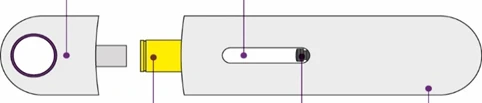
Golden needle shield Grey cap Expiry date
(internal needle)
Materials needed for injection
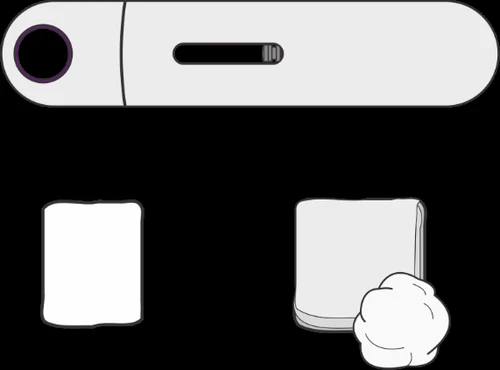
Benlysta pre-filled pen
Alcohol swab Gauze or cotton ball
(not included) (not included)
1. Prepare and check the materials
Prepare the materials
- Remove from the refrigerator a sealed tray containing a prefilled pen.
- Return any remaining prefilled pens to the refrigerator.
- Find a clean, well-lit, and comfortable surface, and gather the following supplies within easy reach:
- Benlysta prefilled pen
- Alcohol swabs ( not included in the package )
- Gauze or cotton ball ( not included in the package )
- Sealed container with lid for safe disposal of the pen ( not included in the package ).
- Do not administer the injection if any of the listed supplies are missing.
Remove the prefilled pen
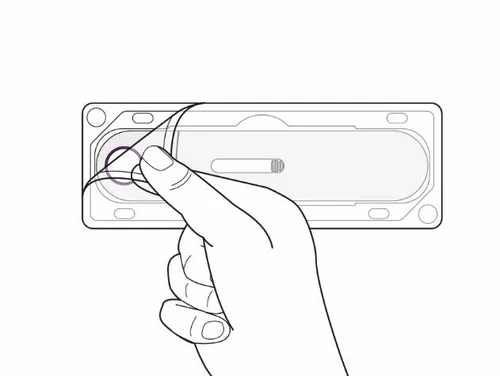
- Peel back the film from the corner of the tray. ( Figure 1 )
Figure 1
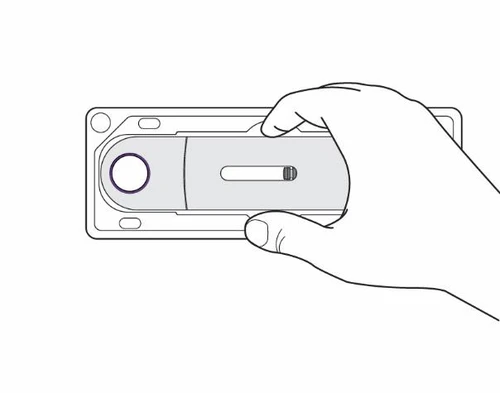
- Holding the center part of the prefilled pen (near the inspection window), carefully remove the prefilled pen from the tray. ( Figure 2 )
Figure 2
Check the expiration date
- Check the expiration date on the prefilled pen. ( Figure 3 )
Figure 3
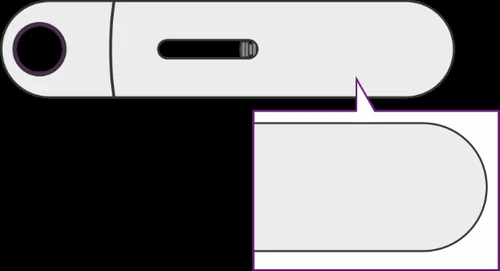
- Do not use after the expiration date.
2. Prepare and inspect the prefilled pen
Allow to reach room temperature
- Leave the pen at room temperature for 30 minutes ( Figure 4 ). Injecting cold Benlysta may take longer and could be uncomfortable.
Figure 4
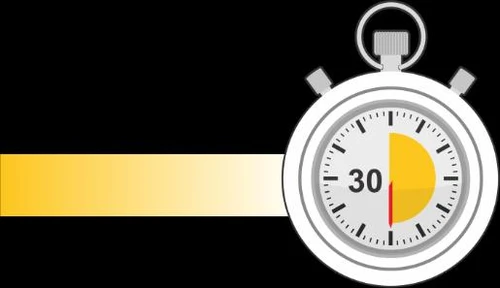
Wait 30 minutes
- Do not warm the pen in any other way. For example, do not heat in a microwave, in hot water, or in direct sunlight.
- Do not remove the cap during this step.
Inspect the Benlysta solution
- Look through the inspection window to check that the Benlysta solution is colorless to pale yellow. ( Figure 5 )
- It is normal to see one or more air bubbles in the solution.
Figure 5
Benlysta solution
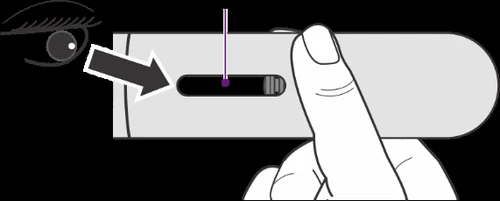
- Do not use if the solution is cloudy, discolored, or contains particles.
3. Choose and clean the injection site
Choose the injection site
- Select an injection site (abdomen or thigh) as shown in Figure 6.
Figure 6
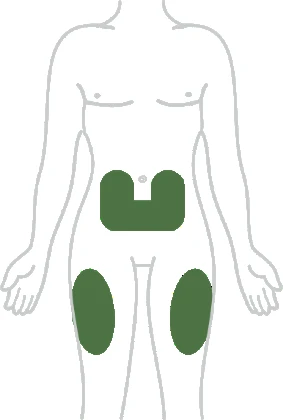
- If 2 injections are needed to complete the dose, leave at least 5 cm (2 inches) between each injection site if the same general area is chosen.
- Do not inject exactly at the same site each time. This is to avoid skin thickening.
- Do not inject in areas where the skin is tender, bruised, red, or hardened.
- Do not inject within 5 cm (2 inches) of the navel.
Clean the injection site
- Wash your hands.
- Clean the injection site by rubbing with an alcohol swab ( Figure 7 ). Allow the skin to air dry.
Figure 7
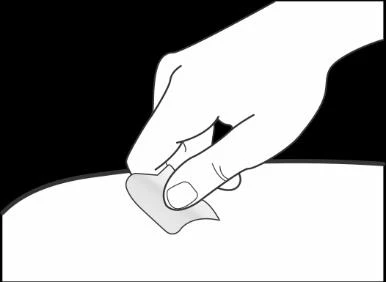
- Do not touch this area before giving the injection.
4. Preparing for the injection
Remove the cap
- Do not remove the cap until immediately before the injection.
- Remove the cap by pulling or twisting it. The cap can be twisted either clockwise or counterclockwise. ( Figure 8 )
Figure 8
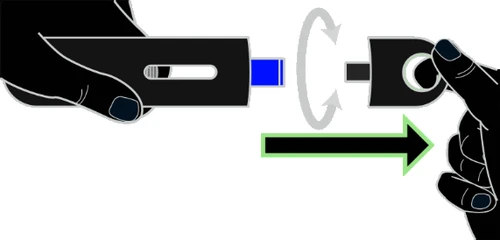
- Do not reattach the cap onto the pen.
Position the pen
- Hold the pen comfortably so that you can see the inspection window. This is important to ensure complete administration. ( Figure 9 )
Figure 9
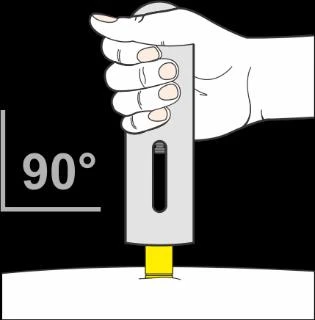
- If necessary, prepare the injection site by pinching or stretching the skin.
- Position the pen straight onto the injection site (at a 90° angle). Make sure the golden needle shield is flat against the skin.
5. Inject Benlysta and inspect
Start the injection
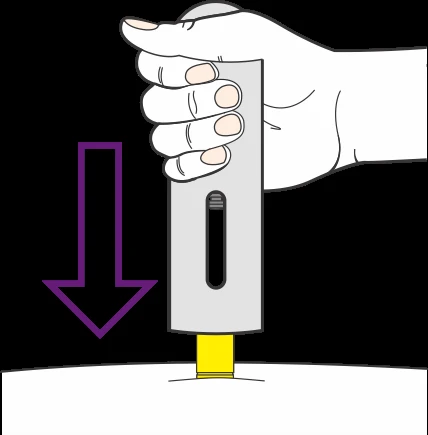
- Firmly press the pen fully down onto the injection site and hold in place. (Figure 10)
- This will insert the needle and start the injection.
Figure 10
- You may hear a first "click" at the beginning of the injection. You will see the purple indicator start to move across the viewing window. (Figure 11)
Figure 11
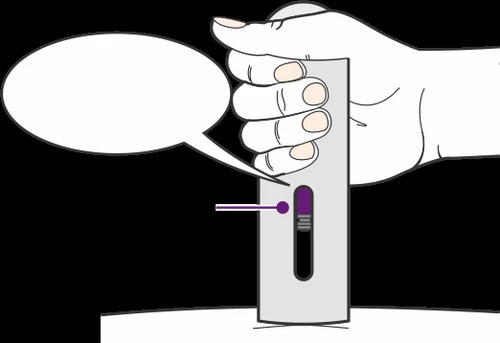
first "click"
purple indicator
Complete the injection
- Continue to hold the pen pressed down until the purple indicator stops moving.
- You may hear a second "click" a few seconds before the purple indicator stops moving. (Figure 12)
Figure 12
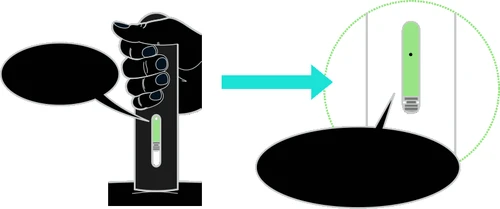
Then wait until
the…
second "click"
…purple indicator
stops moving
- The injection may take up to 15 seconds to complete.
- When the injection is complete, lift the pen away from the injection site.
Inspect the injection site
A small amount of blood at the injection site may be present.
- If needed, press a cotton ball or gauze pad against the injection site.
- Do not rub the injection site.
6. Disposal of the used pen
Disposal of the used pen
- Do not re-cap the pen.
- Dispose of the used pen and cap in a puncture-resistant, tightly-closing container.
- Ask your doctor or pharmacist for instructions on how to properly dispose of the used pen or the container for used pens.
- Do not recycle or throw the used pen or the container for used pens into household waste.
Package leaflet: Information for the user
Benlysta 200 mg solution for injection in pre-filled syringe
belimumab
This medicinal product is subject to additional monitoring. This will allow for rapid identification of new safety information. You can help by reporting any side effects you experience while taking this medicine. See the end of section 4 for information on how to report side effects.
Please read all of this leaflet carefully before using this medicine because it contains important information for you.
- Keep this leaflet. You may need to read it again.
- If you have any questions, ask your doctor.
- This medicine has been prescribed for you only. Do not give it to other people, even if their symptoms are the same as yours, as it may be harmful.
- If you experience any side effect, including those not listed in this leaflet, contact your doctor. See section 4.
Contents of this leaflet
- What Benlysta is and what it is used for
- What you need to know before using Benlysta
- How to use Benlysta
- Possible side effects
- How to store Benlysta
- Contents of the pack and other information
Step-by-step instructions for using the pre-filled syringe
1. What Benlysta is and what it is used for
Benlysta for subcutaneous injection is a medicine used to treat lupus (systemic lupus erythematosus, SLE) in adults (aged 18 years and older) whose disease remains highly active despite standard treatment. Benlysta is also used, in combination with other medicines, to treat adults (aged 18 years and older) with active lupus nephritis (lupus-related kidney inflammation).
Lupus is a disease in which the immune system (the system that fights infections) attacks the body's own cells and tissues, causing inflammation and organ damage. It can affect almost any organ in the body, and it is believed that a type of white blood cells called B cells is involved.
Benlysta contains belimumab (a monoclonal antibody). This reduces the number of B cells in the blood by blocking the action of BLyS, a protein that helps B cells survive longer and which is present in high levels in people with lupus.
You will be given both Benlysta and your usual lupus treatment.
2. What you should know before using Benlysta
Do not use Benlysta:
- if you are allergic to belimumab or to any of the other ingredients of this medicine (listed in section 6)
➔ Check with your doctor if this may apply to you.
Warnings and precautions
Talk to your doctor before using Benlysta
- if you have an ongoing or chronic infection, or if you frequently get infections. Your doctor will decide whether Benlysta can be given to you
- if you are planning a vaccination or have been vaccinated within the last 30 days. Some types of vaccines should not be administered immediately before or during treatment with Benlysta
- if lupus affects your nervous system
- if you are HIV positive or have low levels of immunoglobulins
- if you have or have had hepatitis B or C
- if you have had an organ transplant or a bone marrow or stem cell transplant
- if you have had a tumour
- if you have developed a severe skin rash or skin peeling, blisters, and/or mouth ulcers after using Benlysta.
➔ Inform your doctor if any of these situations apply to you.
Depression and suicide
Cases of depression, suicidal thoughts, and suicide attempts, including suicide, have been reported during treatment with Benlysta. Inform your doctor if you have previously experienced any of these conditions. If at any time you notice the onset or worsening of symptoms:
➔ Contact your doctor or go to hospital immediately.
If you feel depressed or are thinking about harming yourself or committing suicide, it may be helpful to talk about this with a close family member or friend and ask them to read this leaflet. You may also ask them whether they are concerned about changes in your mood or behaviour.
Severe skin reactions
Stevens-Johnson syndrome and toxic epidermal necrolysis have been reported in association with treatment with Benlysta.
➔ Stop using Benlysta and contact a doctor immediately if you notice any of the symptoms described in section 4.
Be alert to important symptoms
People taking medicines that affect the immune system may be at increased risk of infections, including a rare but serious brain infection called progressive multifocal leukoencephalopathy (PML).
➔ Read the information on “Increased risk of brain infection” in section 4 of this leaflet.
To improve traceability of this medicine, you and the healthcare provider should record the batch number of Benlysta. You are advised to keep a note of this information in case you are asked for it in the future.
Children and adolescents
Benlysta pre-filled syringe for subcutaneous injection must not be used in children or adolescents under 18 years of age.
Other medicines and Benlysta
Inform your doctor if you are taking, have recently taken, or might take any other medicines.
In particular, inform your doctor if you are being treated with medicines that affect the immune system, including any medicine acting on B-cells (used to treat tumours or inflammatory diseases).
Combining these medicines with Benlysta may make the immune system less effective. This may increase the risk of a serious infection.
Pregnancy and breastfeeding
Contraception for women who could become pregnant
- Use an effective method of contraception during treatment with Benlysta and for at least 4 months after the last dose.
Pregnancy
Benlysta is not usually recommended if you are pregnant.
- Inform your doctor if you are pregnant, suspect you may be pregnant, or are planning to become pregnant. Your doctor will decide whether you can use Benlysta.
- If you become pregnant while being treated with Benlysta, inform your doctor.
Breastfeeding
Inform your doctor if you are breastfeeding. Benlysta is likely to pass into breast milk. Your doctor will discuss with you whether you should stop treatment with Benlysta while breastfeeding or whether you should stop breastfeeding.
Driving and using machines
Benlysta may have side effects that could affect your ability to drive or operate machinery.
Benlysta contains polysorbate 80
This medicine contains 0.1 mg of polysorbate 80 in each pre-filled syringe. Polysorbates may cause allergic reactions. Inform your doctor if you have known allergies.
Benlysta contains sodium
This medicine contains less than 1 mmol (23 mg) of sodium per dose, i.e. essentially ‘sodium-free’.
3. How to use Benlysta
Use this medicine exactly as instructed by your doctor or pharmacist. If you have any doubts,
consult your doctor or pharmacist.
Benlysta must be injected under the skin on the same day every week.
Dosage
Adults (aged 18 years and older)
Systemic lupus erythematosus
The recommended dose is 200 mg (entire contents of one syringe) once a week.
Lupus nephritis
The recommended dose may vary. Your doctor will prescribe the dose appropriate for you, which is:
- a dose of 200 mg (entire contents of one syringe) once a week
or
- a dose of 400 mg (entire contents of two syringes on the same day) once a week for 4 weeks. After this, the recommended dose is 200 mg (entire contents of one syringe) once a week.
If you wish to change the day of administration
Take a dose on the new day (even if less than one week has passed since your last dose). Continue
with the new weekly schedule from that day.
Injection of Benlysta
Your doctor or nurse will show you or your caregiver how to inject Benlysta. Your first injection with
pre-filled syringe will be administered under the supervision of a doctor or nurse. Once you have been
trained on how to use the syringe, your doctor or nurse may decide that you or your caregiver can
administer the injection independently. Your doctor or nurse will also inform you about which signs and symptoms to watch for when using Benlysta, as serious allergic reactions may occur (see “Allergic reactions” in section 4).
Benlysta should be injected under the skin in the abdominal area (abdomen) or the upper part of the leg (thigh).
The subcutaneous injection of Benlysta must not be injected into a vein (intravenous administration).
Instructions for using the pre-filled syringe are provided at the end of this leaflet.
If you use more Benlysta than you should
If this happens, contact your doctor or nurse immediately. They will monitor you for any signs or symptoms of adverse effects and treat them if necessary. If possible, show them the packaging or this leaflet.
If you forget to use Benlysta
Inject the missed dose as soon as you remember. Then continue with your regular weekly schedule as usual, or start a new weekly schedule beginning on the day you administered the missed dose.
If you do not realize you have missed a dose until it is time for your next scheduled dose, administer only the next scheduled dose as planned.
Stopping treatment with Benlysta
Your doctor will decide whether you need to stop treatment with Benlysta.
4. Possible side effects
Like all medicines, this medicine can cause side effects, although not everybody gets them.
Stop using Benlysta and contact a doctor immediately if you notice any of the following symptoms of a severe skin reaction:
- Reddish patches on the trunk; the patches are target-like or circular, often with blisters in the center, skin peeling, mouth, throat, nose, genital or eye ulcers. These serious skin rashes may be preceded by fever and flu-like symptoms (Stevens-Johnson syndrome, toxic epidermal necrolysis). These side effects have been reported with a frequency not known (cannot be estimated from the available data).
Allergic reactions — seek medical help immediately
Benlysta may cause an injection-site reaction or an allergic reaction (hypersensitivity). These reactions are common side effects (may affect up to 1 in 10 people). Occasionally (uncommon, may affect up to 1 in 100 people), they may be severe and can be life-threatening.
These severe reactions are most likely to occur on the day of the first or second treatment with Benlysta, but may be delayed and occur several days later.
Contact your doctor or nurse immediately or go to the nearest hospital emergency department if you experience any of the following symptoms of an allergic or injection-related reaction:
- swelling of the face, lips, mouth or tongue
- wheezing, difficulty breathing or shortness of breath
- skin rash
- itchy swellings or hives
Less severe adverse reactions may rarely occur later with Benlysta, usually 5–10 days after injection. These include symptoms such as rash, nausea, fatigue, muscle pain, headache, and facial swelling.
If you experience these symptoms, especially if two or more occur together:
➔ Inform your doctor or nurse.
Infections
Benlysta may make it more likely for you to get infections, including urinary and respiratory tract infections. These are very common and may affect more than 1 in 10 people. Some infections may be severe and may result in death with uncommon frequency.
If you experience any of the following signs of infection:
- fever and/or chills
- cough, breathing problems
- diarrhoea, vomiting
- burning sensation when passing urine; frequent urination
- skin that is warm, red, painful or sores on the body ➔ Contact your doctor or nurse immediately.
Depression and suicide
There have been reports of depression, suicidal thoughts and suicide attempts during treatment with Benlysta. Depression may affect up to 1 in 10 people, suicidal thoughts and suicide attempts may affect up to 1 in 100 people. If you feel depressed, think about harming yourself, have other distressing thoughts, or if you are depressed and notice your condition worsening or new symptoms appearing:
➔ Contact your doctor or go to hospital immediately.
Increased risk of brain infection
Medicines that weaken the immune system, such as Benlysta, may increase your risk of getting a rare but serious and potentially life-threatening brain infection called progressive multifocal leukoencephalopathy (PML).
The symptoms of PML include:
- memory loss
- difficulty thinking
- difficulty speaking or walking
- loss of vision ➔ Contact your doctor immediately if you experience any of these symptoms or similar problems lasting for several days.
If you already had these symptoms before starting treatment with Benlysta:
➔ Contact your doctor immediately if you notice any change in these symptoms.
Other possible side effects:
Very common side effects
These may affect more than 1 in 10 people:
- bacterial infections (see “Infections” above)
Common side effects
These may affect up to 1 in 10 people:
- high temperature or fever
- injection site reactions, for example: rash, redness, itching or swelling of the skin where Benlysta was injected
- itching, swellings (hives), rash
- reduced number of white blood cells (seen in blood tests)
- infection of the nose, throat or stomach
- pain in hands or feet
- migraine
- nausea, diarrhoea
Reporting of side effects
If you experience any side effect, including those not listed in this leaflet, talk to your doctor or pharmacist. You can also report side effects directly through the national reporting system listed in Annex V. Reporting side effects can help provide more information on the safety of this medicine.
5. How to store Benlysta
Keep this medicine out of the sight and reach of children.
Do not use this medicine after the expiry date stated on the label and the carton following "Exp". The
expiry date refers to the last day of that month.
Store in a refrigerator (from 2°C to 8°C).
Do not freeze.
Keep in the original packaging to protect the medicine from light.
A single pre-filled Benlysta syringe may be stored at room temperature (up to 25°C) for a maximum of
12 hours, provided it is protected from light. Once removed from the refrigerator, the syringe must be used within
12 hours or discarded.
Do not dispose of any medicine via wastewater or household waste. Ask your pharmacist how to dispose of
medicines you no longer use. This will help protect the environment.
6. Package contents and other information
What Benlysta contains
The active substance is belimumab.
Each 1 mL pre-filled syringe contains 200 mg of belimumab.
The excipients are arginine hydrochloride, histidine, histidine monohydrochloride, polysorbate 80 (E 433), sodium chloride,
water for injections. See section 2 for further information on the content of polysorbate 80 and sodium.
Description of the appearance of Benlysta and contents of the pack
Benlysta is supplied as a solution ranging from colourless to pale yellow in a single-use 1 mL pre-filled syringe with a needle cap.
Available in packs of 1 or 4 pre-filled syringes.
Not all pack sizes may be marketed.
Marketing Authorisation Holder
GlaxoSmithKline (Ireland) Limited
12 Riverwalk
Citywest Business Campus
Dublin 24
Ireland
Manufacturer
GlaxoSmithKline Manufacturing S.p.A.
Strada Provinciale Asolana, 90
43056 San Polo di Torrile
Parma
Italy
For further information on this medicinal product, please contact the local representative of the Marketing Authorisation Holder in your country:
België/Belgique/Belgien
GlaxoSmithKline Pharmaceuticals s.a./n.v.
Tél/Tel: + 32 (0)10 85 52 00
България
GlaxoSmithKline Trading Services Limited
Teл.: + 359 80018205
Česká republika
GlaxoSmithKline s.r.o.
Tel: + 420 222 001 111
[email protected]
Danmark
GlaxoSmithKline Pharma A/S
Tlf.: + 45 36 35 91 00
[email protected]
Deutschland
GlaxoSmithKline GmbH & Co. KG
Tel.: + 49 (0)89 36044 8701
[email protected]
Eesti
GlaxoSmithKline Trading Services Limited
Tel: + 372 8002640
Ελλάδα
GlaxoSmithKline Μονοπρόσωπη A.E.B.E.
Τηλ: + 30 210 68 82 100
España
GlaxoSmithKline, S.A.
Tel: + 34 900 202 700
[email protected]
France
Laboratoire GlaxoSmithKline
Tél.: + 33 (0)1 39 17 84 44
[email protected]
Hrvatska
GlaxoSmithKline Trading Services Limited
Tel: + 385 800787089
Ireland
GlaxoSmithKline (Ireland) Limited
Tel: + 353 (0)1 4955000
Ísland
Vistor ehf.
Sími: +354 535 7000
Italia
GlaxoSmithKline S.p.A.
Tel: + 39 (0)45 7741111
Κύπρος
GlaxoSmithKline Trading Services Limited
Τηλ: + 357 80070017
[email protected]
Latvija
GlaxoSmithKline Trading Services Limited
Tel: + 371 80205045
Lietuva
GlaxoSmithKline Trading Services Limited
Tel: + 370 80000334
Luxembourg/Luxemburg
GlaxoSmithKline Pharmaceuticals s.a./n.v.
Belgique/Belgien
Tél/Tel: + 32 (0)10 85 52 00
Magyarország
GlaxoSmithKline Trading Services Limited
Tel.: + 36 80088309
Malta
GlaxoSmithKline Trading Services Limited
Tel: + 356 80065004
Nederland
GlaxoSmithKline BV
Tel: + 31 (0)33 2081100
Norge
GlaxoSmithKline AS
Tlf: + 47 22 70 20 00
Österreich
GlaxoSmithKline Pharma GmbH
Tel: + 43 (0)1 97075 0
[email protected]
Polska
GSK Services Sp. z o.o.
Tel.: + 48 (0)22 576 9000
Portugal
GlaxoSmithKline – Produtos Farmacêuticos, Lda.
Tel: + 351 21 412 95 00
[email protected]
România
GlaxoSmithKline Trading Services Limited
Tel: + 40 800672524
Slovenija
GlaxoSmithKline Trading Services Limited
Tel: + 386 80688869
Slovenská republika
GlaxoSmithKline Trading Services Limited
Tel: + 421 800500589
Suomi/Finland
GlaxoSmithKline Oy
Puh/Tel: + 358 (0)10 30 30 30
Sverige
GlaxoSmithKline AB
Tel: + 46 (0)8 638 93 00
[email protected]
More detailed information on this medicinal product is available on the European Medicines Agency website: https://www.ema.europa.eu
Step-by-step instructions for using the pre-filled syringe
Once weekly: for adults only
Read these sections first
Follow these instructions carefully to correctly use the pre-filled syringe. Failure to follow these instructions may affect the proper functioning of the pre-filled syringe. You must also be trained on how to use the pre-filled syringe.
Benlysta must be administered under the skin only (subcutaneously).
To improve traceability of this medicinal product, you and the healthcare provider should record the batch number of Benlysta. It is recommended that you note down this information in case you are asked for it in the future.
Storage
- Keep refrigerated until up to 30 minutes before use.
- Keep in the outer carton to protect from light.
- Keep out of sight and reach of children.
- Keep away from heat sources and direct sunlight.
- Do not freeze. If the pre-filled syringe has been frozen, do not use it even if it has been thawed.
- Do not use and do not return to the refrigerator if left at room temperature for more than 12 hours.
Warnings
- The pre-filled syringe must be used only once and then discarded.
- Do not share the Benlysta pre-filled syringe with other people.
- Do not shake.
- Do not use if dropped on a hard surface.
- Do not remove the needle cap until just before injection.
Parts of the Benlysta pre-filled syringe
Before use
Needle cap
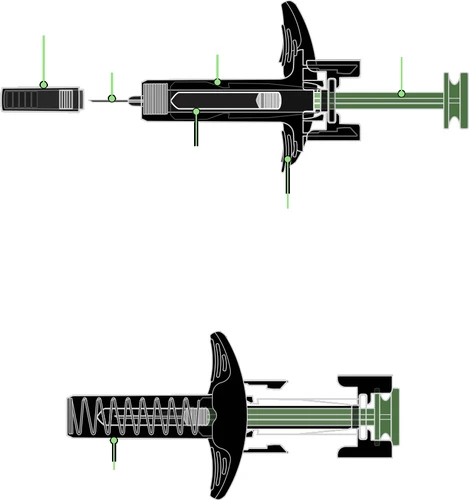
Plunger
Needle Barrel
Inspection
window
Grip
After use — needle covered by activated needle safety guard
Activated needle safety guard
Materials needed for injection
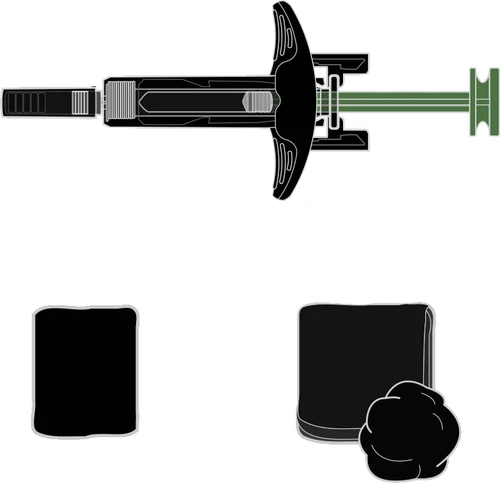
Benlysta pre-filled syringe
Alcohol swab
Gauze or cotton ball
(not included) (not included)
1. Prepare and check the materials
Prepare the materials
- Remove from the refrigerator a sealed tray containing a prefilled syringe.
- Return any remaining prefilled syringes to the refrigerator.
- Find a clean, well-lit, and comfortable surface, and gather the following items within easy reach:
- Benlysta prefilled syringe
- alcohol swabs ( not included in the package )
- gauze or cotton ball ( not included in the package )
- puncture-resistant container with a lid for safe disposal of the syringe ( not included in the package ).
- Do not administer the injection if you do not have all the listed supplies.
Remove the prefilled syringe
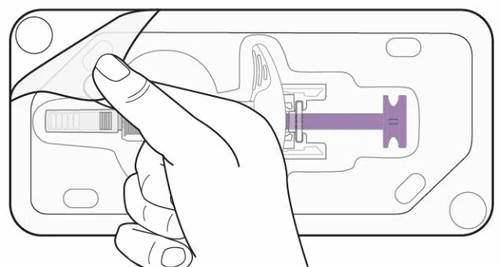
- Peel back the foil from the corner of the tray. ( Figure 1 )
Figure 1
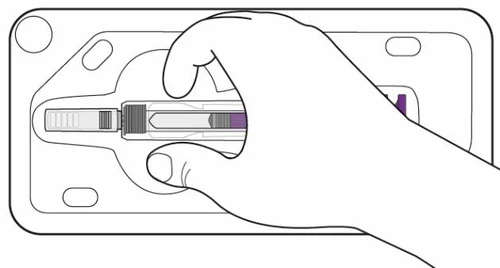
- Holding the center part of the prefilled syringe (near the inspection window), carefully remove the prefilled syringe from the tray. ( Figure 2 )
Figure 2
Check the expiration date
- Check the expiration date on the prefilled syringe. ( Figure 3 )
Figure 3
Exp.: Month – Year
- Do not use after the expiration date.
2. Prepare and inspect the prefilled syringe
Allow to reach room temperature
- Leave the syringe at room temperature for 30 minutes ( Figure 4 ). Injecting Benlysta cold may take longer and may be uncomfortable.
Figure 4
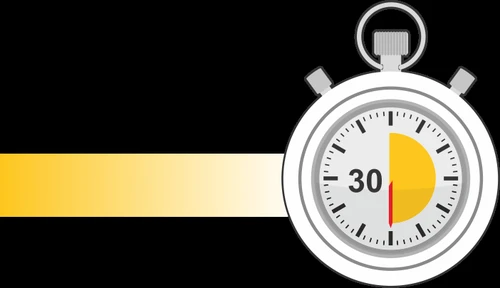
Wait 30 minutes
- Do not warm the syringe by any other method. For example, do not use a microwave oven, hot water, or expose it to direct sunlight.
- Do not remove the needle cap during this step.
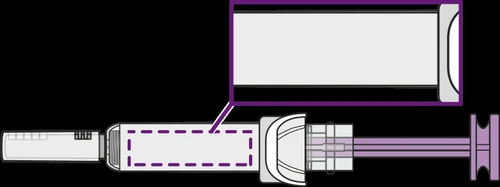
Inspect the Benlysta solution
- Look through the inspection window to check that the Benlysta solution is from colourless to pale yellow. ( Figure 5 )
- It is normal to see one or more air bubbles in the solution.
Figure 5
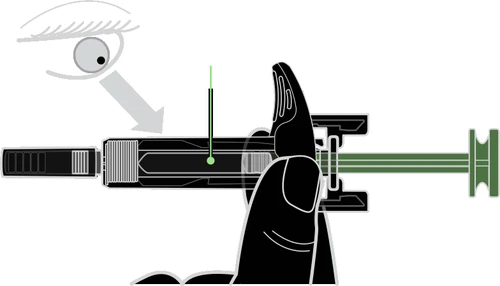
Benlysta solution
- Do not use if the solution is cloudy, discoloured, or contains particles.
3. Choose and clean the injection site
Choose the injection site
- Choose an injection site (abdomen or thigh) as shown in Figure 6.
Figure 6
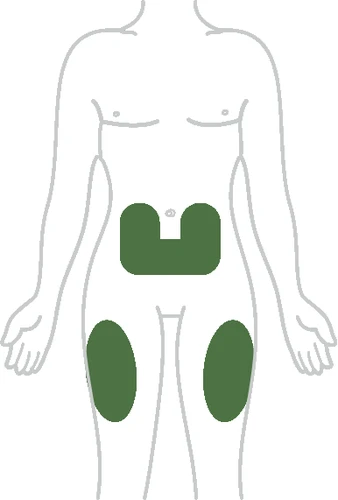
- If 2 injections are needed to complete the dose, leave at least 5 cm (2 inches) between each injection site if the same general area is chosen.
- Do not inject exactly in the same spot each time. This is to avoid skin thickening.
- Do not inject in areas where the skin is tender, bruised, red, or hardened.
- Do not inject within 5 cm (2 inches) of the navel.
Clean the injection site
- Wash your hands.
- Clean the injection site by wiping with an alcohol swab (Figure 7). Allow the skin to air dry.
Figure 7
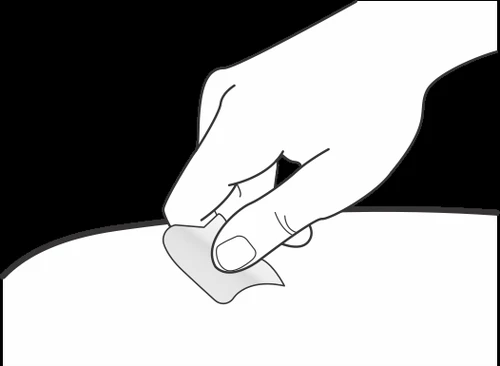
- Do not touch this area before giving the injection.
4. Preparing for the injection
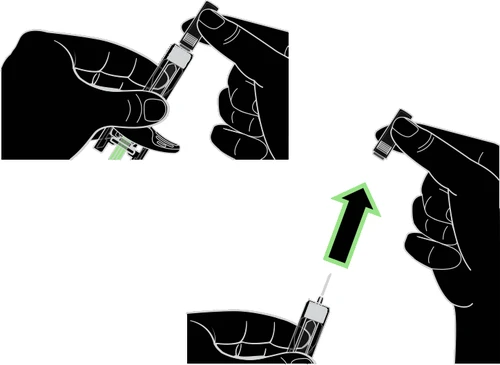
Remove the needle cap
- Do not remove the needle cap until immediately before the injection.
- Hold the pre-filled syringe by the cylindrical body with the needle pointing away from you. (Figure 8a)
- Remove the needle cap by pulling it straight off. (Figure 8b)
Figure 8
a
b
- You may see a drop of liquid at the tip of the needle. This is normal.
- Do not let the needle touch any surface.
- Do not expel any air bubbles from the syringe.
- Do not reattach the needle cap onto the syringe.
5. Inject Benlysta and inspect
Insert the needle
- Hold the syringe in one hand.
- Use your free hand to gently pinch the skin around the injection site. ( Figure 9 )
- Insert the entire needle into the pinched skin area at a slight angle (45°), using a dart-like motion.
Figure 9
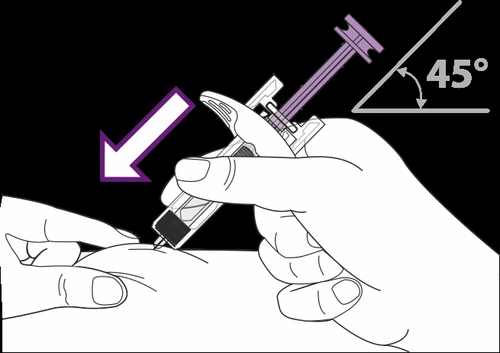
- After fully inserting the needle, release the pinched skin.
Complete the injection
- Push the plunger all the way down until all the solution has been injected. ( Figure 10 )
Figure 10
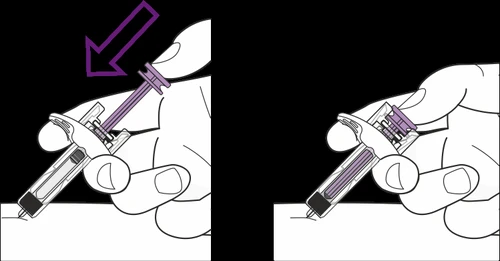
Push the plunger
all the way down
- While holding the syringe in place, slowly move your thumb backward, allowing the plunger to rise ( Figure 11 ).
- The needle will automatically retract into the needle guard.
Figure 11
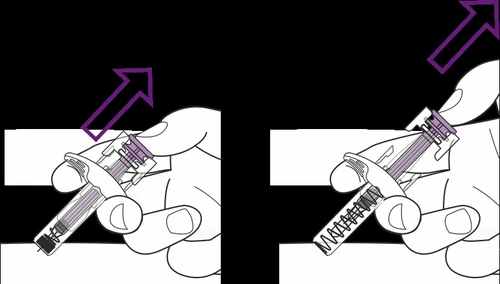
Slowly move
thumb backward
Inspect the injection site
A small amount of blood at the injection site may be present.
- If needed, press a cotton ball or gauze pad against the injection site.
- Do not rub the injection site.
6. Disposal of the used syringe
Disposal of the used syringe
- Place the used syringe and the needle cap into a leak-proof container with a lid.
- Ask your doctor or pharmacist for instructions on how to properly dispose of the used syringe or the container for used syringes.
- Do not recycle or dispose of the used syringe or the container for used syringes in household waste.
Package leaflet: Information for the user
Benlysta 120 mg powder for concentrate for solution for infusion, 400 mg powder for concentrate for solution for infusion
belimumab
This medicinal product is subject to additional monitoring. This will allow rapid identification of new safety information. You can help by reporting any side effects you experience while taking this medicine. See the end of section 4 for information on how to report side effects.
Please read this leaflet carefully before using this medicine as it contains important information for you.
- Keep this leaflet. You may need to read it again.
- If you have any questions, ask your doctor.
- If you experience any side effects, including those not listed in this leaflet, tell your doctor. See section 4.
Contents of this leaflet:
- What Benlysta is and what it is used for
- What you need to know before being given Benlysta
- How to use Benlysta
- Possible side effects
- How to store Benlysta
- Contents of the pack and other information
1. What Benlysta is and what it is used for
Benlysta for infusion is a medicine used to treat lupus (systemic lupus erythematosus, SLE)
in adults and children (aged 5 years and older) whose disease remains highly active despite
standard treatment. Benlysta is also used, in combination with other medicines, to treat adults (aged
18 years and older) with active lupus nephritis (lupus-related kidney inflammation).
Lupus is a disease in which the immune system (the system that fights infections) attacks the body's own
cells and tissues, causing inflammation and organ damage. It can affect almost any organ in the body, and
a type of white blood cells called B cells is believed to be involved.
Benlysta contains belimumab (a monoclonal antibody). This reduces the number of B cells in the blood
by blocking the action of BLyS, a protein that helps B cells live longer and which is present at elevated levels
in people with lupus.
You will be given both Benlysta and your usual lupus treatment.
2. What you should know before being given Benlysta
Do not receive Benlysta
- if you are allergic to belimumab or to any of the other ingredients of this medicine (listed in section 6)
➔ Check with your doctor if this may apply to you.
Warnings and precautions
Talk to your doctor before you are given Benlysta
- if you currently have an infection or have had a long-standing infection, or if you are prone to frequent infections (see section 4). Your doctor will decide whether Benlysta can be administered to you
- if you are planning a vaccination or have been vaccinated within the last 30 days. Some vaccines should not be given immediately before or during treatment with Benlysta
- if lupus affects the nervous system
- if you are HIV positive or have low levels of immunoglobulins
- if you have or have had hepatitis B or C
- if you have had an organ transplant or a bone marrow or stem cell transplant
- if you have had a tumour
- if you developed a severe skin rash, skin peeling, blisters, and/or mouth ulcers after using Benlysta.
➔ Inform your doctor if any of these situations apply to you
Depression and suicide
Cases of depression, suicidal thoughts, suicide attempts, and suicide have been reported during treatment with Benlysta. Inform your doctor if you have previously experienced any of these conditions. If at any time you notice the onset or worsening of symptoms:
➔ Contact your doctor or go to hospital immediately.
If you feel depressed or are thinking about harming yourself or committing suicide, it may be helpful to talk about this with a close family member or friend and ask them to read this leaflet. You may ask them to let you know if they are concerned about changes in your mood or behaviour.
Serious skin reactions
Stevens-Johnson syndrome and toxic epidermal necrolysis have been reported in association with treatment with Benlysta.
➔ Stop using Benlysta and contact a doctor immediately if you notice any of the symptoms described in section 4.
Be alert for important symptoms
People taking medicines that affect the immune system may be at increased risk of infections, including a rare but serious brain infection called progressive multifocal leukoencephalopathy (PML).
➔ Read the information “Increased risk of brain infection” in section 4 of this leaflet.
To improve traceability of this medicine, healthcare professionals should record the batch number of Benlysta in the patient’s medical file. You may also wish to note down this information in case you are asked for it in the future.
Children and adolescents
This medicine is not intended for use in:
- children under 5 years of age with SLE
- children and adolescents (under 18 years of age) with active lupus nephritis.
Other medicines and Benlysta
Inform your doctor if you are taking, have recently taken, or might take any other medicines.
In particular, inform your doctor if you are being treated with medicines that affect the immune system, including any medicine that acts on B-cells (used to treat cancers or inflammatory diseases).
Combining these medicines with Benlysta may make the immune system less effective. This may increase the risk of a serious infection.
Pregnancy and breastfeeding
Contraception for women who could become pregnant
- Use an effective method of contraception while being treated with Benlysta and for at least 4 months after the last dose.
Pregnancy
Benlysta is not usually recommended if you are pregnant.
- Inform your doctor if you are pregnant, suspect you may be pregnant, or are planning to become pregnant. Your doctor will decide whether Benlysta can be administered to you.
- If you become pregnant while being treated with Benlysta, inform your doctor.
Breastfeeding
- Inform your doctor if you are breastfeeding. Benlysta is likely to pass into breast milk. Your doctor will discuss with you whether you should stop treatment with Benlysta while breastfeeding or whether you should stop breastfeeding.
Driving and using machines
Benlysta may have side effects that could impair your ability to drive or operate machinery.
Benlysta contains polysorbate 80
Benlysta 120 mg powder for concentrate for solution for infusion: this medicine contains 0.6 mg of polysorbate 80 per vial.
Benlysta 400 mg powder for concentrate for solution for infusion: this medicine contains 2.0 mg of polysorbate 80 per vial.
Polysorbates may cause allergic reactions. Inform your doctor if you or your child have known allergies.
Benlysta contains sodium
This medicine contains less than 1 mmol (23 mg) of sodium per dose, i.e. essentially ‘sodium-free’.
However, before administration to you or your child, Benlysta is mixed with a solution containing sodium. Talk to your doctor if you or your child are on a low-sodium diet.
3. How to use Benlysta
A nurse or doctor will administer Benlysta to you into a vein as an intravenous infusion (drip) lasting one hour.
Adults and children (aged 5 years and older)
Your doctor will determine the correct dose based on your body weight. The recommended dose is 10 mg per
kilogram (kg) of body weight.
Benlysta will be given to you on the first day of treatment, then again after 14 and 28 days. After that,
Benlysta is usually administered once every 4 weeks.
Medicines given before the infusion
Your doctor may decide to give you medicines before Benlysta to help reduce any infusion reactions. These may include an antihistamine medicine and a medicine to prevent high body temperature. You will be closely monitored and if you have any reaction, it will be treated.
Discontinuation of treatment with Benlysta
Your doctor will decide whether it is necessary for you to stop treatment with Benlysta.
4. Possible side effects
Like all medicines, this medicine can cause side effects, although not everybody gets them.
Stop using Benlysta and contact a doctor immediately if you notice any of the following symptoms of a severe skin reaction:
- Reddish patches on the trunk; the patches are target-like or circular, often with blisters in the center, skin peeling, mouth, throat, nose, genital, or eye ulcers. These serious rashes may be preceded by fever and flu-like symptoms (Stevens-Johnson syndrome, toxic epidermal necrolysis). These side effects have been reported with an unknown frequency (cannot be estimated from the available data).
Allergic reactions – seek medical help immediately
Benlysta may cause an infusion reaction or an allergic reaction (hypersensitivity). These reactions are common side effects (may affect up to 1 in 10 people). They may occasionally (uncommon, may affect up to 1 in 100 people) be severe and may be life-threatening. These serious reactions are most likely to occur on the day of the first or second treatment with Benlysta, but may be delayed and occur several days later.
Contact your doctor or nurse immediately or go to the nearest hospital emergency department if you experience any of the following symptoms of an allergic or infusion-related reaction:
- Swelling of the face, lips, mouth, or tongue
- Wheezing, difficulty breathing, or shortness of breath
- Rash
- Itchy swellings or hives
Rarely, less severe adverse reactions may occur with Benlysta even later, usually 5–10 days after infusion. These include symptoms such as rash, nausea, fatigue, muscle pain, headache, and/or facial swelling.
If you experience these symptoms, especially if two or more occur together:
➔ Contact your doctor or nurse.
Infections
Benlysta may make it more likely that you will get infections, including urinary and respiratory tract infections. Younger children may be at higher risk. These are very common and may affect more than 1 in 10 people. Some infections may be severe and may result in death with uncommon frequency.
If you experience any of the following signs of infection:
- Fever and/or chills
- Cough, breathing problems
- Diarrhea, vomiting
- Burning sensation when passing urine; frequent urination
- Warm, red, painful skin or sores on the body
➔ Contact your doctor or nurse immediately.
Depression and suicide
Cases of depression, suicidal thoughts, and suicide attempts have been reported during treatment with Benlysta. Depression may affect up to 1 in 10 people, suicidal thoughts and suicide attempts may affect up to 1 in 100 people. If you feel depressed, think about harming yourself, have other distressing thoughts, or if you are depressed and notice your condition worsening or new symptoms appearing:
➔ Contact your doctor or go to hospital immediately.
Increased risk of brain infection
Medicines that weaken the immune system, such as Benlysta, may increase your risk of developing a rare but serious and potentially life-threatening brain infection called progressive multifocal leukoencephalopathy (PML).
Symptoms of PML include:
- Memory loss
- Difficulty thinking
- Difficulty speaking or walking
- Vision loss
➔ Contact your doctor immediately if you experience any of these symptoms or similar problems lasting for several days.
If you already had these symptoms before starting treatment with Benlysta:
➔ Contact your doctor immediately if you notice any change in these symptoms.
Other possible side effects
Very common side effects
These may affect more than 1 in 10 people:
- Bacterial infections (see “Infections”, above)
Common side effects
These may affect up to 1 in 10 people:
- High temperature or fever
- Itching, swellings (hives), rash
- Decrease in white blood cell count (seen in blood tests)
- Infection of the nose, throat, or stomach
- Pain in hands or feet
- Migraine
- Nausea, diarrhea
Reporting of side effects
If you experience any side effect, including those not listed in this leaflet, contact your doctor or pharmacist. You can also report side effects directly through the national reporting system listed in Annex V. By reporting side effects, you can help provide more information on the safety of this medicine.
5. How to store Benlysta
Keep this medicine out of the sight and reach of children.
Do not use this medicine after the expiry date which is stated on the label and the carton after Exp. The expiry
date refers to the last day of that month.
Store in a refrigerator (from 2 °C to 8 °C).
Do not freeze.
Keep in the original packaging to protect the medicine from light.
Unused medicine and waste material arising from this medicine must be disposed of in accordance with
local applicable regulations.
6. Contents of the pack and other information
What Benlysta contains
- The active substance is belimumab. Each 5 mL vial contains 120 mg of belimumab. Each 20 mL vial contains 400 mg of belimumab. After reconstitution, the solution contains 80 mg of belimumab per mL.
- The excipients are monohydrate citric acid (E 330), sodium citrate (E 331), sucrose and polysorbate 80 (E 433). See section 2 for further information on the content of polysorbate 80 and sodium.
Description of the appearance of Benlysta and contents of the pack
Benlysta is supplied as a white to off-white powder for solution for infusion, in a glass vial with a siliconized rubber stopper and an aluminium flip-off seal.
Each pack contains 1 vial.
Marketing Authorisation Holder
GlaxoSmithKline (Ireland) Limited
12 Riverwalk
Citywest Business Campus
Dublin 24
Ireland
For further information about this medicinal product, please contact the local representative of the Marketing Authorisation Holder:
België/Belgique/Belgien Lietuva
GlaxoSmithKline Pharmaceuticals s.a./n.v. GlaxoSmithKline Trading Services Limited
Tél/Tel: + 32 (0)10 85 52 00 Tel: + 370 80000334
България Luxembourg/Luxemburg
GlaxoSmithKline Trading Services Limited GlaxoSmithKline Pharmaceuticals s.a./n.v.
Teл.: + 359 80018205 Belgique/Belgien
Tél/Tel: + 32 (0) 10 85 52 00
Česká republika Magyarország
GlaxoSmithKline s.r.o. GlaxoSmithKline Trading Services Limited
Tel: + 420 222 001 111 Tel.: + 36 80088309
[email protected]
Danmark Malta
GlaxoSmithKline Pharma A/S GlaxoSmithKline Trading Services Limited
Tlf.: + 45 36 35 91 00 Tel: + 356 80065004
[email protected]
Deutschland Nederland
GlaxoSmithKline GmbH & Co. KG GlaxoSmithKline BV
Tel.: + 49 (0)89 36044 8701 Tel: + 31 (0)33 2081100
[email protected]
Eesti Norge
GlaxoSmithKline Trading Services Limited GlaxoSmithKline AS
Tel: + 372 8002640 Tlf: + 47 22 70 20 00
Ελλάδα Österreich
GlaxoSmithKline Μονοπρόσωπη A.E.B.E. GlaxoSmithKline Pharma GmbH
Τηλ: + 30 210 68 82 100 Tel: + 43 (0)1 97075 0
[email protected]
España Polska
GlaxoSmithKline, S.A. GSK Services Sp. z o.o.
Tel: + 34 900 202 700 Tel.: + 48 (0)22 576 9000
[email protected]
France Portugal
Laboratoire GlaxoSmithKline GlaxoSmithKline – Produtos Farmacêuticos, Lda.
Tél.: + 33 (0)1 39 17 84 44 Tel: + 351 21 412 95 00
[email protected] [email protected]
Hrvatska România
GlaxoSmithKline Trading Services Limited GlaxoSmithKline Trading Services Limited
Tel:+ 385 800787089 Tel: + 40 800672524
Ireland Slovenija
GlaxoSmithKline (Ireland) Limited GlaxoSmithKline Trading Services Limited
Tel: + 353 (0)1 4955000 Tel: + 386 80688869
Ísland Slovenská republika
Vistor ehf. GlaxoSmithKline Trading Services Limited
Sími: +354 535 7000 Tel: + 421 800500589
Italia Suomi/Finland
GlaxoSmithKline S.p.A. GlaxoSmithKline Oy
Tel: + 39 (0)45 7741111 Puh/Tel: + 358 (0)10 30 30 30
Κύπρος Sverige
GlaxoSmithKline Trading Services Limited GlaxoSmithKline AB
Τηλ: + 357 80070017 Tel: + 46 (0)8 638 93 00
[email protected]
Latvija
GlaxoSmithKline Trading Services Limited
Tel: + 371 80205045
More detailed information on this medicinal product is available on the website of the European Medicines Agency: https://www.ema.europa.eu
The following information is intended for healthcare professionals only:
Instructions for use and handling – reconstitution, dilution and administration
To improve the traceability of biological medicinal products, the name and batch number of the administered medicinal product should be clearly recorded.
1) How to reconstitute Benlysta
Reconstitution and dilution must be performed under aseptic conditions.
Allow the vial to warm to room temperature (15 °C to 25 °C) for 10–15 minutes.
For reconstitution and dilution, it is recommended to use 21–25 gauge needles when puncturing the vial stopper.
WARNING: the 5 mL and 20 mL vials are reconstituted with different volumes of diluent – see below:
120 mg vial
The single-use 120 mg vial of Benlysta is reconstituted with 1.5 mL of water for injections to achieve a final concentration of 80 mg/mL of belimumab.
400 mg vial
The single-use 400 mg vial of Benlysta is reconstituted with 4.8 mL of water for injections to achieve a final concentration of 80 mg/mL of belimumab.
| Benlysta Quantity | Vial Size | Diluent Volume | Final Concentration |
| 120 mg | 5 mL | 1.5 mL | 80 mg/mL |
| 400 mg | 20 mL | 4.8 mL | 80 mg/mL |
The stream of water for injections should be directed onto the wall of the vial to minimize foam formation. Gently rotate the vial for 60 seconds. Allow the vial to equilibrate to room temperature (from 15 °C to 25 °C) during reconstitution, gently rotating the vial for 60 seconds every 5 minutes until the powder is dissolved. Do not shake. Reconstitution is generally complete within 10–15 minutes after addition of water, but may take up to 30 minutes. Protect the reconstituted solution from direct sunlight.
If a mechanical reconstitution device is used to reconstitute Benlysta, the rotation speed must not exceed 500 rpm, and the vial should be rotated for no more than 30 minutes.
2) Before diluting Benlysta
Once reconstitution is complete, the solution should be opalescent, colourless to pale yellow, and free of particles. However, small air bubbles are expected and acceptable.
120 mg vial
After reconstitution, a volume of 1.5 mL (corresponding to 120 mg of belimumab) can be withdrawn from each 5 mL vial.
400 mg vial
After reconstitution, a volume of 5 mL (corresponding to 400 mg of belimumab) can be withdrawn from each 20 mL vial.
3) How to dilute the infusion solution
The reconstituted medicinal product is diluted to 250 mL with an injectable solution of sodium chloride 9 mg/mL (0.9%) or 4.5 mg/mL (0.45%), or with an infusion solution of Ringer's lactate. For patients weighing ≤40 kg, consideration may be given to using 100 mL infusion bags of these diluents, provided that the resulting concentration of belimumab in the infusion bag does not exceed 4 mg/mL.
5% glucose intravenous solutions are incompatible with Benlysta and must not be used.
From a 250 mL (or 100 mL) bag or vial of an injectable solution of sodium chloride 9 mg/mL (0.9%) or 4.5 mg/mL (0.45%) or Ringer's lactate infusion solution, withdraw and discard a volume equal to the volume of the reconstituted Benlysta solution required for the patient's dose. Then add the required volume of reconstituted Benlysta solution to the infusion bag or vial. Gently invert the bag or vial to mix the solution. Any unused solution remaining in the vials must be discarded.
Before administration, visually inspect the Benlysta solution for particulate matter or discoloration. Discard the solution if particulate matter or discoloration is observed.
The reconstituted solution, if not used immediately, must be protected from direct sunlight and stored refrigerated at 2 °C–8 °C.
Solutions diluted in an injectable solution of sodium chloride 9 mg/mL (0.9%) or 4.5 mg/mL (0.45%) or in Ringer's lactate infusion solution may be stored at 2 °C–8 °C or at room temperature (15 °C–25 °C).
The total time from reconstitution of Benlysta to completion of the infusion must not exceed 8 hours.
4) How to administer the diluted solution
Benlysta must be administered by intravenous infusion over a period of 1 hour.
Benlysta must not be administered by infusion through the same intravenous line as other agents.
No incompatibilities have been observed between Benlysta and polyvinylchloride or polyolefin infusion bags.