Benexol
Italy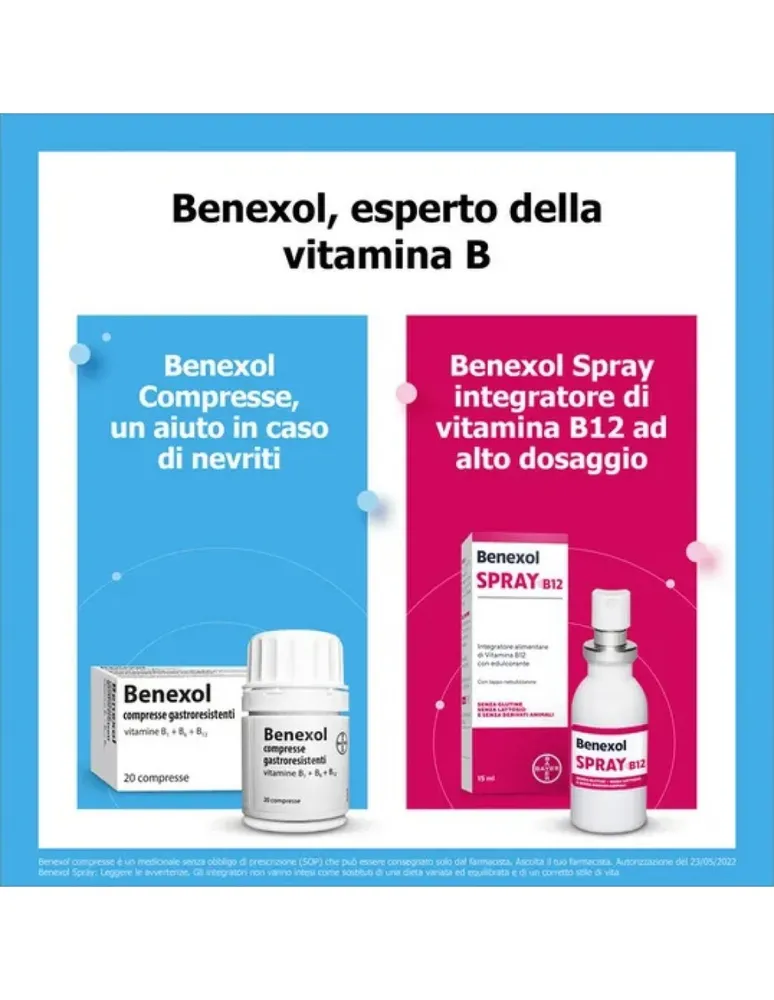
Table of Contents
- Package leaflet: Information for the patient
- Benexol gastro-resistant tablets
- 1. What Benexol tablets are and what they are used for
- 2. What you need to know before taking Benexol tablets
- 3. How to take Benexol tablets
- 4. Possible side effects
- 5. How to store Benexol tablets
- 6. Package contents and other information
Package leaflet: Information for the patient
Benexol gastro-resistant tablets
Vitamins B +B +B
Please read this entire leaflet carefully before taking this medicine because it contains important information for you.
Always take this medicine exactly as described in this leaflet or as your doctor or pharmacist has instructed you to do.
- Keep this leaflet. You may need to read it again.
- If you need more information or advice, consult your pharmacist.
- If you experience any side effects, including those not listed in this leaflet, consult your doctor or pharmacist. See section 4.
- Consult your doctor if you notice no improvement or if your symptoms worsen.
Contents of this leaflet:
- What Benexol tablets are and what they are used for
- What you need to know before taking Benexol tablets
- How to take Benexol tablets
- Possible side effects
- How to store Benexol tablets
- Contents of the pack and other information
1. What Benexol tablets are and what they are used for
Benexol tablets belong to the therapeutic category of vitamin preparations containing vitamin B₁ + B₆ + B₁₂.
This medicine is used in states of deficiency of vitamins B₁, B₆, and B₁₂ and in their various clinical manifestations: deficiency-related polyneuritis (inflammation of peripheral nerves due to vitamin deficiency), neuritis (inflammation of peripheral nerves) occurring during treatment with isoniazid (an antituberculosis agent) and other vitamin B₆ antagonists (medicines that interfere with the action of vitamin B₆).
Benexol tablets are also indicated as adjunctive therapy in non-deficiency-related neuritis (inflammation of peripheral nerves not caused by vitamin deficiency) and during radiotherapy.
Consult your doctor if you do not feel better or if you feel worse after a period of treatment.
2. What you need to know before taking Benexol tablets
Do not take Benexol tablets
- if you are allergic to vitamin B₁, B₆ or B₁₂, or to any of the other ingredients of this medicine (listed in section 6);
- if you have renal or hepatic insufficiency (reduced kidney or liver function);
- if you are pregnant or breastfeeding (see "Pregnancy and breastfeeding");
- if you are under 12 years of age (see "Children and adolescents").
Warnings and precautions
Talk to your doctor or pharmacist before taking Benexol tablets.
Do not take Benexol tablets at higher doses or for longer periods than recommended,
as overdose may lead to severe neurotoxicity (damage to the nervous system)
(risk of overdose, see "If you take more Benexol tablets than you should").
Exercise particular caution if you are concurrently taking levodopa (a medicine used to treat
Parkinson's disease), since pyridoxine (vitamin B₆) at high doses may antagonize its
therapeutic effect (see "Other medicines and Benexol tablets").
Children and adolescents
Due to the high dose of vitamin B₆, Benexol tablets must not be administered to children
and adolescents under 12 years of age (see "Do not take Benexol tablets").
Other medicines and Benexol tablets
Inform your doctor or pharmacist if you are taking, have recently taken, or might take
any other medicines.
Other medicines and Vitamin B₁ (thiamine)
Medicines that inhibit thiamine activity:
- Thiocarlide (antibiotic),
- 5-fluorouracil (anticancer agent).
Other medicines and Vitamin B₆ (pyridoxine)
Medicines that interfere with pyridoxine and may reduce its blood levels:
- Cycloserine (antibiotic),
- Hydralazine (antihypertensive),
- Isoniazid (antituberculosis agent),
- Desoxypyridoxine (vitamin B₆ antagonist),
- D-penicillamine (used in rheumatoid arthritis),
- Oral contraceptives.
Vitamin B₆ may reduce the effectiveness of the following medicines:
- Levodopa (used in Parkinson's disease): at high doses, pyridoxine may antagonize the therapeutic effect of levodopa; this interaction does not occur when carbidopa is administered together with levodopa;
- Altretamine (anticancer agent),
- Phenobarbital (antiepileptic),
- Phenytoin (antiepileptic),
- Amiodarone (a medicine used for certain types of arrhythmias, i.e. irregular heartbeats): concomitant use may increase amiodarone-induced photosensitivity (allergic reaction following exposure to sunlight).
Other medicines and Vitamin B₁₂ (cyanocobalamin)
Medicines that may reduce the absorption of vitamin B₁₂ from the gastrointestinal tract:
- Aminoglycosides (antibiotics),
- Anti-H antihistamines (antiallergic agents),
- Metformin and related biguanides (medicines used in diabetes),
- Oral contraceptives,
- Aminosalicylic acid (intestinal anti-inflammatory),
- Proton pump inhibitors (medicines used for ulcers). Therefore, if you are taking any of these medicines, your requirement for vitamin B₁₂ may be increased. Chloramphenicol (antibiotic) may delay or interrupt the reticulocyte (young red blood cells) response to vitamin B₁₂. Therefore, blood counts (haematological parameters) should be monitored during concomitant use.
Interactions with laboratory tests
If you are due to have urine or blood tests, inform your doctor or laboratory staff
that you are taking Benexol tablets.
Vitamin B₁ (thiamine)
- Thiamine may cause false positive results in urobilinogen testing using Ehrlich's reagent (a test assessing liver and bile function).
- High doses of thiamine may interfere with the spectrophotometric measurement of theophylline (an anti-asthma bronchodilator) in blood.
Vitamin B₆ (pyridoxine)
- Urobilinogen (a test assessing liver and bile function): pyridoxine may cause a false positive result in the test using Ehrlich's reagent.
Benexol tablets and alcohol
Alcohol interferes with vitamin B₆ and may reduce its blood levels.
Pregnancy, breastfeeding and fertility
If you are pregnant, think you may be pregnant, planning to become pregnant, or are breastfeeding,
please consult your doctor or pharmacist before taking this medicine.
Do not use Benexol tablets during pregnancy or while breastfeeding.
If you are a woman of childbearing potential, use effective contraceptive methods during treatment.
Driving and using machines
Benexol has no effect or a negligible effect on the ability to drive or use machinery.
Benexol contains sodium
This medicine contains less than 1 mmol (23 mg) of sodium per tablet, i.e. essentially “sodium-free”.
3. How to take Benexol tablets
Take this medicine exactly as stated in this leaflet or as directed by your doctor or pharmacist. If you have any doubts, consult your doctor or pharmacist.
The recommended dose is 1 tablet daily.
Swallow the tablets with some liquid, without chewing or dissolving them beforehand.
Take the medicine for periods of one or more weeks. If necessary, your doctor may extend the
treatment up to several months.
Use in patients with renal/hepatic impairment
Due to the high dosage of vitamin B, do not take this medicine if you suffer from renal (kidney) or
hepatic (liver) insufficiency (see "Do not take Benexol tablets").
If you take more Benexol tablets than you should
At the recommended doses, Benexol tablets do not cause hypervitaminosis (excess of vitamins).
In case of accidental overdose, contact your doctor immediately or go to the nearest hospital.
Symptoms of overdose include sensory and/or peripheral neuropathy and neuropathic syndromes
(diseases of the nervous system), nausea, headache, paresthesia (altered sensation, for example
tingling), drowsiness, increased blood levels of AST (SGOT) (liver enzymes), and decreased blood
levels of folic acid.
These effects are generally reversible upon discontinuation of treatment.
If you have any doubts about how to use this medicine, consult your doctor or pharmacist.
4. Possible side effects
Like all medicines, this medicine can cause side effects, although not everybody gets them.
The adverse reactions listed below are derived from spontaneous reports, and their frequency cannot be estimated reliably.
Effects on the gastrointestinal system
- diarrhoea,
- dyspepsia (indigestion),
- nausea,
- vomiting,
- gastrointestinal and abdominal pain (stomach ache).
Effects on the immune system
- allergic reaction and anaphylactic reaction,
- allergic reactions with manifestations including asthmatic syndrome, mild to moderate reactions affecting the skin and/or respiratory tract, gastrointestinal tract, and/or cardiovascular system. Symptoms may include oedema (swelling) of the face, dyspnoea (difficulty breathing), urticaria (itching and small skin spots), angioedema (swelling of the skin of the face and mucous membranes), pruritus (itching), and cardiorespiratory distress (severe and acute respiratory failure). If an allergic reaction occurs, stop treatment immediately and consult your doctor.
Effects on the kidneys and urinary system
- abnormal odour of urine.
Effects on the nervous system
- peripheral neuropathy and polyneuropathy,
- paraesthesia (altered sensation, for example tingling).
Effects on the skin
- photosensitivity reaction (sunburn-like),
- skin rash,
- erythema (redness),
- pruritus (itching),
- urticaria (itching and small skin spots),
- bullous dermatitis.
Reporting of side effects
If you experience any side effect, including those not listed in this leaflet, talk to your doctor or pharmacist. You can also report side effects directly through the national reporting system at https://www.aifa.gov.it/content/segnalazioni-reazioni-avverse. By reporting side effects, you can help provide more information on the safety of this medicine.
5. How to store Benexol tablets
Keep this medicine out of the sight and reach of children.
Do not use this medicine after the expiry date stated on the packaging. The expiry date refers to the last day of that month. The expiry date applies to the product in its original unopened packaging, stored correctly.
Do not store above 25 °C. Use the tablets within 3 months after opening the bottle.
Do not dispose of medicines via wastewater or household waste. Ask your pharmacist how to dispose of medicines you no longer use. This will help protect the environment.
6. Package contents and other information
What Benexol tablets contain
- The active substances are: vitamin B (thiamine hydrochloride), vitamin B (pyridoxine hydrochloride) and vitamin B (cyanocobalamin). One gastro-resistant tablet contains 250 mg of vitamin B, 250 mg of vitamin B and 500 micrograms of vitamin B.
- The other components are: hydrated colloidal silica, povidone, magnesium stearate, pregelatinized starch, mannitol, talc, methacrylic acid-ethyl acrylate copolymer (1:1), sodium carmellose, macrogol 6000, glycerol triacetate.
Description of the appearance of Benexol tablets and pack contents
Benexol is available as gastro-resistant tablets.
Plastic bottle (HDPE) closed with a polypropylene (PP) screw cap, containing silica gel
as desiccant: 20 gastro-resistant tablets.
Marketing Authorisation Holder and Manufacturer
Marketing Authorisation Holder
Bayer S.p.A. Viale Certosa 130, 20156 Milan
Manufacturer
Delpharm Gaillard - site of Gaillard (France).