Bendamustine Eg
Italy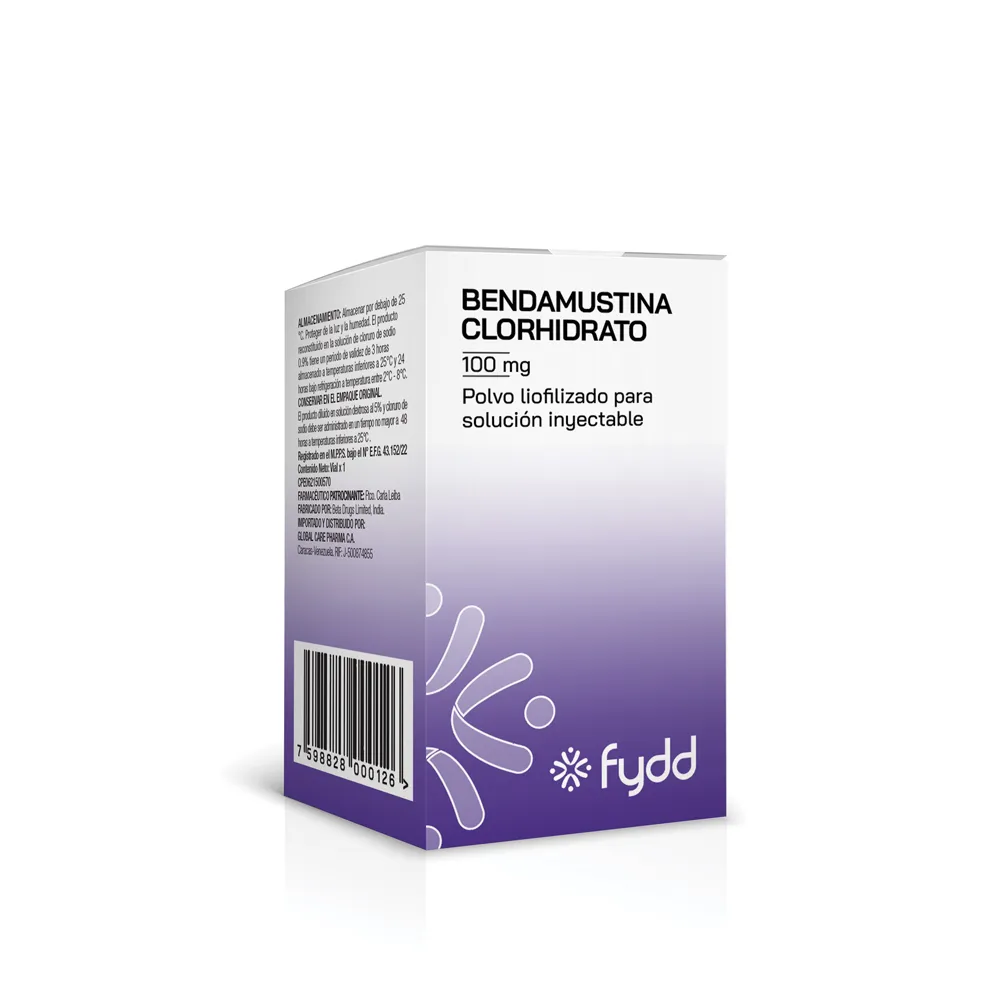
Table of Contents
Package leaflet: Information for the user
BENDAMUSTINA EG 2.5 mg/ml powder for concentrate for solution for infusion
Equivalent medicinal product
Please read this leaflet carefully before using this medicine because it contains
important information for you.
- Keep this leaflet. You may need to read it again.
- If you have any questions, ask your doctor or pharmacist.
- If you experience any adverse reactions, including those not listed in this leaflet, contact your doctor or pharmacist. See section 4.
Contents of this leaflet
- What BENDAMUSTINA EG is and what it is used for
- What you need to know before using BENDAMUSTINA EG
- How to use BENDAMUSTINA EG
- Possible side effects
- How to store BENDAMUSTINA EG
- Contents of the pack and other information
1 What BENDAMUSTINA EG is and what it is used for
Bendamustine is a medicine used to treat certain types of cancer (cytotoxic medicine).
Bendamustine is used alone (monotherapy) or in combination with other medicines to treat the following cancers:
- Chronic lymphocytic leukemia in cases where combination chemotherapy with fludarabine is not suitable for you;
- Non-Hodgkin’s lymphomas that have not responded, or responded only briefly, to prior treatment with rituximab;
- Multiple myeloma in cases where high-dose chemotherapy with autologous stem cell transplantation, thalidomide-based therapy, or bortezomib-based therapy is not suitable for you.
2 What you need to know before using BENDAMUSTINA EG
Do not use BENDAMUSTINA EG:
- If you are allergic to bendamustine hydrochloride or to any of the other ingredients of this medicine (listed in section 6);
- During breastfeeding; if treatment with BENDAMUSTINA EG is necessary during breastfeeding, you must discontinue breastfeeding (see section on warnings and precautions in breastfeeding);
- If you have severe hepatic dysfunction (damage to the functional liver cells);
- If you develop yellowing of the skin or whites of the eyes due to liver or blood problems (jaundice);
- If bone marrow function is severely impaired (bone marrow suppression), resulting in severe changes in white blood cell and platelet counts;
- If you have undergone major surgery less than 30 days before starting treatment;
- If you have an infection, particularly if associated with a reduction in white blood cells (leukopenia);
- In combination with yellow fever vaccines.
Warnings and precautions
Talk to your doctor or nurse before using BENDAMUSTINA EG
- If bone marrow capacity to replace blood cells is reduced. White blood cell and platelet counts must be monitored before starting treatment with BENDAMUSTINA EG, before each subsequent treatment cycle, and at intervals between treatment cycles;
- If you have infections. Contact your doctor if you show signs of infection, including fever and pulmonary symptoms;
- If you have heart disease (e.g., heart attack, chest pain, severely irregular heart rhythms).
Talk to your doctor or nurse during treatment with BENDAMUSTINA EG
- If you experience nausea or vomiting. Your doctor may prescribe a medicine to reduce nausea (an antiemetic);
- If you develop flank pain or notice blood in the urine or reduced urination. If your disease is very advanced, your body may be unable to eliminate all waste products from dying tumor cells. This is known as tumor lysis syndrome, which may cause kidney failure and heart problems within 48 hours after the first dose of BENDAMUSTINA EG. Your doctor will ensure you are adequately hydrated and may prescribe additional medicines to prevent this;
- If you develop skin reactions during treatment with BENDAMUSTINA EG. Skin reactions may become more severe;
- If you develop a painful red or purplish rash that spreads and forms blisters and/or other lesions starting in the mucous membranes (e.g., mouth and lips), especially if you previously had photosensitivity, respiratory tract infections (e.g., bronchitis), and/or fever;
- If you experience severe allergic or hypersensitivity reactions. Pay attention to infusion site reactions after the first treatment cycle.
An accidental injection into tissue outside the blood vessels (extravasation) must be stopped immediately. The needle should be removed after brief aspiration. The affected tissue area should then be cooled. The arm should be elevated. It is unclear whether additional treatments, such as corticosteroids, may be beneficial (see section 4).
Children and adolescents
There is no experience with bendamustine hydrochloride in children and adolescents.
Other medicines and BENDAMUSTINA EG
Tell your doctor or pharmacist if you are taking, have recently taken, or might take any other medicines, including those not requiring a prescription.
If BENDAMUSTINA EG is used in combination with medicines that suppress bone marrow blood cell formation, the effect on the bone marrow may be intensified.
If BENDAMUSTINA EG is used in combination with medicines that alter immune response, this effect may be intensified.
Cytostatic medicines may reduce the effectiveness of vaccination with live viruses. In addition, cytostatic medicines increase the risk of infection after vaccination with live vaccines (e.g., viral vaccination).
Pregnancy, breastfeeding and fertility
If you are pregnant, think you may be pregnant, planning to become pregnant, or breastfeeding, consult your doctor or pharmacist before taking this medicine.
Pregnancy
BENDAMUSTINA EG may cause genetic damage and has caused malformations in animal studies. Do not use BENDAMUSTINA EG during pregnancy unless specifically prescribed by your doctor. If treatment is required, consult a doctor due to the risk of potential adverse effects of therapy on the unborn child, and genetic counseling is recommended.
If you are a woman of childbearing potential, you must use an effective method of contraception both before and during treatment with BENDAMUSTINA EG. If you become pregnant during treatment with BENDAMUSTINA EG, you must immediately inform your doctor and seek genetic counseling.
Breastfeeding
BENDAMUSTINA EG must not be administered during breastfeeding. If treatment with BENDAMUSTINA EG is necessary during the breastfeeding period, you must discontinue breastfeeding.
Fertility
If you are a man, you must avoid fathering children during treatment with BENDAMUSTINA EG and for up to 6 months after the end of treatment. There is a risk that BENDAMUSTINA EG may cause infertility, and you may benefit from counseling on sperm preservation before starting treatment.
Driving and using machines
Bendamustine has a major influence on your ability to drive and use machines. Do not drive vehicles or operate machinery if you experience adverse effects such as dizziness or lack of coordination.
3 How to use BENDAMUSTINA EG
BENDAMUSTINA EG is administered intravenously over 30–60 minutes at various doses, either alone (monotherapy) or in combination with other medicines.
Treatment must not be initiated if the number of white blood cells (leukocytes) and/or the number of platelets has fallen below certain levels.
Your doctor will monitor these values at regular intervals.
Chronic lymphocytic leukemia
| BENDAMUSTINE EG 100 mg per square meter of body surface area (based on your height and weight) | On days 1+2 |
| Repeat the cycle after 4 weeks up to 6 times | |
Non-Hodgkin lymphomas
| BENDAMUSTINE EG 120 mg per square meter of body surface area (based on your height and weight) | On days 1+2 |
| Repeat the cycle every 3 weeks for at least 6 cycles | |
Multiple myeloma
| BENDAMUSTINE EG 120-150 mg per square meter of body surface area (based on your height and weight) | On days 1+2 |
| Prednisone 60 mg per square meter of body surface area (based on your height and weight) administered intravenously or orally. | On days 1–4 |
| Repeat the cycle after 4 weeks, at least 3 times | |
The treatment must be discontinued if white blood cell (leukocyte) and/or platelet counts fall to certain levels. Treatment may be resumed once white blood cell and platelet counts have recovered.
Impairment of renal or hepatic function
Dosage adjustment may be necessary depending on the degree of hepatic impairment (a 30% dose reduction in case of moderate hepatic dysfunction). No dose adjustment is required in case of renal impairment. Your doctor will decide whether dosage adjustment may be necessary.
How BENDAMUSTINA EG must be administered
Treatment with BENDAMUSTINA EG must be administered only by physicians experienced in cancer therapy. Your doctor will administer the exact dose of BENDAMUSTINA EG and take the necessary precautions.
Your doctor will administer the infusion solution after preparing it as directed. The solution is administered intravenously as a short infusion lasting 30–60 minutes.
Duration of treatment
As a general rule, there is no fixed time limit for treatment with BENDAMUSTINA EG. The duration of treatment depends on the disease and the response to therapy.
If you are concerned or have any doubts about treatment with BENDAMUSTINA EG, consult your doctor or nurse.
If you forget to use BENDAMUSTINA EG
If a dose of BENDAMUSTINA EG is missed, your doctor will usually maintain the normal dosing schedule.
If you stop treatment with BENDAMUSTINA EG
Your doctor will decide whether to discontinue treatment or administer a different regimen.
If you have any doubts about using this medicine, consult your doctor or pharmacist.
4. Possible side effects
Like all medicines, this medicine can cause side effects, although not everybody will experience them.
Contact your doctor or seek immediate medical help if you notice any of the following side effects (frequency not known):
- Severe skin rashes including Stevens-Johnson syndrome and toxic epidermal necrolysis. These may appear as red, target-like spots or circular patches, often with central blisters on the trunk, skin peeling, mouth, throat, nose, genital or eye ulcers, and may be preceded by fever and flu-like symptoms.
- Widespread skin rashes, high body temperature, swollen lymph nodes, and involvement of multiple organs in the body (drug reaction with eosinophilia and systemic symptoms, also known as DRESS or drug hypersensitivity syndrome).
Necrotic tissue (necrosis) has very rarely been observed following extravasation of BENDAMUSTINA EG into surrounding tissue outside the blood vessels. A burning sensation at the site where the needle was inserted may indicate extravasation. This may result in pain and skin defects due to poor healing.
The dose-limiting adverse effect of BENDAMUSTINA EG is bone marrow suppression, which usually returns to normal after treatment. Suppression of bone marrow function may lead to a reduction in blood cells, which in turn could increase the risk of infection, cause anaemia, or increase the risk of bleeding.
Very common side effects (may affect more than 1 in 10 people)
- Decrease in white blood cell count (cells in your blood that fight disease)
- Decrease in red blood pigment (haemoglobin: protein in blood cells that carries oxygen in the body)
- Reduction in platelet count (thrombocytopenia)
- Infections
- Feeling unwell (nausea)
- Vomiting
- Mucosal inflammation
- Increased creatinine levels in blood (a waste substance produced by your muscles)
- Increased blood urea levels (a waste chemical)
- Fever
- Fatigue
- Headache
Common side effects (may affect up to 1 in 10 people)
- Bleeding (haemorrhage)
- Metabolic disturbances due to release of cellular contents from dying tumour cells into the bloodstream
- Reduction in red blood cells leading to paleness, weakness or breathlessness (anaemia)
- Reduction in neutrophil count (a type of white blood cell important for fighting infections)
- Hypersensitivity reactions such as allergic skin inflammation (dermatitis), urticaria
- Increased liver enzymes AST/ALT (indicating inflammation or damage to liver cells)
- Increased alkaline phosphatase enzyme levels (an enzyme produced mainly by the liver and bones)
- Increased bile pigment levels (a substance produced following red blood cell breakdown)
- Low potassium levels in blood (a nutrient necessary for nerve and muscle cell function, including those of your heart)
- Impairment of heart function (cardiac dysfunction)
- Irregular heart rhythms (arrhythmia)
- Low or high blood pressure (hypotension or hypertension)
- Impairment of lung function
- Diarrhoea
- Constipation
- Oral ulcers (stomatitis)
- Loss of appetite
- Hair loss
- Skin changes
- Rash, itching (urticaria)
- Absence of menstruation (amenorrhoea)
- Pain
- Insomnia
- Chills
- Dehydration
- Dizziness
Uncommon side effects (may affect up to 1 in 100 people)
- Fluid accumulation in the pericardial sac (fluid leakage into the pericardial space)
- Deficiency in production of all blood cells (spongy material inside bones that produces blood cells)
- Acute leukaemia
- Heart attack, chest pain (myocardial infarction)
- Heart failure
Rare side effects (may affect up to 1 in 1,000 people)
- Blood infection (sepsis)
- Severe allergic hypersensitivity reactions (anaphylactic reactions)
- Reactions similar to anaphylaxis (anaphylactoid reactions)
- Drowsiness
- Loss of voice (aphonia)
- Acute circulatory collapse (circulatory failure primarily of cardiac origin, resulting in inability to supply oxygen and nutrients to tissues and remove toxins)
- Skin redness (erythema)
- Skin inflammation (dermatitis)
- Itching
- Skin rash (macular exanthema)
- Excessive sweating (hyperhidrosis)
- Bone marrow suppression, possibly causing malaise or detectable through blood tests
Very rare side effects (may affect up to 1 in 10,000 people)
- Atypical primary lung inflammation (pneumonia)
- Destruction of red blood cells
- Rapid drop in blood pressure sometimes associated with skin reactions or rash (anaphylactic shock)
- Changes in taste sensation
- Altered sensations (paraesthesia)
- Malaise and limb pain (peripheral neuropathy)
- Severe condition due to blockade of specific receptors in the nervous system
- Disorders of the nervous system
- Lack of coordination (ataxia)
- Inflammation of the brain (encephalitis)
- Increased heart rate (tachycardia)
- Inflammation of veins (phlebitis)
- Tissue formation in the lungs (pulmonary fibrosis)
- Inflammation of the oesophagus associated with bleeding (haemorrhagic oesophagitis)
- Bleeding from the stomach or intestine
- Infertility
- Multi-organ failure
Side effects with unknown frequency (frequency cannot be determined from available data)
- Liver failure
- Kidney failure
- Irregular and often rapid heart rate (atrial fibrillation)
- Painful red or purplish rash that spreads and forms blisters and/or other lesions, initially appearing on mucous membranes (e.g., mouth and lips), particularly if you previously had light sensitivity, respiratory tract infections (e.g., bronchitis), and/or fever
- Drug rash during combination therapy with rituximab
- Pneumonia
- Pulmonary alveolar haemorrhage
Cases of tumours (myelodysplastic syndrome, acute myeloid leukaemia, bronchial carcinoma) have been reported following treatment with bendamustine hydrochloride. A clear relationship with bendamustine hydrochloride has not been established.
Reporting of side effects
If you experience any side effect, including those not listed in this leaflet, talk to your doctor or pharmacist. You can also report side effects directly via the national reporting system at http://www.agenziafarmaco.gov.it/content/come-segnalare-una-sospetta-reazione-avversa. By reporting side effects, you can help provide more information on the safety of this medicine.
5. How to store BENDAMUSTINA EG
Keep this medicine out of the sight and reach of children.
Do not use this medicine after the expiry date stated on the packaging after
EXP. The first two digits indicate the month and the last four digits the year. The expiry date refers to the last day of that month.
Store the container in the outer carton to protect the medicine from light.
Notes regarding the stability period after opening or reconstitution of the solution
Infusion solutions prepared according to the instructions reported at the end of this leaflet remain stable for 3.5 hours in polyethylene bags at room temperature/60% relative humidity, and for 2 days when stored in a refrigerator. BENDAMUSTINA EG does not contain preservatives. Therefore, solutions must not be used beyond this time period.
It is the responsibility of the user to maintain aseptic conditions.
Do not dispose of any medicine via wastewater or household waste. Ask your pharmacist how to dispose of medicines you no longer use. This will help protect the environment.
6. Package contents and other information
What BENDAMUSTINA EG contains
- The active substance is bendamustine hydrochloride. One vial contains 25 mg of bendamustine hydrochloride. One vial contains 100 mg of bendamustine hydrochloride. After reconstitution, 1 ml of concentrate contains 2.5 mg of bendamustine hydrochloride.
- The other ingredient is mannitol.
Description of the appearance of BENDAMUSTINA EG and contents of the pack
Lyophilized powder of white to off-white colour in an amber glass vial closed with a stopper and an aluminium flip-off seal.
25 ml type I glass vials.
50 ml type I glass vials.
BENDAMUSTINA EG is available in packs containing 1, 5, 10 and 20 vials of 25 mg of bendamustine hydrochloride and 1 and 5 vials of 100 mg of bendamustine hydrochloride.
Not all pack sizes may be marketed.
Marketing Authorisation Holder and Manufacturer
Marketing Authorisation Holder:
EG S.p.A., Via Pavia 6, 20136 Milan, Italy
Manufacturers:
Synthon Hispania SL, C/ Castelló no 1, Pol. Las Salinas, Sant Boi de Llobregat,
Barcelona 08830 – Spain
Synthon, s.r.o., Brněnská 32/čp. 597 Blansko 678 01 – Czech Republic
STADA Arzneimittel AG, Stadastrasse 2 – 18, 61118 Bad Vilbel – Germany
STADApharm GmbH, Stadastraße 2-18, 61118 Bad Vilbel – Germany
This medicinal product is authorised in the European Economic Area under the following names:
Belgium Bendamustine EG 2.5 mg/ml powder for concentrate for solution for infusion
Denmark Bendamustinhydrochlorid STADA Arzneimittel AG
France BENDAMUSTINE EG 2.5 mg/ml, poudre pour solution à diluer pour perfusion
Germany Bendamustin cell pharm 2.5 mg/ml Powder for a concentrate for the preparation of an infusion solution
Italy BENDAMUSTINA EG 2.5 mg/ml powder for concentrate for solution for infusion
Luxembourg Bendamustine EG 2.5 mg/ml poudre pour solution à diluer pour perfusion
The following information is intended exclusively for physicians or healthcare professionals:
As with all similar cytotoxic substances, the most stringent safety precautions must be observed for nursing and medical personnel due to the potentially carcinogenic and genotoxic effects of this preparation.
Avoid inhalation and contact with skin and mucous membranes during handling of bendamustine (wear gloves, protective clothing, and, if possible, a face mask!). If any part of the body becomes contaminated, thoroughly clean it with soap and water, and rinse eyes with 0.9% saline (isotonic) solution. Whenever possible, it is recommended to work on special safety workbenches (laminar flow hoods), using disposable, liquid-proof absorbent pads. Contaminated materials must be treated as cytotoxic waste. Follow national guidelines regarding the disposal of cytotoxic materials! Pregnant personnel must not handle cytostatic agents.
The ready-to-use solution must be prepared by dissolving the contents of one vial of bendamustine exclusively in water for injections, as specified below:
-
Preparation of the concentrate
- One vial of Bendamustine EG containing 25 mg of bendamustine hydrochloride is first dissolved in 10 ml, agitating the solution.
- One vial of Bendamustine EG containing 100 mg of bendamustine hydrochloride is first dissolved in 40 ml, agitating the solution.
-
Preparation of the infusion solution
As soon as a clear solution is obtained (usually within 5–10 minutes), the recommended total dose of bendamustine must be immediately diluted with 0.9% saline (isotonic) solution to achieve a final volume of approximately 500 ml. Bendamustine must not be diluted with other infusion or injectable solutions. Bendamustine must not be mixed in an infusion with other substances.