Benadon
Italy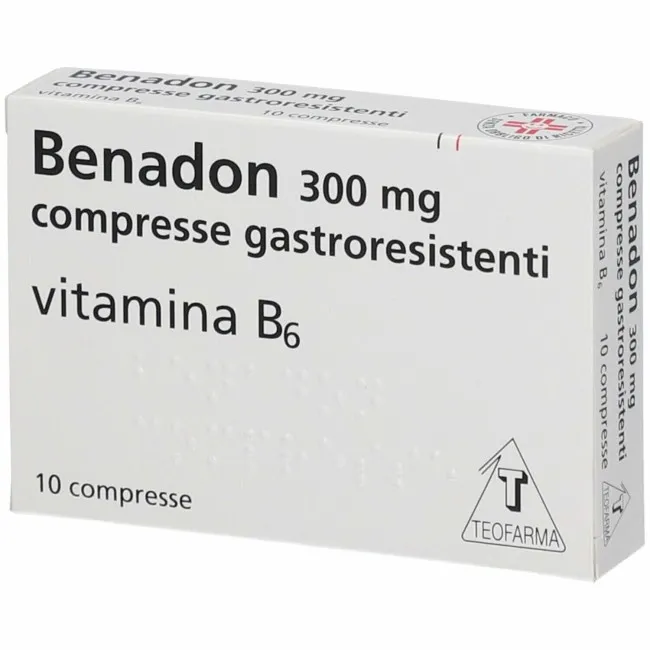
Table of Contents
Package leaflet: Information for the user
Benadon 300 mg gastro-resistant tablets
vitamin B
Please read this leaflet carefully before you take this medicine because it contains
important information for you.
Always take this medicine exactly as described in this leaflet or as your doctor or
pharmacist has told you to.
- Keep this leaflet. You may need to read it again.
- If you need more information or advice, consult your pharmacist.
- If you experience any side effects, including those not listed in this leaflet, consult your doctor or pharmacist. See section 4.
Contents of this leaflet:
- What Benadon is and what it is used for
- What you need to know before taking Benadon
- How to take Benadon
- Possible side effects
- How to store Benadon
- Contents of the pack and other information
1. What Benadon is and what it is used for
Benadon contains pyridoxine hydrochloride (vitamin B6).
Benadon belongs to the group of medicines known as vitamins.
Benadon is indicated in the following cases:
- treatment and prevention of vitamin B6 deficiency (malnutrition, alcoholism, etc.);
- treatment of anaemias responsive to vitamin B6;
- treatment and prevention of nerve inflammation (neuritis) occurring during treatment with isoniazid (a medicine for tuberculosis), hydralazine (an antihypertensive medicine for arterial hypertension), penicillamine (a medicine for rheumatoid arthritis), cycloserine (an antibiotic);
- adjunctive therapy during radiotherapy.
Consult your doctor if you do not feel better or if you feel worse.
2. What you need to know before taking Benadon
Do not take Benadon
- if you are allergic to pyridoxine hydrochloride (vitamina B(_6)) or to any of the other ingredients of this medicine (listed in section 6);
- if you are pregnant or breastfeeding;
- if you are under 12 years of age;
- if you have renal or hepatic impairment (reduced kidney or liver function).
Warnings and precautions
Talk to your doctor or pharmacist before taking Benadon.
Do not take Benadon at doses higher than those recommended, or for longer periods than advised. At daily doses of 300 mg (1 tablet) or higher, vitamin B(_6) should not be taken for longer than 5 months. After 5 months of treatment, a break of at least 25 days is required.
Failure to follow these recommendations may result in severe neurotoxicity (risk of overdose, see “If you take more Benadon than you should”).
Exercise particular caution if you have Parkinson’s disease and are concurrently being treated with L-dopa, as high-dose vitamin B(_6) may antagonize its effects (see “Other medicines and Benadon”).
Children and adolescents
This medicine must not be taken by children and adolescents under 12 years of age.
Other medicines and Benadon
Tell your doctor or pharmacist if you are taking, have recently taken, or might take any other medicines.
Several medicines interfere with vitamin B(_6) and may reduce its blood levels. These include:
- Cycloserine (an antibiotic),
- Hydralazine (an antihypertensive),
- Isoniazid (an antituberculosis agent),
- Deoxypyridoxine (a vitamin B(_6) antagonist),
- D-penicillamine (a medicine used for metabolic disorders),
- Oral contraceptives.
Vitamin B(_6) may reduce the effectiveness of the following medicines when administered concomitantly:
- L-Dopa (a medicine for Parkinson’s disease): this interaction does not occur when carbidopa is co-administered with levodopa,
- Altretamine (an antineoplastic agent),
- Phenobarbital (an antiepileptic),
- Phenytoin (an antiepileptic).
Concomitant administration of amiodarone (a medicine used for certain types of arrhythmias, i.e. irregular heartbeats) and vitamin B(_6) may enhance amiodarone-induced photosensitivity (skin allergic reaction to sunlight, resembling sunburn).
Interactions with laboratory tests
Urobilinogen: pyridoxine (vitamin B(_6)) may cause a false positive result in the Ehrlich reagent test for urobilinogen. If you are due to have this test, inform your doctor or laboratory staff that you are taking Benadon.
Benadon and alcohol
Alcohol interferes with vitamin B(_6) and may reduce its blood levels.
Pregnancy, breastfeeding and fertility
If you are pregnant, suspect you may be pregnant, are planning a pregnancy, or are breastfeeding, consult your doctor or pharmacist before taking this medicine.
Due to the high dose of vitamin B(_6), which greatly exceeds the recommended dietary intake, Benadon is contraindicated during pregnancy and breastfeeding.
If you are a woman of childbearing potential, use effective contraceptive methods during treatment.
3. How to take Benadon
Take this medicine exactly as stated in this leaflet or as directed by your doctor or pharmacist. If you are unsure, consult your doctor or pharmacist.
The recommended dose is: 300 mg daily (1 tablet), taken orally, following your doctor's instructions.
Swallow the tablet with a sufficient amount of water, without chewing it.
In seizures and anemias responsive to vitamin B_, higher doses may be required (600 mg daily or more, i.e. 2 tablets or more).
At daily doses of 300 mg (1 tablet) or higher, vitamin B_ should not be taken for longer than 5 months. After 5 months of treatment, a break of at least 25 days is required.
Use in children and adolescents
This medicine must not be taken by children and adolescents under 12 years of age.
Use in patients with renal or hepatic impairment (reduced kidney or liver function)
Due to the high dosage of vitamin B_, which greatly exceeds the recommended dietary intake, do not take Benadon if you suffer from renal or hepatic impairment (see "Do not take Benadon").
If you take more Benadon than you should
If you accidentally take an excessive dose of Benadon, inform your doctor immediately or go to the nearest hospital.
Symptoms of vitamin B_ overdose may include: sensory and/or peripheral neuropathy (nerve damage), neuronopathy (degeneration of nerve cells), nausea, headache, paresthesia (altered sensation in limbs or other body parts, e.g. tingling), drowsiness, increased AST (SGOT) (a liver enzyme), and decreased blood folate concentrations.
These effects usually resolve upon discontinuation of the medicine.
If you have any doubts about how to use this medicine, consult your doctor or pharmacist.
4. Possible side effects
Like all medicines, this medicine can cause side effects, although not everyone experiences them.
The following adverse reactions have been observed with the use of Benadon, based on spontaneous reports. Since these reactions are reported on a voluntary basis, it is not possible to estimate their frequency.
Gastrointestinal disorders
- nausea,
- vomiting.
Immune system disorders
- allergic reactions (in predisposed individuals).
Nervous system disorders
- peripheral neuropathy (a disease affecting the peripheral nerves) and polyneuropathy (a disease simultaneously affecting multiple peripheral nerves),
- paresthesia (altered sensation in limbs or other body parts, e.g., tingling).
Skin reactions
- photosensitivity reactions (allergic skin reactions to sunlight, such as sunburn-like effects),
- skin rash,
- pruritus,
- urticaria (itching and small skin spots),
- bullous dermatitis.
Reporting of side effects
If you experience any side effect, including those not listed in this leaflet, please contact your doctor or pharmacist. You may also report side effects directly via the website: http://www.agenziafarmaco.gov.it/it/responsabili.
By reporting side effects, you can help provide further information on the safety of this medicine.
5. How to store Benadon
Keep this medicine out of the sight and reach of children.
Do not use this medicine after the expiry date stated on the carton and blister pack. The expiry date refers to the last day of that month. The expiry date applies to the product in its original, unopened packaging, correctly stored.
Do not dispose of any medicine via wastewater or household waste. Ask your pharmacist how to dispose of medicines you no longer use. This will help protect the environment.
6. Package contents and other information
What Benadon contains
- The active substance is pyridoxine hydrochloride (vitamin B ). One gastro-resistant tablet contains 300 mg of pyridoxine hydrochloride.
- The other components are: povidone K90, talc, magnesium stearate, methacrylic acid - ethyl acrylate copolymer (1:1), sodium carmellose, macrogol 6000.
Description of the appearance of Benadon and contents of the pack
Benadon 300 mg gastro-resistant tablets: 10 tablets.
Marketing Authorization Holder
TEOFARMA SRL
VIA FRATELLI CERVI, 8
27010 VALLE SALIMBENE- PAVIA (PV)
Manufacturer
Delpharm Gaillard – Gaillard manufacturing site - France
or
GP Grenzach Produktions GmbH - Grenzach Wyhlen - Germany