BecoZym
Italy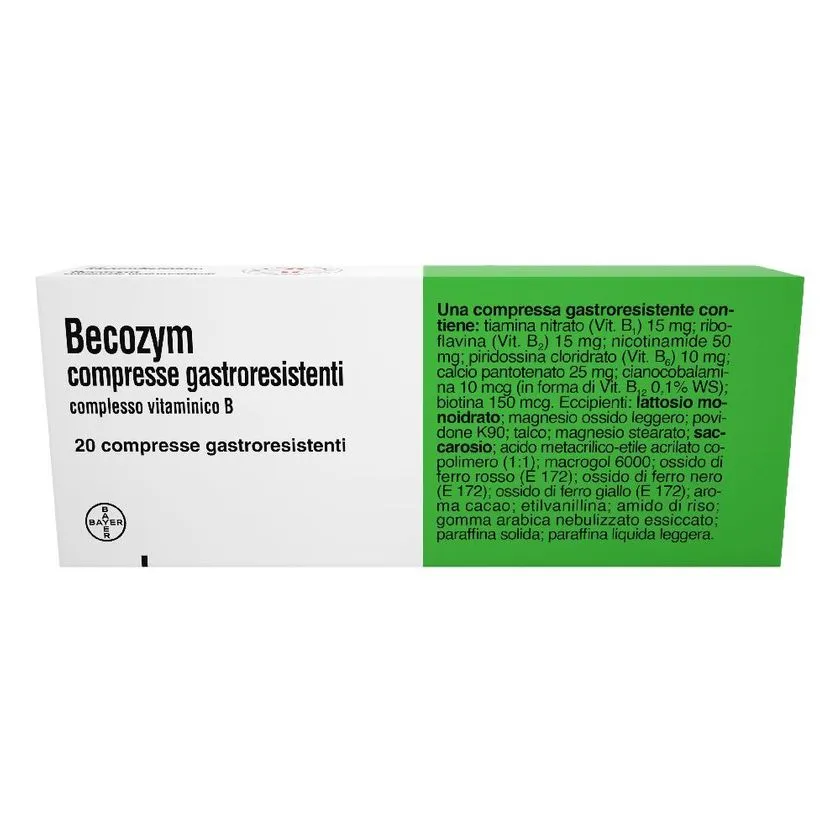
Table of Contents
Package leaflet: Information for the user
Becozym gastro-resistant tablets
Read this leaflet carefully before taking this medicine because it contains important information for you.
Always take this medicine exactly as described in this leaflet or as your doctor or pharmacist has instructed you.
- Keep this leaflet. You may need to read it again.
- If you need more information or advice, consult your pharmacist.
- If you experience any side effects, including those not listed in this leaflet, contact your doctor or pharmacist. See section 4.
Contents of this leaflet:
- What Becozym is and what it is used for
- What you need to know before taking Becozym
- How to take Becozym
- Possible side effects
- How to store Becozym
- Contents of the pack and other information
1. What Becozym is and what it is used for
Becozym belongs to the therapeutic category of vitamin preparations based on vitamin B complex.
Becozym is used to prevent vitamin B deficiency:
- in cases of increased requirement for vitamin B (e.g. during pregnancy or breastfeeding),
- in cases of insufficient absorption of vitamin B (digestive disorders),
- in cases of unbalanced nutrition (monotonous diets),
It is also used in the treatment of:
- glossitis (inflammation of the tongue),
- cheilitis (inflammation of the lips),
- anorexia – loss of appetite – (e.g. during febrile illnesses) associated with weight loss,
- delayed growth in children,
- asthenia (weakness),
- during prolonged antibiotic therapy,
- intestinal malabsorption occurring in gastroenteric disorders,
- as an adjunct in hepatopathies (liver diseases) and neuritis (nerve inflammation, accompanied by pain and numbness),
- treatment of sequelae of chronic alcoholism attributable to vitamin deficiency.
2. What you should know before taking Becozym
Do not take Becozym
- if you are allergic to the active substance or to any of the other ingredients of this medicine (listed in section 6).
Warnings and precautions
Talk to your doctor or pharmacist before taking Becozym.
Do not exceed the recommended doses, as overdosing may increase the risk of adverse effects. Pay particular attention to intake of the same vitamins from all other possible sources, including fortified foods, dietary supplements, and concomitant medicines (see section 3).
Becozym should be used for the treatment of vitamin B deficiency only when it is of dietary origin, and not in patients with atrophic gastritis (inflammation of the stomach mucosa), ileal (intestinal) disorders or pancreatic disorders, or gastrointestinal malabsorption of vitamin B or intrinsic factor deficiency (a substance produced by the stomach essential for vitamin B absorption).
Yellow discoloration of urine after administration of Becozym is due to vitamin B2 (riboflavin).
Patients with severe renal impairment should consult their doctor before taking Becozym, as dose adjustment may be necessary.
Particular care should be taken regarding the daily dose of vitamin B6.
Inform your doctor if you are taking Becozym and need to undergo laboratory diagnostic tests, because Vitamin B1 and Vitamin B6 contained in the medicine may interfere with the laboratory test for urinary urobilinogen determination.
Becozym contains 150 \μg of biotin per tablet. If you are scheduled for laboratory tests, you must inform your doctor or laboratory personnel that you are taking or have recently taken Becozym, because biotin may affect the results of such tests. Depending on the test used, results may be falsely elevated or falsely decreased due to biotin. Your doctor may ask you to stop taking Becozym before undergoing laboratory tests. You should also be aware that other products you may be taking, such as multivitamin complexes or supplements for hair, skin, and nails, may contain biotin and affect laboratory test results. Inform your doctor or laboratory personnel if you are taking such products.
Other medicines and Becozym
Inform your doctor or pharmacist if you are taking, have recently taken, or might take any other medicines.
Patients receiving other mono- or multivitamin preparations, any other medication, or who are on a restricted diet or under medical treatment, should consult a doctor before taking this medicine.
Potential interactions have been reported with the following medicines:
- Levodopa (a medicine used to treat Parkinson's disease); this interaction is due to the presence of Vitamin B6 in the medicine. However, this interaction does not occur when levodopa is used in combination with carbidopa (a medicine used together with levodopa for the treatment of Parkinson's disease);
- Chloramphenicol (an antibiotic); this interaction is due to the presence of Vitamin B12 in the medicine.
Pregnancy and breastfeeding
If you are pregnant, think you might be pregnant, planning a pregnancy, or breastfeeding, consult your doctor or pharmacist before taking this medicine.
Becozym should be administered during pregnancy and breastfeeding only when clinically indicated and recommended by a doctor.
The recommended dose must not be exceeded, as chronic overdosing could be harmful to the fetus or newborn.
Particular attention should be paid to concomitant intake of vitamins from all other sources.
The vitamins contained in this medicine are excreted in breast milk. This should be taken into consideration.
Becozym contains lactose and sucrose
This medicine contains lactose and sucrose.
If your doctor has diagnosed you with an intolerance to certain sugars, contact him or her before taking this medicine.
3. How to take Becozym
Take this medicine exactly as stated in this leaflet or as directed by your doctor or pharmacist. If you have any doubts, consult your doctor or pharmacist.
The recommended dose is:
Adults and children over 12 years of age:
For therapeutic use: 2–3 gastro-resistant tablets per day.
During antibacterial treatments: as preventive treatment, 1 gastro-resistant tablet per day.
For oral use. Swallow the gastro-resistant tablets whole, without chewing, with some liquid.
Use in children
Becozym is not recommended for children under 12 years of age.
If you take more Becozym than you should
When used correctly, this product does not lead to overdose.
When taking Becozym, you should pay attention to the concomitant intake of vitamins from all other sources.
Common manifestations of overdose may include: confusion and gastrointestinal disturbances such as constipation, diarrhoea, nausea, and vomiting.
If these symptoms occur, stop treatment and consult a doctor.
An acute or prolonged overdose of Becozym (e.g. taking up to 10 times the recommended dose) may cause specific toxic effects associated with Vitamin B6.
The clinical signs, symptoms, diagnostic findings, and consequences of an overdose vary widely and depend on individual susceptibility and the circumstances of the case.
Daily administration of more than 200 mg of vitamin B6 (pyridoxine) (corresponding to more than 20 tablets of Becozym per day) over several months or years may lead to symptoms of neuropathy (a disease of the nervous system). If such symptoms occur, discontinue treatment and consult a doctor.
In case of accidental ingestion of an excessive dose of Becozym, inform a doctor immediately or go to the nearest hospital.
If you have any doubts about how to use this medicine, consult your doctor or pharmacist.
4. Possible side effects
Like all medicines, this medicine can cause side effects, although not everyone will experience them.
The adverse reactions listed below are based on spontaneous reports, and therefore it is not possible to estimate their frequency.
Gastrointestinal disorders
Gastrointestinal and abdominal pain, constipation, vomiting, diarrhoea, nausea.
Immune system disorders
Allergic reactions, anaphylactic reaction (a severe and potentially life-threatening allergic reaction), anaphylactic shock (a particularly severe and potentially life-threatening allergic reaction).
Allergic reactions include asthmatic syndrome, mild to moderate reactions affecting the skin, respiratory tract, gastrointestinal tract and/or cardiovascular system. Symptoms may include skin rash, urticaria, facial oedema (fluid accumulation), erythema (skin redness), pruritus, wheezing, cardio-respiratory distress (difficulty breathing and rapid heartbeat), and severe reactions including anaphylactic shock (a severe allergic reaction typically presenting with itchy rash, swelling of the throat, breathing difficulties, and drop in blood pressure). If an allergic reaction occurs, stop treatment and consult a doctor immediately.
Nervous system disorders
Headache.
Renal and urinary disorders
Chromaturia (discoloration of urine).
Following the instructions provided in this leaflet reduces the risk of side effects.
Reporting of side effects
If you experience any side effect, including those not listed in this leaflet, talk to your doctor or pharmacist. You can also report side effects directly via the national reporting system at:
https://www.aifa.gov.it/content/segnalazioni-reazioni-avverse
By reporting side effects, you can help provide more information on the safety of this medicine.
5. How to store Becozym
Keep this medicine out of the sight and reach of children.
Do not use this medicine after the expiry date stated on the packaging. The expiry date refers to the last day of that month.
Do not store above 30 °C.
Do not dispose of any medicine via wastewater or household waste. Ask your pharmacist how to dispose of medicines no longer in use. This will help protect the environment.
6. Package contents and other information
What Becozym contains
- The active substances are: thiamine nitrate (Vit. B), riboflavin (Vit. B2), nicotinamide, pyridoxine hydrochloride (Vit. B6), calcium pantothenate, cyanocobalamin (Vit. B12), biotin. One gastro-resistant tablet contains: thiamine nitrate (Vit. B) 15 mg, riboflavin (Vit. B2) 15 mg, nicotinamide 50 mg, pyridoxine hydrochloride (Vit. B6) 10 mg, calcium pantothenate 25 mg, cyanocobalamin 10 mcg (Vit. B12), biotin 150 mcg.
- The other components are: lactose monohydrate, light magnesium oxide, povidone K90, talc, magnesium stearate, sucrose, methacrylic acid-ethyl acrylate copolymer (1:1), macrogol 6000, red iron oxide (E 172), black iron oxide (E 172), yellow iron oxide (E 172), cocoa flavour, ethyl vanillin, rice starch, glycolated montan wax.
Description of the appearance of Becozym and contents of the pack
Becozym gastro-resistant tablets: 20 gastro-resistant tablets.
Marketing Authorization Holder and Manufacturer
Marketing Authorization Holder
Bayer S.p.A., Viale Certosa 130, 20156 Milan, Italy.
Manufacturer
Dragenopharm Apotheker Puschl, GmbH, Tittmoning (Germany)