Augtyro
Italy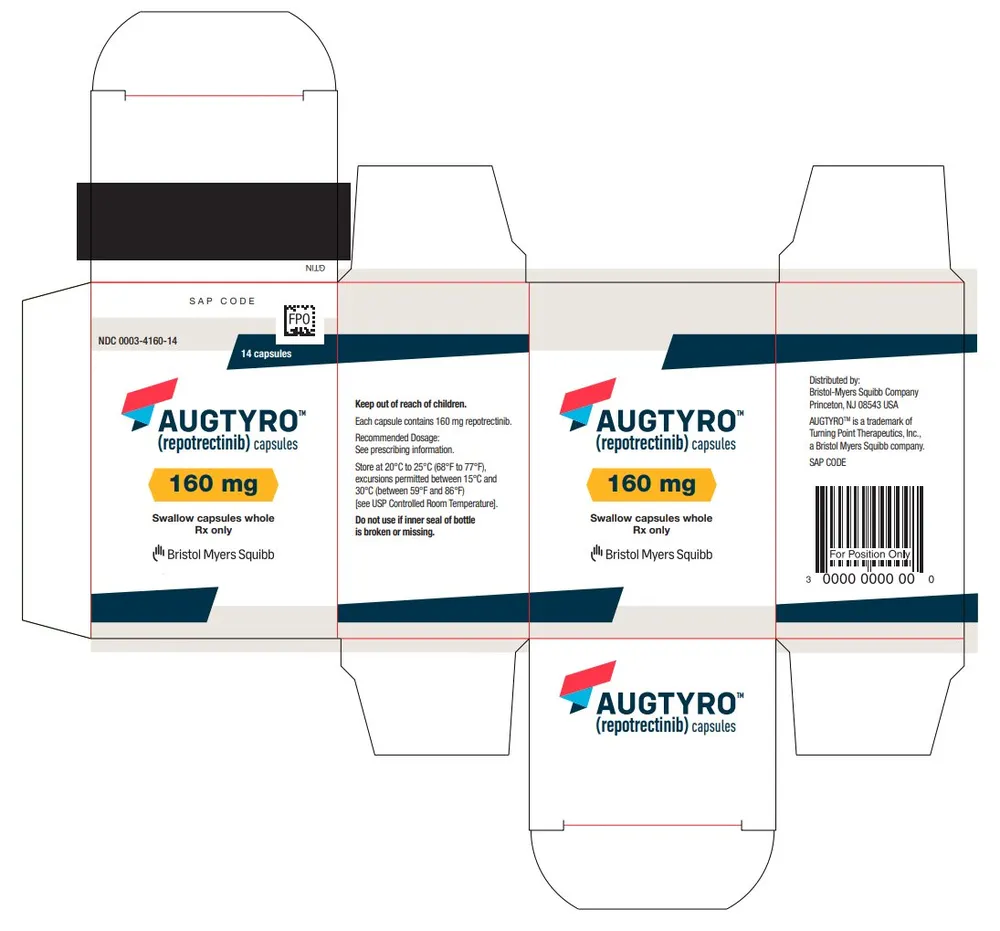
Table of Contents
Patient Information Leaflet
AUGTYRO 40 mg hard capsules, 160 mg hard capsules
repotrectinib
This medicinal product is subject to additional monitoring. This will allow for rapid identification of
new safety information. You can help by reporting any side effects you experience while taking this
medicinal product. See the end of section 4 for information on how to report side effects.
Please read this leaflet carefully before taking this medicine, as it contains important
information for you.
- Keep this leaflet. You may need to read it again.
- If you have any questions, ask your doctor, pharmacist, or nurse.
- This medicine has been prescribed for you only. Do not give it to others, even if their symptoms are the same as yours, as it could be harmful.
- If you experience any side effect, including those not listed in this leaflet, contact your doctor, pharmacist, or nurse. See section 4.
Contents of this leaflet
- What AUGTYRO is and what it is used for
- What you need to know before taking AUGTYRO
- How to take AUGTYRO
- Possible side effects
- How to store AUGTYRO
- Contents of the pack and other information
1. What AUGTYRO is and what it is used for
What AUGTYRO is
AUGTYRO is an anticancer medicine that contains the active substance repotrectinib.
What AUGTYRO is used for
AUGTYRO is used to treat:
- adults with a type of lung cancer called "non-small cell lung cancer" (NSCLC) caused by an alteration in the ROS1 gene, or
- adults and children aged 12 years and older with solid tumour (cancer) in various parts of the body caused by an alteration in the NTRK gene.
ROS1-positive non-small cell lung cancer
AUGTYRO is used when:
- a test has shown that tumour cells have an alteration in a gene called "ROS1" (see "How AUGTYRO works" below), and
- the cancer is advanced, for example, it has spread to other parts of the body (metastatic).
NTRK gene fusion-positive solid tumour
AUGTYRO is used when:
-
a test has shown that tumour cells have an alteration in a gene called "NTRK" and the tumour has spread within the affected organ or to other organs of the body, or
-
surgery to remove the cancer would likely result in severe complications (see "How AUGTYRO works" below), and
-
you have previously received treatment with medicines called NTRK inhibitors, or
-
you have not received treatment with medicines called NTRK inhibitors and other treatments are not suitable for you.
How AUGTYRO works
AUGTYRO works by blocking the action of proteins that function abnormally due to alterations in the NTRK or ROS1 genes that produce them. These abnormal proteins can cause uncontrolled growth of tumour cells. By blocking these abnormal proteins, AUGTYRO can slow down or stop the growth of tumour cells and help reduce the cancer.
2. What you must know before taking AUGTYRO
Do not take AUGTYRO
- if you are allergic to repotrectinib or to any of the other ingredients of this medicine (listed in section 6). If in doubt, consult your doctor, pharmacist, or nurse before taking AUGTYRO.
Warnings and precautions
Consult your doctor, pharmacist, or nurse before taking AUGTYRO if
- you have recently experienced dizziness, memory loss, confusion, hallucinations, changes in mental status, loss of muscle coordination, or unsteady or unstable gait
- you have had other lung problems. Inform your doctor immediately if you develop new or worsening symptoms such as shortness of breath, cough, or fever
- you have a history of bone fractures or a condition that may increase the risk of bone fractures
- you have liver problems.
Other medicines and AUGTYRO
Inform your doctor or pharmacist if you are taking, have recently taken, or might take any other medicines.
In particular, inform your doctor or pharmacist if you are taking any of the following medicines for:
- acquired immunodeficiency syndrome (AIDS)/human immunodeficiency virus (HIV) infection, such as ritonavir, saquinavir, efavirenz
- fungal infections (antifungals), such as ketoconazole, itraconazole, voriconazole, posaconazole
- preventing seizures or epileptic fits (antiepileptics), such as carbamazepine or phenytoin
- tuberculosis, such as rifampicin
- depression, such as bupropion, fluvoxamine, or the herbal remedy: St John's wort ( Hypericum perforatum )
- tumours, such as apalutamide, everolimus
- suppressing the body's immune system or preventing the body from rejecting an organ transplant, such as sirolimus, tacrolimus, cyclosporine, sulfasalazine
- inflamed joints or autoimmune joint disease (rheumatoid arthritis), methotrexate
- severe pain, such as alfentanil, fentanyl
- high blood pressure, such as verapamil, nifedipine, felodipine, valsartan
- lowering cholesterol in the blood, such as lovastatin, simvastatin, rosuvastatin
- reducing blood sugar levels, such as repaglinide, tolbutamide, metformin
- acid reflux (heartburn), such as cisapride, omeprazole
- preventing blood clots, such as warfarin, dabigatran etexilate
- heart problems, such as digoxin, edoxaban
- allergies, such as fexofenadine
- birth control: if you are using oral hormonal contraceptives, you must also use a reliable barrier method of contraception (see "Pregnancy and breastfeeding").
AUGTYRO with food and drinks
Do not drink grapefruit juice or eat grapefruits or Seville oranges during treatment with AUGTYRO, as they may increase the amount of the medicine in your blood to a harmful level.
Pregnancy and breastfeeding
Women and contraception
You must avoid becoming pregnant during treatment with this medicine, as it may harm the unborn child. If you are of childbearing age, you must use highly effective methods of contraception during treatment and for at least 2 months after stopping treatment.
It is not known whether AUGTYRO may reduce the effectiveness of contraceptive medicines (oral pills or implanted hormonal contraceptives). If you use a hormonal contraceptive method, you must also use an additional reliable non-hormonal contraceptive method, such as a barrier method (e.g., condom), to avoid pregnancy while taking AUGTYRO and for 2 months after stopping treatment.
Consult your doctor to determine which contraceptive methods are suitable for you and your partner.
Men and contraception
Your partner must avoid becoming pregnant during treatment with this medicine, as it may harm the unborn child. If your partner is of childbearing age, you must use a condom during treatment and for at least 4 months after stopping treatment.
Consult your doctor to determine which contraceptive methods are suitable for you and your partner.
Pregnancy
- Do not take AUGTYRO if you are pregnant, as it may harm the unborn child.
- If you are a woman of childbearing age, your doctor will perform a pregnancy test before starting treatment with AUGTYRO.
- If you become pregnant while taking this medicine or within 2 months after the last dose, inform your doctor immediately.
Breastfeeding
Do not breastfeed during treatment with this medicine, as it is not known whether AUGTYRO may pass into breast milk and therefore harm the child.
Driving and using machines
AUGTYRO may affect your ability to drive vehicles or operate machinery. AUGTYRO may cause:
- dizziness
- impaired balance or coordination
- fainting (loss of consciousness)
- fatigue
- changes in mental status, confusion, or seeing things that are not there (hallucinations)
- blurred vision. If any of these conditions occur, you must not drive, ride a bicycle, or use machinery until symptoms resolve. Consult your doctor or pharmacist to determine whether you can drive, ride a bicycle, or use machinery.
AUGTYRO contains sodium
AUGTYRO contains less than 1 mmol (23 mg) of sodium per capsule, i.e., essentially "sodium-free".
3. How to take AUGTYRO
Take this medicine exactly as instructed by your doctor or pharmacist. If you
have any doubts, consult your doctor or pharmacist.
What dose to take
The recommended dose is 160 mg once daily for the first 14 days, followed by 160 mg twice
daily for as long as your doctor considers necessary.
Depending on your response to treatment, your doctor may recommend a lower dose or even a brief
interruption of treatment. For lower doses, you may need to take a 120 mg dose (three 40 mg capsules) or an 80 mg dose (two 40 mg capsules).
Always take this medicine exactly as described in this leaflet or as instructed by your doctor, pharmacist, or nurse. If you have any doubts, consult your doctor, pharmacist, or nurse.
How to take AUGTYRO
Take AUGTYRO by mouth, with or without food. Swallow each capsule whole. Capsules must not be opened, crushed, or chewed, and their contents must not be dissolved.
If you take more AUGTYRO than you should
If you take more AUGTYRO than you should, contact your doctor or go to hospital immediately.
Take the medicine pack and this leaflet with you.
If you forget to take AUGTYRO
If you miss a dose or vomit after taking a dose, take the next dose as prescribed. Do not take a double dose to make up for the missed dose.
If you stop taking AUGTYRO
Do not stop taking this medicine without first talking to your doctor. It is important to take AUGTYRO every day for the full duration prescribed by your doctor. If you have any questions about how to use this medicine, consult your doctor, pharmacist, or nurse.
4. Possible side effects
Like all medicines, this medicine can cause side effects, although not everyone will experience them.
Serious side effects
Contact your doctor immediately if you notice any of the following after taking AUGTYRO:
- you feel dizzy, confused, have mood changes, hallucinations (seeing things that are not real), memory problems (cognitive disorders), or loss of muscle coordination, or you walk in an uncoordinated or unstable manner (ataxia)
- you experience shortness of breath (dyspnoea), cough, fever (pyrexia), or lung disorders causing scarring in the lungs
- you notice any joint pain, bone pain, deformities, or changes in mobility, as these may be signs of fractures.
Your doctor may reduce the dose, temporarily suspend treatment, or stop it completely.
Other side effects
Adults
Very common side effects (may affect more than 1 in 10 people):
- lung infection
- decrease in the number of healthy red blood cells that carry oxygen throughout the body (anaemia)
- dizziness
- loss of muscle coordination, unsteady walking (ataxia)
- significant changes in thinking patterns (cognitive disorders)
- sensations of numbness and tingling (paraesthesia)
- inflammation (swelling and redness) or degeneration of peripheral nerves (nerves outside the brain and spinal cord), leading to numbness, tingling, or burning (peripheral sensory neuropathy)
- sleep disturbances
- headache
- altered taste (dysgeusia)
- seeing flashes of light, blurred vision, sensitivity to light, floating spots, or double vision (vision disorders)
- shortness of breath
- cough
- feeling the need to vomit (nausea)
- vomiting
- constipation
- diarrhoea
- muscle weakness
- pain in legs and/or arms
- joint pain (arthralgia)
- muscle pain (myalgia)
- back pain
- fever
- feeling tired (fatigue)
- reduced appetite
- swelling of ankles, feet, and hands
- increased blood levels of the muscle enzyme (creatine phosphokinase)
- weight gain
- increased blood levels of the liver enzymes aspartate aminotransferase or alanine aminotransferase
Common side effects (may affect up to 1 in 10 people):
- increased blood levels of the enzyme (uric acid) (hyperuricaemia)
- inflammation and disorders causing scarring in the lungs
- fluid around the lungs (pleural effusion)
- abdominal pain
- bone fractures
- increased blood levels of the liver enzymes gamma-glutamyl transferase or alkaline phosphatase
- decrease in the number of a type of white blood cells called lymphocytes
- decrease in white blood cell count
- decrease in the number of a type of white blood cells called neutrophils
- falls
Patients aged 18 years and younger
Very common side effects (may affect more than 1 in 10 people):
- decrease in the number of healthy red blood cells that carry oxygen throughout the body (anaemia)
- increased appetite
- high levels of potassium in the blood
- increased blood levels of the enzyme (uric acid) (hyperuricaemia)
- dizziness
- loss of muscle coordination, unsteady walking (ataxia)
- significant changes in thinking patterns (cognitive disorders)
- sensations of numbness and tingling (paraesthesia)
- sleep disturbances
- headache
- altered taste (dysgeusia)
- seeing flashes of light, blurred vision, sensitivity to light, floating spots, or double vision (vision disorders)
- shortness of breath
- cough
- feeling the need to vomit (nausea)
- vomiting
- constipation
- diarrhoea
- abdominal pain
- bone fractures
- joint pain (arthralgia)
- fever
- feeling tired (fatigue)
- increased blood levels of the muscle enzyme (creatine phosphokinase)
- weight gain
- decrease in the number of white blood cells called lymphocytes
- decrease in the number of a type of white blood cells
- decrease in the number of a type of white blood cells called neutrophils
- increased blood levels of the liver enzymes aspartate aminotransferase or alkaline phosphatase
Common side effects (may affect up to 1 in 10 people):
- lung infection
- inflammation (swelling and redness) or degeneration of peripheral nerves (nerves outside the brain and spinal cord), leading to numbness, tingling, or burning (peripheral sensory neuropathy)
- fluid around the lungs (pleural effusion)
- sensations of numbness and tingling in the lips, tongue, or entire mouth (oral paraesthesia), muscle pain (myalgia)
- muscle weakness
- falls
Reporting of side effects
If you experience any side effect, including those not listed in this leaflet, talk to your doctor, pharmacist, or nurse. You can also report side effects directly through the national reporting system referred to in Annex V. By reporting side effects, you can help provide more information on the safety of this medicine.
5. How to store AUGTYRO
Keep this medicine out of the sight and reach of children.
Do not use this medicine after the expiry date stated on the carton, vial or blister after Exp. The expiry date refers to the last day of that month.
This medicine does not require any special storage conditions.
Do not dispose of any medicine via wastewater or household waste. Ask your pharmacist how to dispose of medicines you no longer use. This will help protect the environment.
6. Package contents and other information
What AUGTYRO contains
The active substance is repotrectinib.
AUGTYRO 40 mg: each capsule contains 40 mg of repotrectinib.
AUGTYRO 160 mg: each capsule contains 160 mg of repotrectinib.
The other components are:
- Capsule contents: microcrystalline cellulose, sodium lauryl sulfate, sodium croscarmellose, anhydrous colloidal silica, and magnesium stearate (only in 160 mg hard capsules) (see section 2).
- Capsule shell: gelatin, titanium dioxide (E171), brilliant blue (E133, only in 160 mg hard capsules).
- Printing ink (40 mg hard capsules): shellac (E904) and aluminium lake containing indigo carmine (E132).
- Printing ink (160 mg hard capsules): shellac and titanium dioxide.
Description of the appearance of AUGTYRO and contents of the pack
AUGTYRO 40 mg hard capsules are opaque white, marked with “REP 40” in blue.
AUGTYRO 160 mg hard capsules are opaque blue, marked with “REP 160” in white.
AUGTYRO 40 mg is supplied in a box containing a bottle with 60 or 120 hard capsules.
AUGTYRO 160 mg is supplied in blister packs containing 10 hard capsules. Each package contains 20 or 60 hard capsules.
It is possible that not all pack sizes are marketed.
Marketing Authorisation Holder
Bristol-Myers Squibb Pharma EEIG
Plaza 254
Blanchardstown Corporate Park 2
Dublin 15, D15 T867
Ireland
Manufacturer
Swords Laboratories Unlimited Company
T/A Bristol-Myers Squibb Pharmaceutical Operations
External Manufacturing
Plaza 254
Blanchardstown Corporate Park 2
Dublin 15, D15 T867
Ireland
For further information about this medicinal product, please contact the local representative of the Marketing Authorisation Holder:
Belgique/België/Belgien Lietuva
N.V. Bristol-Myers Squibb Belgium S.A. Swixx Biopharma UAB
Tél/Tel: + 32 2 352 76 11 Tel: + 370 52 369140
[email protected] [email protected]
България Luxembourg/Luxemburg
Swixx Biopharma EOOD N.V. Bristol-Myers Squibb Belgium S.A.
Teл.: + 359 2 4942 480 Tél/Tel: + 32 2 352 76 11
[email protected] [email protected]
Česká republika Magyarország
Bristol-Myers Squibb spol. s r.o. Bristol-Myers Squibb Kft.
Tel: + 420 221 016 111 Tel.: + 36 1 301 9797
[email protected] [email protected]
Danmark Malta
Bristol-Myers Squibb Denmark A.M. Mangion Ltd
Tlf: + 45 45 93 05 06 Tel: + 356 23976333
[email protected] [email protected]
Deutschland Nederland
Bristol-Myers Squibb GmbH & Co. KGaA Bristol-Myers Squibb B.V.
Tel: 0800 0752002 (+ 49 89 121 42 350) Tel: + 31 (0)30 300 2222
[email protected] [email protected]
Eesti Norge
Swixx Biopharma OÜ Bristol-Myers Squibb Norway AS
Tel: + 372 640 1030 Tlf: + 47 67 55 53 50
[email protected] [email protected]
Ελλάδα Österreich
Bristol-Myers Squibb A.E. Bristol-Myers Squibb GesmbH
Τηλ: + 30 210 6074300 Tel: + 43 1 60 14 30
[email protected] [email protected]
España Polska
Bristol-Myers Squibb, S.A. Bristol-Myers Squibb Polska Sp. z o.o.
Tel: + 34 91 456 53 00 Tel.: + 48 22 2606400
[email protected] [email protected]
France Portugal
Bristol-Myers Squibb SAS Bristol-Myers Squibb Farmacêutica Portuguesa, S.A.
Tél: + 33 (0)1 58 83 84 96 Tel: + 351 21 440 70 00
[email protected] [email protected]
Hrvatska România
Swixx Biopharma d.o.o. Bristol-Myers Squibb Marketing Services S.R.L.
Tel: + 385 1 2078 500 Tel: + 40 (0)21 272 16 19
[email protected] [email protected]
Ireland Slovenija
Bristol-Myers Squibb Pharmaceuticals uc Swixx Biopharma d.o.o.
Tel: 1 800 749 749 (+ 353 (0)1 483 3625) Tel: + 386 1 2355 100
[email protected] [email protected]
Ísland Slovenská republika
Vistor hf. Swixx Biopharma s.r.o.
Sími: + 354 535 7000 Tel: + 421 2 20833 600
[email protected] [email protected]
[email protected]
Italia Suomi/Finland
Bristol-Myers Squibb S.r.l. Oy Bristol-Myers Squibb (Finland) Ab
Tel: + 39 06 50 39 61 Puh/Tel: + 358 9 251 21 230
[email protected] [email protected]
Κύπρος Sverige
Bristol-Myers Squibb A.E. Bristol-Myers Squibb Aktiebolag
Τηλ: 800 92666 (+ 30 210 6074300) Tel: + 46 8 704 71 00
[email protected] [email protected]
Latvija
Swixx Biopharma SIA
Tel: + 371 66164750
[email protected]
This medicinal product has been granted a conditional marketing authorisation. This means that further data on this medicinal product are required.
The European Medicines Agency will review new information on this medicinal product at least annually, and this package leaflet will be updated as necessary.
Further sources of information
More detailed information on this medicinal product is available on the website of the European Medicines Agency: https://www.ema.europa.eu/
ANNEX IV
CONCLUSIONS OF THE EUROPEAN MEDICINES AGENCY ON THE GRANTING OF A
CONDITIONAL MARKETING AUTHORISATION
Conclusions of the European Medicines Agency on:
- Granting of a conditional marketing authorisation
Following assessment of the application for marketing authorisation, the Committee for Medicinal Products for Human Use (CHMP) has concluded that the benefit-risk balance is favourable and recommends the granting of a conditional marketing authorisation, as further described in the European Public Assessment Report (EPAR).