Atrocom
Italy
Table of Contents
PACKAGE LEAFLET: INFORMATION FOR THE USER
Atrocom 0.03 mg vaginal tablets
Estriol
Please read all of this leaflet carefully before using this medicine because it contains important information for you.
- Keep this leaflet. You may need to read it again.
- If you have any questions, ask your doctor or pharmacist.
- This medicine has been prescribed for you only. Do not give it to others, even if their symptoms are the same as yours, as it could be harmful.
- If you experience any side effects, including those not listed in this leaflet, tell your doctor or pharmacist. See section 4.
In this package leaflet:
- What Atrocom is and what it is used for
- What you need to know before using Atrocom
- How to use Atrocom
- Possible side effects
- How to store Atrocom
- Contents of the pack and other information
1. What Atrocom is and what it is used for
Atrocom belongs to a group of medicines called vaginal hormone replacement therapy (HRT).
It is used to relieve menopausal symptoms in the vagina, such as dryness or irritation. Medically,
this condition is known as "vaginal atrophy". It is caused by a decrease in estrogen levels in the body.
This occurs naturally after menopause.
Atrocom works by replacing the estrogen that is normally produced in women's ovaries. It is inserted
into your vagina, so the hormone is released where it is needed. This can relieve vaginal discomfort.
2. What you should know before using Atrocom
Medical history and regular check-ups
The use of hormone replacement therapy (HRT) involves risks that should be considered when deciding whether to start or continue using it.
Experience in treating women with premature menopause (due to ovarian failure or surgery) is limited. If you have premature menopause, the risks associated with HRT use may differ.
Talk to your doctor.
Before starting (or restarting) hormone replacement therapy, your doctor will ask about your personal and family medical history. Your doctor may decide to perform a physical examination. This may include a breast examination and/or a pelvic examination, if necessary.
Once you have started Atrocom, you should consult your doctor for regular check-ups (at least once a year).
During these visits, discuss with your doctor the benefits and risks of continuing Atrocom treatment.
As recommended by your doctor, undergo routine mammographic screening.
Before starting treatment with Atrocom, vaginal infections should be treated with appropriate medications.
Do not use Atrocom
If any of the following apply to you. If you are unsure about any of the points listed below, talk to your doctor before using Atrocom.
Do not use Atrocom
- if you have, have ever had, or suspect you have breast cancer;
- if you have or suspect you have an estrogen-dependent cancer, such as cancer of the lining of the womb (endometrium);
- if you have unexpected vaginal bleeding;
- if you have excessive thickening of the lining of the womb (endometrial hyperplasia) that has not been treated;
- if you have or have previously had blood clots in the veins (thrombosis) in the legs (deep vein thrombosis) or lungs (pulmonary embolism);
- if you have a blood clotting disorder (such as protein C, protein S or antithrombin deficiency);
- if you have or have recently had arterial disorders caused by blood clots, such as heart attack, stroke, or angina;
- if you have or have previously had liver disease and your liver function has not yet returned to normal;
- if you have a rare inherited blood disorder called "porphyria";
- if you are allergic to estriol or any of the other ingredients of this medicine (listed in section 6).
If any of these conditions occur for the first time while using Atrocom, stop using it immediately and consult your doctor without delay.
Warnings and precautions
Inform your doctor if you have ever had any of the following conditions before starting treatment, as they may recur or worsen during treatment with Atrocom. In such cases, you should have more frequent check-ups:
- fibroids in the uterus;
- growth of uterine tissue outside the uterus (endometriosis) or a history of excessive growth of the uterine lining (endometrial hyperplasia);
- increased risk of developing a venous blood clot (see “Blood clots in a vein” (thrombosis));
- increased risk of developing an estrogen-sensitive cancer (such as having a mother, sister, or aunt with breast cancer);
- high blood pressure;
- liver disease, such as benign liver tumour;
- diabetes;
- gallstones;
- migraine or severe headache;
- autoimmune disease affecting multiple organs (systemic lupus erythematosus, SLE);
- epilepsy;
- asthma;
- a disease affecting the eardrum and hearing (otosclerosis);
- high levels of fats in the blood (triglycerides);
- fluid retention due to heart or kidney problems;
- hereditary or acquired angioedema.
Stop using Atrocom and contact your doctor immediately
If, during the use of HRT, you notice:
- Any of the events listed under the heading "Do not use Atrocom".
- Yellowing of the skin or eyes (jaundice), which may be signs of liver disease;
- Swelling of the face, tongue and/or throat and/or difficulty swallowing or hives, together with breathing difficulties suggesting angioedema;
- A marked increase in blood pressure (symptoms may include headache, fatigue, dizziness);
- New onset of migraine or headache;
- If you become pregnant;
- If you notice signs of a blood clot, such as:
- Painful swelling and redness in the legs;
- Sudden chest pain;
- Difficulty breathing; For further information, see "Blood clots in a vein (thrombosis)".
Note: Atrocom is not a contraceptive. If less than 12 months have passed since your last menstrual period or if you are under 50 years of age, you may still need to use an additional contraceptive method to prevent pregnancy. Contact your doctor for advice.
HRT and cancer
Excessive thickening of the lining of the womb (endometrial hyperplasia) and cancer of the
lining of the womb (endometrial carcinoma)
Taking systemic estrogen-only HRT for a long time may increase the risk of developing cancer of the lining of the womb (endometrium).
It is unclear whether there is a similar risk when Atrocom is used for repeated or long-term treatment (more than one year). However, Atrocom has been shown to have very low systemic absorption, therefore the addition of a progestogen is not required.
If you experience bleeding or spotting, it is usually not a cause for concern, but you should schedule an appointment to see your doctor. It could be a sign that your endometrium has become thicker.
The following risks apply to systemic hormone replacement therapy (HRT) that circulates in the blood.
However, Atrocom is intended for local vaginal treatment and systemic absorption is very low. It is less likely that the conditions listed below will worsen or recur during treatment with Atrocom, but you should contact your doctor if you have any doubts.
Breast cancer
Evidence suggests that the use of Atrocom does not increase the risk of breast cancer in women who have not previously had this type of cancer. It is not known whether Atrocom can be safely used in women who have previously had breast cancer.
- Regularly check your breasts. Consult your doctor if you notice changes such as:
- Skin puckering;
- Changes in the nipple;
- Any lumps you can see or feel.
In addition, it is advisable to participate in mammographic screening programmes when offered.
Ovarian cancer
Ovarian cancer is rare – much rarer than breast cancer. The use of estrogen-only HRT has been associated with a slight increase in the risk of ovarian cancer.
The risk of ovarian cancer varies with age. For example, among women aged 50 to 54 years who do not use HRT, about 2 out of 2,000 will receive a diagnosis of ovarian cancer over a 5-year period. Among women who have used HRT for 5 years, there will be about 3 cases per 2,000 users (i.e., about 1 additional case).
Effect of HRT on the heart and circulation
Blood clots in a vein (thrombosis)
The risk of blood clots in the veins is 1.3 to 3 times higher in users of HRT compared to non-users, especially during the first year of use.
Venous blood clots can be serious, and if one travels to the lungs, it can cause chest pain, shortness of breath, fainting, or even death.
You are more likely to develop a venous blood clot as you get older and if any of the following conditions apply to you. Inform your doctor if any of these situations apply to you:
- You are unable to walk for long periods due to surgery, injury, or serious illness (see also section 3, "If you need surgery");
- You are significantly overweight (BMI > 30 kg/m²);
- You have a blood clotting disorder requiring long-term treatment with anticoagulant medication;
- A close family member has ever had a blood clot in the leg, lung, or another organ;
- You have systemic lupus erythematosus (SLE);
- You have cancer.
For signs of a blood clot, see "Stop using Atrocom and contact your doctor immediately".
Comparison
Among women aged 50 who do not use HRT, on average, 4 to 7 out of 1,000 are expected to experience a venous blood clot over a 5-year period.
Among women aged 50 who have used estrogen-only HRT for over 5 years, there will be 5 to 8 cases per 1,000 users (i.e., 1 additional case).
Heart disease (heart attack)
For women taking estrogen-only therapy, there is no increased risk of developing heart disease.
Stroke
The risk of stroke is approximately 1.5 times higher in HRT users compared to non-users. The number of additional stroke cases due to hormone replacement therapy increases with age.
Comparison
Among women aged 50 who are not using HRT, on average, 8 out of 1,000 may have a stroke over a 5-year period. For women aged 50 using HRT, there will be 11 cases per 1,000 users over more than 5 years (i.e., 3 additional cases).
Other conditions
Hormone replacement therapy does not prevent memory loss. There is some evidence of a higher risk of memory loss in women who start using HRT after age 65. Talk to your doctor for advice.
Other medicines and Atrocom
Tell your doctor or pharmacist if you are taking/using, have recently taken/used, or might take/use any other medicines.
Atrocom is used for local vaginal treatment and is unlikely to interact with other medicines.
Atrocom may affect other treatments applied vaginally, but it is unlikely to interact with other systemic medicines.
If Atrocom is used simultaneously with latex condoms, it may reduce their tensile strength and thus compromise the safety of the condoms.
Pregnancy and breastfeeding
Atrocom is intended only for postmenopausal women. If you become pregnant, stop using Atrocom and contact your doctor.
Driving and using machines
Atrocom does not affect the ability to drive vehicles or operate machinery.
Atrocom contains butylhydroxytoluene
Butylhydroxytoluene may cause local skin reactions (e.g., contact dermatitis) or irritation to eyes and mucous membranes.
3. How to use Atrocom
Use this medicine exactly as your doctor has told you.
If you have any doubts, consult your doctor or pharmacist.
Recommended dose:
During the first 3 weeks of treatment, one suppository (corresponding to 0.03 mg of estriol) administered daily.
Thereafter, as maintenance dose, 1 suppository twice a week is recommended.
Your doctor will prescribe the lowest dose to treat your symptoms for the shortest possible time. Talk to your doctor if you think this dose is too strong or not strong enough.
Method of administration
The suppository must be inserted deeply into the vagina, preferably in the evening before going to bed.
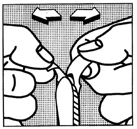
To administer a suppository, tear the foil at the top until the suppository can be easily removed.
If you use more Atrocom than you should
If you use too many suppositories at any time, there is no need to worry. However, you may consult a doctor for advice. You may feel unwell or nauseous, and some women may experience some vaginal bleeding after a few days.
If you forget to use Atrocom
- During daily use in the first 3 weeks of treatment: If you do not realize that a dose has been missed before the next day, you should skip the missed dose. In this case, resume your usual dosing schedule.
- During use twice a week: If you have forgotten to take Atrocom on the scheduled day, take the missed dose as soon as possible.
If you stop using Atrocom
Even if your symptoms improve significantly, you should continue treatment until the end. However, if you wish to stop or end treatment early, consult your doctor.
If you need surgery
If you are planning to have surgery, inform your surgeon that you are using Atrocom. You may need to stop using Atrocom 4 to 6 weeks before the operation to reduce the risk of blood clots (see section 2, "Blood clots in a vein (thrombosis)"). Ask your doctor when you can start using Atrocom again.
If you have any further questions about the use of this medicine, ask your doctor or pharmacist.
4. Possible side effects
Like all medicines, this medicine can cause side effects, although not everyone experiences them.
The following conditions are reported more frequently in women using systemic hormone replacement therapy (HRT) circulating in the bloodstream compared to women not using HRT. These risks are lower with vaginal treatments such as Atrocom:
- ovarian cancer;
- blood clots in the veins of the legs or lungs (venous thromboembolism);
- stroke;
- possible memory loss if HRT is started after the age of 65. For further information on these side effects, see section 2.
Local irritation may occur at the beginning of treatment.
Common (may occur in 1 to 10 out of 100 users)
- vulvovaginal burning, itching, and pain;
- urinary discomfort (dysuria).
Uncommon (may occur in 1 out of 100 users)
- vaginal discharge;
- anorectal disorders.
The following side effects have been reported with other HRTs:
- gallbladder disease;
- various skin disorders:
- skin discoloration, especially on the face or neck, known as "pregnancy mask" (chloasma),
- painful red nodules under the skin (erythema nodosum),
- skin rash with redness or lesions resembling targets (erythema multiforme).
Reporting of side effects
If you experience any side effect, including those not listed in this leaflet, talk to your doctor or pharmacist. You may also report side effects directly via the national reporting system at www.aifa.gov.it/content/segnalazioni-reazioni-avverse.
By reporting side effects, you can help provide more information on the safety of this medicine.
5. How to store Atrocom
Keep this medicine out of the sight and reach of children.
Do not use this medicine after the expiry date stated on the carton and on the strip after "Exp."
The expiry date refers to the last day of that month.
Do not store above 25 °C.
Do not dispose of any medicine via wastewater or household waste. Ask your pharmacist how to
dispose of medicines you no longer use. This will help protect the environment.
6. Package contents and other information
What Atrocom contains
The active substance is estriol.
Each ovule contains 0.03 mg of estriol.
The other ingredients are: butylhydroxytoluene, glyceryl ricinoleate, saturated fatty acids, macrogol
cetostearyl ether.
Description of the appearance of Atrocom and pack contents
Atrocom is presented as white ovules.
Atrocom is available in packs containing 10, 15, 20, 24 and 30 ovules.
It is possible that not all pack sizes are marketed.
Marketing Authorization Holder
Farmitalia S.r.l.
Via Pinciana 25
00198 Rome, Italy
Manufacturer
DR. KADE Pharmazeutische Fabrik GmbH
Rigistraße 2
12277 Berlin (Germany)
This medicinal product is authorized in the European Economic Area (EEA) Member States and in the United Kingdom (Northern Ireland) under the following names:
Germany – OeKolp Ovula 0.03 mg
Denmark, Finland, Norway, and Sweden – Estrokad
Hungary – Estrokad 0.03 mg hüvelykúp
Belgium, Luxembourg – Oekolp 0.03 mg ovule/ovules/Vaginalzäpfchen
Italy – Atrocom 0.03 mg ovuli
United Kingdom, Ireland – IMVAGGIS 0.03 mg pessary
Netherlands – Estriol DR. KADE 0.03 mg ovules
Austria – Estrokad 0.03 mg Vaginalzäpfchen
United Kingdom (Northern Ireland) – IMVAGGIS 0.03 mg pessary
This summary of product characteristics was last approved on