Atenativ
Italy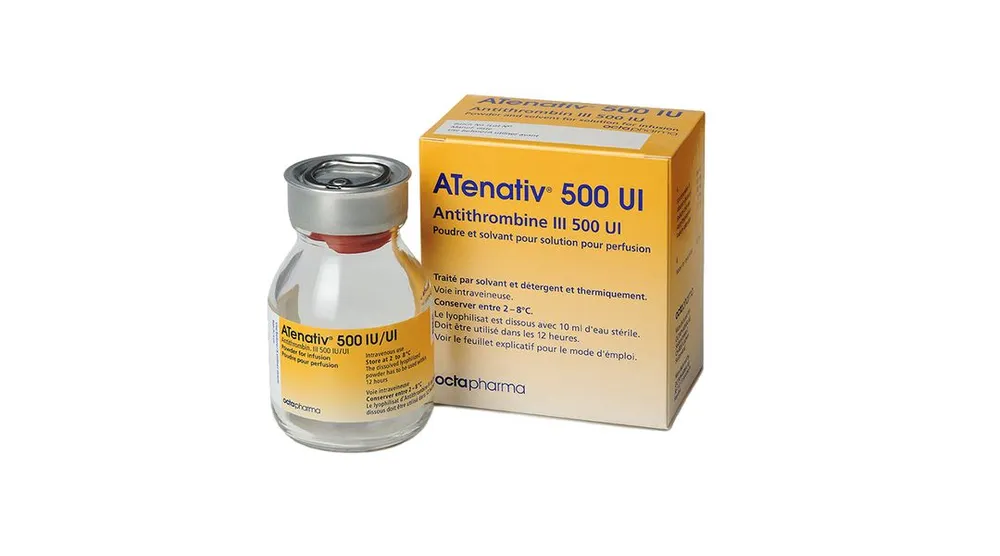
Table of Contents
- Package leaflet: Information for the user
- ATENATIV 500 UI/10 ml - 1000 UI/20 ml powder and solvent for solution for infusion
- 1. What Atenativ is and what it is used for
- 2. What you should know before using Atenativ
- 3. How to use Atenativ
- 4. Possible side effects
- 5. How to store Atenativ
- 6. Contents of the pack and other information
- The following information is intended exclusively for healthcare professionals:
Package leaflet: Information for the user
ATENATIV 500 UI/10 ml - 1000 UI/20 ml powder and solvent for solution for infusion
Human Antithrombin III
Please read all of this leaflet carefully before you start using this medicine because it contains important information for you.
Keep this leaflet. You may need to read it again.
If you have any questions, ask your doctor or pharmacist.
This medicine has been prescribed for you only. Do not give it to other people, even if their symptoms are the same as yours, because it may be harmful.
If you experience any side effects, including those not listed in this leaflet, tell your doctor or pharmacist. See section 4.
Contents of this leaflet:
- What Atenativ is and what it is used for
- What you need to know before using Atenativ
- How to use Atenativ
- Possible side effects
- How to store Atenativ
- Contents of the pack and other information
1. What Atenativ is and what it is used for
Human antithrombin III is one of the main inhibitors of blood coagulation. Atenativ belongs to the group of antithrombotic medicines (used in diseases caused by the formation of blood clots in blood vessels) and is used for the treatment of:
Congenital antithrombin deficiency
- Prophylaxis of deep vein thrombosis and thromboembolism in clinical risk conditions (especially during surgery, childbirth and postpartum), in combination with heparin, if indicated.
- Prevention of progression of deep vein thrombosis and thromboembolism in combination with heparin, as indicated.
Acquired antithrombin deficiency. Atenativ is administered as replacement therapy to normalize coagulation and enable the treatment of the above-mentioned conditions.
2. What you should know before using Atenativ
Do not use Atenativ
if you are allergic to human antithrombin III or to any of the other ingredients of this
medicinal product (listed in section 6).
Viral safety
When medicinal products are prepared from human blood or plasma, specific measures are taken to prevent transmission of infections to patients. These measures include:
- careful selection of blood and plasma donors to ensure that potentially infected donors are excluded;
- testing of each individual donation and plasma pool (a mixture of multiple donations) to detect possible presence of infections/viruses;
- inclusion in the manufacturing process of steps capable of inactivating or removing viruses.
Despite these measures, when products derived from human blood or plasma are administered, the possibility of transmitting infectious agents cannot be completely ruled out. This also applies to unknown or emerging viruses and other types of infections.
The measures taken are considered effective against enveloped viruses such as human immunodeficiency virus (HIV), hepatitis B virus (HBV), hepatitis C virus (HCV), and against the non-enveloped hepatitis A virus (HAV).
Viral inactivation/removal procedures may have limited effectiveness against certain non-enveloped viruses such as Parvovirus B19.
Parvovirus B19 infection may be severe in pregnant women and in individuals with weakened immune systems or suffering from certain types of anaemia (e.g. haemolytic anaemia).
It is strongly recommended that each time Atenativ is administered, the name and batch number of the product be recorded to ensure traceability of the batches used.
Warnings and precautions
In case of allergic or anaphylactic reactions, immediately discontinue the injection/infusion and initiate standard therapeutic measures used for treating shock.
Other medicines and Atenativ
Heparin: Antithrombin replacement therapy during administration of therapeutic doses of heparin increases the risk of bleeding. The effect of antithrombin is strongly enhanced by heparin. The half-life of heparin may be considerably reduced during concomitant treatment due to accelerated antithrombin turnover. Therefore, simultaneous administration of heparin and antithrombin in patients at increased risk of bleeding should be clinically and biologically monitored.
Inform your doctor if you are taking, have recently taken, or might take any other medicines.
Atenativ with food and drink
No effects have been observed with food and drink.
Pregnancy and breastfeeding
No controlled clinical studies have been conducted to demonstrate the safety of human antithrombin III concentrate during pregnancy.
Animal studies are not sufficient to fully assess safety in humans regarding reproduction, embryonal or foetal development, pregnancy, and peri- and postnatal development. Atenativ should be administered to women with antithrombin deficiency during pregnancy and breastfeeding only if clearly indicated, taking into account that pregnancy increases the risk of thromboembolic events in these patients.
Driving and using machines
No effects on the ability to drive and use machines have been observed.
Atenativ contains sodium chloride, human albumin stabilized with acetyltryptophan and caprylic acid, water for injections.
Atenativ contains sodium
This medicinal product contains sodium (a main component of table salt) in amounts of 36 mg (Atenativ 500 IU) or 72 mg (Atenativ 1000 IU) per vial, equivalent to 1.8% and 3.6% of the maximum daily recommended sodium intake in an adult's diet, respectively.
3. How to use Atenativ
Use this medicine exactly as instructed by your doctor. If you have any doubts, consult your doctor.
Atenativ may only be used in hospitals or clinics and healthcare facilities by medical professionals or other healthcare providers.
For instructions on correct use and dosage, refer to the section "The following information is intended exclusively for doctors or healthcare professionals".
Treatment should be initiated under the supervision of a physician experienced in the treatment of patients with antithrombin deficiency.
The dose and treatment regimen depend on the indication; your doctor will determine the appropriate dose and treatment schedule for you.
Use in children
The safety and efficacy of Atenativ in children has not been established.
No data are available.
If you use more Atenativ than you should:
Symptoms of overdose with antithrombin III have not been reported.
4. Possible side effects
Like all medicines, this medicine can cause side effects, although not everybody will experience them.
Rarely, hypersensitivity or allergic-type reactions have been observed (which may include: swelling of the eyes, face or tongue, burning or prickling sensation at the injection site,
chills, urticaria, nausea, vomiting, dyspnea, headache, dizziness, shortness of breath, wheezing, changes in blood pressure, palpitations, lethargy, restlessness, anxiety, back pain, sweating, hot flushes, tingling, and in some cases, shock. In some instances, a progressive worsening leading to severe anaphylaxis (including shock) has been observed.
Fever has been observed in rare cases.
Reporting of side effects
If you experience any side effects, including those not listed in this leaflet, please inform your doctor or pharmacist. You may also report side effects directly through the national reporting system at the following website: www.agenziafarmaco.gov.it/content/come-segnalare-una-sospetta-reazione-avversa. By reporting side effects, you can help provide more information on the safety of this medicine.
5. How to store Atenativ
Keep this medicine out of the sight and reach of children.
Do not use this medicine after the expiry date stated on the label and carton after the abbreviation used for expiry date {Exp.}. The expiry date refers to the last day of that month.
Store between +2°C and +8°C. However, storage at room temperature for up to 1 month does not compromise the stability of the product.
The reconstituted solution must be used within 12 hours.
Do not dispose of medicines via wastewater or household waste. Ask your pharmacist how to dispose of medicines you no longer use. This will help protect the environment.
6. Contents of the pack and other information
What Atenativ contains
- The active substance is human antithrombin III
| Atenativ 500 UI/10ml | Atenativ 1000 UI/20ml | |
| Antithrombin from human plasma | 500 IU/vial | 1000 IU/vial |
| Antithrombin from human plasma reconstituted with water for injectable preparations | 50 IU/ml (500 IU/10 ml) | 50 IU/ml (1000 IU/20 ml) |
| Solvent volume | 10 ml | 20 ml |
- The other excipients are sodium chloride, human albumin stabilised with N-acetyltryptophan and caprylic acid, water for injections.
Description of the appearance of Atenativ and contents of the pack
Powder and solvent for solution for infusion.
The reconstituted product should be inspected visually for particulate matter or discoloration prior to administration. The solution should be clear or slightly opalescent. Do not use solutions showing deposits or cloudiness.
Atenativ powder and solvent is supplied in glass vials with bromobutyl rubber stoppers coated with Purcoat and sealed with an aluminium overseal.
Pack contents:
Atenativ 500 IU/10 ml: 1 vial of 500 IU (50 ml) + 1 vial of solvent 10 ml
Atenativ 1000 IU/20 ml: 1 vial of 1000 IU (50 ml) + 1 vial of solvent 20 ml
Marketing Authorisation Holder
Octapharma (IP) SPRL
Allée de la Recherche 65
1070 Brussels
Belgium
Legal representative and distributor:
Octapharma Italy S.p.A.
Via Cisanello, 145
56100 Pisa
Italy
Manufacturer
Octapharma AB
Lars Forssells gata 23
SE-112 75 Stockholm
Sweden
The following information is intended exclusively for healthcare professionals:
Dosing recommendations:
In congenital deficiency, the dosage must be individualized for each patient,
taking into account family history of thromboembolic events, current clinical risk factors, and laboratory tests.
The dose and duration of replacement therapy in acquired deficiency depend on the plasma level of antithrombin, the presence of signs of increased turnover, the underlying disease, and the severity of the clinical condition.
The amount of medication to be administered and the frequency of administration must always be based on individual clinical findings and laboratory evaluations.
To determine the initial dose, the following formula should be used:
Units required = body weight (kg) x (desired level - actual antithrombin activity level in [%]).
Antithrombin activity should be maintained above 80% throughout the treatment period, unless clinical characteristics indicate a different effective level.
The usual initial dose in congenital deficiency is 30–50 IU/kg. Subsequently, dosage, frequency, and duration of treatment should be adjusted based on biological data and clinical status.
Therapeutic treatment of acquired antithrombin deficiency
Patients with acquired antithrombin deficiency are treated with Atenativ to normalize coagulation. Throughout the entire treatment period, a normal antithrombin level must be maintained. Antithrombin levels should be determined at least twice daily until the patient is stabilized, and thereafter once daily. It should be noted that the half-life of Antithrombin III may be significantly reduced under certain clinical conditions. In such cases, higher daily doses are required, and antithrombin measurements should be performed every 4–6 hours. Treatment continues until the coagulation status is normalized.
Prophylactic treatment of hereditary antithrombin deficiency
Surgery: The first dose should be administered immediately before surgery, and the next dose within 12 hours of the first.
Dosage is then directly related to the antithrombin level in the patient’s plasma. Treatment with Atenativ should continue for at least 2–6 days and should be supported by other forms of thromboembolism prophylaxis. The exact nature of treatment depends on the type of surgery planned.
Pregnancy: Subcutaneous heparin treatment should be initiated as soon as pregnancy is confirmed. Initially, 12,500 IU is administered twice daily. Antithrombin plasma concentration must be monitored throughout pregnancy. One day before the expected delivery date, the heparin dose should be reduced to 5,000 IU subcutaneously twice daily. Additionally, 50 IU of antithrombin per kg of body weight should be administered. During delivery and the following week, antithrombin levels should be maintained above 80% of that found in normal human plasma. Typically, 30 IU per kg of body weight per day are required. After delivery, anticoagulant prophylactic treatment is recommended for 8–12 weeks.
Therapeutic treatment of hereditary deficiency
Dosage must be determined individually and adjusted according to the antithrombin level in the patient’s plasma. Treatment with Atenativ should continue for at least one week and should be combined with appropriate anticoagulant therapy.
Method of administration
Powder and solvent for solution for intravenous infusion.
Atenativ is supplied as a sterile lyophilized powder. After reconstitution with the provided solvent, the medication must be administered intravenously.
Reconstitution of powder with solvent:
Instructions for use and administration
The lyophilisate is reconstituted with sterile water for injections.
Atenativ is also compatible with isotonic sodium chloride (9 mg/mL) and glucose (50 mg/mL) solutions, which may be used for reconstitution both in glass infusion vials and in plastic containers.
Do not use after the expiry date stated on the label.
Unused product or waste material must be disposed of in accordance with local regulations.
The reconstituted solution should be inspected visually for particulate matter or discoloration prior to administration. The solution should be clear or slightly opalescent. Do not use solutions containing deposits or that appear cloudy. Reconstitution time is typically 5 minutes. After reconstitution, the product should be used as soon as possible and in any case within 12 hours of reconstitution; unused solution must be properly discarded.
For patient safety, whenever Atenativ is administered, it is recommended to record the trade name of the product and the production batch number to ensure traceability between the patient and the product batch.
Administration of the solution
The recommended infusion rate in adults is 50 IU/min and must not exceed 300 IU/min.
Warnings and precautions
As with all intravenously administered protein-containing products, allergic-type hypersensitivity reactions may occur. Patients must be closely monitored for any symptoms during the infusion period. Patients should be informed about early signs of hypersensitivity reactions, such as wheals, generalized urticaria, chest tightness, wheezing, hypotension, and anaphylaxis. If these symptoms occur, they must immediately discontinue use of the product and contact their physician.
In case of shock, infusion must be stopped immediately and standard medical procedures for shock management must be followed.