Atem
Italy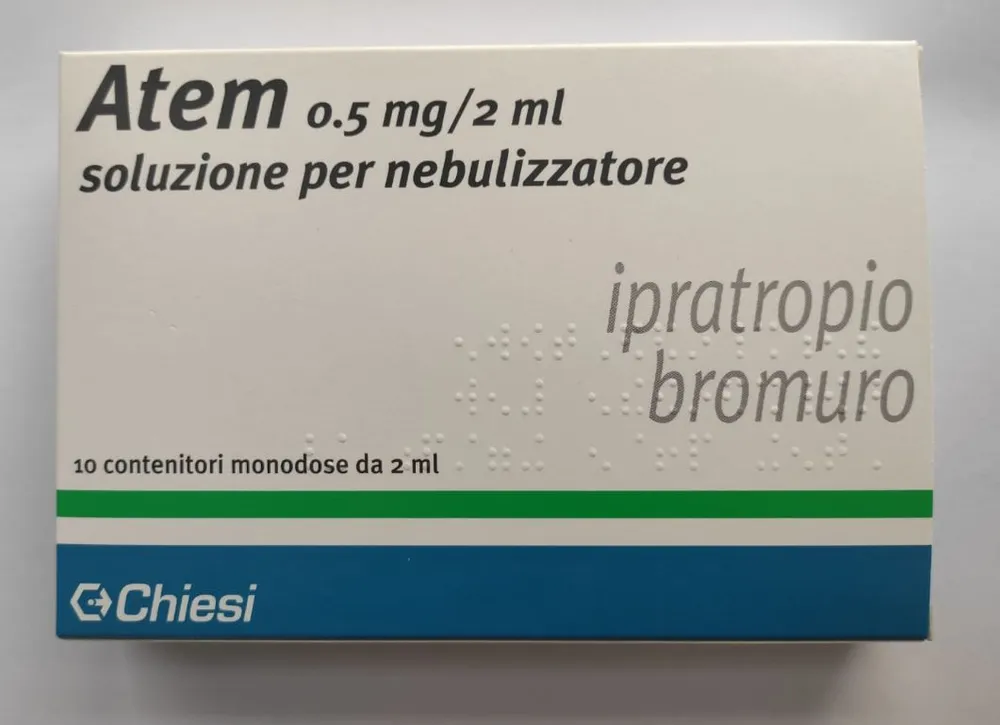
Instructions for Use
Package leaflet: Information for the patient
ATEM 0.5 mg/2 ml, solution for nebuliser
Ipratropium bromide monohydrate
Please read all of this leaflet carefully before taking this medicine because it contains important information for you.
- Keep this leaflet. You may need to read it again.
- If you have any questions, ask your doctor or pharmacist.
- This medicine has been prescribed for you only. Do not give it to other people, even if their symptoms are the same as yours, as it may be harmful.
- If you experience any side effects, including those not listed in this leaflet, tell your doctor or pharmacist. See section 4.
Contents of this leaflet:
- What ATEM is and what it is used for
- What you need to know before taking ATEM
- How to take ATEM
- Possible side effects
- How to store ATEM
- Contents of the pack and other information
1. What ATEM is and what it is used for
ATEM is a medicine containing ipratropium bromide monohydrate, an active substance belonging to the group of anticholinergic medicines, which relaxes the muscles in the walls of the small airways of the lungs.
ATEM is used for the treatment of asthma and chronic obstructive pulmonary disease, a condition caused by inflammation of the lungs and airways, associated with asthma.
2. What you need to know before taking ATEM
Do not take ATEM if:
- you are allergic (hypersensitive) to ipratropium bromide monohydrate or to any of the other ingredients of this medicine (listed in section 6);
- you are allergic to atropine or to medicines belonging to the same class;
- you have an enlarged prostate (prostatic hypertrophy);
- you have an eye disease causing increased eye pressure with worsening of vision (glaucoma);
- you have difficulty urinating (urinary retention);
- you have intestinal obstruction manifested by inability to defecate, abdominal pain, and bloating.
Warnings and precautions
Talk to your doctor before taking ATEM:
- if you suffer from cystic fibrosis, a multi-organ genetic disease that makes secretions produced by the body thicker and more viscous, causing harmful effects especially on the respiratory system and gastrointestinal tract (intestinal motility disorders);
- if you have heart problems, including, for example, heart vessel diseases (coronary artery disease);
- if you are pregnant, suspect you may be pregnant, or are breastfeeding.
Exercise particular caution:
- ATEM starts to act 3–5 minutes after the start of administration;
- when using ATEM, ensure that neither the liquid nor the nebulized mist comes into contact with the eyes. It is advisable to inhale using the mouthpiece of the nebulizer. If using a face mask, it must fit snugly to the face;
- if the medicine accidentally comes into contact with the eyes, you may experience eye or vision disturbances, such as difficulty focusing images (visual accommodation disorders), eye pain or discomfort, blurred vision, colored halos or images together with eye redness; contact your doctor immediately and remember to inform them about prior use of ATEM;
- if you are a patient at high risk of increased intraocular pressure and developing glaucoma, you must ensure adequate eye protection during ATEM administration;
- if you experience allergic reactions such as: skin rash with intense itching accompanied by pustule formation, angioedema (sudden accumulation of fluid in the skin and mucous membranes, such as throat and tongue, resulting in breathing difficulties), or acute sensation of chest tightness caused by airway muscle contraction, you must consult your doctor immediately;
- if your asthma worsens during treatment with ATEM, does not improve, or if you experience increased breathing difficulty. Inform your doctor, who may need to adjust your therapy.
Children
This medicine is not recommended for children under 3 years of age.
Other medicines and ATEM
Inform your doctor or pharmacist if you are taking, have recently taken, or might take any other medicines.
Some bronchodilators (so-called beta-sympathomimetics such as salbutamol) and xanthine derivatives (e.g. theophylline) may enhance the effect of ATEM.
ATEM may enhance the effects of other medicines containing anticholinergics.
Pregnancy, breastfeeding and fertility
If you are pregnant, suspect you may be pregnant, plan to become pregnant, or are breastfeeding, consult your doctor or pharmacist before taking this medicine.
Driving and using machines
ATEM may impair your ability to drive vehicles or operate machinery.
During treatment, dizziness, difficulty focusing vision, pupil dilation (mydriasis), or blurred vision may occur. If this happens, avoid driving or operating machinery.
3. How to take ATEM
Take this medicine exactly as your doctor has told you. If you are unsure, consult your doctor or pharmacist.
Use in adults and adolescents over 14 years of age
1 single-dose container, 1 or 2 times daily, unless otherwise directed by the doctor.
The maximum dose is 1 single-dose container, 4 times daily.
Use in children from 3 to 14 years of age
Half a single-dose container, 1 or 2 times daily, unless otherwise directed by the doctor. The interval between administrations will be determined by the doctor.
To administer half a dose, use the graduation mark found on the container.
The maximum dose is half a single-dose container, 3 times daily. Treatment of children under 6 years of age must be supervised by a doctor.
If you take more ATEM than you should:
In case of ingestion/overdose of ATEM, contact your doctor or go to the nearest hospital immediately.
In case of overdose, symptoms such as dry mouth, difficulty focusing clearly (accommodation disorders), and rapid heartbeat may occur.
In case of severe overdose, symptoms may include rapid breathing, fast heartbeat, high fever, inability to stay still (restlessness), confusion, or hallucinations.
Bring this patient information leaflet or a single-dose container of your medicine with you so that your doctor will know what you have taken.
If you forget to take ATEM:
Do not take a double dose to make up for the forgotten dose.
If you stop using ATEM:
If you have any doubts about using this medicine, consult your doctor or pharmacist.
Method of administration
This medicine must be nebulized (converted into very fine droplets) using a "nebulizer device" equipped with oral and/or nasal administration accessories. Do not swallow or inject.
Administer ATEM by inhalation through the mouth and/or nose. The prescribed dose may be diluted by adding an equal amount of distilled water (1:1 ratio) to the nebulizer chamber.
Before use, read carefully the following instructions, which indicate what to do and what to pay attention to.
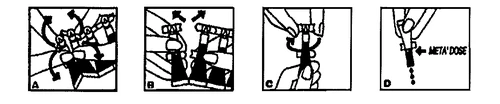
To use, perform the following steps:
Figure A Bend the single-dose container in both directions.
Figure B Detach the single-dose container from the strip, first above and then in the center.
Figure C Open the single-dose container by rotating the tab in the direction indicated by the arrow.
Figure D
Apply moderate pressure to the sides of the single-dose container to dispense the prescribed amount of medicine into the nebulizer chamber (nebulizer device).
To verify that half a dose has been used, hold the single-dose container up to the light and compare the remaining level of medicine with the graduation mark on the container (corresponding to half a dose). If using half a dose, any remaining amount must be discarded.
4. Possible side effects
Like all medicines, this medicine can cause side effects, although not everyone gets them.
All medicines can cause allergic reactions, although serious allergic reactions are very rare.
Call your doctor immediately if you experience sudden wheezing, breathing difficulties, swelling of the eyelids, face or lips, rash or itching (especially if it affects the whole body). This is known as "angioedema".
Rarely, inhaled medicines such as ATEM can cause increased wheezing and/or shortness of breath; if this occurs, stop taking the medicine immediately and consult your doctor.
Common side effects (may affect up to 1 in 10 people)
Dry mouth.
Very rare side effects (may affect up to 1 in 10,000 people)
Dizziness and drowsiness.
Problems focusing images (visual accommodation disorders).
Problems passing urine (urinary retention) or constipation.
Heart rhythm disorders (arrhythmia).
Side effects with unknown frequency (frequency cannot be estimated from the available data)
Allergy-related reactions (hypersensitivity).
Eye disorders: increased eye pressure with possible worsening of vision, blurred vision, pupils of different size between the eyes (anisocoria), dilation of both pupils (mydriasis).
Breathlessness, cough, short and wheezing breathing (paradoxical bronchospasm).
Swelling (angioedema) of the face, eyes, lips or throat, with breathing difficulties.
Reporting of side effects
If you experience any side effect, including those not listed in this leaflet, talk to your doctor or pharmacist. You may also report side effects directly via the national reporting system at the website: "https://www.aifa.gov.it/content/segnalazioni-reazioni-avverse".
By reporting side effects, you can help provide more information on the safety of this medicine.
5. How to store ATEM
Keep this medicine out of the sight and reach of children.
Store below 30°C.
If a half dose is used, the remaining amount in the container must be discarded.
Do not use this medicine after the expiry date which is stated on the packaging after the word EXP. The
expiry date refers to the last day of that month.
Do not dispose of any medicine via wastewater or household waste. Ask your pharmacist how to dispose of
medicines you no longer use. This will help protect the environment.
6. Package contents and other information
What ATEM contains
The active substance is: ipratropium bromide monohydrate.
One 2 ml single-dose container contains: 0.5218 mg of ipratropium bromide monohydrate, corresponding to
0.50 mg of ipratropium bromide.
The other components are: sodium dihydrogen phosphate monohydrate, sodium hydrogen phosphate dibasic dihydrate, sodium
chloride, purified water.
Description of the appearance of ATEM and contents of the pack
This medicine is available in cardboard packs containing 10 or 20 single-dose containers, each containing 2 ml of
solution. Each single-dose container has a half-dose graduation mark.
Marketing Authorization Holder and Manufacturer
Marketing Authorization Holder
PROMEDICA S.r.l., Via Palermo 26/A – 43122 Parma.
Manufacturer
C.O.C. Farmaceutici S.r.l. - Via Modena, 15 - S. Agata Bolognese (BO).
This page has been machine-translated and may contain inaccuracies. The original data is available in the manufacturing country's language.
Last data check: May 11, 2026 · Data source: Agenzia Italiana del Farmaco (AIFA)