Asensil
Italy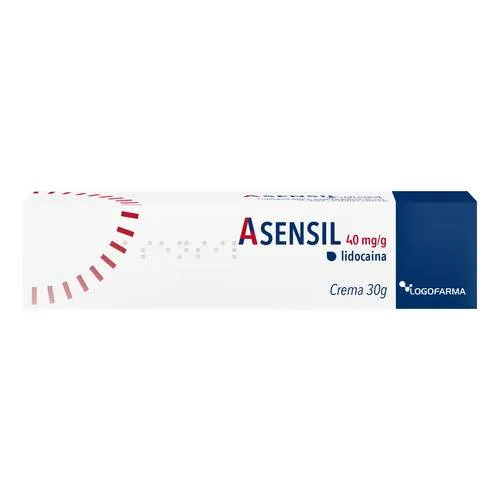
Table of Contents
Package leaflet: Information for the user
ASENSIL 40 mg/g cream
Lidocaine
Please read this leaflet carefully before using this medicine because it contains important information for you.
- Keep this leaflet. You may need to read it again.
- If you have any questions, ask your doctor or pharmacist.
- This medicine has been prescribed for you only. Do not give it to other people, even if their symptoms are the same as yours, as it could be harmful.
- If you experience any side effect, including those not listed in this leaflet, talk to your doctor or pharmacist. See section 4.
Contents of this leaflet:
- What ASENSIL is and what it is used for
- What you need to know before using ASENSIL
- How to use ASENSIL
- Possible side effects
- How to store ASENSIL
- Contents of the pack and other information
1. What ASENSIL is and what it is used for
This medicine is called: ASENSIL
ASENSIL is a type of medicine called a local anaesthetic, used to numb an area of the body.
ASENSIL temporarily numbs the surface of the skin, providing relief from pain when a needle is inserted into a vein (venipuncture or intravenous cannulation) for medical purposes, such as blood collection for laboratory tests, in adults and neonates aged one month and older.
It may also be used in adults only to numb the skin prior to administration of painful topical treatments on larger areas of intact skin.
2. What you need to know before using ASENSIL
Do not use ASENSIL:
Talk to your doctor or pharmacist and do not use ASENSIL if:
- you are allergic (hypersensitive) to lidocaine or to any of the other ingredients of this medicine.
- you are allergic to any other similar local anaesthetic.
- you are allergic to soy or peanuts (contains hydrogenated soy lecithin).
Warnings and precautions
Talk to your doctor or pharmacist before using ASENSIL if:
- you are seriously ill, debilitated, or elderly (you may be more sensitive to lidocaine).
- you have a history of sensitivity to components of any medicine, especially other local anaesthetics.
- you have severe liver (hepatic) disease.
Other medicines and ASENSIL
Inform your doctor or pharmacist if you are taking, have recently taken, or might take any other
medicines, especially:
- ASENSIL, lidocaine, or any other local anaesthetic.
- Medicines used to prevent or treat irregular heartbeat, such as tocainide, mexiletine, or amiodarone.
- The beta-blocker propranolol, used to treat high blood pressure.
- Cimetidine, used to treat gastric ulcers or heartburn.
- If you are about to receive a vaccine containing live vaccine (e.g. the tuberculosis vaccine). Vaccines must not be administered in areas where ASENSIL has been applied, as this could affect the vaccine's effect.
Pregnancy, breastfeeding, and fertility
If you are pregnant, think you may be pregnant, planning to become pregnant, or are breastfeeding,
consult your doctor or pharmacist before using this medicine.
Driving and using machines
ASENSIL has no known effects on the ability to drive or operate machinery.
ASENSIL contains 75 mg of propylene glycol in 1 g. Propylene glycol may cause skin irritation.
ASENSIL contains 15 mg of benzyl alcohol in 1 g. Benzyl alcohol may cause allergic reactions or mild local irritation.
ASENSIL contains hydrogenated soy lecithin. If you are allergic to peanuts or soy, do not use this medicine.
3. How to use ASENSIL
Use this medicine exactly as directed by your doctor or pharmacist. If you have any doubts, consult your doctor or pharmacist.
Use of ASENSIL:
- The use of ASENSIL varies depending on the reason for which the product is being used. Make sure to select and follow the correct dosage stated in the section on the back.
- Your doctor or nurse will explain how to apply the cream. If the cream is to be used on large areas, the doctor or nurse will apply it for you.
Precautions for the use of ASENSIL:
- For external use only.
- Do not apply on abraded skin, skin with blisters, in the presence of skin rash or eczema, or if there are cuts, abrasions, or wounds.
- Do not apply in the ear, inside the nose, in the mouth, on the anus (anal canal), or on genital mucous membranes.
- Avoid contact of ASENSIL with the eyes, as it may cause severe irritation. In case of accidental contact with the eyes, immediately rinse thoroughly with lukewarm water or with a sodium chloride (salt) solution, and protect the area until sensitivity returns.
- Application of ASENSIL to the skin may cause transient paleness followed by temporary redness at the application site.
- Application over larger areas or for longer durations than recommended may cause serious adverse effects due to absorption of lidocaine.
- ASENSIL completely blocks sensation in the treated area. Avoid scratching, rubbing, or exposing the area to extremely hot or cold temperatures until the anesthetic effect has completely worn off.
Recommended dose to provide pain relief during venous insertion of a needle:
1 g of cream, corresponding to approximately 5 cm of cream squeezed from the 5 g tube, or 3.5 cm from the 30 g tube.
Adults, including elderly, and children over one year of age:
Apply from 1 g to 2.5 g of cream, sufficient to cover a skin area of 2.5 cm x 2.5 cm (1" x 1") where the needle will be inserted. Do not leave on the skin for more than 5 hours.
Infants over 3 months but less than 1 year of age:
Do not apply more than 1 g of cream. Do not leave on the skin for more than 4 hours.
Infants over 1 month but less than 3 months of age:
Do not apply more than 1 g of cream. Do not leave on the skin for more than 1 hour.
Do not use in infants under one month of age.
- Apply ASENSIL at least 30 minutes before the medical procedure begins.
- Using the amount indicated above, apply the cream to the skin in a uniform layer.
- If instructed by your doctor or nurse, cover the cream with an occlusive dressing to prevent accidental removal.
- After approximately 30 minutes, remove the dressing. Immediately remove the cream with a gauze swab.
- The venous needle insertion must be performed immediately after removal of the cream.
Recommended dose to provide anesthesia prior to administration of painful topical treatments on larger areas of intact skin:
1 g of cream, corresponding to approximately 5 cm of cream squeezed from the 5 g tube, or 3.5 cm from the 30 g tube.
Adults and elderly aged 18 years and over:
Apply 1.5 g to 2 g per 10 cm² of skin, covering a maximum total surface area of 300 cm² (200 cm² is approximately the surface area of a face, 300 cm² that of an arm). Do not exceed the recommended dose.
- Apply ASENSIL approximately 30–60 minutes before the procedure begins.
- Using the amount indicated above, apply the cream to the skin in a thin, even layer.
- Ensure that the cream is not accidentally removed from the skin.
- After 30 to 60 minutes, remove the cream with a gauze swab.
- The procedure should begin immediately after removal of the cream.
The cream must not be reapplied for at least 12 hours after removal.
Do not use in patients under 18 years of age.
If you use more ASENSIL than you should
Overdose is unlikely, but if it occurs, contact your doctor or nurse immediately, even if you do not feel any symptoms. Overdose may occur if you use more than the recommended amount, apply the cream on large skin areas, or use it for longer than recommended.
Symptoms of overdose may include blurred vision, dizziness or drowsiness, breathing difficulties, tremors, chest pain, or irregular heartbeat.
4. Possible side effects
Like all medicines, this medicine can cause side effects, although not everybody gets them.
If you experience any of the side effects listed below, remove the cream immediately, stop using it and contact your doctor or pharmacist.
Allergic reaction is rare; it may affect up to 1 in 1,000 people. Symptoms may include skin rash, swelling, very low blood pressure or anaphylactic shock.
Skin irritation, redness, itching or rash at the application site are common side effects and may affect up to 1 in 10 people.
You may experience eye irritation if the cream is accidentally applied to the eye or nearby areas. The number of affected people is unknown as the frequency cannot be determined from the available data. Refer to "Precautions for the use of ASENSIL" in section 3 to find out what to do in case of accidental exposure to the eyes.
Reporting of side effects
If you get any side effects, including any not listed in this leaflet, talk to your doctor, pharmacist or nurse. You can also report side effects directly via the national reporting system at https://www.aifa.gov.it/content/segnalazioni-reazioni%20avverse
By reporting side effects, you can help provide more information on the safety of this medicine.
5. How to store ASENSIL
Keep this medicine out of the sight and reach of children.
This medicine does not require any special storage conditions.
Do not use this medicine after the expiry date stated on the tube and the carton after EXP. The
expiry date refers to the last day of that month.
After opening the tube, the product remains usable for 6 months.
Do not dispose of medicines via wastewater or household waste. Ask your pharmacist how to dispose of medicines you no longer use. This will help protect the environment.
6. Package contents and other information
What ASENSIL contains
- The active substance is lidocaine. 1 g of cream contains 40 mg of lidocaine.
- The other components are benzyl alcohol, carbomers, cholesterol, hydrogenated soybean lecithin, polysorbate 80, propylene glycol, triethanolamine, all-rac-alpha-tocopheryl acetate, purified water.
Description of the appearance of ASENSIL and contents of the pack
ASENSIL is a white or almost white cream supplied as:
- an aluminum tube lined with epoxy-phenolic resin and fitted with a polypropylene screw cap, or
- an aluminum tube lined with polyamide-imide resin and fitted with a high-density polyethylene screw cap.
Pack sizes: - Box containing 1 tube of 5 g or 5 tubes of 5 g
- Box containing 1 tube of 5 g or 5 tubes of 5 g, including 2 or 10 occlusive dressings
- Box containing 1 tube of 30 g
Not all pack sizes may be marketed.
Marketing Authorisation Holder and Manufacturer
Marketing Authorisation Holder:
Logofarma S.r.l., Piazzale Luigi Cadorna, 11, 20123, Milan, Italy.
Manufacturers:
Laboratório Medinfar S.A., Rua Henrique de Paiva Couceiro, Nº 29, Venda Nova 2700-451 Amadora – Portugal
Adamed Pharma S.A.,
ul. Marszałka Józefa Piłsudskiego 5, 95-200 Pabianice, Poland
This medicinal product is authorised in the European Economic Area countries under the following names:
Germany: LidoGALEN 40 mg/g cream
Ireland: DOLOCOPIN 40 mg/g cream
Italy: ASENSIL 40 mg/g cream
Sweden: MAXILENE 40 mg/g kräm