Articaine with adrenaline Pierrel
Italy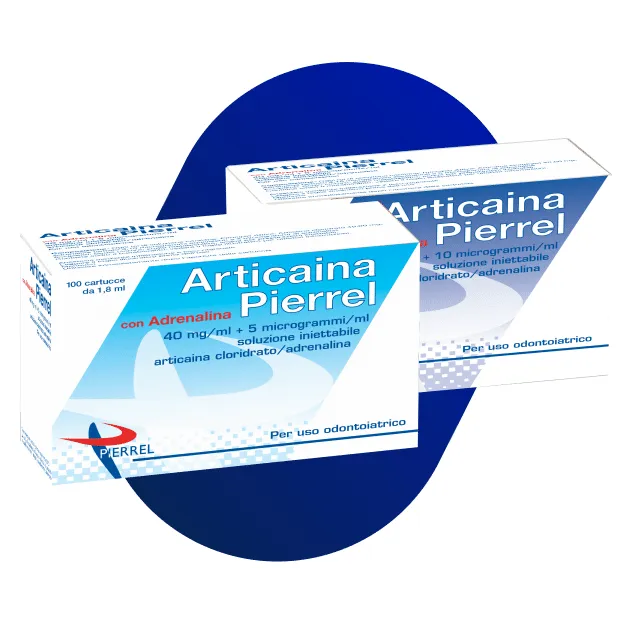
Table of Contents
- Package leaflet: Information for the patient
- ARTICAINA CON ADRENALINA PIERREL
- 1. What ARTICAINA CON ADRENALINA PIERREL is and what it is used for
- 2. What you should know before using ARTICAINA CON ADRENALINA PIERREL
- 3. How to use ARTICAINA CON ADRENALINA PIERREL
- 4. Possible side effects
- 5. How to store ARTICAINA CON ADRENALINA PIERREL
- 6. Package contents and other information
Package leaflet: Information for the patient
ARTICAINA CON ADRENALINA PIERREL
40 mg/ml + 5 micrograms/ml solution for injection
40 mg/ml + 10 micrograms/ml solution for injection
Articaine hydrochloride / Adrenaline
Please read this leaflet carefully before using this medicine because it contains important information for you
- Keep this leaflet. You may need to read it again.
- If you have any questions, consult your dentist, doctor or pharmacist.
- If you experience any side effects, including those not listed in this leaflet, tell your dentist, doctor or pharmacist. See section 4.
Contents of this leaflet:
- What ARTICAINA CON ADRENALINA PIERREL is and what it is used for
- What you need to know before using ARTICAINA CON ADRENALINA PIERREL
- How to use ARTICAINA CON ADRENALINA PIERREL
- Possible side effects
- How to store ARTICAINA CON ADRENALINA PIERREL
- Contents of the pack and other information
1. What ARTICAINA CON ADRENALINA PIERREL is and what it is used for
ARTICAINA CON ADRENALINA PIERREL is used to numb (anesthetize) the oral cavity during dental procedures.
This medicinal product contains two active substances:
- Articaine, a local anaesthetic that prevents pain
- Adrenaline, a vasoconstrictor that narrows the blood vessels at the injection site, thereby prolonging the effect of articaine. In addition, adrenaline reduces bleeding during surgical procedures.
ARTICAINA CON ADRENALINA PIERREL 40 mg/ml + 5 micrograms/ml or ARTICAINA CON ADRENALINA PIERREL 40 mg/ml + 10 micrograms/ml solution for injection will be administered by a dentist.
ARTICAINA CON ADRENALINA PIERREL is indicated for children over 4 years of age (approximately 20 kg body weight), adolescents and adults.
Depending on the type of dental procedure to be performed, the dentist will choose one of the following medicinal products:
- ARTICAINA CON ADRENALINA PIERREL 40 mg/ml + 5 micrograms/ml solution for injection is generally used for simple and short-duration dental procedures;
- ARTICAINA CON ADRENALINA PIERREL 40 mg/ml + 10 micrograms/ml solution for injection is more suitable for longer procedures or those that may involve significant bleeding;
2. What you should know before using ARTICAINA CON ADRENALINA PIERREL
Do not use ARTICAINA CON ADRENALINA PIERREL if you have any of the following conditions:
- allergy to articaine or adrenaline, or to any of the other ingredients of this medicine (listed in section 6);
- allergy to other local anaesthetics;
- epilepsy not adequately controlled with pharmacological treatment.
1/9
Warnings and precautions
Consult your dentist before using ARTICAINA CON ADRENALINA PIERREL if you have any of the following conditions:
- severe heart rhythm disorders (e.g. second- or third-degree atrioventricular block);
- acute heart failure (acute weakness of the heart muscle, e.g. sudden chest pain at rest or after myocardial infarction (e.g. heart attack));
- low blood pressure;
- abnormally rapid heart rate;
- heart attack within the last 3–6 months;
- coronary artery bypass surgery within the last 3 months;
- taking blood pressure medications called beta-blockers, such as propranolol. There is a risk of hypertensive crisis (very high blood pressure) or severe slowing of the heart rate (see section Other medicines);
- very high blood pressure;
- concomitant use of medications for depression and Parkinson’s disease (tricyclic antidepressants). These medicines may enhance the effects of adrenaline;
- epilepsy;
- deficiency of a naturally occurring chemical called cholinesterase in the blood (plasma cholinesterase deficiency);
- kidney problems;
- severe liver problems;
- a disease called myasthenia gravis, which causes muscle weakness;
- porphyria, which causes neurological complications or skin problems;
- use of other local anaesthetics, or medicines causing reversible loss of sensation (including volatile anaesthetics such as halothane);
- taking medications called antiplatelet agents or anticoagulants, to prevent narrowing or hardening of blood vessels in the arms and legs;
- age over 70 years;
- any current or past heart problems;
- uncontrolled diabetes;
- excessive thyroid activity (thyrotoxicosis);
- a tumour called phaeochromocytoma;
- a condition called closed-angle glaucoma affecting the eyes;
- inflammation or infection at the site where the injection is to be administered;
- reduced oxygen levels in body tissues (hypoxia), high levels of potassium in the blood (hyperkalaemia), and metabolic disturbances due to excess acid in the blood (metabolic acidosis).
Other medicines and ARTICAINA CON ADRENALINA PIERREL
Inform your dentist if you are taking, have recently taken, or might take any other medicine.
It is especially important to inform your dentist if you are taking any of the following medicines:
- other local anaesthetics, medicines causing reversible loss of sensation (including volatile anaesthetics such as halothane);
- sedatives (e.g. benzodiazepines, opioids), for example to reduce anxiety before the dental procedure;
- heart and blood pressure medications (e.g. guanadrel, guanethidine, propranolol, nadolol);
- tricyclic antidepressants used to treat depression (e.g. amitriptyline, desipramine, imipramine, nortriptyline, maprotiline, and protriptyline);
- COMT inhibitors used to treat Parkinson’s disease (e.g. entacapone or tolcapone);
- MAO inhibitors used to treat depressive or anxiety disorders (e.g. moclobemide, phenelzine, tranylcypromine, linezolid);
- medicines used to treat irregular heart rhythms (e.g. digitalis, quinidine);
- medicines used for migraine attacks (e.g. methysergide or ergotamine); 2/9
- sympathomimetic vasoconstrictors (e.g. cocaine, amphetamines, phenylephrine, pseudoephedrine, oxymetazoline); used to increase blood pressure: if used within the previous 24 hours, the scheduled dental treatment must be postponed;
- neuroleptic drugs (e.g. phenothiazines).
ARTICAINA CON ADRENALINA PIERREL and food
Avoid eating or chewing gum until normal sensation returns, as there is a risk of biting your lips, cheeks, or tongue, especially in children.
Pregnancy, breastfeeding and fertility
If you are pregnant, suspect you may be pregnant, planning a pregnancy, or breastfeeding, consult your dentist or doctor before using this medicine.
Your dentist or doctor will decide whether you can use ARTICAINA CON ADRENALINA PIERREL during pregnancy.
Breastfeeding may be resumed 5 hours after anaesthesia.
No adverse effects on fertility are expected at the doses used for dental procedures.
Driving and operating machinery
If you experience side effects such as dizziness, blurred vision, or fatigue, you must not drive or operate machinery until your abilities are fully restored (usually within 30 minutes after the dental procedure).
ARTICAINA CON ADRENALINA PIERREL contains sodium chloride and sodium metabisulphite
- Sodium: less than 23 mg per cartridge; this means it is practically “sodium-free”.
- Sodium metabisulphite: may rarely cause severe allergic reactions and breathing difficulties (bronchospasm). If there is a risk of an allergic reaction, the dentist will choose a different medicine for anaesthesia.
3. How to use ARTICAINA CON ADRENALINA PIERREL
Only physicians and dentists are qualified to use ARTICAINA CON ADRENALINA PIERREL.
The dentist will decide whether to use ARTICAINA CON ADRENALINA PIERREL 40 mg/ml + 10 micrograms/ml or ARTICAINA CON ADRENALINA PIERREL 40 mg/ml + 5 micrograms/ml, and will determine the appropriate dose based on your age, weight, general health status, and dental procedure.
The lowest effective dose capable of inducing anesthesia should be used.
This medicine is administered by slow injection into the oral cavity.
If you are given more ARTICAINA CON ADRENALINA PIERREL than you should
It is unlikely that you will receive an excessive amount of injection; however, if you start to feel unwell, inform the dentist immediately. Symptoms of overdose include severe weakness, pale skin, headache, agitation or restlessness, disorientation, loss of balance, involuntary tremor or chills, dilated pupils, blurred vision, difficulty focusing objects, speech disturbances, dizziness, seizures, stupor, loss of consciousness, coma, yawning, abnormally slow or rapid breathing which may cause temporary cessation of breathing, inability of the heart to contract effectively (cardiac arrest).
If you have any doubts about the use of this medicine, consult your dentist.
4. Possible side effects
Like all medicines, this medicine can cause side effects, although not everybody will experience them.
While you are at the dental clinic, your dentist will carefully monitor the effects of ARTICAINA CON ADRENALINA PIERREL.
3/9
Inform your dentist, doctor or pharmacist immediately if you experience any of the following serious side effects:
- swelling of the face, tongue or pharynx, difficulty swallowing, hives or breathing difficulties (angioedema);
- skin rash, itching, swelling of the throat and breathing difficulties: these could be symptoms of an allergic reaction (hypersensitivity);
- a combination of drooping eyelid and pupil constriction ( Horner's syndrome ). These side effects occur rarely (may affect up to 1 in 1,000 people). Other side effects not listed above may also occur in some patients.
Common side effects (may affect up to 1 in 10 people):
- gum inflammation;
- neuropathic pain: pain due to nerve damage;
- numbness or reduced sensation inside and around the mouth;
- metallic taste, altered or loss of taste;
- increased, unpleasant or abnormal tactile sensitivity;
- increased sensitivity to heat;
- headache;
- abnormally increased heart rate;
- abnormally decreased heart rate;
- low blood pressure;
- swelling of the tongue, lips and gums;
Uncommon side effects (may affect up to 1 in 100 people):
- burning sensation;
- high blood pressure;
- inflammation of the tongue and mouth;
- nausea, vomiting, diarrhoea;
- skin rash, itching;
- neck pain or injection site pain;
Rare side effects (may affect up to 1 in 1,000 people):
- nervousness, anxiety;
- facial nerve disorders (facial paralysis);
- drowsiness;
- involuntary eye movements;
- double vision, temporary blindness;
- drooping eyelid and pupil constriction (Horner's syndrome);
- displacement with recession of the eyeball into the orbit due to changes in orbital volume (enophthalmos);
- ringing in the ears, hypersensitivity of hearing;
- palpitations;
- hot flushes;
- wheezing (bronchospasm), asthma;
- breathing difficulties;
- exfoliation and ulceration of the gums;
- exfoliation at the injection site;
- hives;
- muscle spasms, involuntary muscle contractions;
- fatigue, weakness;
- chills;
Very rare side effects (may affect up to 1 in 10,000 people):
- persistent loss of sensation, widespread numbness and loss of taste;
Not known: (frequency cannot be estimated from the available data)
4/9
- excessive well-being (euphoria);
- heart rhythm coordination problems (conduction disorders, atrioventricular block);
- increased blood flow to a body area, resulting in blood vessel congestion;
- dilation or constriction of blood vessels;
- hoarseness;
- difficulty swallowing;
- localized cheek swelling;
- burning mouth syndrome;
- skin redness (erythema);
- abnormally increased sweating;
- worsening of neuromuscular symptoms in Kearns-Sayre syndrome;
- sensation of heat or cold;
- jaw locking.
Reporting of side effects
If you experience any side effect, including those not listed in this leaflet, talk to your dentist, doctor or pharmacist. You can also report side effects directly via the national reporting system at https://www.aifa.gov.it/content/segnalazioni-reazioni-avverse.
By reporting side effects, you can help provide more information on the safety of this medicine.
5. How to store ARTICAINA CON ADRENALINA PIERREL
Keep this medicine out of the sight and reach of children.
Do not use this medicine after the expiry date stated on the label and the carton after "Expiry:". The expiry date refers to the last day of that month.
Store this medicine at a temperature not exceeding 25 °C.
Do not use this medicine if you notice that the solution is cloudy or changes colour.
Cartridges are for single use only. Use immediately after opening the cartridge. Discard any unused solution.
Do not dispose of medicines via wastewater or household waste. Ask your pharmacist how to dispose of medicines no longer required. This will help protect the environment.
6. Package contents and other information
What ARTICAINA CON ADRENALINA PIERREL contains
- The active substances are: articaine hydrochloride and adrenaline tartrate.
- Each ml of Articaina con adrenalina Pierrel 40 mg/ml + 10 micrograms/ml solution for injection contains 40.00 mg of articaine hydrochloride and 18.20 micrograms of adrenaline tartrate (equivalent to 10 micrograms of adrenaline).
- Each ml of Articaina con adrenalina Pierrel 40 mg/ml + 5 micrograms/ml solution for injection contains 40.00 mg of articaine hydrochloride and 9.10 micrograms of adrenaline tartrate (equivalent to 5 micrograms of adrenaline).
- The other components are: sodium chloride, sodium metabisulfite, water for injections.
Description of the appearance of ARTICAINA CON ADRENALINA PIERREL and package contents
ARTICAINA CON ADRENALINA PIERREL is a clear, colourless solution.
It is supplied in single-use, transparent glass cartridges with high hydrolytic resistance (type I), fitted with a bromobutyl rubber plunger. Closure consists of a rubber seal and an aluminium cap.
The cartridge is available in the following pack sizes:
Carton box containing 100 cartridges of 1.8 ml.
5/9
.
Alternatively
Carton box containing 50 cartridges of 1.8 ml.
It is possible that not all pack sizes are marketed.
Marketing Authorization Holder
Pierrel Sp.A.
Strada Statale Appia 7 bis, 46/48 – 81043 Capua (CE)
Manufacturer
Pierrel S.p.A.
Strada Statale Appia 7 bis, 46/48 – 81043 Capua (CE)
(Bulk solution production, primary and secondary packaging, batch control and release).
The following information is intended exclusively for physicians or healthcare professionals
Dosage
For all populations, the lowest effective dose sufficient to induce anesthesia should be used. The required dosage must be determined on an individual basis.
For routine procedures, the normal dose for adult patients is 1 cartridge, although less than one cartridge may be sufficient to achieve effective anesthesia. At the dentist's discretion, more than one cartridge may be necessary for more complex procedures, without exceeding the recommended maximum dose.
For most routine dental procedures, ARTICAINA CON ADRENALINA PIERREL 40 mg/ml + 5 micrograms/ml solution for injection is preferred.
For more complex procedures, for example those requiring pronounced hemostasis, ARTICAINA CON ADRENALINA PIERREL 40 mg/ml + 10 micrograms/ml solution for injection is preferred.
Concomitant use of sedatives to reduce patient anxiety:
The safe maximum dose of local anesthetic may be reduced in sedated patients due to the additive central nervous system depressant effect.
Adults and adolescents (aged 12 to 18 years):
In adults and adolescents, the maximum dose of articaine is 7 mg/kg, with an absolute maximum dose of 500 mg. The maximum dose of 500 mg of articaine applies to a healthy adult weighing more than 70 kg.
Children (aged 4 to 11 years):
The safety of ARTICAINA CON ADRENALINA PIERREL in children under 4 years of age has not been established. No data are available.
The amount to be injected must be determined based on the child's age, weight, and the extent of the procedure. The effective average dose is 2 mg/kg and 4 mg/kg for simple and complex procedures, respectively. The lowest effective dose sufficient to induce anesthesia should be used. In children aged 4 years (or at least 20 kg (44 lbs) body weight) and older, the maximum dose of articaine is 7 mg/kg, with an absolute maximum dose of 385 mg of articaine for a healthy child weighing 55 kg.
Special populations:
Elderly patients and patients with renal impairment
Due to the lack of clinical data, particular precautions are necessary to administer the lowest effective dose sufficient to induce anesthesia in elderly patients and those with renal disease.
Elevated plasma levels of the product may occur in these patients, especially following repeated use. If repeated injections are necessary, the patient must be closely monitored for signs of relative overdose.
Patients with hepatic impairment
Particular precautions are necessary to administer the lowest effective dose sufficient to induce anesthesia in patients with hepatic impairment, particularly after repeated use, despite the fact that 90% of articaine is inactivated by nonspecific plasma esterases in tissues and blood.
Patients with plasma cholinesterase deficiency
Elevated plasma levels of the product may occur in patients with cholinesterase deficiency or those receiving treatment with acetylcholinesterase inhibitors, since the product is inactivated by 90% via plasma esterases. Therefore, the lowest effective dose sufficient to induce anesthesia should be used.
Method of administration
Infiltration and perineural use in the oral cavity.
Local anesthetics must be injected cautiously in the presence of inflammation and/or infection at the injection site. The injection must be performed very slowly (1 ml/min).
Precautions to be taken before handling or administering the medicinal product
This medicinal product must be used exclusively by physicians or dentists with adequate knowledge and experience in the diagnosis and treatment of systemic toxicity, or under their supervision. Before inducing regional anesthesia with local anesthetics, appropriate resuscitation equipment and medications must be available to ensure immediate management of any respiratory or cardiovascular emergencies. The patient's level of consciousness must be monitored after each injection of local anesthetic.
When using ARTICAINA CON ADRENALINA PIERREL for infiltration or locoregional anesthesia, the injection must always be performed slowly and preceded by aspiration.
Special warnings
Adrenaline reduces blood flow in the gingiva, which may cause local tissue necrosis.
Very rare cases of prolonged or irreversible nerve injury and loss of taste have been reported following mandibular block anesthesia.
Precautions for use
Risks associated with accidental intravascular injection
Accidental intravascular injection may cause a sudden increase in systemic levels of adrenaline and articaine. This may lead to severe adverse reactions, such as seizures, followed by cardiorespiratory and central nervous system depression, coma, and potentially respiratory and circulatory arrest.
Therefore, to ensure that the needle does not enter a blood vessel during injection, aspiration must be performed before injecting the local anesthetic. However, the absence of blood in the syringe does not guarantee that intravascular injection has been avoided.
Risks associated with intraneural injection
Accidental intraneural injection may cause the drug to travel up the nerve.
To avoid intraneural injection and prevent nerve injuries related to nerve blocks, the needle should be slightly withdrawn if the patient experiences an electric shock sensation during injection or if the injection is particularly painful. In case of nerve injury, the neurotoxic effect may be worsened by the potential chemical neurotoxicity of articaine and the presence of adrenaline, as adrenaline may reduce perineural blood supply and hinder local elimination of articaine.
8/9
Management of overdose
Before administering regional anesthesia with local anesthetics, appropriate resuscitation equipment and medications must be available to ensure immediate management of any respiratory or cardiovascular emergencies.
The severity of overdose symptoms requires the physician/dentist to implement protocols ensuring timely airway protection and assisted ventilation. The patient's level of consciousness must be monitored after each injection of local anesthetic. If signs of acute systemic toxicity occur, the injection of local anesthetic must be immediately stopped. If necessary, place the patient in a supine position.
Symptoms affecting the central nervous system (seizures, CNS depression) must be treated immediately with appropriate airway/respiratory support and administration of anticonvulsant drugs.
Optimal oxygenation, ventilation, circulatory support, and correction of acidosis may prevent cardiac arrest.
In case of cardiovascular depression (hypotension, bradycardia), appropriate treatment with intravenous fluids, vasopressors and/or inotropes should be considered. In children, the administered dose must be adjusted according to age and weight.
In case of cardiac arrest, immediate cardiopulmonary resuscitation must be initiated.
Special precautions for disposal and handling
This medicinal product must not be used if the solution is cloudy or changes colour. To avoid the risk of infection (e.g., transmission of hepatitis), syringes and needles used to withdraw the solution must always be new and sterile.
Cartridges are for single use only. If a cartridge is partially used, discard the remaining solution. Unused medicine and waste derived from this medicine must be disposed of in accordance with local regulations.
For further information, consult the Summary of Product Characteristics.
9/9