Artesunate Amivas
Italy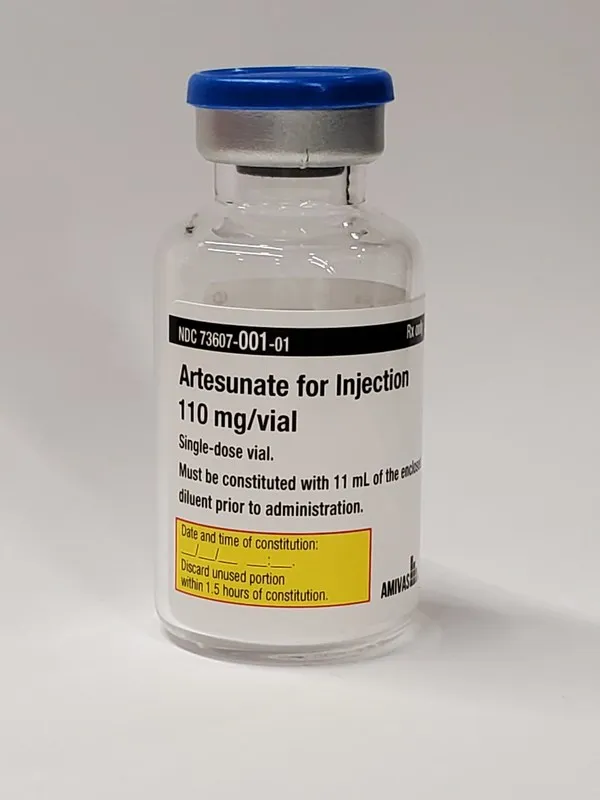
Table of Contents
- Package leaflet: Information for the patient
- Artesunate Amivas 110 mg powder and solvent for solution for injection
- 1. What Artesunate Amivas is and what it is used for
- 2. What you need to know before taking Artesunate Amivas
- 3. How to take Artesunate Amivas
- 4. Possible side effects
- 5. How to store Artesunate Amivas
- 6. Package contents and other information
Package leaflet: Information for the patient
Artesunate Amivas 110 mg powder and solvent for solution for injection
artesunate
This medicinal product is under additional monitoring. This will allow quick identification of new safety information. You can help by reporting any side effects you experience while taking this medicine. See the end of section 4 for information on how to report side effects.
Please read this leaflet carefully before this medicine is administered to you because it contains important information for you.
- Keep this leaflet. You may need to read it again.
- If you have any questions, ask your doctor or nurse.
- If you get any side effects, including those not listed in this leaflet, talk to your doctor or nurse. See section 4.
Contents of this leaflet
- What Artesunate Amivas is and what it is used for
- What you need to know before you are given Artesunate Amivas
- How to use Artesunate Amivas
- Possible side effects
- How to store Artesunate Amivas
- Contents of the pack and other information
1. What Artesunate Amivas is and what it is used for
Artesunate Amivas contains the active substance artesunate. Artesunate Amivas is indicated for the
treatment of severe malaria in adults and children.
After treatment with Artesunate Amivas, your doctor will complete the malaria treatment with a course of oral antimalarial medicines.
2. What you need to know before taking Artesunate Amivas
Do not use Artesunate Amivas
- if you are allergic to artesunate, to other antimalarial treatments containing an artemisinin (e.g. artemether or dihydroartemisinin), or to any of the other ingredients of this medicine (listed in section 6).
Warnings and precautions
After treatment with this medicine, you may develop anaemia, a reduction in the number of red blood
cells, or other blood abnormalities. During treatment, some changes in blood cell counts may occur,
which usually resolve after stopping malaria treatment. However, some people develop severe anaemia
that may appear several weeks after completion of malaria treatment. In most cases, anaemia resolves
without specific treatment. In a limited number of cases, anaemia may be severe and may require blood
transfusions. Your doctor will perform regular blood tests, which may include a direct antiglobulin test,
to determine whether treatment (e.g. with corticosteroids) is needed, and will monitor your recovery for
4 weeks after completion of malaria treatment. It is important to attend these follow-up appointments.
Please consult your doctor for further information.
Other medicines and Artesunate Amivas
Tell your doctor if you are taking, have recently taken, or might take any other medicines. This includes
medicines not requiring a prescription.
Some medicines must not be taken with artesunate because they could reduce its effectiveness against
malaria. Some examples:
- rifampicin (for the treatment of bacterial infections)
- ritonavir, nevirapine (anti-HIV drugs)
- carbamazepine, phenytoin (for the treatment of epilepsy).
Some medicines may increase artesunate levels in the blood and increase the risk of adverse effects.
Some examples:
- diclofenac (for the treatment of pain or inflammation)
- axitinib, vandetanib, and imatinib (used in the treatment of certain tumours).
Artesunate may increase or decrease blood levels of other medicines. Your doctor will advise you on
whether you can take other medicines during treatment with artesunate.
Pregnancy and breastfeeding
If you are pregnant, think you might be pregnant, are planning to become pregnant, or are breastfeeding,
please consult your doctor before taking this medicine.
Your doctor will discuss with you the potential risks of taking Artesunate Amivas during pregnancy. Use
during the first trimester of pregnancy is not recommended unless your doctor determines that the
benefit of treatment to you outweighs the risk to the foetus. During later stages of pregnancy, you
should take Artesunate Amivas only if your doctor considers that no suitable alternative medicines are
available.
If you become pregnant or remain pregnant during treatment with this medicine, your doctor will report
your pregnancy to the manufacturer, which maintains a registry to understand the effects that the
treatment may have on pregnancy and the baby.
Trace amounts of this medicine may pass into breast milk. It is not known whether these trace amounts
may affect the breastfed infant. If you are planning to breastfeed, ask your doctor whether the benefits of
breastfeeding for you and your baby outweigh the potential risk.
Driving and using machines
You must not drive or operate machinery if you feel tired or dizzy.
Artesunate Amivas contains sodium
This medicine contains 193 mg of sodium (a main component of table salt) per single dose, equivalent to
just under 10% of the maximum daily recommended intake of sodium for an adult.
Since the first and second doses are recommended 12 hours apart, this amounts to 386 mg of sodium
(almost 20% of the maximum daily intake).
3. How to take Artesunate Amivas
Use this medicine exactly as your doctor has instructed you. If you have any doubts, consult your doctor.
This medicine will be administered to you as a slow injection directly into a vein. Your doctor or nurse will administer this medicine for you.
The dose of medicine you will receive depends on your body weight, and your doctor or nurse will calculate the correct amount to administer. The recommended dose is 2.4 mg per kg of body weight. The dose per kg is the same for adults and children of all ages.
You will receive at least three doses of Artesunate Amivas, administered 12 hours apart.
After three doses, if you are still unable to take medicines by mouth, you will receive a dose of Artesunate Amivas every 24 hours (once daily) until you are able to take a different antimalarial treatment orally.
It is very important to complete a full course of oral antimalarial treatment after receiving at least three doses of Artesunate Amivas by injection.
If you are given more Artesunate Amivas than you should receive
Since this medicine will be administered to you in a hospital, it is unlikely that you will receive an overdose. If in doubt, speak to your doctor. Signs of overdose may include seizures, dark-coloured stools, a low blood cell count in blood tests, weakness, fatigue, fever, and nausea. Your doctor will help you manage these symptoms if you are given too much of this medicine.
If you miss a dose of Artesunate Amivas
Since this medicine will be administered to you in a hospital, your doctor or nurse will manage your treatment, and it is unlikely that a dose will be missed. In case of a delay in administration, your doctor or nurse will give you the required dose as soon as possible and continue administering subsequent doses at 12- or 24-hour intervals.
If you have any questions about how to use this medicine, speak to your doctor or nurse.
4. Possible side effects
Like all medicines, this medicine can cause side effects, although not everybody gets them.
If you experience any of the following side effects, consult a doctor immediately:
- difficulty breathing or swallowing, swelling of the face, mouth or throat. These are signs of a possible severe allergic reaction. The frequency of very severe allergic reactions leading to loss of consciousness is unknown.
Very common side effects (may affect more than 1 in 10 people):
deficiency of healthy red blood cells, which may cause tiredness and weakness (anaemia); this effect may
occur at least 7 days or sometimes several weeks after treatment has ended.
Common side effects (may affect up to 1 in 10 people)
- inflammation of a vein
- altered sense of taste
- increased body temperature or fever
- urine that is very dark yellow or reddish-brown
- reduced kidney function, including low urine output
- easy bruising or slow healing of cuts or wounds
- abnormal liver enzyme levels detected in blood tests
- yellowing of the skin (jaundice)
- diarrhoea
- abdominal pain
- vomiting
- slow heart rate
- low blood pressure
- cough
- rhinitis (stuffy and/or runny nose)
- feeling dizzy or weak
- headache
Uncommon (affects less than 1 in 100 patients)
- tiredness
- nausea
- constipation
- pain at injection site
- widespread painful rash with blisters, especially around the mouth, nose, eyes and genitals, flu-like symptoms lasting several days (Stevens-Johnson syndrome or SJS)
- loss of appetite
- skin rash
- itching
- swelling and redness of the face
- redness
Not known (frequency cannot be estimated from the available data)
- deficiency of healthy red blood cells caused by your immune system (immune haemolytic anaemia)
- abnormal electrical activity of the heart affecting its rhythm (prolonged QT interval on electrocardiogram)
Reporting of side effects
If you get any side effects, including ones not listed in this leaflet, talk to your doctor or nurse.
You can also report side effects directly via the national reporting system listed in Annex V. By reporting side effects, you can help provide more information on the safety of this medicine.
5. How to store Artesunate Amivas
Keep this medicine out of the sight and reach of children.
Do not use this medicine after the expiry date stated on the label and the carton after
EXP.
This medicine does not require any special storage conditions.
The reconstituted solution must be used within 1.5 hours of preparation.
6. Package contents and other information
What Artesunate Amivas contains
- The active substance is artesunate.
- Each vial of powder contains 110 mg of artesunate.
- Each vial of solvent for reconstitution contains 12 mL of 0.3 M sodium phosphate buffer.
- The other components of the 0.3 M sodium phosphate buffer solvent are monosodium phosphate monohydrate, disodium phosphate dihydrate (see section 2 “Artesunate Amivas contains sodium”), concentrated phosphoric acid (for pH adjustment), sodium hydroxide (for pH adjustment), and water for injections.
After reconstitution with 11 mL of the provided solvent, the injectable solution contains 10 mg of
artesunate per mL.
Description of the appearance of Artesunate Amivas and contents of the pack
Artesunate Amivas 110 mg powder and solvent for solution for injection.
The powder is a fine, crystalline, white or almost white powder contained in a glass vial.
The solvent is a clear, colourless liquid contained in a glass vial.
Each pack contains 2 or 4 vials of Artesunate Amivas powder and 2 or 4 vials of
sodium phosphate buffer solvent.
It is possible that not all pack sizes are marketed.
Marketing Authorisation Holder
Amivas Ireland Ltd, Suite 5, Second Floor, Station House, Railway Square, Waterford, Ireland
Manufacturer
MIAS Pharma Limited, Suite 1, Stafford House, Strand Road, Portmarnock, Co. Dublin, Ireland
Other sources of information
More detailed information on this medicinal product is available on the European Medicines Agency
website: http://www.ema.europa.eu
<------------------------------------------------------------------------------------------------------------------------>
The following information is intended for healthcare professionals only:
Preparation and administration
Calculate the required dose of Artesunate Amivas before reconstitution:
dose in mg = patient's weight in kg x 2.4
During dose preparation, reconstitute only the required number of vials of Artesunate Amivas. Unused, unopened vials can be stored in the carton and used for subsequent scheduled administrations.
To reconstitute the medicinal product, withdraw 11 mL of the provided solvent (0.3 M sodium phosphate buffer) using a needle and syringe. Inject into the vial containing the artesunate powder (the final artesunate concentration after reconstitution is 10 mg/mL). Gently rotate for 5–6 minutes until the powder is completely dissolved. Do not shake.
Visually inspect the solution in the vial to ensure no visible particles remain and that there is no discolouration. Do not administer if the solution is discoloured or contains visible particles.
Administer the reconstituted medicinal product solution by intravenous injection as a slow bolus over
1–2 minutes. Do not administer by continuous intravenous infusion.
The recommended dosing schedule is at 0, 12, 24, and 48 hours, followed by once daily until the
patient is able to tolerate an alternative oral antimalarial agent.
Artesunate Amivas contains 193 mg of sodium per recommended single dose for a 60 kg adult, equivalent to 9.6% of the maximum daily intake recommended by the WHO, which is 2 g of sodium for an adult. Since the first and second doses are recommended 12 hours apart, on days when two doses are administered within a 24-hour period, the total sodium intake would be 386 mg per day, corresponding to 19.2% of the maximum daily intake recommended by the WHO, which is 2 g of sodium for an adult.
Storage of reconstituted Artesunate Amivas solution
Once reconstituted, the Artesunate Amivas solution must be administered within 1.5 hours of preparation. Discard any unused solution in accordance with local guidelines.