Artemis
Italy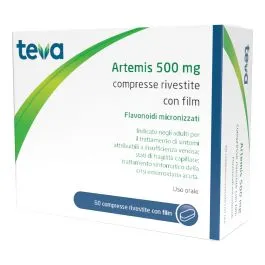
Table of Contents
Package leaflet: Information for the patient
ARTEMIS 500 mg film-coated tablets
Micronized flavonoids, as diosmin and other flavonoids expressed as hesperidin
Please read all of this leaflet carefully before you start taking this medicine because it contains important information for you.
Always take this medicine exactly as described in this leaflet or as your doctor or pharmacist has instructed you.
- Keep this leaflet. You may need to read it again.
- If you need more information or advice, consult your pharmacist.
- If you experience any adverse reactions, including those not listed in this leaflet, contact your doctor or pharmacist. See section 4.
- Contact your doctor if you do not notice any improvement, or if your symptoms worsen after 7 days.
Contents of this leaflet:
- What ARTEMIS is and what it is used for
- What you need to know before taking ARTEMIS
- How to take ARTEMIS
- Possible side effects
- How to store ARTEMIS
- Contents of the pack and other information
1. What ARTEMIS is and what it is used for
ARTEMIS is a vasoprotective agent: it increases venous tone and the resistance of small blood vessels.
ARTEMIS is indicated in adults for the treatment of:
- symptoms related to chronic venous insufficiency of the lower limbs: heaviness, swelling, pain or cramps in the legs;
- capillary fragility (easy rupture of capillaries which become visible on the skin and may cause spots and bruising);
- functional symptoms associated with acute haemorrhoidal crisis, such as pain, bleeding and swelling in the anal region.
Consult your doctor if you do not feel better or if you feel worse after one week of treatment.
2. What you need to know before taking ARTEMIS
Do not take ARTEMIS
If you are allergic to the active substances or to any of the other ingredients of this medicine (listed in
section 6).
Warnings and precautions
Talk to your doctor or pharmacist before taking ARTEMIS.
Chronic venous disease
If your condition worsens during treatment, with symptoms such as skin or vein inflammation, hardening of the subcutaneous tissue, severe pain, skin ulcers, or atypical symptoms such as sudden swelling of one or both legs, speak to your doctor immediately.
ARTEMIS does not help reduce swelling of the lower limbs if this is caused by heart, kidney, or liver diseases.
In case of venous insufficiency, treatment should be combined with a healthy lifestyle to achieve the best results. Avoid exposure to sunlight and heat, prolonged standing, and being overweight.
Walking and wearing special compression stockings improve circulation.
Acute haemorrhoidal disease
If you have an acute haemorrhoid attack, you may take ARTEMIS only for a limited period of 7 days. If symptoms of acute haemorrhoidal crisis do not disappear within 7 days, consult your doctor.
If your condition worsens during treatment—for example, if you notice increased rectal bleeding, blood in the stool, or have doubts about bleeding from haemorrhoids—consult your doctor immediately.
Treatment with ARTEMIS does not replace specific treatment for other anal disorders.
If you have any questions, ask your doctor or pharmacist.
Children and adolescents
The use of ARTEMIS is not recommended in children and adolescents.
Other medicines and ARTEMIS
Inform your doctor or pharmacist if you are taking, have recently taken, or might take any other medicines.
Currently, no interactions with other medicines are known.
Pregnancy and breastfeeding
If you are pregnant, think you might be pregnant, planning a pregnancy, or are breastfeeding, consult your doctor or pharmacist before taking this medicine.
This medicine is not recommended during pregnancy and breastfeeding due to the lack of clinical data.
Driving and using machines
This medicine does not alter or alters negligibly the ability to drive or use machinery.
ARTEMIS contains sodium
This medicine contains less than 1 mmol (23 mg) of sodium per dose, i.e. essentially "sodium-free".
3. How to take ARTEMIS
Take this medicine exactly as stated in this leaflet or as instructed by your doctor or pharmacist. If you have any doubts, consult your doctor or pharmacist.
Chronic venous insufficiency
The recommended dose for adults is 2 tablets daily, taken with the main meals (lunch and dinner), including in cases of haemorrhoids.
Do not exceed the maximum daily dose.
Treatment may last up to 8 weeks. Contact your doctor if you do not feel better or if you feel worse; they will assess whether or not treatment should continue.
Acute haemorrhoidal attack
During the first 4 days of treatment, the recommended dose for adults is 3 tablets twice daily (6 tablets per day). For the following 3 days, the dose is 2 tablets twice daily (4 tablets per day).
Do not exceed the maximum daily dose.
Take these tablets during meals.
If you are taking ARTEMIS to treat symptoms of acute haemorrhoidal disease, consult your doctor or pharmacist if you do not feel better or if you feel worse after 7 days.
If you take more ARTEMIS than you should
If you have taken more ARTEMIS than you should, contact your doctor or pharmacist.
Experience with overdosage of micronized flavonoids is limited. Possible adverse effects in case of overdose may include diarrhoea, nausea, abdominal pain, pruritus, and skin rash.
If you forget to take ARTEMIS
Do not take a double dose to make up for the missed dose.
4. Possible side effects
Like all medicines, this medicine can cause side effects, although not everybody will experience them.
The side effects that may occur with the frequency described below include:
Common (may affect up to 1 in 10 people)
Nausea, vomiting, diarrhoea, indigestion (dyspepsia).
Uncommon (may affect up to 1 in 100 people)
Inflammation of the colon (colitis).
Rare (may affect up to 1 in 1,000 people)
Headache, dizziness, malaise, skin rash, itching, urticaria.
Not known (frequency cannot be estimated from the available data)
Abdominal pain, abnormally low platelet count (thrombocytopenia), swelling of the face, lips or eyelids (oedema) associated with allergic symptoms. Very rarely, rapidly developing oedema of the face, lips, mouth, tongue or pharynx may occur, which may be accompanied by breathing difficulties (angioedema/Quincke's oedema).
Reporting of side effects
If you experience any side effect, including those not listed in this leaflet, talk to your doctor or pharmacist. You can also report side effects directly via the national reporting system at https://www.aifa.gov.it/content/segnalazioni-reazioni-avverse.
By reporting side effects, you can help provide more information on the safety of this medicine.
5. How to store ARTEMIS
Keep this medicine out of the sight and reach of children.
OPA/AL/PVC blister packs: This medicine does not require any special storage conditions.
PVC/AL blister packs: Store at a temperature not exceeding 25°C.
Do not use this medicine after the expiry date stated on the packaging after "Exp". The expiry date refers to the last day of that month.
Do not dispose of any medicine via wastewater or household waste. Ask your pharmacist how to dispose of medicines no longer required. This will help protect the environment.
6. Package contents and other information
What ARTEMIS contains
The active substance consists of micronized flavonoids, including diosmin and other flavonoids expressed as hesperidin. Each film-coated tablet contains 500 mg of micronized flavonoids, comprising 450 mg of diosmin and 50 mg of other flavonoids expressed as hesperidin.
The other components are:
Tablet core: gelatin, sodium lauryl sulfate, sodium starch glycolate (type A), microcrystalline cellulose, magnesium stearate, talc.
Coating: hypromellose (E464), titanium dioxide (E171), glycerol (E422), magnesium stearate (E470b), yellow iron oxide (E172), red iron oxide (E172), macrogol (E1521).
Description of the appearance of ARTEMIS and contents of the pack
ARTEMIS is presented in a cardboard carton containing blisters made of OPA/AL/PVC or PVC/AL, with 30, 60, or 120 film-coated tablets, salmon-red in color and oblong in shape.
Not all pack sizes may be marketed.
Marketing Authorization Holder
Teva Italia s.r.l.
Piazzale Luigi Cadorna, 4
20123 Milan
Manufacturer
Doppel Farmaceutici S.r.l.
Via Volturno, 48 – 20089 Quinto De’ Stampi
Rozzano (MI), Italy