Arlevertan
Italy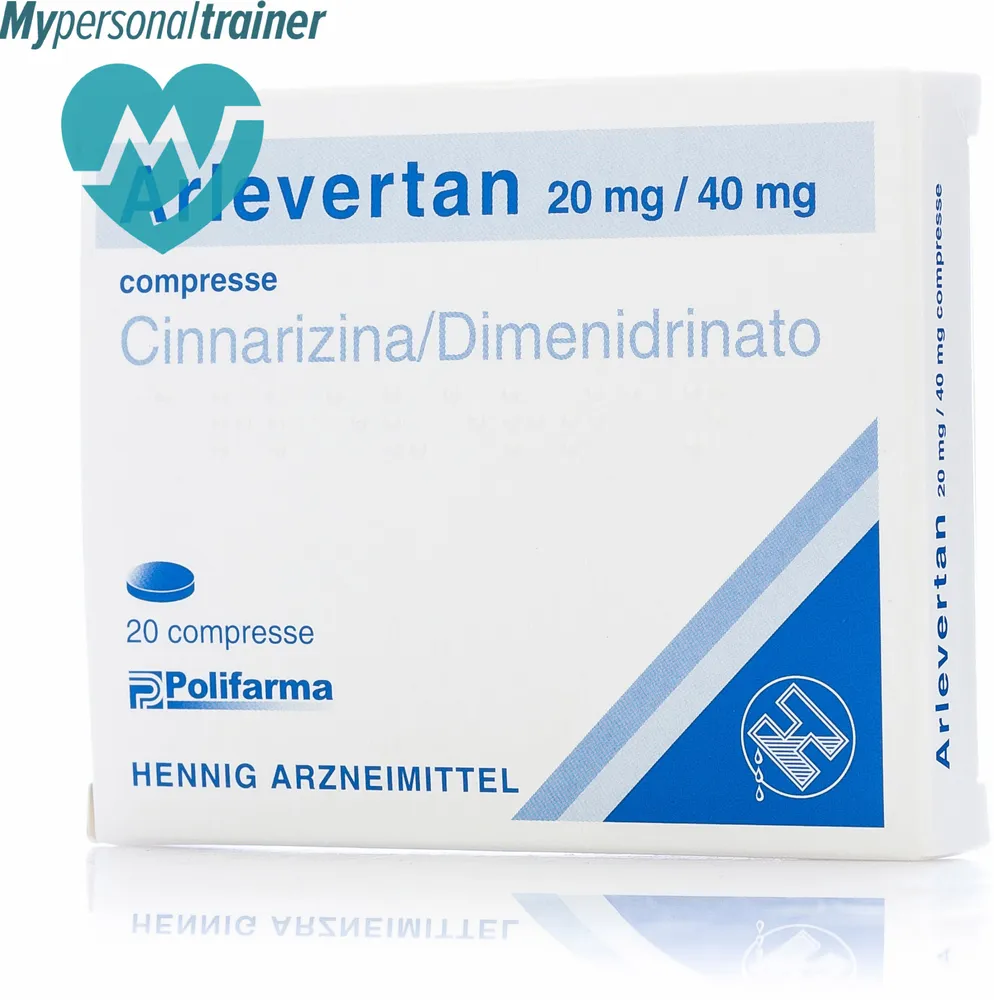
Table of Contents
PACKAGE LEAFLET: INFORMATION FOR THE USER
Arlevertan 20 mg/40 mg tablets
cinnarizine/dimenhydrinate
Please read all of this leaflet carefully before you take this medicine because it contains important information for you.
- Keep this leaflet. You may need to read it again.
- If you have any questions, ask your doctor, pharmacist or nurse.
- This medicine has been prescribed for you only. Do not give it to other people, even if their symptoms are the same as yours, because it could be harmful.
- If you experience any side effect, including those not listed in this leaflet, tell your doctor, pharmacist or nurse. See section 4.
Contents of this leaflet:
- What Arlevertan is and what it is used for
- What you need to know before taking Arlevertan
- How to take Arlevertan
- Possible side effects
- How to store Arlevertan
- Contents of the pack and other information
1. What Arlevertan is and what it is used for
Arlevertan contains two active substances, cinnarizine and dimenhydrinate. These two substances belong to different groups of medicines. Cinnarizine belongs to the so-called calcium antagonists, while dimenhydrinate belongs to the so-called antihistamines.
Both substances work by reducing symptoms of vertigo (a sensation of dizziness or spinning) and nausea (feeling unwell). When these two substances are used in combination, they are more effective than each substance used alone.
Arlevertan is used to treat various types of vertigo in adults. Vertigo can have a number of different causes. The use of Arlevertan may help in carrying out daily activities that are made difficult by vertigo.
2. What you need to know before taking Arlevertan
Do not take Arlevertan
- if you are under 18 years of age
- if you are allergic to cinnarizine, dimenhydrinate or diphenhydramine or to any of the other ingredients of this medicine (listed in section 6)
- if you are allergic to any other antihistamines (such as astemizole, chlorpheniramine and terfenadine, used as antiallergic medicines). You must not take this medicine unless prescribed by your doctor.
- if you have angle-closure glaucoma (a specific type of eye disorder)
- if you have epilepsy
1/6
- if you have increased pressure inside the brain (e.g. due to a tumour)
- if you have a history of alcohol abuse
- if you have prostate problems causing difficulty in urination
- if you have liver or kidney impairment.
Warnings and precautions
Talk to your doctor, pharmacist or nurse before taking Arlevertan if you have:
- low or high blood pressure
- elevated intraocular pressure
- intestinal obstruction
- enlarged prostate
- overactive thyroid
- severe heart disease
- Parkinson's disease.
The use of Arlevertan may worsen these conditions. Although Arlevertan might still be appropriate for you, your doctor must take these factors into account.
Other medicines and Arlevertan
Tell your doctor or pharmacist if you are taking, have recently taken or might take any other medicines.
Arlevertan may interact with other medicines you are taking.
When taken together with the following listed medicines, Arlevertan may cause tiredness or drowsiness:
- barbiturates (medicines often taken to induce a calm state)
- narcotic analgesics (strong painkillers such as morphine)
- tranquillisers (a type of medicine used to treat depression and anxiety)
- monoamine oxidase inhibitors (used to treat depression and anxiety).
Arlevertan may enhance the effects of the following medicines:
- tricyclic antidepressants (used to treat depression and anxiety)
- atropine (a medicine that relaxes muscles and is often used during eye examinations)
- ephedrine (may be used to treat cough or nasal congestion)
- medicines used to lower blood pressure.
Procarbazine (a medicine used to treat certain types of cancer) may intensify the effect of Arlevertan.
Aminoglycosides (a type of antibiotic) may damage the inner ear. If you are taking Arlevertan, you may not notice such damage.
You must not take Arlevertan together with medicines used to correct heart rhythm problems (antiarrhythmics).
Arlevertan may also alter the skin's response to allergy tests.
Arlevertan with food, drinks and alcohol
2/6
Arlevertan may cause indigestion, which can be reduced by taking the tablets after meals. Do not drink alcohol during treatment with Arlevertan, as it may cause tiredness or drowsiness.
Pregnancy, breastfeeding and fertility
If you are pregnant, think you may be pregnant, planning to become pregnant, or breastfeeding, consult your doctor or pharmacist before taking this medicine.
Driving and using machines
Arlevertan may cause drowsiness. If affected, do not drive or operate machinery.
Arlevertan contains sodium
This medicine contains less than 1 mmol (23 mg) of sodium per tablet, i.e. essentially 'sodium-free'.
3. How to take Arlevertan
Take this medicine exactly as directed by your doctor or pharmacist. If you are in doubt, consult your doctor or pharmacist.
The recommended dose is 1 tablet three times a day, taken after meals with some liquid. The tablet must be swallowed whole without chewing.
Arlevertan is usually taken for up to 4 weeks. Your doctor will advise you if it is necessary to continue taking Arlevertan for a longer period.
If you take more Arlevertan than you should
Seek urgent medical advice if you have accidentally taken too many tablets or if a child has swallowed any.
Taking too much Arlevertan may cause severe tiredness, drowsiness and unsteadiness.
Your pupils may become dilated and you may be unable to urinate. You may experience dry mouth, facial flushing, increased heart rate, fever, sweating and headache.
If you take a very large dose of Arlevertan, you may develop seizures, hallucinations, high blood pressure, feel shaky, agitated and have breathing difficulties. You may fall into a coma.
If you forget to take Arlevertan
If you forget to take a dose of Arlevertan, skip that dose. Take the next tablet at your usual time. Do not take a double dose to make up for a forgotten tablet.
If you stop taking Arlevertan
Do not stop taking Arlevertan unless your doctor tells you to. If you stop treatment too early, your vertigo symptoms (sensation of dizziness and spinning) are likely to return.
3/6
If you have any questions about the use of this medicine, consult your doctor, pharmacist or nurse.
4. Possible side effects
Like all medicines, this medicine can cause side effects, although not everyone experiences them.
Common side effects (affect up to 1 in 10 people): drowsiness, dry mouth, headache, and stomach pain. These are usually mild and disappear within a few days, even while continuing treatment with Arlevertan.
Uncommon side effects (affect up to 1 in 100 people): sweating, skin flushing, indigestion, nausea (feeling unwell), diarrhoea, nervousness, cramps, forgetfulness, tinnitus (ringing in the ears), paraesthesia (tingling of hands and/or feet), tremor.
Rare side effects (affect up to 1 in 1,000 people): visual disturbances, allergic reactions (e.g. skin reactions), light sensitivity, and difficulty in urination.
Very rare side effects (affect fewer than 1 in 10,000 people): reduction in white blood cell and platelet counts, and a marked reduction in red blood cell count, which may cause weakness, bruising, or increase the likelihood of developing infections. If you experience infections with fever and a severe worsening of your general health, consult your doctor and inform them of the medicines you are taking.
Other possible reactions (frequency cannot be estimated from the available data) that may occur with this type of medicine include:
weight gain, constipation, chest tightness, jaundice (yellowing of the skin or whites of the eyes due to blood or liver problems), worsening of angle-closure glaucoma (an eye condition with increased eye pressure), uncontrolled movements, unusual excitement and restlessness (particularly in children), and severe skin reactions.
Reporting of side effects
If you experience any side effect, including those not listed in this leaflet, talk to your doctor, pharmacist, or nurse. You can also report side effects directly via the national reporting system at the website
https://www.aifa.gov.it/content/segnalazioni-reazioni-avverse.
By reporting side effects, you can help provide more information on the safety of this medicine.
5. How to store Arlevertan
Keep this medicine out of the sight and reach of children.
Do not use this medicine after the expiry date stated on the blister and outer carton after Exp. The expiry date refers to the last day of that month.
This medicine does not require any special storage conditions.
4/6
Do not dispose of medicines via wastewater or household waste. Ask your pharmacist how to dispose of medicines you no longer use. This will help protect the environment.
6. Package contents and other information
What Arlevertan contains
- The active substances are: cinnarizine 20 mg and dimenhydrinate 40 mg.
- The other components are: microcrystalline cellulose, corn starch, talc, hypromellose, colloidal anhydrous silica, magnesium stearate and sodium croscarmellose.
Description of the appearance of Arlevertan and package contents
Arlevertan tablets are round, biconvex, white to light yellow in colour, and marked with an "A" on one side, with a diameter of 8 mm. They are available in packs containing 20, 24, 48, 50 or 100 tablets. The tablets are supplied in PVC/PVDC/aluminium blisters containing 20, 24 or 25 tablets, depending on the case. Not all pack sizes may be marketed.
Marketing Authorisation Holder and Manufacturer
HENNIG ARZNEIMITTEL GmbH & Co. KG
Liebigstrasse 1-2
65439 Flörsheim am Main
Germany
Marketing Authorisation Holder in Italy:
Polifarma S.p.A.
Viale dell'Arte, 69
00144 - Roma
Tel. 06227421
Fax 0622742261
e-mail: [email protected]
This medicinal product is authorised in the European Economic Area and in the United Kingdom (Northern Ireland) under the following names:
Austria: Arlevert 20 mg/40 mg Tabletten
Belgium, Luxembourg: Arlevertan 20 mg/40 mg tabletten/comprimés/Tabletten
Bulgaria: Arlevert 20 mg/40 mg таблетки
Cyprus, Greece: Arlevert 20 mg/40 mg δισκία
Czech Republic: Arlevert 20 mg/40 mg tablety
Denmark, Sweden: Arlevert 20 mg/40 mg tabletter
Estonia: Arlevert 20 mg/40 mg tabletid
Finland: Arlevert 20 mg/40 mg tabletit
Germany: Arlevert 20 mg/40 mg Tabletten;
Cinnarizin Dimenhydrinat Hennig 20 mg/40 mg Tabletten
Hungary: Arlevert 20 mg/40 mg tabletta
Italy: Arlevertan 20 mg/40 mg compresse
Ireland,
5/6
United Kingdom (Northern Ireland): Arlevert 20 mg/40 mg tablets
Latvia: Arlevert 20 mg/40 mg tabletes
Lithuania: Arlevert 20 mg/40 mg tabletės
Poland: Arlevert 20 mg + 40 mg tabletki
Portugal: Arlevert 20 mg + 40 mg comprimidos
Romania: Arlevert 20 mg/40 mg comprimate
Slovakia: Arlevert 20 mg/40 mg tablety
Slovenia: Arlevert 20 mg/40 mg tablete
Netherlands: Arlevert 20 mg/40 mg tabletten
6/6