Argotone
Italy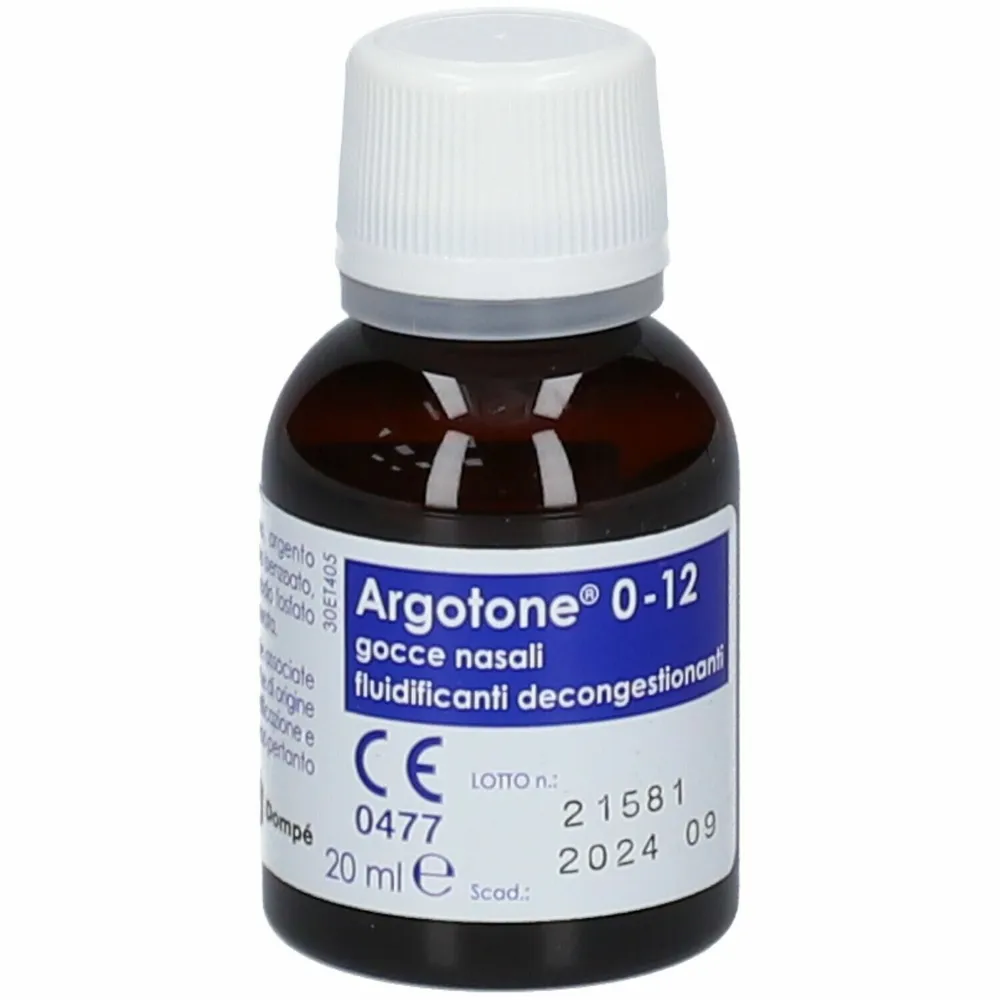
Table of Contents
Package leaflet: information for the user
ARGOTONE 1%/0,9% nasal drops, solution
Argenti proteinatis/Ephedrine hydrochloride
Please read all of this leaflet carefully before you start using this medicine because it contains important information for you.
Use this medicine exactly as described in this leaflet or as your doctor or pharmacist has told you to do.
- Keep this leaflet. You may need to read it again.
- If you need more information or advice, consult your pharmacist.
- If you experience any side effects, including those not listed in this leaflet, contact your doctor or pharmacist. See section 4.
- Contact your doctor if you do not notice any improvement or if your symptoms worsen.
Contents of this leaflet:
- What ARGOTONE is and what it is used for
- What you need to know before using ARGOTONE
- How to use ARGOTONE
- Possible side effects
- How to store ARGOTONE
- Contents of the pack and other information
1. What ARGOTONE is and what it is used for
ARGOTONE contains the active ingredients vitellinized silver, responsible for the antiseptic action, and ephedrine hydrochloride, responsible for the nasal decongestant action. It belongs to the group of nasal decongestant medicines for topical (local) use.
Therefore, ARGOTONE acts as an antiseptic and nasal decongestant.
Consult your doctor if you do not feel better or if you feel worse.
2. What you need to know before using ARGOTONE
Do not use ARGOTONE
- if you are allergic to silver vitellinate, ephedrine hydrochloride, sympathomimetic amines in general, or any of the other ingredients of this medicine (listed in section 6).
- if the patient is a child under 12 years of age.
- if you have heart disease or severe arterial hypertension.
- if you have glaucoma (increased pressure inside the eye).
- if you have prostatic hypertrophy (enlarged prostate).
- if you have hyperthyroidism (overactive thyroid).
- if you have phaeochromocytoma (a tumor of the adrenal gland).
Do not administer during or within two weeks following treatment with monoamine oxidase inhibitors (MAOIs), medicines used to treat depression.
Warnings and precautions
Talk to your doctor or pharmacist before using ARGOTONE.
In patients with cardiovascular diseases and in hypertensive patients, the use of nasal decongestants should always be evaluated by a physician.
Cardiovascular effects may occur with the use of Argotone; rare cases of myocardial ischemia have been reported in association with the use of beta agonists.
Prolonged use of vasoconstrictors—i.e., medicines that cause narrowing of blood vessels, leading to increased blood pressure—may alter the normal function of the nasal and paranasal sinus mucosa and may even lead to drug dependence. Repeated applications for longer than recommended may therefore be harmful.
Use with caution in diabetic patients and, due to the risk of urinary retention, in elderly patients.
Consult your doctor if you experience symptoms such as chest pain or difficulty breathing.
The use, especially prolonged, of topical products may lead to sensitization reactions; in such cases, treatment must be discontinued and, if necessary, appropriate therapy initiated. If there is no complete therapeutic response within a few days, consult your doctor; in any case, treatment should not last longer than one week.
Strictly adhere to the recommended dosage. If accidentally ingested or if used for long periods at excessive doses, this medicine may cause toxic effects.
This medicine must not be taken orally.
Avoid contact of the liquid with the eyes.
Attention for those engaged in sports activities: The medicinal product contains substances prohibited in doping. Any use differing from the recommended dosage regimen or route of administration is forbidden.
Ephedrine may be a substance subject to abuse.
Children and adolescents
This medicine must not be used in children under 12 years of age (see section "Do not use ARGOTONE").
Other medicines and ARGOTONE
Inform your doctor or pharmacist if you are taking, have recently taken, or might take any other medicines.
Ephedrine reduces the plasma half-life of corticosteroids. Therefore, asthmatic patients being treated with these drugs should avoid taking ephedrine-containing products.
Ephedrine contained in ARGOTONE may interact negatively with monoamine oxidase inhibitors (MAOIs). Consequently, administration of this product is contraindicated during or within two weeks following antidepressant drug therapy.
Ephedrine may reduce the pharmacological effectiveness of antihypertensive medicines (used to treat high blood pressure). When combined with clonidine (an antihypertensive), it may cause increased levels of noradrenaline, elevated blood pressure, and an increased risk of arrhythmias.
The urinary excretion of ephedrine is pH-dependent; acetazolamide (a medicine used as a diuretic), antacids, ammonium chloride, and sodium bicarbonate can alkalinize the urine and consequently slow down the elimination of ephedrine.
Concurrent use of ephedrine with digoxin (a medicine that stimulates the heart), phenylpropanolamine (a nasal decongestant), cyclopropane (used to induce anesthesia), and pseudoephedrine (a nasal decongestant) is associated with an increased risk of cardiovascular adverse events (increased risk of arrhythmias).
Reserpine (a medicine used as an antihypertensive and antipsychotic), by causing depletion of noradrenaline, may reduce the effectiveness of ephedrine.
Theophylline may increase the incidence of central nervous system and gastrointestinal adverse effects following administration of ephedrine.
Thyroid hormones: caution is required when sympathomimetics are used concomitantly with thyroid hormones.
Volatile anesthetics: ephedrine should be avoided in patients undergoing anesthesia with halogenated anesthetics.
Pregnancy and breastfeeding
If you are pregnant, think you may be pregnant, planning to become pregnant, or breastfeeding, consult your doctor or pharmacist before using this medicine.
It is advisable to avoid using this medicine during pregnancy or while breastfeeding.
Driving and operating machinery
No effects on the ability to drive or operate machinery are known.
3. How to use ARGOTONE
Use this medicine exactly as stated in this leaflet or as instructed by your doctor or pharmacist. If you have any doubts, consult your doctor or pharmacist.
For adults and children over 12 years of age, the recommended dose is 3 drops in each nostril 2–3 times a day.
Treatment should not be continued for longer than 7 days.
Strictly adhere to the recommended dosage. Exceeding the recommended dose, even if applied locally and for a short period of time, may lead to serious systemic (generalized) effects.
If you use more ARGOTONE than you should
In case of accidental overdose of ARGOTONE, contact your doctor immediately or go to the nearest hospital.
In case of overdose (e.g. accidental oral intake), central depression (depression of the central nervous system) and sedation may occur in children, or episodes of excitation with agitation, hypertensive crises, and facial congestion.
4. Possible side effects
Like all medicines, this medicine can cause side effects, although not everybody will experience them.
This medicine may cause local hypersensitivity or congestion of the mucous membranes, and rebound phenomena, i.e. effects opposite to those desired.
The following side effects have been reported with systemic use of ephedrine and could also occur following the use of nasal drops containing ephedrine.
The following side effects have been reported during post-marketing experience. Frequencies are defined as follows: very common (≥1/10); common (≥1/100, <1/10); uncommon (≥1/1,000, <1/100); rare (≥1/10,000, <1/1,000); very rare (<1/10,000); not known (frequency cannot be estimated from the available data).
Nervous system disorders
Not known: Headache, restlessness, insomnia, tolerance
Cardiac disorders
Not known: Tachycardia (increased heart rate), palpitations, myocardial ischemia
Vascular disorders
Not known: Hypertension (increased blood pressure)
Respiratory, thoracic and mediastinal disorders
Not known: Dyspnoea (difficulty breathing)
Renal and urinary disorders
Not known: Nocturia (frequent urination during the night) in patients with prostate hyperplasia (enlargement of the prostate gland), urinary retention (difficulty passing urine)
Skin and subcutaneous tissue disorders
Not known: Hyperhidrosis (excessive sweating), rash (temporary skin eruption)
Immune system disorders
Not known: Hypersensitivity
Reporting of side effects
If you experience any side effect, including those not listed in this leaflet, consult your doctor, pharmacist or nurse. You may also report side effects directly via the national reporting system at the following website: http://www.agenziafarmaco.gov.it/content/come-segnalare-una-sospetta-reazione-avversa .
By reporting side effects, you can help provide more information on the safety of this medicine.
5. How to store ARGOTONE
Keep this medicine out of the sight and reach of children.
Do not use this medicine after the expiry date stated on the packaging.
The expiry date refers to the last day of that month.
The stated expiry date applies to the product in its original, undamaged packaging and correctly stored.
Do not dispose of any medicine via wastewater or household waste. Ask your pharmacist how to dispose of medicines you no longer use. This will help protect the environment.
Stains caused by Argotone on handkerchiefs can be easily removed by washing them in lukewarm water with any type of detergent. Do not use boiling water, as this would make the stains permanent.
6. Pack contents and other information
What ARGOTONE contains
- The active substances are silver vitellinate and ephedrine hydrochloride.
- 100 ml of solution contain 1.0 g of silver vitellinate and 0.9 g of ephedrine hydrochloride.
- The other components are sodium chloride, purified water, and anhydrous sodium thiosulfate.
Description of the appearance of ARGOTONE and pack contents
20 ml glass bottle.
ARGOTONE is packaged in a child-resistant, hard-to-open container. Therefore, TO OPEN THE BOTTLE, PRESS THE CAP WHILE UNSCREWING IT AT THE SAME TIME. To close it again, simply screw the cap back on tightly.
Marketing Authorization Holder
Dompé farmaceutici S.p.A. Via San Martino 12 - 20122 Milan
Manufacturer
Doppel Farmaceutici S.r.l. - Via Volturno, 48 - Quinto de' Stampi - Rozzano (MI)
Zeta Farmaceutici spa Via Galvani, 10 – 36066 Sandrigo (VI)