Antrolin
Italy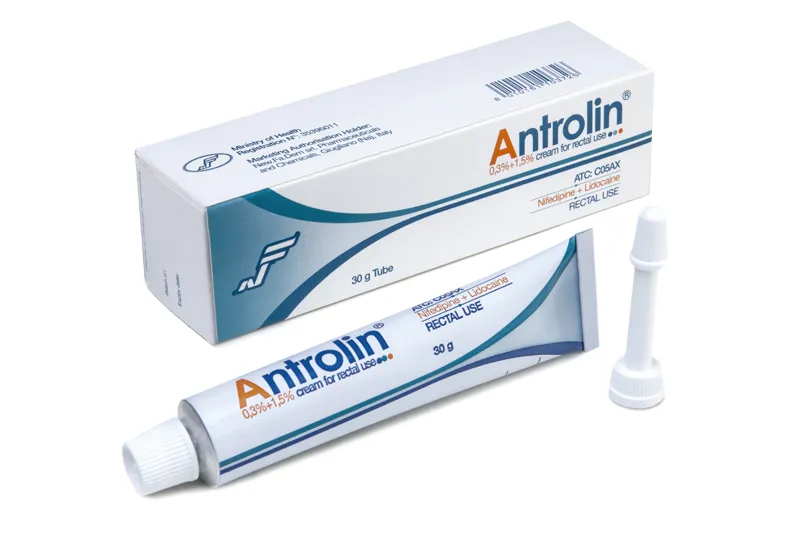
Table of Contents
PACKAGE LEAFLET
ANTROLIN 0.3% + 1.5% rectal cream
ATC Code: C05AX - Nifedipine + Lidocaine
30 g tube
COMPOSITION
100 g of cream contains:
Active substances: Nifedipine 0.3 g - Lidocaine hydrochloride 1.5 g
Excipients: White vaseline, Propylene glycol, Liquid semisynthetic glycerides,
Polyethylene glycol stearate, Cetostearyl alcohol, Glyceryl monostearate, Sodium methyl p-hydroxybenzoate,
Propyl p-hydroxybenzoate, Purified water.
PHARMACEUTICAL FORM AND CONTENT
Rectal cream. 30 g aluminium tube with applicator nozzle, packed in a cardboard carton.
PHARMACOTHERAPEUTIC CATEGORY
Medicinal product containing nifedipine, a dihydropyridine calcium antagonist which, when applied locally, exerts a relaxing effect on peripheral smooth muscle and is able to reduce the tone of the internal anal sphincter. The action of nifedipine is complemented in this product by lidocaine, a surface local anaesthetic.
MARKETING AUTHORISATION HOLDER
Neopharmed Gentili S.p.A.
Via San Giuseppe Cottolengo, 15
20143 - Milan
MANUFACTURER AND FINAL CONTROLLER
New.Fa.Dem srl Farmaceutici e Chimici, with legal seat and manufacturing plant at Viale Ferrovie dello Stato, zona A.S.I., Giugliano in Campania (NA)
THERAPEUTIC INDICATIONS
Treatment of anal fissure and proctalgia in general associated with anal sphincter hypertonia.
CONTRAINDICATIONS
Hypersensitivity to the active substances, particularly to lidocaine (and other local anaesthetics of similar amide-type structure), or to any of the excipients.
Confirmed or suspected pregnancy and breastfeeding (see also "Special warnings").
Severe hypotensive states and cardiovascular insufficiency.
PRECAUTIONS FOR USE
During clinical trials, no adverse effects related to possible systemic absorption of the drug have been reported. However, ANTROLIN rectal cream should still be used with extreme caution in patients with severely damaged mucosa or inflammation in the area to be treated, as excessive absorption of the active substances may occur under such conditions. The medicinal product should also be used cautiously in diabetic patients or in those with severe hepatic and/or renal insufficiency.
Treatment with ANTROLIN rectal cream should be carried out under medical supervision in very elderly patients, in patients under 18 years of age, and in patients receiving beta-blockers or antihypertensive drugs.
It is advisable to monitor blood pressure at the beginning and periodically during treatment.
If treatment fails (no improvement or worsening of symptoms), treatment must be discontinued and the physician consulted for further management.
INTERACTIONS WITH OTHER MEDICINAL PRODUCTS
Due to the presence of nifedipine, the effect of antihypertensive drugs may be enhanced by the use of ANTROLIN rectal cream. Propranolol prolongs the plasma half-life of lidocaine and increases plasma levels of nifedipine. Cimetidine may increase plasma levels of lidocaine and nifedipine. Concomitant administration of ANTROLIN rectal cream in patients receiving digoxin may lead to increased plasma levels of digoxin.
SPECIAL WARNINGS
Topical application of the medicinal product in excessive doses and/or for prolonged periods may lead to sensitisation phenomena and local reactions such as hyperaemia and bleeding, which resolve upon discontinuation of treatment.
Use during pregnancy and breastfeeding
Nifedipine and lidocaine cross the placental barrier and are excreted in breast milk. In studies conducted in rats and rabbits, nifedipine has been shown to produce teratogenic effects. Lidocaine has not shown risks for the fetus. However, use of this product is not recommended in pregnant and breastfeeding women.
Warnings regarding certain excipients present in the medicinal product
ANTROLIN rectal cream contains sodium methyl p-hydroxybenzoate and propyl p-hydroxybenzoate, which may cause allergic reactions, including delayed reactions. Furthermore, ANTROLIN rectal cream contains propylene glycol and cetostearyl alcohol, which may cause local skin reactions (e.g., contact dermatitis).
T.
DOSAGE, METHOD AND DURATION OF ADMINISTRATION:
For endorectal and perianal application.
Apply the cream twice daily for at least three weeks.
Method of administration
- Lie on your left side on the bed;
- unscrew the cap from the tube and screw on the applicator nozzle; squeeze out a small amount of cream to lubricate the nozzle and insert it into the anus;
- press the end of the tube and squeeze out the amount of cream contained in approximately one centimetre of the tube (one centimetre of the tube contains approximately 2.5–3 g of cream).
OVERDOSE
No cases of systemic toxicity due to overdose following topical application of ANTROLIN rectal cream have been reported. In the event of intoxication after topical application, systemic effects would be expected to be similar to those induced by the active substances administered via other routes.
In cases of severe intoxication with nifedipine, symptoms may include disturbances of consciousness up to coma, decreased arterial pressure, cardiac rhythm disturbances and cardiogenic shock. For treatment, beta-sympathomimetics may be used for bradycardic rhythm disturbances, and in cases of severe hypotension, calcium gluconate (10–20 ml of 10% solution slowly administered intravenously) and, if necessary, dopamine or noradrenaline may be used.
Most toxic reactions to local anaesthetics and lidocaine in humans affect the CNS; a sensation of "light-headedness" and dizziness may occur, often followed by visual and auditory disturbances such as difficulty in accommodation and tinnitus; in more severe cases, CNS depression and convulsions may occur. Treatment is symptomatic.
UNDESIRABLE EFFECTS
Locally, reactions such as pain, burning, itching, hyperaemia and bleeding may occur. These effects resolve after discontinuation of treatment.
Very rarely, local application of lidocaine-containing preparations has caused allergic reactions (in the most severe cases, anaphylactic shock).
During the clinical trial phase, no undesirable effects due to possible systemic absorption of the two active substances (headache, dizziness, peripheral vasodilation, hypotension, dizziness and tremors) were observed.
Undesirable effect with unknown frequency: respiratory difficulty.
Inform your doctor or pharmacist if you experience any adverse effects not described here or not otherwise explainable.
EXPIRY DATE AND STORAGE:
Check the expiry date stated on the packaging.
Store in a tightly closed container; store at a temperature not exceeding 25°C.
The expiry date refers to the product in its original, unopened packaging, correctly stored.
The product remains valid for 30 days after first opening (record the date of first opening in the designated space on the carton).
WARNING: Do not use the medicinal product after the expiry date stated on the packaging or after 30 days from first opening.
Keep the medicinal product out of the reach of children.
REVISION OF THE PACKAGE LEAFLET BY THE MINISTRY OF HEALTH: