Antithrombin III Kedrion
ItalyTable of Contents
- Package leaflet: Information for the user
- AT III KEDRION 500 IU/10 ml Powder and solvent for solution for infusion, 1000 IU/20 ml Powder and solvent for solution for infusion
- 1. What AT III KEDRION is and what it is used for
- 2. What you should know before using AT III KEDRION
- 3. How to use AT III KEDRION
- 4. Possible adverse reactions
- 5. How to store AT III KEDRION
- 6. Contents of the pack and other information
- The following information is intended exclusively for healthcare professionals:
- Package leaflet: Information for the user
- AT III KEDRION 2000 IU / 40 ml Powder and solvent for solution for infusion
- 1. What AT III KEDRION is and what it is used for
- 2. What you should know before using AT III KEDRION
- 3. How to use AT III KEDRION
- 4. Possible adverse reactions
- 5. How to store AT III KEDRION
- 6. Contents of the pack and other information
- The following information is intended exclusively for healthcare professionals:
Package leaflet: Information for the user
AT III KEDRION 500 IU/10 ml Powder and solvent for solution for infusion, 1000 IU/20 ml Powder and solvent for solution for infusion
Human Antithrombin
Please read all of this leaflet carefully before you start using this medicine because it contains important information for you.
- Keep this leaflet. You may need to read it again.
- If you have any questions, ask your doctor.
- This medicine has been prescribed for you only. Do not give it to other people, even if they have the same symptoms as yours, because it may be harmful.
- If you experience any side effects, including those not listed in this leaflet, tell your doctor or pharmacist. See section 4.
Contents of this leaflet:
- What AT III KEDRION is and what it is used for
- What you need to know before you use AT III KEDRION
- How to use AT III KEDRION
- Possible side effects
- How to store AT III KEDRION
- Contents of the pack and other information
1. What AT III KEDRION is and what it is used for
AT III KEDRION is a solution of Antithrombin derived from human plasma. Antithrombin is a
plasma glycoprotein (a normal constituent of human plasma) with anticoagulant activity (inhibitor of blood
coagulation).
In patients with congenital or acquired Antithrombin deficiency:
a) for prophylaxis (prevention) of deep vein thrombosis (obstruction of a vein by a blood clot) and
thromboembolism (abnormal formation of blood clots) in clinical risk situations (especially during
surgical procedures or the peripartum period), in association with heparin when indicated;
b) for prevention of progression of deep vein thrombosis and thromboembolism, in association with
heparin, when indicated.
2. What you should know before using AT III KEDRION
Do not use AT III KEDRION
- if you are allergic to AT III KEDRION or to any of the other ingredients of this medicine (listed in section 6).
- if you have previously experienced heparin-induced thrombocytopenia (low platelet count)
Warnings and precautions
Talk to your doctor before using AT III KEDRION.
Your doctor or another healthcare professional will closely monitor and carefully observe you throughout
the entire infusion period with AT III KEDRION to ensure that no reactions occur.
As with any intravenous protein product, allergic-type hypersensitivity reactions may occur.
If during administration of the product you notice any of the symptoms listed below, inform the attending
physician immediately, as these symptoms could be the first signs of an allergic reaction. The doctor will decide whether to reduce the infusion rate or to stop the infusion.
Furthermore, the doctor will determine the necessary treatment based on the nature and severity of the side effect.
The first signs of hypersensitivity reactions are:
- urticaria,
- generalized urticaria,
- chest tightness (feeling of chest constriction),
- wheezing (breathing difficulty),
- hypotension and anaphylaxis (severe and rapid allergic reaction). If these symptoms occur after administration, contact your doctor.
In case of shock, the doctor must follow the standard treatment for this condition.
If antithrombin is administered together with heparin:
to adjust the heparin dosage and to avoid excessive hypocoagulability (poor blood clotting), clinical tests will be performed at close intervals to monitor the extent of anticoagulation, particularly during the first minutes/hours following the start of antithrombin administration;
to adjust the individual dose, antithrombin levels will be monitored daily through clinical tests due to the risk of decreased antithrombin levels caused by prolonged treatment with unfractionated heparin.
Viral safety
Medicinal products prepared from human blood or plasma are subject to a number of safety measures to prevent transmission of infections to patients. These measures include careful selection of blood or plasma donors to ensure that potentially infected donors are excluded, and testing of each donation and plasma pool to detect the possible presence of viruses. In addition, manufacturers of these products incorporate into the manufacturing process certain steps capable of inactivating or removing pathogens. Despite these measures, when administering medicinal products prepared from human blood or plasma, the possibility of transmitting an infection cannot be completely ruled out. This also applies to emerging or unknown viruses or other infectious agents.
The measures taken are considered effective against lipid-enveloped viruses such as human immunodeficiency virus (HIV), hepatitis B virus (HBV), hepatitis C virus (HCV), and against the non-lipid-enveloped hepatitis A virus (HAV).
The measures adopted have limited effectiveness against non-lipid-enveloped viruses such as parvovirus B19.
Parvovirus B19 infection may be severe during pregnancy (fetal infection) and in individuals with depressed immune systems or certain types of anemia (e.g. hemolytic anemia).
Appropriate vaccination (hepatitis A and B) is recommended for patients receiving regular plasma-derived antithrombin concentrates.
Other medicines and AT III KEDRION
Inform your doctor or pharmacist if you are taking, have recently taken, or might take any other medicines.
Antithrombin replacement therapy during administration of therapeutic doses of heparin increases the risk of bleeding.
The effect of antithrombin is strongly enhanced by heparin.
Concomitant administration of heparin and antithrombin in a patient with increased risk of bleeding must be clinically and biologically monitored.
AT III KEDRION must not be mixed with other medicinal products.
Only commercially available, authorized devices should be used for infusion, as treatment may be ineffective due to absorption of human antithrombin onto the inner surfaces of certain injection/infusion devices.
Pregnancy, breastfeeding and fertility
If you are pregnant, suspect you may be pregnant, are planning a pregnancy, or are breastfeeding, consult your doctor or pharmacist before using this medicine.
Experience regarding the safety of human antithrombin-containing products during human pregnancy is limited.
AT III KEDRION should be administered during pregnancy and breastfeeding to women with antithrombin deficiency under medical supervision, considering that in these patients the risk of thromboembolic events increases during pregnancy.
Driving and using machines
No effects on the ability to drive or use machinery have been observed.
AT III KEDRION contains sodium
This medicine contains up to 92 mg of sodium (a main component of cooking salt) per vial in the 1000 IU presentation and up to 46 mg of sodium (a main component of cooking salt) per vial in the 500 IU presentation.
This corresponds to 4.6% and 2.3% of the maximum daily dietary intake recommended for an adult, respectively.
3. How to use AT III KEDRION
Use this medicine exactly as directed by your doctor. If you have any doubts, consult your doctor.
AT III KEDRION may only be used in hospitals or clinics and healthcare facilities by medical professionals or other healthcare providers.
For instructions on correct use and dosage, refer to the section "The following information is intended exclusively for doctors or healthcare professionals".
Treatment must be initiated under the supervision of a physician experienced in managing patients with antithrombin deficiency.
The dose and treatment regimen depend on the indication; your doctor will determine the appropriate dose and treatment schedule for you.
For patient safety, whenever AT III KEDRION is administered to patients, it is recommended to record the product's brand name and the production batch number, in order to maintain traceability between the patient and the product batch.
Use in children
There are insufficient data to recommend the use of AT III KEDRION in children under 6 years of age.
If you use more AT III KEDRION than you should
Symptoms of antithrombin overdose are not known.
4. Possible adverse reactions
Like all medicines, AT III KEDRION can cause adverse reactions, although not everyone experiences them.
Rarely, hypersensitivity or allergic reactions have been observed, which may include angioedema (localized swelling), burning and itching sensations at the infusion site, chills, flushing, generalized urticaria, headache, urticaria, hypotension, lethargy (drowsiness), nausea, restlessness, tachycardia, chest tightness (feeling of chest constriction), paresthesia (altered sensation in limbs), vomiting, wheezing (difficulty breathing), which in some cases may lead to acute anaphylaxis including shock (severe and rapid allergic reaction).
Fever has been observed in rare cases.
For information on viral safety, see section “Viral safety”.
Reporting of adverse reactions
If you experience any adverse reaction, including those not listed in this leaflet, consult your doctor. You may also report adverse reactions directly via the national adverse reaction reporting system.
By reporting adverse reactions, you can help provide more information on the safety of this medicine.
5. How to store AT III KEDRION
Keep this medicine out of the sight and reach of children.
See the expiry date stated on the packaging.
The expiry date refers to the product in its original, unopened packaging, correctly stored.
Do not use this medicine after the expiry date stated on the label and the carton. The expiry date refers to the last day of that month.
Store in the refrigerator (2°C - 8°C). Do not freeze.
Keep the vial in the outer packaging to protect the medicine from light.
Do not use this medicine if you notice cloudy solutions or particles.
The product should be used within 8 hours after reconstitution. It is, however, advisable to administer the reconstituted solution immediately, whenever possible, using the solvent supplied.
The reconstituted product may be stored for up to 8 hours at a temperature not exceeding 30°C, or in the refrigerator (2°C - 8°C).
Do not dispose of any medicine via wastewater or household waste. Ask your pharmacist how to dispose of medicines no longer required. This will help protect the environment.
6. Contents of the pack and other information
What AT III KEDRION contains
The active substance is antithrombin derived from human plasma.
| AT III KEDRION 500 IU/10ml | AT III KEDRION 1000 IU/20ml | |
| Antithrombin from human plasma | 500 IU/vial | 1000 IU/vial |
| Antithrombin from human plasma reconstituted with water for injectable preparations | 50 IU/ml (500 IU/10 ml) | 50 IU/ml (1000 IU/20 ml) |
| Solvent volume | 10 ml | 20 ml |
The activity (IU) is determined using the chromogenic method of the European Pharmacopoeia.
The specific activity of AT III KEDRION is approximately 5.0 IU/mg of protein.
The other components of the powder vial are Monosodium phosphate, Sodium chloride, Glycine.
The solvent vial contains Water for Injections.
Description of the appearance of AT III KEDRION and contents of the pack
Powder and solvent for solution for infusion.
The medicinal product appears as a hygroscopic powder or friable mass, white or almost white.
After reconstitution with the solvent, the solution appears clear or slightly opalescent.
Before administration, the dissolved products must be visually inspected for the presence of suspended particles or abnormal discoloration.
Do not use cloudy solutions or those showing deposits.
The AT III KEDRION pack contains one powder vial, one solvent vial for preparing the solution to be administered, and a sterile, pyrogen-free, single-use set consisting of a reconstitution device, an injection syringe, and a butterfly needle with a PVC tube.
Pack sizes
AT III KEDRION 500 IU/10 ml powder and solvent for solution for infusion. Contains: 1 powder vial + 1 solvent vial 10 ml + reconstitution and administration set.
AT III KEDRION 1000 IU/20 ml powder and solvent for solution for infusion. Contains: 1 powder vial + 1 solvent vial 20 ml + reconstitution and administration set.
MARKETING AUTHORISATION HOLDER
Kedrion S.p.A. – Loc. Ai Conti, 55051 Castelvecchio Pascoli, Barga (Lucca).
MANUFACTURER
Kedrion S.p.A. – 55027 Bolognana, Gallicano (Lucca).
The following information is intended exclusively for healthcare professionals:
Dosage recommendations:
In congenital deficiencies, the dosage must be individualized for each patient, taking into account the
family history, particularly with regard to thromboembolic events, clinical risk factors, and laboratory
assessments.
The dosage and duration of replacement therapy in acquired deficiencies depend on the plasma antithrombin
level, the presence of signs of increased turnover, the underlying disease, and the severity of the clinical
condition. The amount to be administered and the frequency of administration must always be based, in each
individual case, on clinical efficacy and laboratory monitoring.
The quantity of antithrombin administered is expressed in International Units (IU), which are standardized
against the current WHO reference standard for antithrombin. Antithrombin activity in plasma is expressed
both as a percentage (relative to normal human plasma) and as International Units (relative to the
international standard for plasma antithrombin).
One International Unit (IU) of antithrombin activity is equivalent to the amount of antithrombin present in one
milliliter of normal human plasma. The calculation of the required antithrombin dose is based on the
empirical observation that one International Unit (IU) of antithrombin per kg of body weight increases
plasma antithrombin activity by approximately 1.5%.
The initial dose is determined using the following formula:
Units required = body weight (kg) × (desired level – actual antithrombin activity [%]) ×
correction factor
The initial antithrombin activity level to be achieved depends on the clinical situation. When antithrombin
replacement is indicated, the dosage must be sufficient to reach the desired antithrombin activity and to
maintain an effective level. The dosage must be individualized and monitored based on laboratory
measurements of antithrombin activity, which should be performed at least twice daily until the patient is
stable, and then once daily, preferably immediately before the next infusion. Dosage adjustments must take
into account both signs of increased antithrombin turnover, as indicated by laboratory monitoring, and the
clinical course. Antithrombin activity should be maintained above 80% throughout the duration of treatment,
unless clinical characteristics indicate a different effective level.
The usual initial dose in congenital deficiencies is 30–50 IU/kg.
Subsequently, the dose, frequency, and duration of treatment must be adjusted based on biological data and
clinical status.
Administration method
Reconstitute the lyophilized powder as described in the following section Instructions for correct use.
The product must be administered intravenously.
The infusion should be completed within a maximum of two hours.
Instructions for correct use
Reconstitution of the powder with the solvent:
- Bring the vial of powder and the solvent vial to room temperature;
- Maintain this temperature throughout the entire reconstitution process (maximum 10 minutes);
- Remove the protective caps from the powder and solvent vials;
- Clean the surfaces of the stoppers of both vials with alcohol;
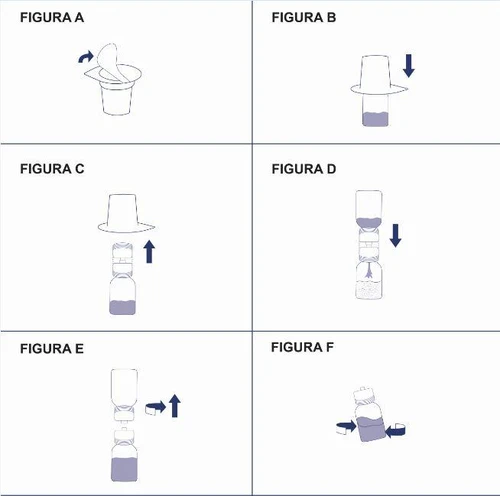
- Open the device package by removing the top part; take care not to touch the inside (fig. A);
- Do not remove the device from the package;
- Turn the device package upside down and insert the plastic spike through the stopper of the solvent vial so that the blue part of the device is connected to the solvent vial (fig. B);
- Grasp the edge of the device package and pull it off to release the device without touching it (fig. C);
- Ensure the vial containing the powder is placed on a stable surface; invert the system so that the solvent vial is positioned above the device; push the transparent/white adapter onto the stopper of the vial containing the powder so that the plastic spike penetrates the stopper of the powder vial. The solvent will be automatically drawn into the powder vial (fig. D);
- After the transfer of solvent, unscrew the blue part of the transfer system with the attached solvent vial and remove it (fig. E);
- Gently rotate the vial until the powder is completely dissolved. Do not shake vigorously to avoid foam formation (fig. F);
Ensure that the powder is completely dissolved; otherwise, there will be a loss of product activity.
Administration of the solution
The reconstituted medicinal product must be visually inspected before administration for particles or
discoloration. The solution should be clear or slightly opalescent.
Do not use solutions that are cloudy or contain deposits.
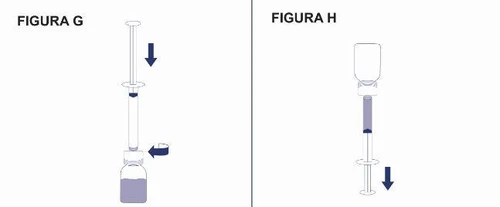
- Fill the syringe with air by pulling back the plunger, attach it to the device, and inject the air into the vial containing the reconstituted solution (fig. G);
- While holding the plunger steady, invert the system so that the vial containing the reconstituted solution is positioned above the device, and draw the concentrate into the syringe by slowly pulling back the plunger (fig. H);
- Detach the syringe by rotating it counterclockwise;
- Visually inspect the solution in the syringe, which should appear clear or slightly opalescent and free from particles;
- Attach the butterfly needle to the syringe and administer by slow intravenous infusion or injection.
Once the vials have been opened, the contents must be used immediately.
The reconstituted solution transferred into the syringe must be administered immediately.
The contents of the vial must be used for a single administration only.
Do not use after the expiry date stated on the label.
Any unused medicinal product and waste materials derived from it must be disposed of in
accordance with local regulations.
Warnings and precautions
Patients must be closely monitored and carefully observed for any symptoms during the infusion period.
The half-life of antithrombin may be considerably reduced by concomitant treatment with heparin due to
accelerated antithrombin turnover. Therefore, the simultaneous administration of heparin and antithrombin
to a patient with an increased risk of bleeding must be clinically and biologically monitored.
Package leaflet: Information for the user
AT III KEDRION 2000 IU / 40 ml Powder and solvent for solution for infusion
Human antithrombin
Please read this leaflet carefully before using this medicine because it contains important information for you.
- Keep this leaflet. You may need to read it again.
- If you have any questions, ask your doctor.
- This medicine has been prescribed for you only. Do not give it to others, even if their symptoms are the same as yours, as it could be harmful.
- If you experience any adverse reaction, including those not listed in this leaflet, consult your doctor or pharmacist. See section 4.
Contents of this leaflet:
- What AT III KEDRION is and what it is used for
- What you need to know before using AT III KEDRION
- How to use AT III KEDRION
- Possible side effects
- How to store AT III KEDRION
- Contents of the pack and other information
1. What AT III KEDRION is and what it is used for
AT III KEDRION is a solution of Antithrombin derived from human plasma. Antithrombin is a
plasma glycoprotein (a normal constituent of human plasma) with anticoagulant activity (an inhibitor of
blood coagulation).
In patients with congenital or acquired Antithrombin deficiency:
a) for prophylaxis (prevention) of deep vein thrombosis (obstruction of a vein by a blood clot) and thromboembolism (abnormal formation of blood clots) in clinical risk situations (especially during surgical procedures or the childbirth period), in combination with heparin when indicated;
b) for prevention of progression of deep vein thrombosis and thromboembolism, in combination with heparin when indicated.
2. What you should know before using AT III KEDRION
Do not use AT III KEDRION
- if you are allergic to AT III KEDRION or to any of the other ingredients of this medicine (listed in section 6).
- if you have previously experienced heparin-induced thrombocytopenia (low platelet count)
Warnings and precautions
Talk to your doctor before using AT III KEDRION.
Your doctor or another healthcare professional will closely monitor and carefully observe you throughout
the entire infusion period with AT III KEDRION to ensure that no reactions occur.
As with any intravenous protein product, allergic-type hypersensitivity reactions may occur.
If during administration of the product you notice any of the symptoms listed below, you must
inform the attending physician immediately, as these symptoms could be the first signs of an allergic reaction. The physician will decide whether to reduce the infusion rate or to stop the infusion.
Additionally, the physician will determine the necessary treatment based on the nature and severity of the side effect.
The first signs of hypersensitivity reactions are:
- urticaria,
- generalized urticaria,
- chest tightness (feeling of chest constriction),
- wheezing (breathing difficulty),
- hypotension and anaphylaxis (severe and rapid allergic reaction). If these symptoms occur after administration, contact your doctor.
In case of shock, the physician must follow the standard treatment for this condition.
If antithrombin is administered together with heparin:
to adjust the heparin dosage and to avoid excessive hypocoagulability (poor blood clotting), clinical tests will be performed at close intervals to monitor the extent of anticoagulation, particularly during the first minutes/hours following the start of antithrombin administration;
to adjust the individual dose, antithrombin levels will be monitored daily through clinical tests due to the risk of decreased antithrombin levels associated with prolonged treatment with unfractionated heparin.
Viral safety
Medicines prepared from human blood or plasma are subject to a number of safety measures to prevent transmission of infections to patients. These measures include careful selection of blood or plasma donors to ensure that potentially infected donors are excluded, and testing of each donation and plasma pool to detect possible presence of viruses. In addition, manufacturers of these medicines incorporate into the manufacturing process certain steps capable of inactivating or removing pathogens. Despite these measures, when administering medicinal products prepared from human blood or plasma, the possibility of transmitting an infection cannot be completely ruled out. This also applies to emerging or unknown viruses or other types of infectious agents.
The measures taken are considered effective against lipid-enveloped viruses such as human immunodeficiency virus (HIV), hepatitis B virus (HBV), hepatitis C virus (HCV), and the non-enveloped hepatitis A virus (HAV).
The measures adopted have limited effectiveness against non-enveloped viruses such as parvovirus B19.
Parvovirus B19 infection may be severe during pregnancy (fetal infection) and in individuals with depressed immune systems or certain types of anemia (e.g., hemolytic anemia).
Appropriate vaccination (hepatitis A and B) is recommended for patients who regularly receive plasma-derived antithrombin concentrates.
Other medicines and AT III KEDRION
Inform your doctor or pharmacist if you are taking, have recently taken, or might take any other medicines.
Antithrombin replacement therapy during administration of therapeutic doses of heparin increases the risk of bleeding.
The effect of antithrombin is strongly enhanced by heparin.
Concomitant administration of heparin and antithrombin in a patient with increased risk of bleeding must be clinically and biologically monitored.
AT III KEDRION must not be mixed with other medicinal products.
Only commercially available, authorized devices should be used for infusion, as treatment may become ineffective due to adsorption of human antithrombin onto the inner surfaces of certain injection/infusion devices.
Pregnancy, breastfeeding and fertility
If you are pregnant, think you may be pregnant, are planning a pregnancy, or are breastfeeding, ask your doctor or pharmacist for advice before using this medicine.
Experience regarding the safety of antithrombin-containing products during human pregnancy is limited.
AT III KEDRION should be administered during pregnancy and breastfeeding to women with antithrombin deficiency under medical supervision, considering that in these patients the risk of thromboembolic events increases during pregnancy.
Driving and using machines
No effects on the ability to drive or operate machinery have been observed.
AT III KEDRION contains sodium
This medicine contains up to 184 mg of sodium (a main component of table salt) per vial.
This corresponds to 9.2% of the maximum daily recommended dietary intake for an adult.
3. How to use AT III KEDRION
Use this medicine exactly as directed by your doctor. If you have any doubts, consult your doctor.
AT III KEDRION may only be used in hospitals or clinics and healthcare facilities by medical professionals or other healthcare providers.
For instructions on correct use and dosage, refer to the section "The following information is intended exclusively for doctors or healthcare professionals."
Treatment must be initiated under the supervision of a physician experienced in managing patients with antithrombin deficiency.
The dose and treatment regimen depend on the indication; your doctor will determine the appropriate dose and regimen for you.
For patient safety, whenever AT III KEDRION is administered to patients, it is recommended to record the brand name of the product and the manufacturing batch number, in order to maintain traceability between the patient and the product batch.
Use in children
There are insufficient data to recommend the use of AT III KEDRION in children under 6 years of age.
If you use more AT III KEDRION than you should
Symptoms of antithrombin overdose are not known.
4. Possible adverse reactions
Like all medicines, AT III KEDRION can cause adverse reactions, although not everyone experiences them.
Rarely, hypersensitivity or allergic reactions have been observed, which may include angioedema (localized swelling), burning and stinging sensations at the infusion site, chills, flushing, generalized urticaria, headache, urticaria, hypotension, lethargy (drowsiness), nausea, restlessness, tachycardia, chest tightness (feeling of chest constriction), paresthesia (altered sensation in limbs), vomiting, wheezing (difficulty breathing), which in some cases may lead to acute anaphylaxis including shock (severe and rapid allergic reaction).
Fever has been observed in rare cases.
For information on viral safety, see section “Viral safety”.
Reporting of adverse reactions
If you experience any adverse reaction, including those not listed in this leaflet, contact your doctor. You may also report adverse reactions directly via the national reporting system at:
https://www.aifa.gov.it/content/segnalazioni-reazioni-avverse
By reporting adverse reactions, you can help provide more information on the safety of this medicine.
5. How to store AT III KEDRION
Keep this medicine out of the sight and reach of children.
See the expiry date stated on the packaging.
The expiry date refers to the product in its original packaging, when properly stored.
Do not use this medicine after the expiry date shown on the label and the box. The expiry date refers to the last day of that month.
Store in the refrigerator (2°C - 8°C). Do not freeze.
Keep the vial in the outer packaging to protect the medicine from light.
Do not use this medicine if you notice cloudy solutions or particles.
The product should be used within 8 hours after reconstitution. Immediate administration of the solution reconstituted with the included solvent is recommended whenever possible.
The reconstituted product may be stored for 8 hours at a temperature not exceeding 30°C, or in the refrigerator (2°C - 8°C).
Do not dispose of medicines via wastewater or household waste. Ask your pharmacist how to dispose of medicines you no longer use. This will help protect the environment.
6. Contents of the pack and other information
What AT III KEDRION contains
The active substance is antithrombin derived from human plasma.
| AT III KEDRION 2000 UI/40ml | |
| antithrombin from human plasma | 2000 IU/vial |
| antithrombin from human plasma reconstituted with water for injectable preparations | 50 IU/ml (2000 IU/40 ml) |
| solvent volume | 40 ml |
The activity (IU) is determined using the chromogenic method of the European Pharmacopoeia.
The specific activity of AT III KEDRION is approximately 5.0 IU/mg of protein.
The other components of the powder vial are Monobasic sodium phosphate, Sodium chloride, Glycine.
The solvent vial contains water for injections.
Description of the appearance of AT III KEDRION and contents of the pack
Powder and solvent for solution for infusion.
The medicinal product appears as a hygroscopic powder or friable mass, white or almost white.
After reconstitution with the solvent, the solution appears clear or slightly opalescent.
Before administration, the dissolved products should be inspected visually for the presence of
suspended particles or abnormal discoloration.
Do not use cloudy solutions or those showing deposits.
The AT III KEDRION pack contains one vial of powder, one vial of solvent used to prepare the solution for administration, and a sterile, pyrogen-free, single-use set consisting of a double needle, a filter needle, a butterfly needle, a medicated plaster, and an infusion set for the 2000 IU/40 ml pack.
Pack
AT III KEDRION 2000 IU/40 ml powder and solvent for solution for infusion, 1 powder vial + 1 solvent vial 40 ml + infusion set.
MARKETING AUTHORISATION HOLDER
Kedrion S.p.A. – Loc. Ai Conti, 55051 Castelvecchio Pascoli, Barga (Lucca).
MANUFACTURER
Kedrion S.p.A. – 55027 Bolognana, Gallicano (Lucca).
The following information is intended exclusively for healthcare professionals:
Dosage recommendations:
In congenital deficiencies, the dosage must be individualized for each patient, taking into account the
family history—particularly thromboembolic events—clinical risk factors, and laboratory assessments.
The dosage and duration of replacement therapy in acquired deficiencies depend on the plasma level of
antithrombin, the presence of signs indicating increased turnover, the underlying disease, and the severity of
the clinical condition. The amount to be administered and the frequency of administration must always be based
on clinical efficacy and laboratory monitoring for each individual case.
The quantity of antithrombin administered is expressed in International Units (IU), which are referenced to
the current WHO standard for antithrombin. Antithrombin activity in plasma is expressed both as a percentage
(relative to normal human plasma) and in International Units (relative to the international standard for plasma
antithrombin).
One International Unit (IU) of antithrombin activity is equivalent to the amount of antithrombin present in
one milliliter of normal human plasma. The calculation of the required antithrombin dose is based on the
empirical observation that one International Unit (IU) of antithrombin per kg of body weight increases
plasma antithrombin activity by approximately 1.5%.
The initial dose is determined using the following formula:
Units required = body weight (kg) × (desired level – actual antithrombin activity [%]) ×
correction factor
The initial antithrombin activity level to be achieved depends on the clinical situation. When antithrombin
replacement is indicated, the dosage should be sufficient to reach and maintain the desired antithrombin
activity level. The dosage must be determined and monitored based on laboratory measurements of
antithrombin activity, which should be performed at least twice daily until the patient is stabilized, and then
once daily, preferably immediately before the next infusion. Dose adjustments should take into account both
signs of increased antithrombin turnover, as indicated by laboratory monitoring, and the clinical course.
Antithrombin activity should be maintained above 80% throughout the treatment period, unless clinical
characteristics indicate otherwise.
The usual initial dose in congenital deficiencies is 30–50 IU/kg.
Subsequently, the dose, frequency, and duration of treatment must be adjusted according to biological data
and clinical status.
Method of administration
Reconstitute the lyophilized powder as described in the following section Instructions for correct use.
The product must be administered intravenously.
The infusion should be completed within a maximum of two hours.
Instructions for correct use
Reconstitution of the powder with the solvent:
- Remove the protective caps from the vials containing the lyophilized powder and the solvent;
- Clean the stoppers of both vials with alcohol;
- Insert the double-ended needle, from the corrugated side, into the vial containing the solvent;
- Remove the needle cap from the other end of the double-ended needle;
- Be careful not to touch the second needle;
- Invert the solvent vial with the double-ended needle and insert the other needle into the vial containing the lyophilized powder; at the moment of piercing the stopper of the lyophilized powder vial, the tip of the needle in the solvent vial must be in contact with the liquid, not with the air;
- Gently swirl at room temperature until complete dissolution is achieved;
- Remove together the solvent vial with the double-ended needle;
- Attach the infusion set and administer intravenously.
Maximum reconstitution time: 10 minutes.
Administration of the solution
Reconstituted products must be visually inspected for the presence of particulate matter or abnormal discoloration before administration.
The solution should be clear or slightly opalescent.
Do not use solutions that are cloudy or contain deposits.
Any unused medicine and waste material derived from this medicine must be disposed of in accordance with
local applicable regulations.
Warnings and precautions
Patients must be closely monitored and carefully observed for any symptoms during the infusion period.
The half-life of antithrombin may be considerably reduced by concomitant heparin therapy due to
accelerated antithrombin turnover. Therefore, the simultaneous administration of heparin and
antithrombin to a patient with an increased risk of bleeding must be clinically and biologically
monitored.