Antepsin
Italy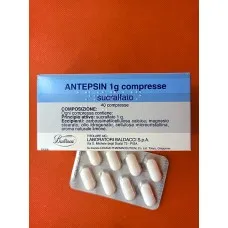
Table of Contents
- Package leaflet: Information for the patient
- ANTEPSIN 1 g tablets
- 1. What ANTEPSIN is and what it is used for
- 2. What you should know before taking ANTEPSIN
- 3. How to take ANTEPSIN
- 4. Possible side effects
- 5. How to store ANTEPSIN
- 6. Package contents and other information
- Patient Information Leaflet
- ANTEPSIN 1 g/5 ml oral suspension
- 1. What ANTEPSIN is and what it is used for
- 2. What you need to know before taking ANTEPSIN
- 3. How to take ANTEPSIN
- 4. Possible side effects
- 5. How to store ANTEPSIN
- 6. Package contents and other information
Package leaflet: Information for the patient
ANTEPSIN 1 g tablets
Sucralfate
Read this leaflet carefully before taking this medicine because it contains important information for you.
- Keep this leaflet. You may need to read it again.
- If you have any questions, ask your doctor or pharmacist.
- This medicine has been prescribed for you only. Do not give it to other people, even if their symptoms are the same as yours, as it may be harmful.
- If you experience any adverse reaction, including those not listed in this leaflet, contact your doctor or pharmacist. See section 4.
Contents of this leaflet:
- What ANTEPSIN is and what it is used for
- What you need to know before taking ANTEPSIN
- How to take ANTEPSIN
- Possible side effects
- How to store ANTEPSIN
- Contents of the pack and other information
1. What ANTEPSIN is and what it is used for
ANTEPSIN contains the active substance sucralfate, which belongs to the class of medicines used for the treatment of g astroduodenal ulcers. It works by forming a protective barrier over the lesions, preventing further irritation caused by stomach acids.
This medicine is used for the treatment of:
- lesions in the stomach (gastric ulcer) and lesions in the intestine (duodenal ulcer);
- inflammation of the stomach, either as a transient or permanent condition (acute gastritis and symptomatic chronic gastritis);
- stomach disorders due to the use of anti-inflammatory medicines belonging to the NSAID class (non-steroidal anti-inflammatory drugs) (NSAID-induced gastropathy);
- inflammation of the oesophagus caused by the backflow of acidic liquids and/or food (reflux oesophagitis).
2. What you should know before taking ANTEPSIN
Do not take ANTEPSIN
- if you are allergic to sucralfate or to any of the other ingredients of this medicine (listed in section 6);
- if the patient is a premature newborn;
- if you are pregnant.
Warnings and precautions
Talk to your doctor or pharmacist before taking ANTEPSIN.
Inform your doctor and use this medicine with caution, avoiding prolonged treatments, in the following cases:
- if you suffer from severe kidney problems (renal failure);
- if you are undergoing mechanical blood filtration (haemodialysis);
- if you have disorders affecting food movement through the digestive tract, as undigested material may accumulate (bezoars).
Children and adolescents
ANTEPSIN is not recommended in children due to lack of data on safety and efficacy of this medicine.
Other medicines and ANTEPSIN
Inform your doctor or pharmacist if you are taking, have recently taken, or might take any other medicines, including those not requiring a prescription.
Sucralfate may alter the effect of certain drugs, including:
- medicines used to treat bacterial infections (antibiotics) such as tetracyclines, ciprofloxacin and norfloxacin;
- ketoconazole, a medicine used to treat fungal infections;
- medicines used to treat stomach disorders such as gastritis and ulcers, such as cimetidine and ranitidine;
- digoxin, a medicine used to treat heart disorders;
- phenytoin, a medicine used in epilepsy;
- theophylline, a medicine used to treat respiratory disorders such as bronchial asthma.
If you need to take other medicines, including those listed above, take them at least two hours before or after taking ANTEPSIN.
Pregnancy and breastfeeding
If you are pregnant, suspect you may be pregnant, plan to become pregnant, or are breastfeeding, consult your doctor or pharmacist before taking this medicine.
If you are pregnant or breastfeeding, use this medicine only if clearly needed and under medical supervision.
Driving and using machines
This medicine does not affect the ability to drive or operate machinery.
ANTEPSIN 1g tablets contain hydrogenated oil
This medicine contains hydrogenated castor oil which may cause gastrointestinal disturbances and diarrhoea.
3. How to take ANTEPSIN
Take this medicine exactly as your doctor or pharmacist has told you. If you are unsure, consult your doctor or pharmacist.
Take the medicine on an empty stomach, one hour before meals and before going to bed.
The recommended dose is 1 tablet, 4 times daily, unless otherwise prescribed by your doctor.
If you take more ANTEPSIN than you should
If you accidentally ingest/overdose on ANTEPSIN, contact your doctor immediately or go to the nearest hospital.
If you forget to take ANTEPSIN
Do not take a double dose to make up for the forgotten dose.
If you have any doubts about how to use this medicine, consult your doctor or pharmacist.
4. Possible side effects
Like all medicines, this medicine may cause side effects, although not everyone gets them.
The following side effects may occur:
Very rare (may affect up to 1 in 10,000 people)
- formation of accumulations of undigested material (bezoars).
Not known (frequency cannot be estimated from available data)
- diarrhoea, flatulence, nausea, vomiting, feeling of gastric fullness (heaviness of stomach);
- constipation, with prolonged treatment;
- dry mouth;
- skin irritation and itching (rash);
- dizziness;
- insomnia;
- headache (cephalalgia);
- lower back pain;
- allergic-type reactions, including skin irritations (urticaria), swelling of the skin and mucous membranes, especially around mouth and eyes (angioedema), breathing difficulties, and allergic rhinitis.
Reporting of side effects
If you experience any side effect, including those not listed in this leaflet, please inform your doctor or pharmacist. You may also report side effects directly via the national reporting system at the website https://www.aifa.gov.it/content/segnalazioni-reazioni-avverse
By reporting side effects, you can help provide more information on the safety of this medicine.
5. How to store ANTEPSIN
Keep this medicine out of the sight and reach of children.
Do not use this medicine after the expiry date which is stated on the packaging after "Exp.".
The expiry date refers to the last day of that month and to the medicine being properly stored.
Do not dispose of any medicine via wastewater or household waste. Ask your pharmacist how to dispose of
medicines you no longer use. This will help protect the environment.
6. Package contents and other information
What ANTEPSIN 1 g tablets contain
- The active substance is sucralfate. Each tablet contains 1 g of sucralfate.
- The other components are calcium carboxymethylcellulose, magnesium stearate, hydrogenated castor oil, microcrystalline cellulose, natural lemon flavour.
Description of the appearance of ANTEPSIN and the contents of the pack
Pack of 40 tablets.
Marketing Authorization Holder
Laboratori Baldacci S.p.A., Via S. Michele degli Scalzi, 73 – Pisa
Under licence from Fuji Chemical Industries Co. Ltd. Toyama - Japan
Manufacturer
Laboratori Baldacci S.p.A., Via S. Michele degli Scalzi, 73 - Pisa
March 2026
Patient Information Leaflet
ANTEPSIN 1 g/5 ml oral suspension
Sucralfate
Please read this leaflet carefully before taking this medicine because it contains important information for you.
- Keep this leaflet. You may need to read it again.
- If you have any questions, consult your doctor or pharmacist.
- This medicine has been prescribed for you only. Do not give it to others, even if they have the same symptoms as you, because it could be harmful.
- If you experience any side effect, including those not listed in this leaflet, contact your doctor or pharmacist. See section 4.
Contents of this leaflet:
- What ANTEPSIN is and what it is used for
- What you need to know before taking ANTEPSIN
- How to take ANTEPSIN
- Possible side effects
- How to store ANTEPSIN
- Contents of the pack and other information
1. What ANTEPSIN is and what it is used for
ANTEPSIN contains the active substance sucralfate, which belongs to a class of medicines used for the treatment of g astroduodenal ulcers. It works by forming a protective barrier over the lesions, preventing further irritation caused by stomach acids.
This medicine is used for the treatment of:
- stomach lesions (gastric ulcer) and intestinal lesions (duodenal ulcer);
- inflammation of the stomach, either as a transient or chronic symptomatic condition (acute gastritis and chronic symptomatic gastritis);
- stomach disorders caused by the use of anti-inflammatory medicines belonging to the NSAID class (non-steroidal anti-inflammatory drugs) (NSAID-induced gastropathy);
- inflammation of the esophagus due to the backflow of acidic fluids and/or food (reflux esophagitis).
2. What you need to know before taking ANTEPSIN
Do not take ANTEPSIN
- if you are allergic to sucralfate or to any of the other ingredients of this medicine (listed in section 6);
- if the patient is a premature newborn;
- if you are pregnant.
Warnings and precautions
Talk to your doctor or pharmacist before taking ANTEPSIN.
Inform your doctor and use this medicine with caution, avoiding prolonged treatments, in the following cases:
- if you suffer from severe kidney problems (renal failure);
- if you are undergoing mechanical filtration of the blood (hemodialysis);
- if you suffer from disorders affecting food movement through the digestive tract, as undigested material may accumulate (bezoars).
Children and adolescents
ANTEPSIN is not recommended in children due to lack of data on safety and efficacy of this medicine.
Other medicines and ANTEPSIN
Inform your doctor or pharmacist if you are taking, have recently taken, or might take any other medicines, including those not requiring a prescription.
Sucralfate may alter the effect of certain drugs, including:
- medicines used to treat bacterial infections (antibiotics) such as tetracyclines, ciprofloxacin, and norfloxacin;
- ketoconazole, a medicine used to treat fungal infections;
- medicines used to treat stomach disorders such as gastritis and ulcers, such as cimetidine and ranitidine;
- digoxin, a medicine used to treat heart conditions;
- phenytoin, a medicine used in epilepsy;
- theophylline, a medicine used to treat respiratory disorders such as bronchial asthma.
If you need to take other medicines, including those listed above, take them at least two hours before or after taking ANTEPSIN.
Pregnancy and breastfeeding
If you are pregnant, suspect you may be pregnant, planning a pregnancy, or breastfeeding, consult your doctor or pharmacist before taking this medicine.
If you are pregnant or breastfeeding, use this medicine only if clearly needed and under medical supervision.
Driving and using machines
This medicine does not affect the ability to drive or operate machinery.
ANTEPSIN 1 g/5 ml oral suspension contains hydroxybenzoates
This medicine contains hydroxybenzoates which may cause allergic reactions (including delayed reactions).
3. How to take ANTEPSIN
Take this medicine exactly as instructed by your doctor or pharmacist. If you have
any doubts, consult your doctor or pharmacist.
Take the medicine on an empty stomach, one hour before meals and before going to bed.
The recommended dose is 5 ml, four times a day, administered using the dosing syringe provided,
unless otherwise prescribed by your doctor. Shake the suspension well before use.
If you take more ANTEPSIN than you should
In case of accidental ingestion/overdose of ANTEPSIN, contact your doctor immediately or go to the nearest hospital.
If you forget to take ANTEPSIN
Do not take a double dose to make up for the missed dose.
If you have any doubts about how to use this medicine, consult your doctor or pharmacist.
4. Possible side effects
Like all medicines, this medicine may cause side effects, although not everyone gets them.
The following side effects may occur:
Very rare (may affect up to 1 in 10,000 people)
- formation of accumulations of undigested material (bezoars).
Not known (frequency cannot be estimated from available data)
- diarrhoea, flatulence, nausea, vomiting, feeling of gastric fullness (heaviness of stomach);
- constipation, with prolonged treatment;
- dryness of the mouth;
- skin irritation and itching (rash);
- dizziness;
- insomnia;
- headache (cephalalgia);
- lower back pain;
- allergic-type reactions, including skin irritations (urticaria), swelling of the skin and mucous membranes, especially around the mouth and eyes (angioedema), breathing difficulties, and allergic rhinitis.
Reporting of side effects
If you experience any side effect, including those not listed in this leaflet, talk to your doctor or pharmacist. You may also report side effects directly through the national reporting system at https://www.aifa.gov.it/content/segnalazioni-reazioni-avverse
By reporting side effects, you can help provide more information on the safety of this medicine.
5. How to store ANTEPSIN
Keep this medicine out of the sight and reach of children.
Do not use this medicine after the expiry date stated on the pack after "Exp.".
The expiry date refers to the last day of that month and to the medicine properly stored.
Do not dispose of any medicine via wastewater or household waste. Ask your pharmacist how to dispose of
medicines you no longer use. This will help protect the environment.
6. Package contents and other information
What ANTEPSIN 1 g/5 ml oral suspension contains
- The active substance is sucralfate. Each 100 ml of suspension contains 20 g of sucralfate (1 g/5 ml).
- The other components are methyl p-hydroxybenzoate sodium salt, propyl p-hydroxybenzoate sodium salt, sodium dihydrogen phosphate dihydrate, xanthan gum, anise flavour, caramel flavour, sodium saccharin dihydrate, glycerol 85%, deionized water.
Description of the appearance of ANTEPSIN and the contents of the pack
200 ml bottle of suspension. The pack also contains a dosing spoon.
Marketing Authorization Holder
Laboratori Baldacci S.p.A., Via S. Michele degli Scalzi, 73 – Pisa
Under licence from Fuji Chemical Industries Co. Ltd. Toyama - Japan
Manufacturer
Laboratorio Chimico Farmaceutico A. Sella S.r.l.
Via Vicenza 67 - Schio (VI)
May 2025