Antabuse Dispergettes
Italy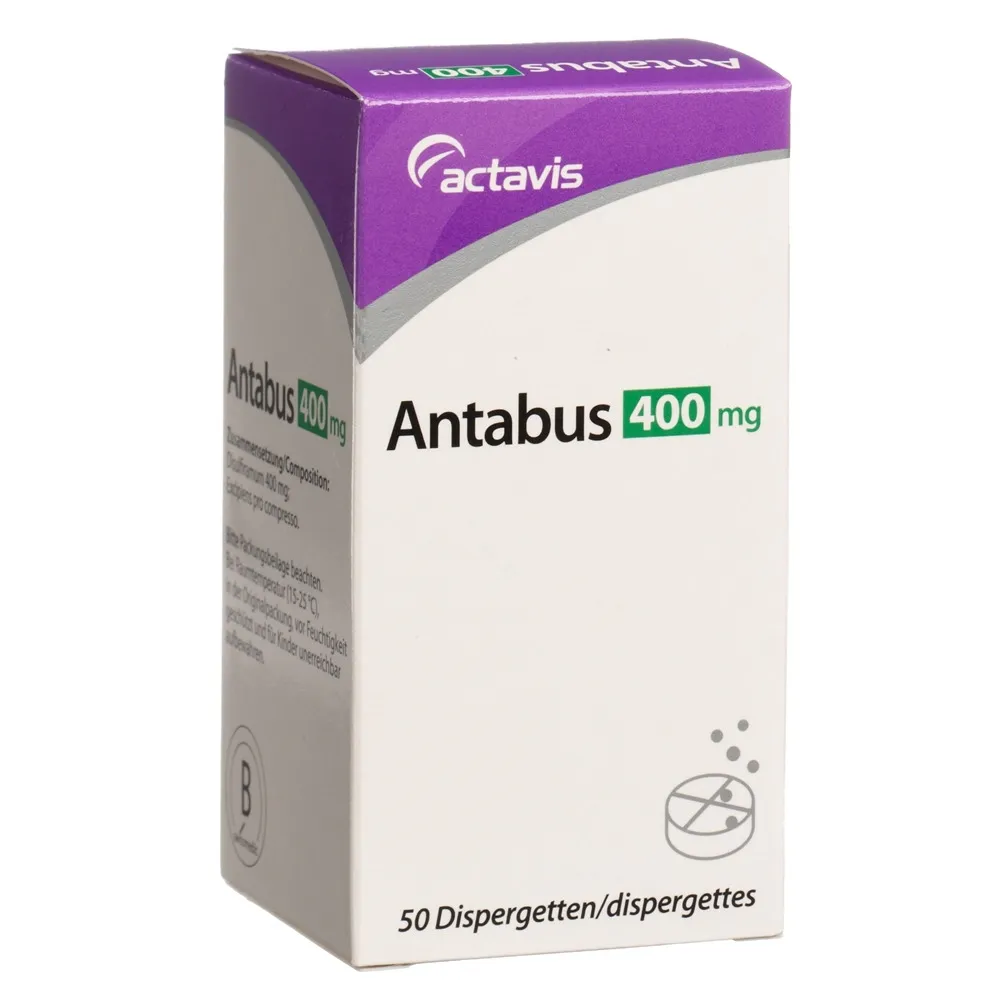
Table of Contents
- Patient Information Leaflet
- ANTABUSE DISPERGETTES 400 mg effervescent tablets
- 1. What ANTABUSE DISPERGETTES is and what it is used for
- 2. What you need to know before taking ANTABUSE DISPERGETTES
- 3. How to take ANTABUSE DISPERGETTES
- 4. Possible side effects
- 5. How to store ANTABUSE DISPERGETTES
- 6. Package contents and other information
Patient Information Leaflet
ANTABUSE DISPERGETTES 400 mg effervescent tablets
Disulfiram
Please read this leaflet carefully before taking this medicine, as it contains important information for you.
- Keep this leaflet. You may need to read it again.
- If you have any questions, ask your doctor or pharmacist.
- This medicine has been prescribed for you only. Do not give it to other people, even if they have the same symptoms as yours, because it may be harmful.
- If you experience any adverse reactions, including those not listed in this leaflet, consult your doctor or pharmacist. See section 4.
Contents of this leaflet:
- What ANTABUSE DISPERGETTES is and what it is used for
- What you need to know before taking ANTABUSE DISPERGETTES
- How to take ANTABUSE DISPERGETTES
- Possible side effects
- How to store ANTABUSE DISPERGETTES
- Contents of the pack and other information
1. What ANTABUSE DISPERGETTES is and what it is used for
ANTABUSE DISPERGETTES contains the active substance disulfiram, which interferes with the body's process of metabolizing alcohol. When alcohol is consumed during treatment with disulfiram, it causes unpleasant symptoms such as difficulty breathing, awareness of heartbeats (palpitations), headache, nausea, and vomiting, thereby discouraging continued consumption of alcoholic substances.
ANTABUSE DISPERGETTES is therefore indicated for the treatment of chronic alcoholism (alcohol dependence).
2. What you need to know before taking ANTABUSE DISPERGETTES
Do not take ANTABUSE DISPERGETTES
- if you are allergic to disulfiram or to any of the other ingredients of this medicine (listed in section 6);
- if you have heart failure (the heart’s inability to pump enough blood to meet the body’s needs) or obstruction of the blood vessels supplying the heart (coronary artery disease);
- if you have previously suffered brain damage (serious cerebrovascular events);
- if you have high blood pressure and are not receiving treatment for it (untreated hypertension);
- if you suffer from mental disorders (serious personality disorder) and disturbances of mental equilibrium (psychosis);
- if you have suicidal thoughts or self-harming behaviours;
- if you consume alcoholic beverages or have recently undergone treatment with medicines containing alcohol, such as certain cough syrups, drops, or dietary supplements;
- if you are at risk of exposure to a chemical substance called ethylene dibromide and its vapours;
- if you are breastfeeding (see "Pregnancy and breastfeeding").
ANTABUSE DISPERGETTES is contraindicated in children and adolescents.
Warnings and precautions
Talk to your doctor or pharmacist before taking ANTABUSE DISPERGETTES.
Take this medicine only under the direct supervision of a physician experienced in the treatment of alcohol
dependence, and only if you are genuinely committed to undergoing detoxification treatment.
Before starting treatment, your doctor will prescribe blood tests to determine whether you are a suitable
candidate for treatment with this medicine and will inform you about the unpleasant, even serious, side
effects that may occur if you consume alcohol during treatment (see "Possible side effects").
Your doctor will also prescribe regular check-ups during and after treatment.
Furthermore, your doctor will advise you not to use products (such as syrups, drops, toiletries, mouthwashes,
and foods) that contain alcohol, as they may cause serious adverse effects (see "ANTABUSE DISPERGETTES
with food, drinks and alcohol").
Inform your doctor if:
- you have severe kidney or liver problems (renal or hepatic insufficiency);
- you suffer from long-standing respiratory diseases (chronic respiratory conditions);
- you have diabetes mellitus (a disease characterised by high blood sugar levels);
- you have thyroid function disorders (a gland at the base of the neck that regulates metabolism) (hypothyroidism, hyperthyroidism);
- you suffer from epilepsy, a disease causing seizures (sudden, uncontrollable movements) and loss of consciousness;
- you experience an allergic skin reaction caused by contact with rubber (contact dermatitis).
During treatment with this medicine, seek support from your family and from a specialist doctor (psychological
therapy) to help you properly avoid alcohol consumption.
This medicine may cause severe liver damage, particularly after 1–3 months of treatment.
Other medicines and ANTABUSE DISPERGETTES
Inform your doctor or pharmacist if you are taking, have recently taken, or might take any other medicines.
Inform your doctor if you are being treated with:
- medicines used to treat diabetes;
- phenylbutazone, aminophenazone and antipyrine, used to treat inflammation;
- moxalactam, cefamandole and cefoperazone, isoniazid, rifampicin and metronidazole (antibiotics), used to treat bacterial infections;
- amitriptyline, phenelzine and tranycypromine, used to treat low mood (depression);
- pimozide and chlorpromazine, used to treat certain mental disorders;
- chlordiazepoxide and diazepam, used to treat anxiety and sleep disorders;
- warfarin, an oral anticoagulant that delays blood clotting;
- theophylline, used to treat respiratory diseases;
- meperidine and morphine, used to treat pain;
- amphetamines, used as central nervous system stimulants;
- phenytoin and paraldehyde, used to treat epilepsy;
- medicines that affect heart rate and vascular tone, used to treat various heart conditions and high blood pressure;
- antacids, used for disorders related to increased stomach acidity.
ANTABUSE DISPERGETTES with food, drinks and alcohol
During treatment and for 14 days after stopping treatment, do not consume alcoholic substances or foods
containing alcohol in liquid form, as unpleasant, unpredictable and sometimes fatal adverse effects may occur.
For the same reason, pay particular attention to the consumption of "non-alcoholic" or "alcohol-free" beverages,
such as beer or wine with low alcohol content (see "Possible side effects").
Pregnancy and breastfeeding
If you are pregnant, think you may be pregnant, are planning to become pregnant, or are breastfeeding,
consult your doctor or pharmacist before taking this medicine.
Avoid taking this medicine during the first three months of pregnancy.
Your doctor will prescribe ANTABUSE DISPERGETTES only if clearly needed.
Do not take ANTABUSE DISPERGETTES if you are breastfeeding (see "Do not take ANTABUSE DISPERGETTES").
Driving and using machines
ANTABUSE DISPERGETTES may cause drowsiness and fatigue, and therefore may impair your ability to drive
and use machinery.
3. How to take ANTABUSE DISPERGETTES
Take this medicine exactly as directed by your doctor or pharmacist. If you are unsure, consult your doctor or pharmacist.
Treatment with ANTABUSE DISPERGETTES is indicated only for adults and must be accompanied by psychological support (psychotherapeutic).
You may take this medicine only if you have not consumed alcohol for at least 24 hours.
The recommended initial dose is between 2 and 3 tablets daily, taken as a single dose for 3–4 consecutive days. Your doctor will gradually reduce the dose to a maintenance dose ranging from half a tablet to one and a half tablets per day.
To prevent relapse, your doctor will continue your therapy for several months (not exceeding 5 months), periodically assessing your health condition.
The tablets can be swallowed whole or dissolved in water or another drink. In the latter case, to facilitate dissolution, shake the liquid and immediately drink the resulting suspension to avoid sedimentation at the bottom.
To open the container, press down on the cap and unscrew. Close the container after use.
If you take more ANTABUSE DISPERGETTES than you should
Following an overdose of this medicine, the following effects may occur:
- nausea, vomiting, abdominal pain, diarrhea;
- drowsiness, delirium (false thoughts not corresponding to reality), hallucinations (seeing or hearing things that do not exist), lethargy (deep sleep);
- tachycardia (increased heart rate);
- tachypnea (increased respiratory rate);
- hyperthermia (elevated body temperature);
- hypotension (low blood pressure);
- hypotonia (reduced muscle tone), especially in children;
- reduced tendon reflexes (altered responses to nervous system stimuli);
- hyperglycemia (increased blood sugar levels);
- leukocytosis (increased number of white blood cells in the blood);
- ketosis (disturbance in fat metabolism), often disproportionate to the degree of dehydration;
- methemoglobinemia (dangerous increase in a specific blood protein);
- cardiocirculatory collapse (rapid drop in blood pressure), coma (deep unconsciousness), and convulsions (sudden, uncontrollable movements), in the most severe cases;
- sensorimotor neuropathy (numbness or weakness in arms and legs);
- changes in heart activity observed on electrocardiogram (ECG, the electrical tracing of the heart);
- encephalopathy (brain disease);
- psychosis (mental imbalance);
- catatonia (mental state alteration characterized by immobility, expressionlessness, and unresponsiveness);
- dysarthria (difficulty in articulating speech);
- myoclonus (involuntary muscle contractions);
- ataxia (progressive loss of muscular coordination making movements difficult);
- dystonia (abnormal muscle tone);
- akinesia (reduced or loss of ability to perform movements).
Your doctor will determine the most appropriate treatment based on the severity of symptoms.
In case of accidental ingestion or overdose of ANTABUSE DISPERGETTES, contact your doctor immediately or go to the nearest hospital.
If you forget to take ANTABUSE DISPERGETTES
Do not take a double dose to make up for the forgotten tablet.
If you have any doubts about using this medicine, consult your doctor or pharmacist.
4. Possible side effects
Like all medicines, this medicine can cause side effects, although not everybody will experience them.
The following side effects may occur, which tend to decrease during treatment or after adjustment of the dose:
Common (may affect up to 1 in 10 people)
- drowsiness, at the beginning of treatment, headache;
- nausea, vomiting, halitosis (bad breath), stomach pain, diarrhoea;
- asthenia (feeling of weakness), at the beginning of treatment.
Uncommon (may affect up to 1 in 100 people)
- hypersensitivity (allergy);
- allergic dermatitis with rash (skin irritation with eruption), itching, and acne-like rash;
- reduced libido (decreased sexual desire), sexual dysfunction.
Rare (may affect up to 1 in 1,000 people)
- psychotic reactions, mania and schizophrenia (mental imbalance), paranoia (seeing or hearing things that are not real), depression (low mood);
- peripheral neuropathy (numbness, tingling, sensitivity and weakness in arms and legs), optic neuritis (inflammation of the optic nerve);
- jaundice, changes in blood test results (elevated ASAT, ALAT, bilirubin levels). Very rare (may affect up to 1 in 10,000 people)
- liver damage, fulminant hepatitis, hepatic necrosis (liver problems). Frequency not known (cannot be estimated from the available data)
- encephalopathy (brain problems);
- skin rashes;
- medicine-induced liver injury (fatal cases have been reported).
Alcohol-disulfiram reaction
If you consume alcohol during treatment with ANTABUSE DISPERGETTES, an alcohol-disulfiram reaction may occur, with severe and potentially life-threatening symptoms. The reaction appears within 15 minutes after alcohol intake.
Symptoms last from 30 minutes to 1 hour and subside within a few hours. They include:
- “flushing”, intense increase in blood flow to the face and neck with sensation of warmth, redness, increased body temperature, sweating, nausea, vomiting, itching, urticaria (skin rash), anxiety, dizziness, headache, blurred vision, palpitations (increased awareness of heartbeat), and hyperventilation (increased depth of breathing);
- tachycardia (increased heart rate), hypotension (low blood pressure), respiratory depression (reduced breathing activity), chest pain, changes in heart rhythm (QT prolongation, ST depression, arrhythmias), coma (deep unconscious state), and seizures (sudden, uncontrollable movements), in the most severe cases;
- hypertension (high blood pressure), bronchospasm (constriction of the bronchi), and methaemoglobinaemia (dangerous increase in a blood protein). The doctor will provide appropriate treatment depending on the severity of symptoms (administration of oxygen and fluid replacement).
Reporting of side effects
If you experience any side effect, including those not listed in this leaflet, talk to your doctor or pharmacist. You can also report side effects directly via the national reporting system at https://www.aifa.gov.it/content/segnalazioni-reazioni-avverse .
By reporting side effects, you can help provide more information on the safety of this medicine.
5. How to store ANTABUSE DISPERGETTES
Keep this medicine out of the sight and reach of children.
Do not use this medicine after the expiry date stated on the packaging after "Exp.". The expiry date refers to the last day of that month.
Store in the original container to protect the medicine from moisture.
Do not dispose of any medicine via wastewater or household waste. Ask your pharmacist how to dispose of medicines you no longer use. This will help protect the environment.
6. Package contents and other information
What ANTABUSE DISPERGETTES contains
- The active substance is disulfiram. Each effervescent tablet contains 400 mg of disulfiram.
- The other components are: maize starch, polyvinylpyrrolidone, tartaric acid, sodium bicarbonate, precipitated silica, microcrystalline cellulose, magnesium stearate, polysorbate 20, talc.
Description of the appearance of ANTABUSE DISPERGETTES and pack contents
24 effervescent tablets in a bottle with screw cap and child-resistant closure.
Marketing Authorization Holder
Aurobindo Pharma (Italia) S.r.l. – Via San Giuseppe, 102 – 21047 Saronno (Varese)
Manufacturer
Fine Foods & Pharmaceuticals N.T.M. S.p.A. - Via Grignano 43, 24041 Brembate (BG) - Italy