Ankermann
Italy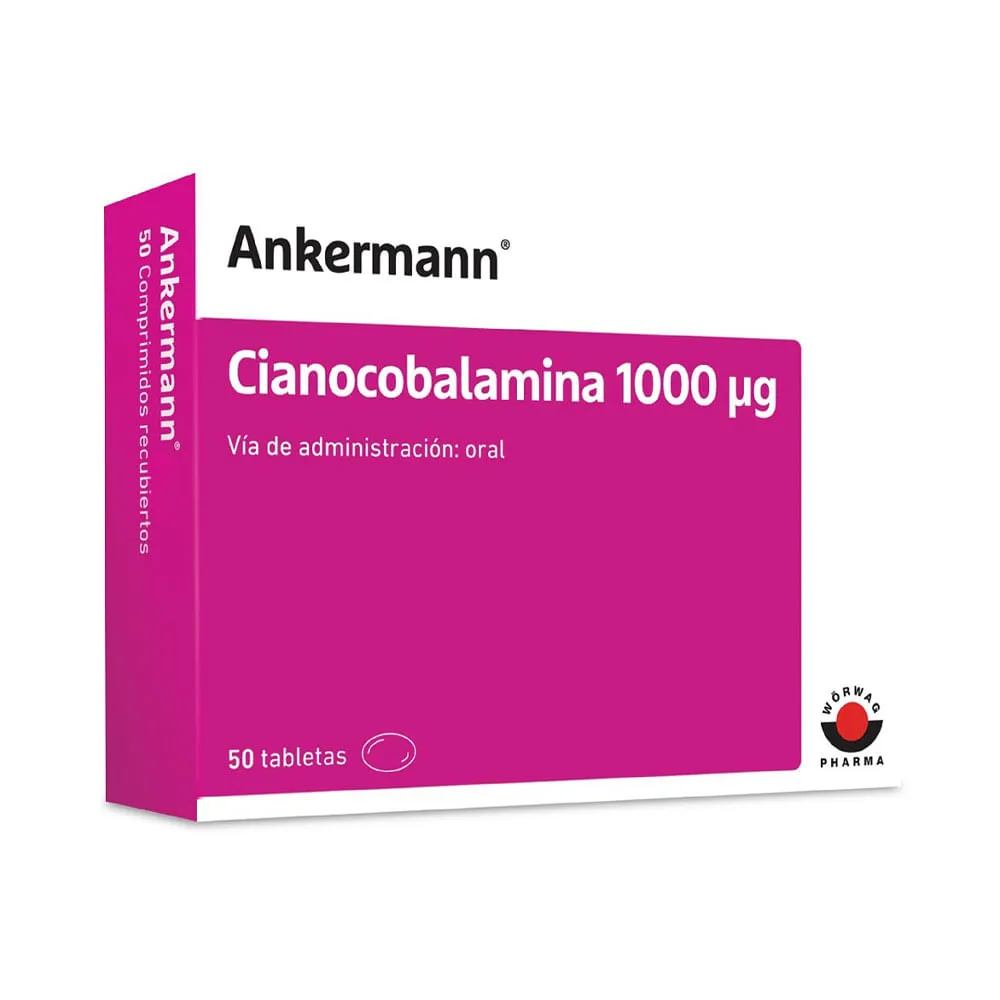
Table of Contents
Package leaflet: Information for the user
Ankermann 1 000 micrograms coated tablets
cyanocobalamin (vitamin B )
Please read all of this leaflet carefully before you start taking this medicine because it contains important information for you.
- Keep this leaflet. You may need to read it again.
- If you have any questions, ask your doctor or pharmacist.
- This medicine has been prescribed for you only. Do not give it to other people, even if their symptoms are the same as yours, as it may be harmful.
- If you experience any side effects, including those not listed in this leaflet, tell your doctor or pharmacist. See section 4.
Contents of this leaflet
- What Ankermann is and what it is used for
- What you need to know before taking Ankermann
- How to take Ankermann
- Possible side effects
- How to store Ankermann
- Contents of the pack and other information
1. What Ankermann is and what it is used for
This medicinal product contains cyanocobalamin, known as vitamin B12.
Most people obtain sufficient amounts of vitamin B12 through food; however, if you have undergone stomach surgery, suffer from certain intestinal diseases, follow a restrictive diet, or are taking certain medications, you may not absorb enough vitamin B12.
This medicine is used for the treatment and maintenance therapy of vitamin B12 deficiency in adults:
○ Who have been diagnosed with pernicious anaemia.
○ Who have vitamin B12 malabsorption (e.g. due to atrophic gastritis, inflammatory bowel disease, coeliac disease, total or partial gastrectomy, ileal resection, gastric bypass, or other bariatric surgery).
○ Who are on long-term treatment with histamine H2 receptor antagonists, proton pump inhibitors, aminosalicylates, or metformin.
This medicine is also used to treat vitamin B12 deficiency due to inadequate dietary intake (e.g. vegetarian diet) in adults.
2. What you should know before taking Ankermann
Do not take Ankermann
- if you are allergic to cyanocobalamin or vitamin B or to any of the other ingredients of this medicine (listed in section 6 of this leaflet)
- if you have anemia caused by impaired blood cell production in the bone marrow (megaloblastic anemia, a condition in which the body produces unusually large and immature red blood cells) caused solely by a deficiency of folates (vitamin B)
- if you suffer from visual disorders caused by tobacco or alcohol abuse, which is often associated with nutritional deficiencies (nutritional optic neuropathy), or from inflammation of the optic nerve (retrobulbar neuritis) occurring as a result of a disease characterized by a deficiency of
red blood cells (pernicious anemia), or if you have any other condition requiring
the elimination of cyanide from the body (detoxification). In such cases, other cobalamin-based
medicines should be used
- if you suffer from optic nerve degeneration (which may lead to vision problems because the nerve transmitting visual signals from the retina to the brain is damaged)
Warnings and precautions
Talk to your doctor or pharmacist before taking this medicine.
At the beginning of treatment, your doctor should perform a diagnosis to determine the underlying cause of the deficiency, including an assessment of gastrointestinal tract function. Your doctor will determine whether vitamin B absorption from food is insufficient and whether oral supplementation with this medicine is required.
Due to the severity of the condition, your doctor will likely monitor your response to this medicine within the first 3 months. This will probably involve a blood test. If you respond well to the treatment plan, therapy may continue for life, depending on the underlying condition.
If you require regular renal dialysis, your doctor should perform regular blood tests and a dose reduction of this medicine may be necessary.
If you have a folic acid deficiency, this may weaken your response to therapy. In such cases, the use of this medicine should be combined with folic acid supplementation.
Ankermann contains 1,000 micrograms of cyanocobalamin per tablet. If you are scheduled for laboratory tests, you must inform your doctor or laboratory staff that you are taking or have recently taken this medicine, because cyanocobalamin may affect the results of such tests (including blood tests, urine tests, skin tests using allergens, etc.) due to its red color. This medicine may affect test results for the detection of anti-intrinsic factor antibodies (IFA).
Children and adolescents
Do not give this medicine to children and adolescents under 18 years of age, as the potential risks and benefits are still unknown.
Other medicines and Ankermann
Tell your doctor or pharmacist if you are taking, have recently taken, or might take any other medicines, including those without a prescription.
The effects of this medicine may be affected by:
- Proton pump inhibitors (e.g., omeprazole) and histamine H2-receptor antagonists (e.g., cimetidine); both are used to treat excess stomach acid causing indigestion or ulcers
- Colchicine, a treatment for gout
- Aminoglycosides (e.g., neomycin) and chloramphenicol, which are antibiotics
- Biguanides, e.g., metformin, used in the treatment of diabetes
- Aminosalicylic acid, used for treating inflammatory bowel diseases
- Oral contraceptives
- Antiepileptic drugs (e.g., carbamazepine)
- Potassium salts
- Methyldopa, used to treat high blood pressure
- Prolonged use of nitrous oxide (a gas used for anesthesia)
- Second-generation antipsychotics (e.g., olanzapine and risperidone)
- Cholestyramine, used to reduce high blood cholesterol levels
- Glucocorticoids (e.g., prednisolone), often used to treat inflammatory diseases
Ankermann and alcohol
Alcohol may affect the absorption of this medicine in the body.
Pregnancy, breastfeeding, and fertility
If you are pregnant, suspect you may be pregnant, planning a pregnancy, or breastfeeding, consult your doctor or pharmacist before taking this medicine. As a precautionary measure, it is preferable to avoid using this medicine during pregnancy, except when treatment with cyanocobalamin is required due to the woman's medical condition.
This medicine may be used during breastfeeding.
Driving and using machines
This medicine is not expected to affect your ability to drive or operate machinery.
Ankermann contains lactose, sucrose, macrogol glycerol hydroxystearate, and sodium
Lactose and sucrose
If your doctor has informed you that you have an intolerance to certain sugars, consult your doctor before taking this medicine.
Macrogol glycerol hydroxystearate
May cause gastrointestinal disturbances and diarrhea.
Sodium
This medicine contains less than 1 mmol (23 mg) of sodium per tablet, i.e., it is essentially "sodium-free".
3. How to take Ankermann
Take this medicine exactly as stated in this leaflet or as directed by your doctor or pharmacist. If you have any doubts, consult your doctor or pharmacist.
Use in adults
The recommended daily dose is 1 tablet, corresponding to 1,000 micrograms of cyanocobalamin, for the following indications:
- Treatment of vitamin B12 deficiency in patients with reduced dietary intake (e.g. vegetarian diet).
- Treatment of vitamin B12 deficiency and maintenance therapy in patients diagnosed with pernicious anemia or with vitamin B12 malabsorption.
- Treatment in case of long-term use of histamine H2-receptor antagonists, proton pump inhibitors, aminosalicylates, and metformin.
Patients with severe hematological or neurological symptoms of vitamin B12 deficiency should initially be treated parenterally until blood levels are normalized.
If well tolerated, oral vitamin B12 may be substituted lifelong in cases of pernicious anemia or vitamin B12 malabsorption. Response to therapy should be monitored regularly. See also section 2. Warnings and precautions.
If you have kidney problems
In patients with moderate renal impairment, this medicine can be used at the normal dose. In case of severe renal impairment, a dose reduction is recommended. In addition, serum vitamin B12 levels should be monitored regularly.
If you have liver problems
It is not known whether this medicine is safe in patients with liver problems. Inform your doctor if you have liver disease.
How to take the tablets
Ankermann is for oral use. The tablets should be swallowed whole with some water, preferably in the morning on an empty stomach. The duration of treatment depends on how your body responds to the medicine. To determine the optimal dose, your doctor must perform regular check-ups.
If you take more Ankermann than you should
If you take more of this medicine than you should, contact your doctor, who will decide on the necessary measures. Cases of intoxication have not been reported.
There is no known antidote for overdose. In case of overdose, symptoms should be treated accordingly.
If you forget to take Ankermann
If you forget to take a dose, take it as soon as you remember, unless it is almost time for your next dose. In this case, do not take the missed dose but take the next dose at the usual time. Do not take a double dose to make up for the forgotten dose.
If you stop taking Ankermann
Always consult your doctor before stopping treatment.
If you have any questions about the use of this medicine, ask your doctor or pharmacist.
4. Possible side effects
Like all medicines, this medicine can cause side effects, although not everyone experiences them.
Uncommon: may affect up to 1 in 100 people
- Severe allergic reactions with symptoms such as hives, skin rash, or itching affecting large areas of the body.
Not known (frequency cannot be estimated from the available data):
- Acne-like rashes and blisters;
- Fever.
Reporting of side effects
If you experience any side effect, including those not listed in this leaflet, talk to your doctor or pharmacist. You may also report side effects directly through the national reporting system at https://www.aifa.gov.it/content/segnalazioni-reazioni-avverse.
By reporting side effects, you can help provide more information on the safety of this medicine.
5. How to store Ankermann
Keep this medicine out of the sight and reach of children.
Do not use this medicine after the expiry date stated on the container after "Exp.".
The expiry date refers to the last day of that month.
Do not store above 25 °C.
Do not dispose of any medicine via wastewater or household waste. Ask your pharmacist how to
dispose of medicines no longer required. This will help protect the environment.
6. Contents of the pack and other information
What Ankermann contains
The active substance is: 1,000 micrograms of cyanocobalamin (a synthetic form of
vitamin B ).
The other components are: monohydrate lactose, povidone K30, sodium croscarmellose, stearic acid 50 (stearic acid and palmitic acid), AquaPolish P white*,
sucrose, talc, heavy kaolin, calcium carbonate, titanium dioxide,
dried acacia dispersion, macrogol 6000, macrogol glycerol hydroxystearate 40, sodium lauryl sulfate (E487), glycol montan wax.
(* Composition of AquaPolish P white: hypromellose,
hydroxypropylcellulose, stearic acid 50 (stearic acid and palmitic acid),
talc, medium-chain triglycerides, titanium dioxide)
Description of the appearance of Ankermann and contents of the pack
White, round, biconvex coated tablet with an approximate diameter of 9.8 mm.
Aluminum-PVDC/PVC blisters in cardboard boxes. Pack sizes of 10, 25, 30, 50, 60, 90 and
100 coated tablets.
Not all pack sizes may be marketed.
Marketing Authorization Holder
AAA-Pharma GmbH
Flugfeld-Allee 24
71034 Böblingen
Germany
Manufacturer
Artesan Pharma GmbH & Co. KG
Wendlandstraße 1
29439 Lüchow
Germany
This medicinal product is authorized in the Member States of the European Economic Area under the following names:
| Member State Name | Medicinal Product Name |
| Estonia, Italy, Latvia, Lithuania, Poland | Ankermann |
| Spain | B12 Ankermann |