Andembry
Italy
Table of Contents
- Patient Information Leaflet
- ANDEMBRY 200 mg injection solution in pre-filled syringe
- 1. What ANDEMBRY is and what it is used for
- 2. What you need to know before taking ANDEMBRY
- 3. How to take ANDEMBRY
- 4. Possible side effects
- 5. How to store ANDEMBRY
- 6. Package contents and other information
- 7. Instructions for Use
- Patient Information Leaflet
- ANDEMBRY 200 mg solution for injection in a pre-filled pen
- 1. What ANDEMBRY is and what it is used for
- 2. What you should know before taking ANDEMBRY
- 3. How to take ANDEMBRY
- 4. Possible side effects
- 5. How to store ANDEMBRY
- 6. Package contents and other information
- 7. Instructions for Use
Patient Information Leaflet
ANDEMBRY 200 mg injection solution in pre-filled syringe
garadacimab
This medicinal product is under additional monitoring. This will allow for rapid identification of new safety information. You can help by reporting any side effects you experience while taking this medicine. See the end of section 4 for information on how to report side effects.
Please read this leaflet carefully before using this medicine as it contains important information for you.
- Keep this leaflet. You may need to read it again.
- If you need more information or advice, please consult your doctor, pharmacist, or nurse.
- This medicine has been prescribed for you only. Do not give it to others, even if they have the same symptoms as you, because it may be harmful.
- If you experience any side effect, including those not listed in this leaflet, contact your doctor, pharmacist, or nurse. See section 4.
Contents of this leaflet
- What ANDEMBRY is and what it is used for
- What you need to know before using ANDEMBRY
- How to use ANDEMBRY
- Possible side effects
- How to store ANDEMBRY
- Contents of the pack and other information
- Instructions for use
1. What ANDEMBRY is and what it is used for
ANDEMBRY contains the active substance garadacimab.
ANDEMBRY is a medicine used in patients aged 12 years and older with hereditary angioedema (HAE) to prevent angioedema attacks.
HAE is a condition that causes recurrent episodes of rapid swelling, known as HAE attacks, in different parts of the body, including:
- hands and feet;
- face, eyelids, lips, or tongue;
- larynx and throat, which can make breathing difficult;
- genitals;
- stomach and intestines.
HAE attacks can be painful and debilitating. Attacks affecting the throat or larynx can be life-threatening or even potentially fatal.
HAE is often familial, but some individuals may not have a family history. Three types of HAE are known, based on the type of genetic defect and its effect on a protein circulating in the blood called C1 esterase inhibitor (C1-INH). A person may have low levels of C1-INH in the body (Type I HAE), dysfunctional C1-INH (Type II HAE), or HAE with normally functioning C1-INH (Type III HAE). The latter type is extremely rare. All three types produce the same clinical symptoms of localized swelling.
C1-INH regulates a process that controls the production of an inflammatory substance called bradykinin. Overproduction of bradykinin causes swelling and inflammation in people with HAE.
The active substance in ANDEMBRY, garadacimab, blocks the activation of a protein known as factor XIIa (FXIIa), which is involved in stimulating bradykinin production. By blocking FXIIa activity, garadacimab reduces bradykinin levels, thereby preventing HAE attacks. Some subcategories of HAE with normal C1-INH may not respond to treatment with garadacimab.
Please consult your doctor if you have any doubts about the medicine.
2. What you need to know before taking ANDEMBRY
Do not use ANDEMBRY
- if you are allergic to garadacimab or to any of the other ingredients of this medicine (listed in section 6).
Warnings and precautions
- Talk to your doctor, pharmacist, or nurse before taking ANDEMBRY.
- If you experience a severe allergic reaction to ANDEMBRY with symptoms such as hives, chest tightness, difficulty breathing, wheezing, hypotension, or anaphylaxis, inform your doctor, pharmacist, or nurse immediately.
- Treat an attack of hereditary angioedema with your usual rescue medication; do not take additional doses of ANDEMBRY.
Keep a diary
We strongly recommend that you record the name and batch number of the medicine each time you take
a dose of ANDEMBRY. This way, you can keep track of the batches used.
Laboratory tests
Inform your doctor if you are using ANDEMBRY before undergoing laboratory tests to measure
blood coagulation. This is because ANDEMBRY may interfere with certain laboratory tests, leading to inaccurate results.
Children and adolescents
The use of ANDEMBRY is not recommended in children under 12 years of age, as it has not been studied in this age group.
Other medicines and ANDEMBRY
Inform your doctor or pharmacist if you are taking, have recently taken, or might take any other medicines.
ANDEMBRY is not known to affect other medicines or to be affected by other medicines.
Pregnancy and breastfeeding
If you are pregnant, think you may be pregnant, are planning a pregnancy, or are breastfeeding, consult your doctor or pharmacist before taking ANDEMBRY. Information on the safety of using ANDEMBRY during pregnancy and breastfeeding is limited. As a precaution, it is preferable to avoid using ANDEMBRY during pregnancy. Your doctor will discuss with you the risks and benefits of taking this medicine.
Driving and using machines
This medicine does not impair or impairs negligibly the ability to drive vehicles or operate machinery.
ANDEMBRY contains proline
This medicine contains 19.3 mg of proline per pre-filled syringe, equivalent to 16.1 mg/mL. Proline may be harmful for patients with hyperprolinemia, a rare genetic disorder caused by accumulation of proline in the body. If you (or your child) have hyperprolinemia, do not use this medicine unless your doctor has recommended it.
ANDEMBRY contains polysorbate 80
This medicine contains 0.24 mg of polysorbate 80 per pre-filled syringe, equivalent to 0.2 mg/mL. Polysorbates may cause allergic reactions. Inform your doctor if you have known allergies.
3. How to take ANDEMBRY
ANDEMBRY is supplied in single-use prefilled syringes with a needle safety device.
Treatment will begin under the supervision and management of a healthcare professional.
Always use this medicine exactly as described in this leaflet or as your doctor, pharmacist, or nurse has instructed you.
Consult your doctor, pharmacist, or nurse if you have any doubts or further questions about the use of this medicine.
How much ANDEMBRY to use
The recommended dose of ANDEMBRY is an initial loading dose of 400 mg administered as two 200 mg injections on the first day of treatment, followed by a 200 mg injection administered once a month.
How to inject ANDEMBRY
You may self-inject ANDEMBRY, or your caregiver may inject it for you. In either case, you or your caregiver must carefully read and follow the instructions provided in section 7, "Instructions for use".
- ANDEMBRY is for injection under the skin ("subcutaneous injection") in the stomach (abdomen), thigh, or upper arm.
- A doctor, pharmacist, or nurse must show you how to correctly inject ANDEMBRY before you use it for the first time. Do not perform the injection on yourself or allow a caregiver to inject it for you until you have been trained to administer the medicine.
- Use each prefilled syringe only once.
- If the prefilled syringe with needle safety device does not function as intended, inform your doctor, pharmacist, or nurse as soon as possible.
- It is recommended to rotate injection sites.
If you use more ANDEMBRY than you should
If you use too much ANDEMBRY, inform your doctor, pharmacist, or nurse.
If you forget to use ANDEMBRY
If you miss a dose of ANDEMBRY, inject the dose as soon as possible. If you are unsure about when to inject ANDEMBRY after missing a dose, consult your doctor, pharmacist, or nurse.
If you stop using ANDEMBRY
It is important that you continue to inject ANDEMBRY as directed by your doctor, even if you feel better.
If you have any further questions about the use of this medicine, consult your doctor, pharmacist, or nurse.
4. Possible side effects
Like all medicines, this medicine can cause side effects, although not everyone experiences them.
Inform your doctor, pharmacist or nurse if you notice any of the following side effects.
Common (may affect up to 1 in 10 people)
- Reactions at the injection site, including redness, bruising, itching and hives
- Headache
- Abdominal pain
Reporting of side effects
If you experience any side effect, including those not listed in this leaflet, talk to your doctor or pharmacist.
You can also report side effects directly via the national reporting system at https://www.aifa.gov.it/content/segnalazioni-reazioni-
avverse . Reporting side effects helps provide more information on the safety of this medicine.
5. How to store ANDEMBRY
Keep this medicine out of the sight and reach of children.
Do not use this medicine after the expiry date which is stated on the outer packaging and
on the label after Exp. The expiry date refers to the last day of that month.
Store in a refrigerator (2°C - 8°C). Do not freeze. Keep the pre-filled syringe in the
outer packaging to protect it from light.
The pre-filled syringe may be stored at room temperature (up to 25°C) for a single period of up to 2 months maximum, but not beyond the expiry date.
Do not return ANDEMBRY to a refrigerated storage place after it has been stored at room temperature.
Do not use this medicine if you notice signs of deterioration such as particles or change in colour of the solution.
Do not dispose of any medicine via wastewater or household waste. Ask your pharmacist how to dispose of medicines no longer required. This will help protect the environment.
6. Package contents and other information
What ANDEMBRY contains
- The active substance is garadacimab. Each pre-filled syringe contains 200 mg of garadacimab in 1.2 mL of solution.
- The excipients are histidine, arginine hydrochloride, proline, polysorbate 80 and water for injections – see section 2 "ANDEMBRY contains proline and polysorbate 80".
Description of the appearance of ANDEMBRY and contents of the pack
ANDEMBRY is a slightly opalescent to clear solution, ranging in colour from brownish-yellow to yellow, supplied in a pre-filled syringe.
ANDEMBRY is available in a single pack containing 1 pre-filled syringe and in a multiple pack containing 3 packs, each containing 1 pre-filled syringe.
Not all pack sizes may be marketed.
Marketing Authorisation Holder and Manufacturer
CSL Behring GmbH
Emil-von-Behring-Strasse 76
D-35041 Marburg
Germany
For further information about this medicinal product, please contact the local representative of the Marketing Authorisation Holder:
België/Belgique/Belgien Lietuva
CSL Behring NV CentralPharma Communications UAB
Tél/Tel: +32 15 28 89 20 Tel: +370 5 243 0444
България Luxembourg/Luxemburg
МагнаФарм България ЕАД CSL Behring NV
Тел: +359 2 810 3949 Tél/Tel: +32 15 28 89 20
Česká republika Magyarország
CSL Behring s.r.o. CSL Behring Kft.
Tel: +420 702 137 233 Tel: +36 1 213 4290
Danmark Malta
CSL Behring AB AM Mangion Ltd.
Tlf: +46 8 544 966 70 Tel: +356 2397 6333
Deutschland Nederland
CSL Behring GmbH CSL Behring BV
Tel: +49 6190 75 84810 Tel: +31 85 111 96 00
Eesti Norge
CentralPharma Communications OÜ CSL Behring AB
Tel: +3726015540 Tlf: +46 8 544 966 70
Ελλάδα Österreich
CSL Behring ΕΠΕ CSL Behring GmbH
Τηλ: +30 210 7255 660 Tel: +43 1 80101 1040
España Polska
CSL Behring S.A. CSL Behring Sp. z o.o.
Tel: +34 933 67 1870 Tel.: +48 22 213 22 65
France Portugal
CSL Behring SA CSL Behring Lda
Tél: +33 1 53 58 54 00 Tel: +351 21 782 62 30
Hrvatska România
Marti Farm d.o.o. Prisum Healthcare S.R.L.
Tel: +40 21 322 01 71
Tel: +385 1 5588297
Ireland Slovenija
CSL Behring GmbH EMMES BIOPHARMA GLOBAL s.r.o.-
Tel: +49 6190 75 84700 podružnica v Sloveniji
Tel: +386 41 42 0002
Ísland Slovenská republika
CSL Behring AB CSL Behring Slovakia s.r.o.
Sími: +46 8 544 966 70 Tel: +421 911 653 862
Italia Suomi/Finland
CSL Behring S.p.A. CSL Behring AB
Tel: +39 02 34964 200 Puh/Tel: +46 8 544 966 70
Κύπρος Sverige
CSL Behring ΕΠΕ CSL Behring AB
Τηλ: +30 210 7255 660 Tel: +46 8 544 966 70
Latvija
CentralPharma Communications SIA
Tel: +371 6 7450497
Other sources of information
More detailed information on this medicinal product is available on the website of the European Medicines Agency: http://www.ema.europa.eu, which also provides links to other websites on rare diseases and their treatments.
7. Instructions for Use
ANDEMBRY injectable solution in pre-filled syringe
Subcutaneous use
Important:
This pre-filled syringe works differently from other injection devices. Read the instructions for use carefully before using this pre-filled syringe and each time you receive a new one (there may be updated information). These instructions do not replace discussions with your doctor about your medical condition or treatment. In adolescent patients, ANDEMBRY must be administered under the supervision of an adult.
Before using this pre-filled syringe for the first time, you must be certain that you have been instructed and trained by your doctor.
Parts of the pre-filled syringe (see Figure A):
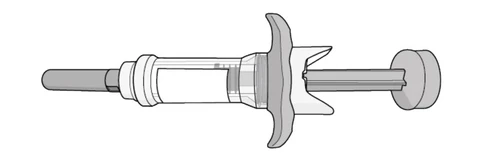
Before use:
Needle cap Plunger
|
Expiry date (Exp.)
printed on the label
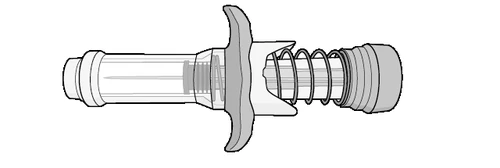
After use:
Retracted needle
Figure A
Read the following safety information:
- Keep the pre-filled syringe in its original carton until use to protect it from light.
- Do not remove the needle cap until you are ready to inject the medicine.
- Do not recap the pre-filled syringe.
- Do not reuse the same pre-filled syringe. The pre-filled syringe contains 1 dose and is for single use only.
- The pre-filled syringe is for subcutaneous injection (under the skin) only.
- Do not use the pre-filled syringe if it appears damaged, cracked, leaking medicine, or has been dropped. In such cases, discard the pre-filled syringe and use a new one.
- Do not inject the medicine through clothing.
- Keep ANDEMBRY out of the reach of children. How should I store ANDEMBRY?
- Store in the refrigerator at 2°C to 8°C in its original carton until use, to protect it from light.
- Do not freeze. If the pre-filled syringe has been frozen, do not use it even if it has thawed.
- The refrigerated pre-filled syringe may be used until the expiry date printed on the label.
- Remove the pre-filled syringe from the refrigerator 30 minutes before use to allow it to reach room temperature.
Alternative storage (room temperature):
- If necessary, for example during travel, the pre-filled syringe may be stored at room temperature (up to 25°C) for a single period of up to 2 months, but not beyond the expiry date.
- If you choose to store the pre-filled syringe at room temperature:
o Write the date you first removed the pre-filled syringe from the refrigerator in the designated space on the carton. This will help you remember how long it has been stored at room temperature.
o Do not return the pre-filled syringe to the refrigerator after it has reached room temperature.
o Discard the pre-filled syringe if it has been stored at room temperature for more than 2 months.
Materials needed for injection with pre-filled syringe (see Figure B):
The carton contains:
- 1 pre-filled syringe
Needed but not included: - Alcohol swab
- Cotton ball or gauze
- Sharps container or puncture-resistant container for disposal (see step 12. Disposal of the syringe)
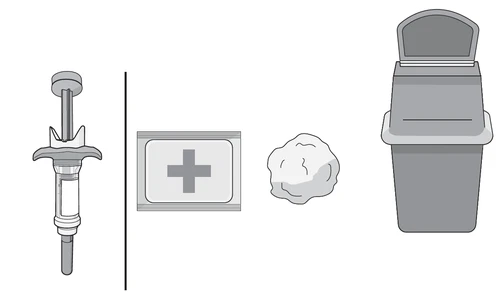
Alcohol swab Cotton ball Sharps container
Needed but not included
Included
Figure B
Preparation for injection
Step 1. Allow the pre-filled syringe to reach room temperature
- Remove the pre-filled syringe from the carton and place it on a clean, flat surface.
- Do not remove the pre-filled syringe from the carton by holding the needle cap or the plunger.
- Do not move or pull the plunger.
- If the medicine has been stored in the refrigerator (see Figure C), wait 30 minutes for it to reach room temperature.
- Injecting cold medicine may be uncomfortable.
- Do not attempt to speed up the warming process in any way. Do not place the pre-filled syringe in a microwave, run warm water over it, or expose it to direct sunlight.
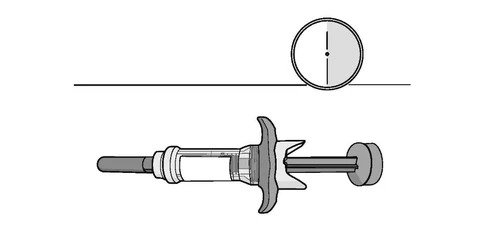
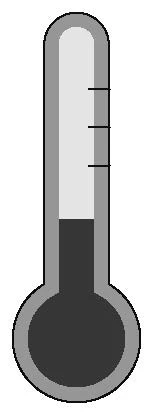
Figure C
Step 2. Check the expiry date
- Check the expiry date on the pre-filled syringe (see Figure D).
- Do not use the pre-filled syringe if the expiry date has passed.
- Do not use the pre-filled syringe if it has been stored at room temperature for more than 2 months. If the expiry date has passed or if the pre-filled syringe has been stored at room temperature for more than 2 months, dispose of it safely and use a new one (see step 12. Disposal of the syringe).
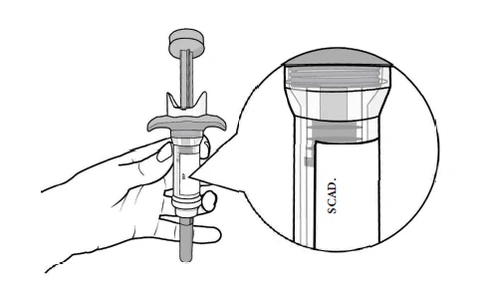
Figure D
Step 3. Inspect the pre-filled syringe
- Examine the medicine through the transparent window of the pre-filled syringe (see Figure E and Figure F).
- Remove the label if you cannot see enough medicine through the window (see Figure F).
- It is normal to see air bubbles. Do not try to remove them.
- The medicine should be yellow-brown to yellow in color and may appear slightly opalescent to clear.
- If the medicine is discolored or contains particles (see Figure E), do not use it. Dispose of the pre-filled syringe safely and use a new one (see step 12. Disposal of the syringe).
- Check the pre-filled syringe. If it appears damaged, cracked, leaking medicine, or has been dropped, dispose of it safely and use a new one.
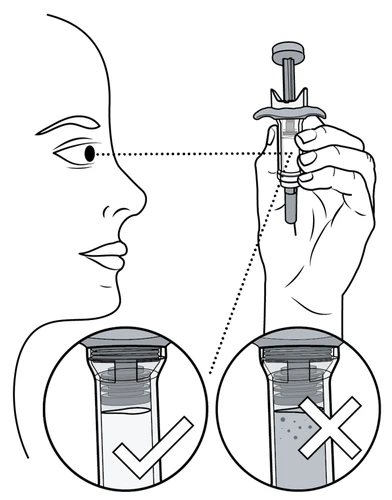
Figure E
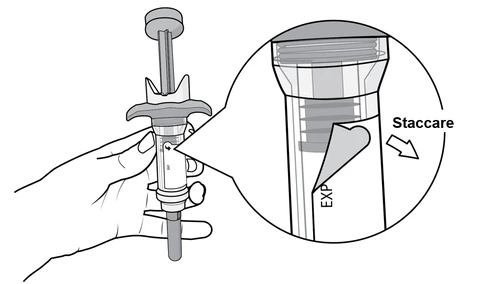
Figure F
Choosing and preparing the injection site
Step 4. Wash your hands
- Wash your hands thoroughly with soap and water or use a hand sanitizer (see Figure G).
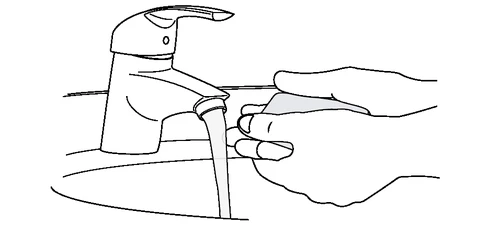
Figure G
Step 5. Choose the injection site
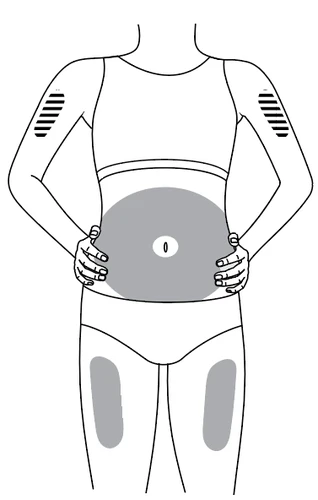
- Inject in the thigh or abdominal area (abdomen), but stay at least 2 cm away from the navel (see Figure H).
- If someone else (e.g., a caregiver) is administering the injection, the upper arm may also be used.
- Rotate injection sites. Do not inject multiple times at the same site if you notice skin damage.
- Do not inject into the navel, moles, scars, or bruises, or into areas where the skin is tender, red, hard, or injured.
Injection site only for
caregivers
Figure H
Step 6. Prepare the injection site
- Clean the injection site with a circular motion using an alcohol swab (see Figure I).
- Allow the injection site to air dry.
- Do not touch the cleaned area before injecting.
- Do not fan or blow on the cleaned skin.
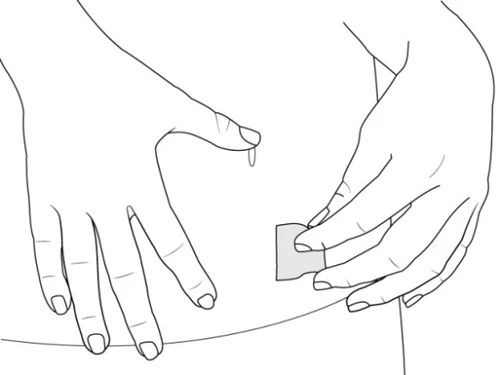
Figure I
Injecting the medicine with the pre-filled syringe
Complete the injection without stopping. Read all steps before beginning.
Step 7. Remove the needle cap and dispose of the cap
- Do not remove the needle cap until you are fully ready to inject.
- Hold the pre-filled syringe by the barrel with the needle pointing away from you.
- Remove the needle cap using one hand while holding the pre-filled syringe with the other (see Figure J). If you cannot remove the cap, ask a caregiver for help or contact your doctor.
- Do not touch or press the plunger while removing the needle cap.
- Do not recap the pre-filled syringe.
- Dispose of the needle cap in a sharps container or a puncture-resistant container.
- You may see a drop of liquid at the tip of the needle. This is normal.
- The needle must remain sterile after removing the cap. Do not touch the needle and do not let it touch any surface after the cap is removed.
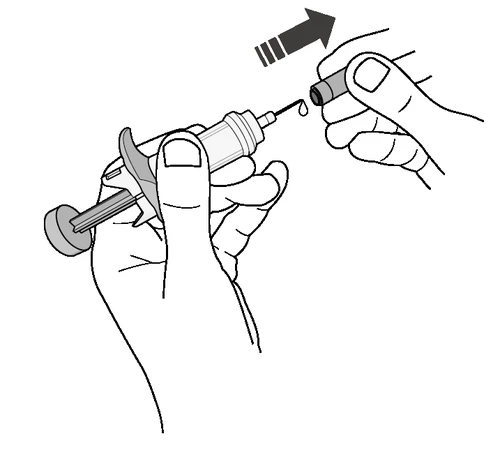
Figure J
Step 8. Pinch the skin and insert the needle
Immediately after removing the needle cap, complete the following steps without stopping:
- With your thumb and index finger, lift the cleaned area of skin around the injection site (without squeezing it) and hold it firmly in place until the injection is complete (see Figure K).
- Insert the needle completely at an angle between 45° and 90°. Do not change the angle during injection (see Figure K: images show an example of injection at a 90° angle).
- Do not hold or push the plunger while inserting the needle into the skin.
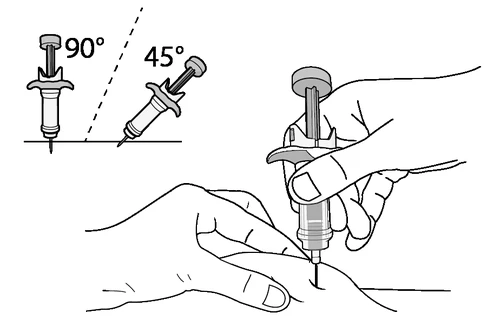
Figure K
Step 9. Inject the medicine
- Keep the pre-filled syringe in position and inject all the medicine by firmly pushing the plunger all the way down (see Figure L).
- Press the plunger fully to the stop to deliver the complete dose. Push the plunger firmly until the injection is complete (see Figure M).
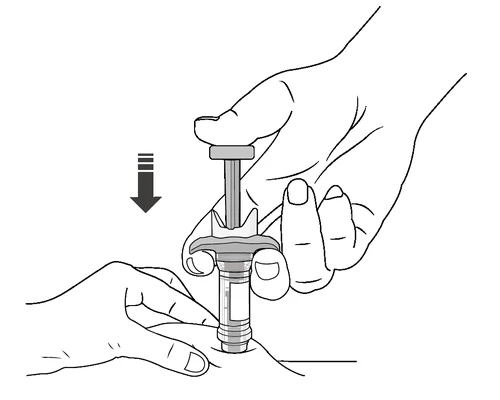
Figure L
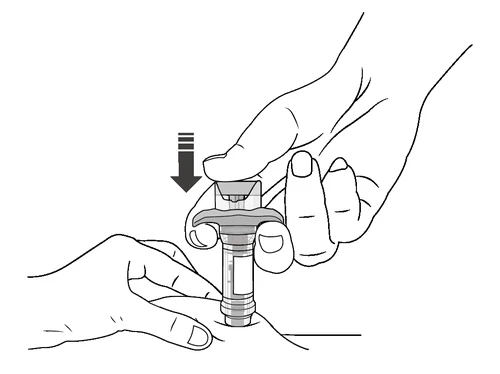
Step 10. Release the plunger
- After pushing the plunger completely down and injecting the full dose, slowly remove your thumb from the plunger before removing the syringe from the skin (see Figure N). This will allow the needle to retract into the syringe. Caution: Do not remove the syringe from the skin before removing your thumb, as you may accidentally prick yourself with the needle.
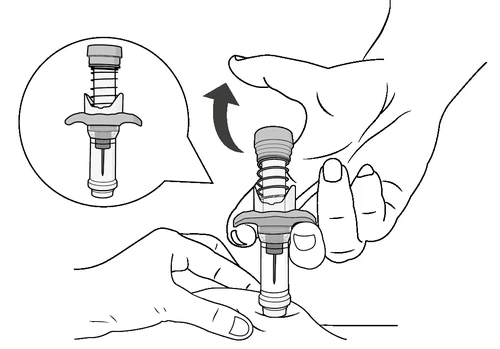
Figure N
Step 11. Release the skin and remove the pre-filled syringe
- Release the pinched skin and remove the pre-filled syringe from the injection site (see Figure O).
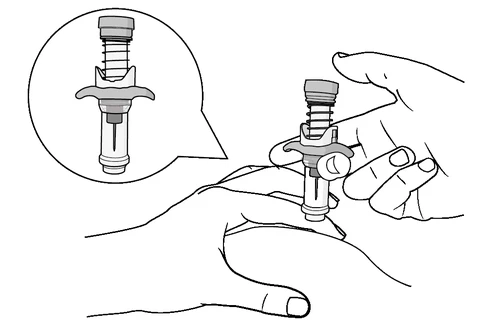
Figure O
- If you notice slight bleeding at the injection site, you may gently press a cotton ball or gauze over it.
- Do not rub the injection site.
- If needed, you may cover the injection site with a small plaster.
Disposal
Step 12. Disposal of the syringe
- Do not reuse the pre-filled syringe.
- After injecting the dose, place the syringe in a sharps disposal container or a closed, puncture-resistant container (see Figure P).
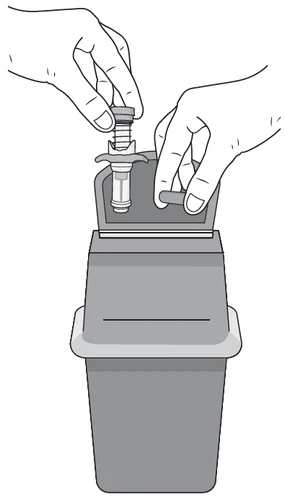
Figure P
- If you do not have a sharps disposal container or a closed, puncture-resistant container, you may use a household container that is:
o Made of durable plastic or has a tightly fitting, puncture-resistant lid to keep sharp objects safely inside
o Stable in an upright position during use
o Leak-proof
o Properly labeled to warn of hazardous waste inside the container. - When the sharps disposal container is nearly full, follow local regulations for proper disposal of the container. Ask your pharmacist or healthcare provider for more information on how to dispose of the sharps container.
- Do not throw used sharps disposal containers into household waste unless permitted by local regulations.
- Do not recycle used sharps disposal containers.
Step 13. Keep a record of treatment
- If requested by your doctor, record the injection in a diary to track your use of the medicine.
Patient Information Leaflet
ANDEMBRY 200 mg solution for injection in a pre-filled pen
garadacimab
This medicinal product is subject to additional monitoring. This will allow for the rapid identification of new safety information. You can help by reporting any side effects you experience while taking this medicine. See the end of section 4 for information on how to report side effects.
Please read this leaflet carefully before using this medicine as it contains important information for you.
- Keep this leaflet. You may need to read it again.
- If you need more information or advice, consult your doctor, pharmacist, or nurse.
- This medicine has been prescribed for you only. Do not give it to others, even if they have the same symptoms as you, as it may be harmful.
- If you experience any side effect, including those not listed in this leaflet, consult your doctor, pharmacist, or nurse. See section 4.
Contents of this leaflet
- What ANDEMBRY is and what it is used for
- What you need to know before using ANDEMBRY
- How to use ANDEMBRY
- Possible side effects
- How to store ANDEMBRY
- Contents of the pack and other information
- Instructions for use
1. What ANDEMBRY is and what it is used for
ANDEMBRY contains the active substance garadacimab.
ANDEMBRY is a medicine used in patients 12 years of age and older with hereditary angioedema (HAE) to prevent angioedema attacks.
HAE is a condition that causes recurrent episodes of swelling, known as HAE attacks, in various parts of the body, including:
- hands and feet;
- face, eyelids, lips, or tongue;
- larynx and throat, which can make breathing difficult;
- genitals;
- stomach and intestines.
HAE attacks can be painful and disabling. Attacks affecting the throat or larynx can be dangerous or even potentially life-threatening.
HAE is often hereditary, but some individuals may not have a family history. There are three types of HAE, classified according to the type of genetic defect and its effect on a protein circulating in the blood called C1 esterase inhibitor (C1-INH). A person may have low levels of C1-INH in the body (Type I HAE), poorly functioning C1-INH (Type II HAE), or HAE with normally functioning C1-INH (Type III HAE). The latter type is extremely rare. All three types produce the same clinical symptoms of localized swelling.
C1-INH regulates a process that controls the production of an inflammatory substance called bradykinin. Overproduction of bradykinin causes swelling and inflammation in people with HAE.
The active substance in ANDEMBRY, garadacimab, blocks the activation of a protein known as factor XIIa (FXIIa), which is involved in stimulating bradykinin production. By blocking FXIIa activity, garadacimab reduces bradykinin levels, thereby preventing HAE attacks. Some subcategories of HAE with normal C1-INH may not respond to treatment with garadacimab.
Talk to your doctor if you have any doubts about the medicine.
2. What you should know before taking ANDEMBRY
Do not use ANDEMBRY
- if you are allergic to garadacimab or to any of the other ingredients of this medicine (listed in section 6).
Warnings and precautions
- Talk to your doctor, pharmacist, or nurse before taking ANDEMBRY.
- If you experience a severe allergic reaction to ANDEMBRY with symptoms such as hives, chest tightness, difficulty breathing, wheezing, hypotension, or anaphylaxis, inform your doctor, pharmacist, or nurse immediately.
- Treat an attack of hereditary angioedema with your usual rescue medication; do not take additional doses of ANDEMBRY.
Keep a diary
You are strongly advised to record the name and batch number of the medicine each time you take a dose of ANDEMBRY. This allows you to keep track of the batches used.
Laboratory tests
Inform your doctor if you are using ANDEMBRY before undergoing laboratory tests to measure blood clotting capacity. This is because ANDEMBRY may interfere with certain laboratory tests, leading to inaccurate results.
Children and adolescents
The use of ANDEMBRY is not recommended in children under 12 years of age. This is because it has not been studied in this age group.
Other medicines and ANDEMBRY
Inform your doctor or pharmacist if you are taking, have recently taken, or might take any other medicines.
ANDEMBRY is not known to affect other medicines or to be affected by other medicines.
Pregnancy and breastfeeding
If you are pregnant, suspect you may be pregnant, planning a pregnancy, or breastfeeding, consult your doctor or pharmacist before taking ANDEMBRY. Information on the safety of using ANDEMBRY during pregnancy and breastfeeding is limited. As a precaution, it is preferable to avoid using ANDEMBRY during pregnancy. Your doctor will discuss with you the risks and benefits of taking this medicine.
Driving and using machines
This medicine does not affect or affects negligibly the ability to drive or operate machinery.
ANDEMBRY contains proline
This medicine contains 19.3 mg of proline per 200 mg/1.2 mL, equivalent to 16.1 mg/mL.
Proline may be harmful for patients with hyperprolinemia, a rare genetic disorder caused by accumulation of proline in the body. Do not use this medicine if you (or your child) have hyperprolinemia, unless recommended by your doctor.
ANDEMBRY contains polysorbate 80
This medicine contains 0.24 mg of polysorbate 80 per 200 mg/1.2 mL, equivalent to 0.2 mg/mL.
Polysorbates may cause allergic reactions. Inform your doctor if you have known allergies.
3. How to take ANDEMBRY
ANDEMBRY is provided as a single-use pre-filled pen. Treatment will begin under the supervision and management of a healthcare professional.
Always use this medicine exactly as described in this leaflet or as your doctor, pharmacist, or nurse has told you. Consult your doctor, pharmacist, or nurse if you have any doubts or further questions about the use of this medicine.
How much ANDEMBRY to use
The recommended dose of ANDEMBRY is an initial loading dose of 400 mg administered as two 200 mg injections on the first day of treatment, followed by a 200 mg injection administered once a month.
How to inject ANDEMBRY
You may self-inject ANDEMBRY, or your caregiver may inject it for you. In either case, you or your caregiver must carefully read and follow the instructions provided in section 7, "Instructions for use".
- ANDEMBRY is for injection under the skin ("subcutaneous injection") in the stomach (abdomen), thigh, or upper arm.
- A doctor, pharmacist, or nurse must show you how to correctly inject ANDEMBRY before you use it for the first time. Do not self-inject, and do not allow a caregiver to inject it for you, until you have been trained to inject the medicine.
- Use each pre-filled pen only once.
- If the pre-filled pen does not work as expected, inform your doctor, pharmacist, or nurse as soon as possible.
- Rotation of injection sites is recommended.
If you use more ANDEMBRY than you should
If you use too much ANDEMBRY, inform your doctor, pharmacist, or nurse.
If you forget to use ANDEMBRY
If you forget a dose of ANDEMBRY, inject the missed dose as soon as possible. If you are unsure about when to inject ANDEMBRY after missing a dose, consult your doctor, pharmacist, or nurse.
If you stop using ANDEMBRY
It is important that you continue to inject ANDEMBRY as directed by your doctor, even if you feel better.
If you have any further questions about the use of this medicine, consult your doctor, pharmacist, or nurse.
4. Possible side effects
Like all medicines, this medicine can cause side effects, although not everybody gets them.
Tell your doctor, pharmacist or nurse if you notice any of the following side effects.
Common (may affect up to 1 in 10 people)
- Reactions at the injection site, including redness, bruising, itching and hives
- Headache
- Abdominal pain
Reporting of side effects
If you get any side effects, including ones not listed in this leaflet, tell your doctor or pharmacist.
You can also report side effects directly via the national reporting system at https://www.aifa.gov.it/content/segnalazioni-reazioni-
avverse . Reporting side effects can help provide more information on the safety of this medicine.
5. How to store ANDEMBRY
Keep this medicine out of the sight and reach of children.
Do not use this medicine after the expiry date which is stated on the outer packaging and
on the label after Exp. The expiry date refers to the last day of that month.
Store in a refrigerator (2°C - 8°C). Do not freeze. Keep the pre-filled pen in the
outer packaging to protect it from light.
The pre-filled pen may be stored at room temperature (up to 25°C) for a single period
not exceeding 2 months, but not beyond the expiry date.
Do not return ANDEMBRY to refrigerated storage after it has been stored at room temperature.
Do not use this medicine if you notice any signs of deterioration, such as particles or change in colour of the solution.
Do not dispose of any medicine via wastewater or household waste. Ask your pharmacist how to dispose of medicines you no longer use. This will help protect the environment.
6. Package contents and other information
What ANDEMBRY contains
- The active substance is garadacimab. Each pre-filled pen contains 200 mg of garadacimab in 1.2 mL of solution.
- The excipients are histidine, arginine monohydrochloride, proline, polysorbate 80 and water for injections – see section 2 "ANDEMBRY contains proline and polysorbate 80".
Description of the appearance of ANDEMBRY and contents of the pack
ANDEMBRY is a slightly opalescent to clear solution, ranging in colour from yellow-brown to yellow, supplied in a pre-filled pen.
ANDEMBRY is available in a single pack containing 1 pre-filled pen and in multiple packs containing 3 pre-filled pens, each pack containing 1 pre-filled pen.
Not all pack sizes may be marketed.
Marketing Authorisation Holder and Manufacturer
CSL Behring GmbH
Emil-von-Behring-Strasse 76
D-35041 Marburg
Germany
For further information about this medicinal product, please contact the local representative of the Marketing Authorisation Holder:
België/Belgique/Belgien Lietuva
CSL Behring NV CentralPharma Communications UAB
Tél/Tel: +32 15 28 89 20 Tel: +370 5 243 0444
България Luxembourg/Luxemburg
МагнаФарм България ЕАД CSL Behring NV
Тел: +359 2 810 3949 Tél/Tel: +32 15 28 89 20
Česká republika Magyarország
CSL Behring s.r.o. CSL Behring Kft.
Tel: +420 702 137 233 Tel: +36 1 213 4290
Danmark Malta
CSL Behring AB AM Mangion Ltd.
Tlf: +46 8 544 966 70 Tel: +356 2397 6333
Deutschland Nederland
CSL Behring GmbH CSL Behring BV
Tel: +49 6190 75 84810 Tel: +31 85 111 96 00
Eesti Norge
CentralPharma Communications OÜ CSL Behring AB
Tel: +3726015540 Tlf: +46 8 544 966 70
Ελλάδα Österreich
CSL Behring ΕΠΕ CSL Behring GmbH
Τηλ: +30 210 7255 660 Tel: +43 1 80101 1040
España Polska
CSL Behring S.A. CSL Behring Sp. z o.o.
Tel: +34 933 67 1870 Tel.: +48 22 213 22 65
France Portugal
CSL Behring SA CSL Behring Lda
Tél: +33 1 53 58 54 00 Tel: +351 21 782 62 30
Hrvatska România
Marti Farm d.o.o. Prisum Healthcare S.R.L.
Tel: +40 21 322 01 71
Tel: +385 1 5588297
Ireland Slovenija
CSL Behring GmbH EMMES BIOPHARMA GLOBAL s.r.o.-
Tel: +49 6190 75 84700 podružnica v Sloveniji
Tel: +386 41 42 0002
Ísland Slovenská republika
CSL Behring AB CSL Behring Slovakia s.r.o.
Sími: +46 8 544 966 70 Tel: +421 911 653 862
Italia Suomi/Finland
CSL Behring S.p.A. CSL Behring AB
Tel: +39 02 34964 200 Puh/Tel: +46 8 544 966 70
Κύπρος Sverige
CSL Behring ΕΠΕ CSL Behring AB
Τηλ: +30 210 7255 660 Tel: +46 8 544 966 70
Latvija
CentralPharma Communications SIA
Tel: +371 6 7450497
Other sources of information
More detailed information on this medicinal product is available on the website of the European Medicines Agency: http://www.ema.europa.eu, which also provides links to other websites on rare diseases and their treatments.
7. Instructions for Use
ANDEMBRY injectable solution in pre-filled pen
for subcutaneous use
Important:
This pre-filled pen works differently from other injection devices. Read the Instructions for Use carefully before using it and each time you receive a new one, as there may be updated information. These instructions do not replace discussions with your doctor about your medical condition or treatment.
In adolescent patients, ANDEMBRY must be administered under adult supervision.
Before using this pre-filled pen for the first time, you must be certain that you have been instructed and trained by your doctor.
Parts of the pre-filled pen (see Figure A):
Continue with the following paragraphs to prepare and administer the injection.
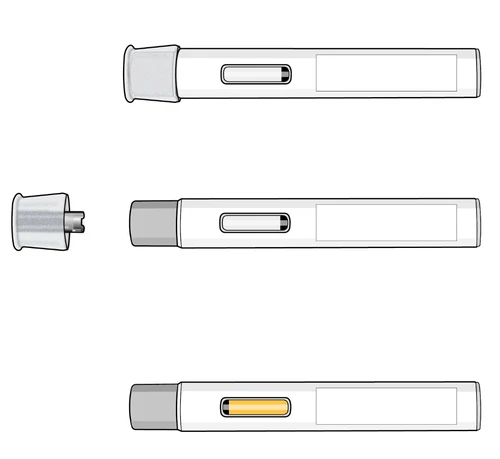
Before use: Expiry date (Exp.)
printed on the label
Transparent cap of the
pre-filled pen
Plunger observation window
Do not remove it until
(medicine visible)
you are ready for injection
Metal part inside the
Gray needle shield
transparent cap of the
(Warning: needle inside. Do not touch)
pre-filled pen
After use:
After use, at the end of the injection, the observation window is completely filled by the yellow plunger
Figure A
Read the following safety information:
- Store the pre-filled pen in its original cardboard box until use to protect it from light.
- Do not remove the transparent cap of the pre-filled pen until you are ready for injection.
- Do not replace the transparent cap onto the pen after it has been removed, as this could start the injection and cause injury.
- The pre-filled pen contains one dose and is for single use only. Do not attempt to reuse the same pre-filled pen.
- Do not use the pre-filled pen if the expiry date has passed.
- The pre-filled pen is intended only for subcutaneous injection (under the skin).
- Do not use the pre-filled pen if it appears damaged, cracked, leaking medicine, or if it has been dropped. In such cases, dispose of the pre-filled pen as described in section 11 and use a new one.
- Do not inject through clothing.
- Do not touch or attempt to remove the gray needle shield at any time.
- Keep ANDEMBRY out of the reach of children.
For any questions, consult your doctor.
How should I store ANDEMBRY?
- Store the ANDEMBRY pre-filled pen in the refrigerator at a temperature between 2°C and 8°C in its original box until use, to protect it from light.
- Do not freeze. If the pre-filled pen has been frozen, do not use it, even if thawed.
- Remove the pre-filled pen from the refrigerator 30 minutes before use, allowing it to reach room temperature.
Alternative storage (room temperature):
- If necessary, for example during travel, the pre-filled pen may be stored at room temperature (up to 25°C) for a single period of up to a maximum of 2 months, but not beyond the expiry date.
- If you decide to store the pre-filled pen at room temperature:
o Write the date you first removed the pre-filled pen from the refrigerator in the designated space on the cardboard box. This will help you remember how long it has been stored at room temperature.
o Do not return the pre-filled pen to the refrigerator after it has reached room temperature.
o Dispose of the pre-filled pen if it has been stored at room temperature for more than 2 months (see step 11. Disposal of the pre-filled pen).
Materials required for injection with pre-filled pen (see Figure B):
The cardboard box contains:
- 1 single-dose pre-filled pen
Items required but not included in the package: - Alcohol swab
- Cotton ball or gauze
- Sharps container or puncture-resistant container for disposal (see step 11. Disposal of the pre-filled pen)
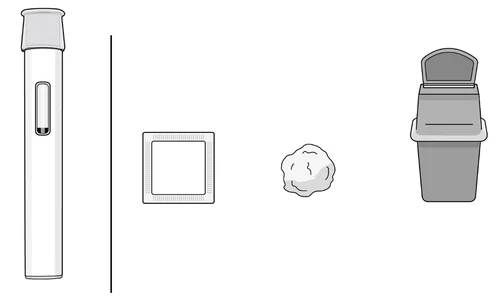
Alcohol swab Cotton ball Sharps container
Pre-filled single-use pen
Included Required but not included
Figure B
Preparation for injection
Do not remove the transparent cap of the pre-filled pen until immediately before
injection.
Step 1. Allow the pre-filled pen to reach room temperature
- Remove the pre-filled pen from the cardboard box and place it on a clean, flat surface.
- If the medicine has been stored in the refrigerator, wait 30 minutes to allow it to reach room temperature (see Figure C).
- Injecting cold medicine may be uncomfortable.
- Do not attempt to speed up the warming process in any way. For example, do not heat the pen in a microwave, in warm water, or leave it in direct sunlight.
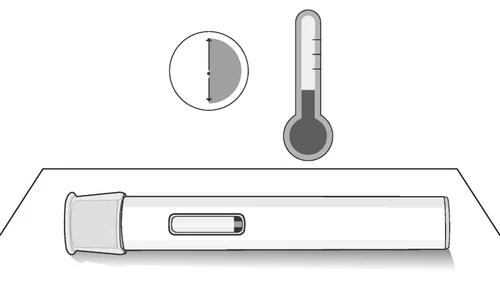
Figure C
Step 2. Check the expiry date
- Check the expiry date on the label of the pre-filled pen (see Figure D).
- Do not use the pre-filled pen if the expiry date has passed.
- Do not use the pre-filled pen if it has been stored at room temperature for more than 2 months.
- If the expiry date has passed or if the pen has been stored at room temperature for more than 2 months, dispose of it safely and use a new one (see step 11. Disposal of the pre-filled pen).
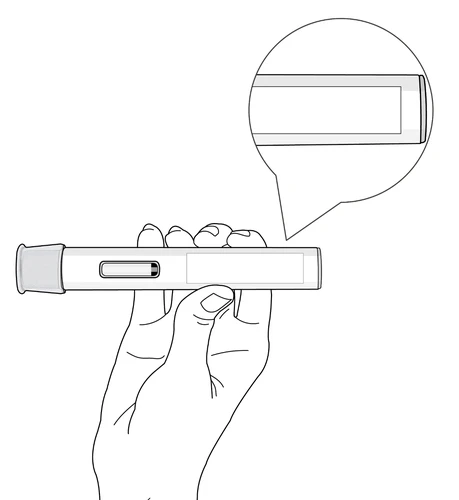
Figure D
Step 3. Inspect the pre-filled pen and medicine
- Check that the pre-filled pen is not damaged.
- Inspect the medicine through the transparent window of the pen (see Figure E).
- It is normal to see air bubbles; do not try to remove them.
- The medicine should be brownish-yellow to yellow in color and may appear slightly opalescent to clear.
- Do not use the pre-filled pen, dispose of it safely and use a new one (see step 11. Disposal of the pre-filled pen) if: o The medicine has changed color or contains particles o The pre-filled pen appears damaged or cracked o The pen is leaking medicine o The pen has been dropped on a hard surface, even if it does not appear damaged.
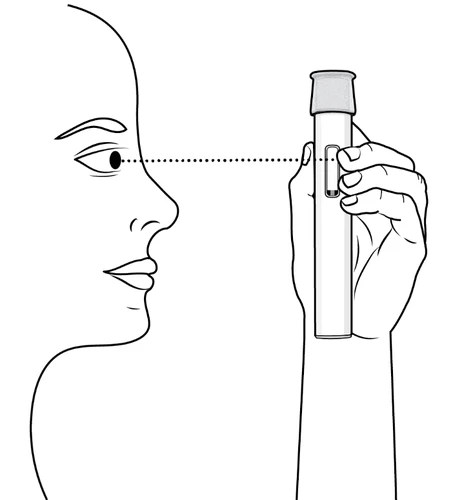
Figure E
Choosing and preparing the injection site
Step 4. Wash hands
- Wash your hands thoroughly with soap and water or use a hand sanitizer (see Figure F).
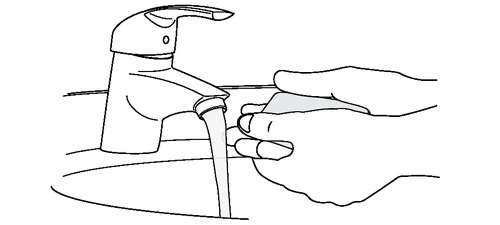
Figure F
Step 5. Choose the injection site
- Inject into the thigh or abdominal area (abdomen), but stay at least 2 cm away from the navel (see Figure G).
- If someone else (caregiver) administers the injection, the upper arm may also be used. Do not attempt to inject into your own upper arm.
- Rotate injection sites with each injection. Do not inject multiple times into the same spot if the skin is damaged.
- Do not inject into the navel, moles, scars, or bruises, or into areas where the skin is tender, red, hard, or injured.
Injection sites for self-injection
Injection sites for caregiver
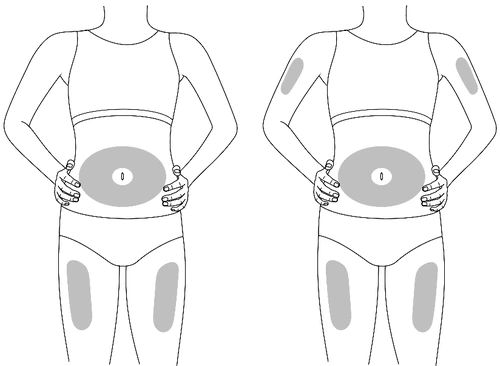
Figure G
Step 6. Prepare the injection site
- Clean the injection site with an alcohol swab (see Figure H).
- Allow the injection site to air dry.
- Do not touch the cleaned area before administering the injection.
- Do not fan or blow on the cleaned skin.
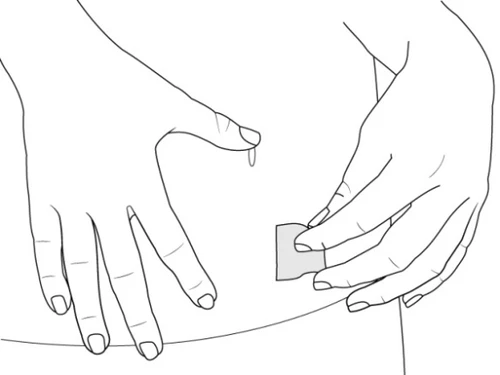
Figure H
Injecting the medicine with the pre-filled pen
Complete the injection without stopping. Read all steps before beginning.
Do not remove the transparent cap until you are fully ready for injection.
Step 7. Remove the transparent cap of the pre-filled pen and dispose of it.
- Hold the pre-filled pen in one hand and pull off the transparent cap with the other hand.
- Do not twist the transparent cap (see Figure I). If you cannot remove it, ask a caregiver for help or contact your doctor.
- The transparent cap has a metal part inside; this is normal.
- Do not replace the cap after removal, as this could start the injection and cause injury.
- Dispose of the transparent cap in a sharps container or a closed, puncture-resistant container.
Important:
- To avoid injury, do not touch the gray needle shield of the pre-filled pen.
- Do not place the pre-filled pen down after removing the transparent cap.
Gray needle shield
Do not touch
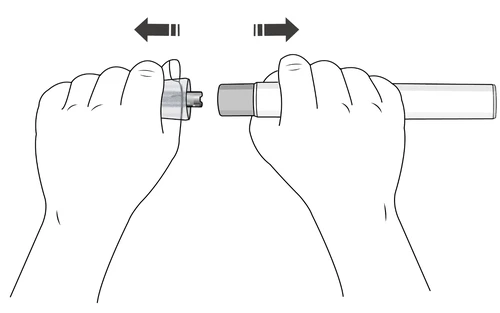
Transparent cap of the
pre-filled pen
Figure I
Step 8. Pinch the skin and position the pre-filled pen on the injection site
Immediately after removing the transparent cap of the pre-filled pen, complete the following steps without stopping:
- Gently pinch the cleaned skin area around the injection site between your thumb and index finger (without squeezing it) and hold it firmly in this position until the injection is complete (see Figure J).
- Position the pre-filled pen at a 90° angle on the cleaned injection site (see Figure J).
- Ensure you can see the observation window.
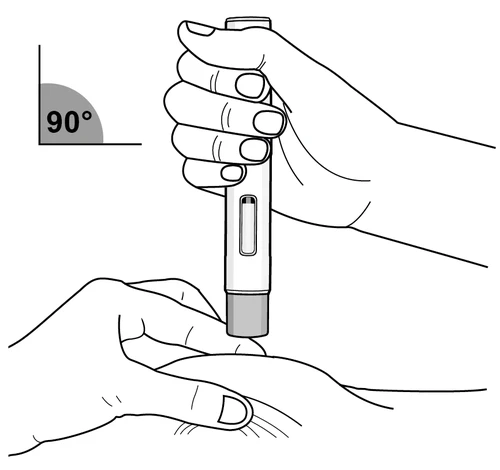
Figure J
Step 9. Inject the medicine
You must read the entire step 9 before injection.

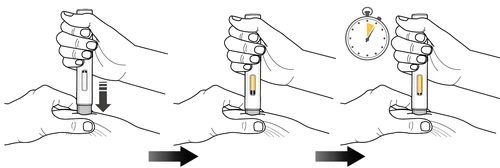
The injection may take up to 15 seconds.
To ensure you receive a complete dose, you must keep the pre-filled pen
firmly pressed against the pinched skin until:
- the yellow plunger stops moving, completely filling the observation window, and
- 5 seconds have passed after the second “click”.
To start the injection, press the gray needle shield firmly against the pinched skin and continue pressing until all the following steps are completed.
Press to start Continue pressing downward Continue pressing for another
5 seconds
First Second
'click' 'click'
Press down to start Continue pressing the Continue pressing the pen
the injection until you hear a pre-filled pen downward and downward for another 5 seconds
first “click”. watch the observation window. to ensure you have received
- The first “click” means the injection has started.
- The observation window will turn yellow.
- The yellow plunger will begin moving in the observation window.
- You will hear a second “click”.
Continue pressing the pre-filled pen downward.
Continue pressing the pre-filled pen downward.
Figure K
- Do not remove the pre-filled pen until the yellow plunger has stopped moving and completely filled the observation window, and until 5 seconds have passed after the second “click”.
- Do not remove, invert, or rotate the pre-filled pen during injection.
Step 10. Release the skin and remove the pre-filled pen
- Release the skin and remove the pre-filled pen while maintaining a 90° angle (see Figure L).
- When the pen is lifted from the skin, the gray needle shield will return to its original position (as before use) and lock in place, covering the needle.
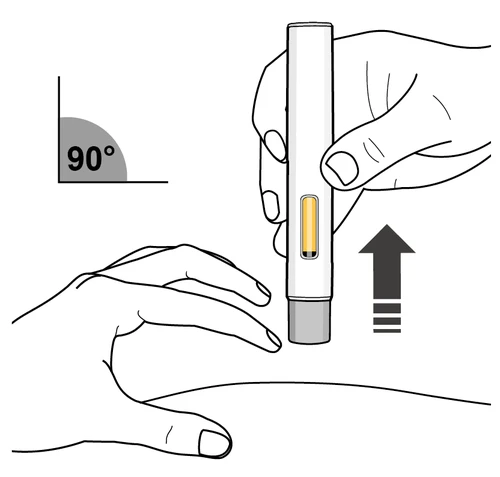
Figure L
Important: If you think you did not receive the full dose, contact your doctor immediately.
- If you notice minor bleeding at the injection site, you may gently press a cotton ball or gauze over it.
- Do not rub the injection site.
- If needed, you may cover the injection site with a small plaster.
Disposal
Step 11. Disposal of the pre-filled pen
- Do not attempt to reuse the pre-filled pen.
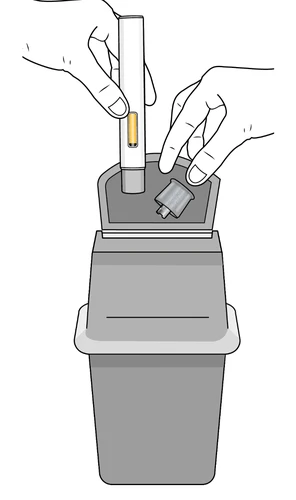
- After injecting the dose, place the pen into a sharps container or a closed, puncture-resistant container (see Figure M).
Sharps container
- If you do not have a sharps container or a closed, puncture-resistant container, you may use a household container that is:
o Made of heavy-duty plastic
o Has a tightly secured, puncture-resistant lid to keep sharp objects safely inside
o Stable in an upright position during use
o Leak-proof
o Clearly labeled to warn of hazardous waste inside. - When your sharps container is nearly full, follow local regulations for proper disposal of the container. Ask your pharmacist or healthcare provider for more information on how to dispose of your sharps container.
- Do not throw used sharps containers into household waste unless permitted by local regulations.
- Do not recycle used sharps containers.
Step 12. Keep a record of treatment
- If required by your doctor, record the injection in a diary to track your use of the medicine.